New federal test score data from the long-term trend (LTT) report reveal a remarkable finding: For the first time in the 50 years of the assessment, nine-year-old boys are now scoring equally with girls in reading. The erasure of this long-standing gap occurred because nine-year-old boys made historic improvements on the LTT test between 2022 and 2025, while girls’ scores did not significantly change.
This seems like great news, as boys have historically struggled in reading relative to girls. However, we have reason to be cautious about these findings, as they are inconsistent with what we know about reading gender gaps from multiple other assessments.
To better contextualize the nine-year-old NAEP-LTT results within our broader understanding of reading gender gaps, we reviewed trends in reading gender gaps between 2011 and 2025 from three additional national sources that tested students at similar age ranges. First, we examined the national fourth grade reading trends from the “main” NAEP assessments. Second, we examined national fourth grade reading trends on MAP Growth from 2017 to 2025. Finally, we examined average within-district gender gaps in fourth grade reading from the Stanford Educational Data Archive.
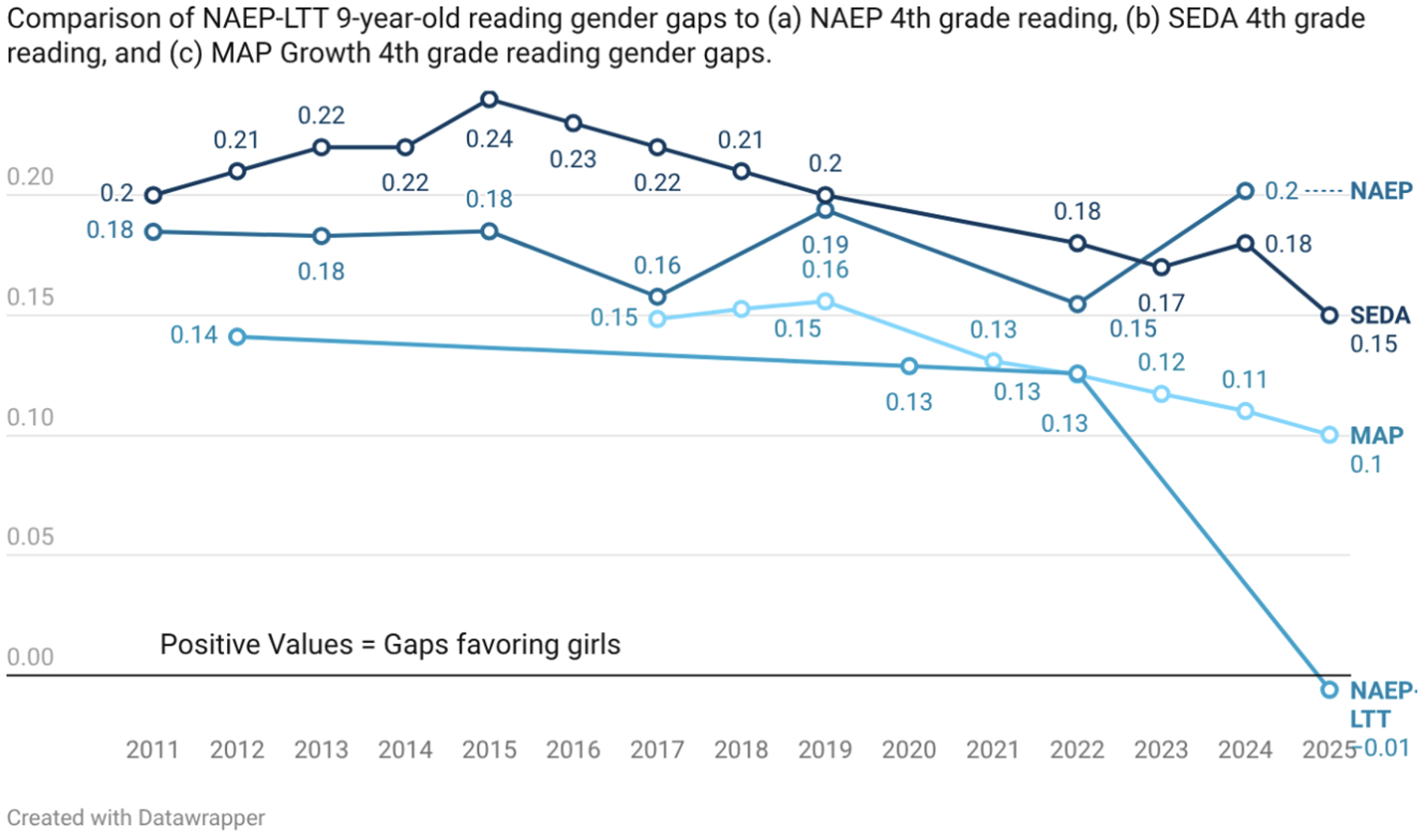
As shown in Figure 1, no other data sources indicate that boys have pulled even with girls in reading in recent years. The main NAEP results indicate that reading gaps actually widened (favoring girls) between 2022 and 2024, while the SEDA and MAP Growth show gaps have narrowed slightly between 2022 and 2025 but still significantly favor girls. Meanwhile, the NAEP-LTT gender gap had hovered around 0.13 standard deviations over the prior decade before dramatically shifting to parity between boys and girls in 2025.
Figure 1. Elementary reading gender gaps, 2011–2025
 All in all, the latest NAEP-LTT reading gender gaps for nine-year-olds are a notable outlier compared to other national reading assessment data collected during the same period, including main NAEP. What could explain why the gender gaps on the NAEP-LTT reading results look so different than the other available assessments? A few potential theories:
- Item types: The majority of the items on NAEP-LTT are multiple-choice, while the main NAEP and other assessments have a wider mix of item types. Prior research has found that boys outperform girls on multiple-choice items compared to constructed-response items.
- Mode of administration: NAEP-LTT is administered as a paper-and-pencil test, while most other national assessments (including main NAEP) are computer-based. While there is not much research on gender differences in the effects of test administration mode, it is possible this mode difference is contributing to NAEP-LTT gender gaps looking different.
- Test content: The NAEP-LTT reading test contains short narrative or document passages and asks students to find specific information or identify the main idea of the passage, while main NAEP features a wider range of text types and questions about the passages. It is possible that boys on average have lower stamina for long reading passages, and therefore do better on tests with shorter passages.
Given these discrepancies, we should probably hold off celebrating boys’ historic reading achievement improvements. The release of main NAEP 2026 results will provide an important signal on whether boys have truly pulled even with girls in reading.