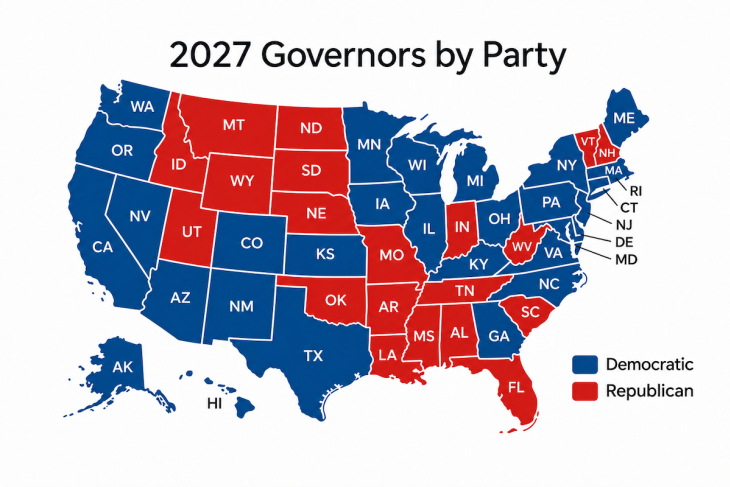
In the November 13 edition of my SCHOOLED newsletter, I asked:
Do you work in a state that’s been living with divided government in recent years, especially with a Democratic governor and at least a partial Republican legislature? In states like Pennsylvania, Michigan, Wisconsin, North Carolina, and Arizona? Or do you work in a deep blue state that’s had a Democratic trifecta, like New York, California, Illinois, or New Jersey?
What advice can you offer your fellow reformers who find themselves in terrain that’s new to them but not new to you?
(My assumption is that, because of the enormous power of the teachers unions within the Democratic Party, blue governance makes it harder to achieve ed-reform policy victories. Harder, but not impossible.)
Many SCHOOLED readers in blue or divided-government states responded with great suggestions. We’ll get to that, but let’s start with some encouragement from folks who’ve made progress in deep-blue locales. Hawaii is one of them. David Sun-Miyashiro of HawaiiKidsCAN wrote in to say:
We’ve had some traction even here in uber-blue Hawaii trying to elevate student outcomes as a matter of fundamental civil rights. “Equity” isn’t seen as a forbidden word, so we’re generous in utilizing that.
Likewise in Minnesota, a blue state with a narrowly divided legislature (before this month’s election gave it a Democratic trifecta, that is). Josh Crosson of EdAllies explains:
Trifectas tend to rush policy and tune out perspectives that cut against the majority’s narrative. During our last Democratic trifecta, we fought a bill that would have stripped teacher licenses from roughly 20 percent of our teachers of color. Legislators were listening almost exclusively to teacher preparation programs, our Democratically-appointed state licensing agency, and higher education institutions. Supporters had unlimited time to testify in both chambers. Opponents, including students who would lose their teachers and the teachers who would lose their licenses, got two minutes. That was two minutes for all opposition total, not two minutes per testifier…
A divided Legislature doesn’t stop those shenanigans in one chamber. It does mean the other chamber can counter one-sided, bad governance efforts and make room for real debate and amendments. Policy is simply better when two perspectives must negotiate a final compromise.
As I said, that’s encouraging for states with newly divided government, like Texas, Georgia, and Ohio.
It’s also possible that Democratic officials in these newly blue (and purple) states will remember that moderation—including on education—is essential to getting re-elected. Yuval Levin, for one, is optimistic that landslides can “renew American politics.” That’s because, in his words:
Winning big and losing big both tend to create incentives for thinking in terms of coalitions and prioritizing persuadable voters. In contrast, long stretches of close elections—like the run we’ve experienced with remarkably few interruptions since 2000—send our politics toward the margins by convincing the parties that pure mobilization is the only way to prevail, and that only narrow wins are possible…
Winning big makes governing effectively a little more achievable, too. Larger majorities have more room to maneuver and advance legislation. Increasing the internal diversity of the parties can also encourage the kinds of strange-bedfellow coalitions our politics depends upon. And a politics better oriented to the desires of the median voter than of radical activists of either party is more likely to be responsive to changing public priorities and novel issues.
That all sounds promising for education reform—especially if we’re seeing “the return of the Obama Democrats,” as Gabe Fleisher posited the other day.
On the other hand...
So that’s the encouraging take. Now let’s add a dose of realism from Ravi Gupta, who is worried that, for too many Democrats, “education is not their thing.” Ravi has met and interviewed dozens of top national Dems and asked them their opinions on ed policy—and almost always found them disappointing. That was the case for populists like Graham Platner and David Hogg, but even Pete “technocrat” Buttigieg, too. Ravi writes:
I know K–12 education unusually well. I spent years founding and running public charter schools, first in Tennessee and then in Mississippi. My team led an effort to expand AP Computer Science training in public schools across the South. And I’ve spent recent years interviewing hundreds of education leaders about what works.
And here was someone near the top of my list of politicians I admire—someone I’ve seen display incredible intelligence and thoughtfulness in many settings. Yet on the issue I know most—the issue most central to the future of our country—he was incredibly thin.
So we have work to do, people!
Meanwhile, Jeanne Allen is also skeptical that “there’s a new kind of Dem in town.”
Even before the ink was dry on the election results, newly empowered Democrats were talking about restricting, overhauling or outright eliminating programs that give families power over their children’s education….
In Texas, Governor-elect Gina Hinojosa took aim at the state’s new education savings accounts in her victory speech. In Arizona, the country’s most expansive ESA program is in the crosshairs. And in D.C., congressional Democrats have already put repeal of the new federal scholarship tax credit on the table.
“Build political power”
So let’s get back to your advice for reform advocates dealing with blue or divided government for the first time in a long time. Andrew Broy, head of the Illinois Network of Charter Schools, put it well and succinctly:
You need to build political power before you need it. And have an aggressive affirmative policy agenda.
Yes, it might be too late to “build political power” in newly blue states—at least in time for January’s legislative session. But better late than never! (That’s probably the thinking of Michael Bloomberg, who just made a million-dollar donation to New York charter advocates to shore up their political advocacy efforts in the face of overwhelming Democratic majorities in the legislature.)
And Andrew and his allies, notably, just managed to win a charter-friendly majority on the newly elected Chicago school board—a remarkable feat, especially in this political environment.
It’s not just in Illinois. Charter advocates in Washington State also had a big win this election cycle. Rebecca Thomas of WA Charters Action tells the story:
The House Education Committee was chaired by an incumbent of 30 years who mostly refused to give charter bills a hearing.
We watched this race closely through the primary. When her Democratic challenger posted strong results in August, we did our homework. We ran a district-wide post-primary poll of likely voters… We met with him (the challenger) to make sure he understood and supported families choosing public charters, and we offered the incumbent the same meeting.
Then we went in:
-
We ran an independent expenditure mailer to every voter in the district. It went to about 42,000 people since it was a Democrat v. Democrat race. This helped build his name recognition.
-
We sent more than 1,000 direct texts to charter families in the district.
-
Organized charter community members knocking on doors alongside the challenger (and his mom).
This race was the biggest investment we made.
He won! Washington will have a new House Education chair. Because we planned ahead, our org and school leaders have spent the past few months building relationships with him and the other potential chairs. It’s also a sweet victory because he’s just a really great person.
Very, very impressive!
Jed Wallace wants to see more of this:
For years here, I have been arguing that our world needs to take on advocacy efforts in new ways.
Part of it has been structural.
Part of it has been the need for better agendas.
The idea has been that stronger advocacy in cities, coordinated with stronger advocacy at the state level, can change how the public and policymakers understand our movement and what we’re trying to achieve.
And though it has plenty of work to do, it seems to me that the charter movement is ahead of the broader ed-reform sector when it comes to this sort of political advocacy. Charter schools and their students, families, and educators face existential risks when their opponents gain power, and so, just as political scientists would predict, they organize to fight back. We need to bring that same sense of urgency (and organization) to other issues, too, from accountability to differential teacher pay to the nuts and bolts of improving literacy and math.
Soft power
And it’s not just campaign donations and the like that reformers need to embrace. Efforts at persuasion, coalition-building, and shoring up relationships all matter, too.
Starlee Coleman explains that charter leaders:
…should be building relationships with the elected officials that represent you/your school right now. Don’t wait. Put in an email today to congratulate them on their win and invite them to campus. Having a holiday choir show? Perfect time to introduce a new elected official to your school community. PTA meeting? Lawmakers love facetime with parents (a.k.a. voters).
Rebecca Thomas agrees:
It seems obvious, but relationship building is everything. We are doing a post-election strategy to reach out to every lawmaker with a personal email just to say thank you for their service… Elections are a time to show up for lawmakers, post-election is a time to thank them. And then the door is open to talk policy. For Dems especially, it has been helpful to then bring them to a school to see kids… School tours are forgettable (sorry, but true!), so we are working with schools to make the visits impactful. Student round tables, parent chats, etc.
Ideally much of the relationship building has already happened, but it isn’t too late. I’ve had handfuls of freshman lawmakers (Dems) email me back curious to learn more.
“It isn’t too late.” That’s huge!
Myrna Castrejón, leader of the California Charter Schools Association, chimes in:
Invest in your membership and tighten your value proposition… Make the fight real—deploy all relational assets you can as early and in a sustained manner as you can.
Understand and explain well the value of defense—monetize the ‘stops’ to normalize the depth of what you’re truly facing and enlist your members to carry it with you. This is a key learning whether you’re in high investment or a low investment state with philanthropic support.
Coalition work has never been truly possible in CA given the dearth of other reform organizations across the state and the genuine fear they have in antagonizing labor in CA. That’s OK; keep signing on and “me too”ing where legislators have priorities or where other organizations are advancing priorities—yes even if they don’t show up for you.
Play the long game—it’s all math; close the gap one seat at a time and work to secure a firewall in at least one chamber.
Lean hard on your “public messaging” and who you are and who you serve. Stay tight with the messaging because you will be swept in the wave of all the other things they oppose that you’re not about.
Another blue-state reform leader agrees:
Success begins with building and sustaining diverse and durable coalitions that include the voices of students and families (very importantly including if not led by those of color) and business, among others. These coalitions have to be willing and able to take on the power of the unions. If you can build power with the unions, that’s great; but my experience tells me the dynamics between the coalitions and the unions tend to be adversarial.
As does Brenda Dickhoner, CEO of (the right-leaning) Ready Colorado:
Coalitions matter more than ever. Build a strong relationship with at least one of the leaders in the trifecta and partner with organizations who hold the other relationships. You may find unexpected allies on certain issues, so it’s helpful to keep an open mind about who you include in a coalition.
And for those conservatives working in our blue states—you are still relevant! We have killed many bad bills in our education committees by getting the Republicans to team up with a few reform-minded Dems (in some committees it may just take one Dem to cross over).
Lastly, defense does matter and it does count as a win so don’t let anyone tell you otherwise.
Amanda Aragon Bernabe of NewMexicoKidsCAN offers similar thoughts:
At 50CAN, we have PORCH values—basically the values of our organization: Plussing It, Optimism, Relentlessness, Candor and Humility. I think three of those values can do double duty as my advice:
Plussing It: ...While we often have an urgency that drives us to BIG SWINGS and BIG WINS, be ready to take many more at-bats and get more base runs. Eventually you’ll score a run, but it may not be as quickly as you’d like. Use those at bats to build relationship and trust and figure out who your new allies are.
Optimism: Look, it’s hard. You cannot let the fight or the bad actors get to you. As you work to build new coalitions, relationships and supporters you have to be open to giving people a second chance. If you put people in a box before, rethink it. Maybe there is a path forward. The story of our relationship with our Governor from when she got elected to today is a big arc and I’m grateful we never stopped trying.
Relentlessness: Don’t give up. Sometimes the despair is high and people begin to lose hope—YOU CAN’T. It may be an uphill battle—but the alternative is that everyone gives up and where would that get us?
Those are some damn inspiring words IMO. Let’s do it, team! And thanks, y’all, for the great advice.
Editor’s note: A version of this was first published on Mike’s Substack, SCHOOLED.