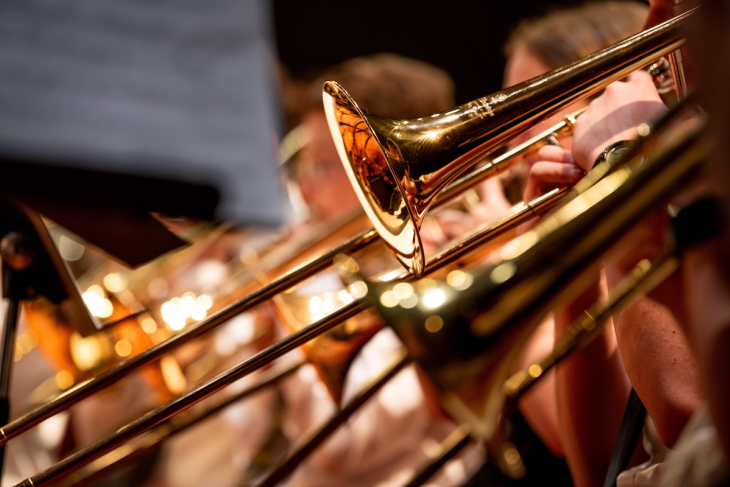
I still remember my elementary music teacher roaming the halls, pushing a cart overflowing with tambourines, recorders, and sheet music. This vibrant world was threatened, however, when I was in fourth grade as the district began discussing cuts to our music program. That night, in a small act of defiance, my parents took my brother (who was in sixth grade band) and me to Old Navy to buy “Save Our Music” T-shirts, which I wore proudly to school the next morning.
We quickly realized we were not alone in this fight. Later that month, our town hall was packed with students, parents, and community members united in protest. It was because of that collective resistance that my music teacher was able to keep pushing her cart, and why I eventually had the privilege of participating in North Smithfield’s band program from sixth grade through high school.
But many students today are not so lucky. Across the United States, access to music education is turning into a discretionary luxury. Amidst district budget cuts, music programs have taken significant hits over the past decade in states such as Oklahoma and California. Nationally, more than 3.6 million students lack access to music education, and these gaps disproportionately affect students in high-poverty schools, large urban districts, and communities with high populations of Black, Hispanic, and Native American students.
Access also declines as students grow older. While 87 percent of elementary schools offer some form of music instruction, that figure drops to 78 percent by high school. Even in schools that technically “offer” music, the quality of access is uneven: Fewer than half of high schools have the instruments, sheet music, or modern equipment necessary for every interested student to participate.
These disparities are likely to worsen. Though the Every Student Succeeds Act (2015) explicitly emphasizes music as a core component of a “well-rounded education,” the Trump administration proposed eliminating funding for the National Endowment for the Arts (NEA), an agency that provides crucial grants to schools and communities to support music and arts programs, particularly for underserved students. While Congress ultimately maintained NEA funding for FY2026, the calls for its elimination ignore the large body of research demonstrating that music is a powerful engine for cognitive development.
From an early age, music helps children learn how language works. We learn our alphabet by singing it, we learn how to rhyme through “Twinkle, Twinkle, Little Star,” and we play the recorder to learn about the foundations of attention and pattern recognition. These traditions reflect how music reinforces phonics and literacy by helping young students internalize language patterns long before formal instruction clicks.
Research shows that these benefits begin well before elementary school. In one randomized study, nine-month-old infants were assigned to either music sessions or non-musical play for 12 classes. Babies in the music group showed stronger neural responses to patterns in both music and speech, demonstrating early improvements in language processing before they can even speak.
Even short, low-cost programs can have lasting effects. A two-year study of five- and six-year-olds found that weekly “music playschool” lessons in kindergarten significantly improved phoneme processing and vocabulary, compared with peers in dance classes or with no organized activity. Programs like these help build the foundations for reading, language development, and long-term academic success.
The benefits of music education extend well beyond early childhood. Studies of middle and high school students consistently find that sustained participation in school music programs is associated with improved academic outcomes, higher standardized test scores, and stronger executive function. In one national survey, 87 percent of teachers and 79 percent of parents said they believe music education positively affects students’ academic performance.
Music’s value is not just something that can be measured in test scores or metrics. It is the experience of learning to persist through frustration and to create something meaningful with others. It’s the confidence of mastering a difficult piece and the sense of belonging that comes from being part of a group.
These benefits may be more important now than ever. Students continue to face unprecedented post-pandemic challenges, including slow recovery in reading and math scores, a weakened sense of belonging at school, and rising psychological struggles, such as anxiety and insomnia. These trends are especially pronounced among high-poverty students and students of color, the same groups that are least likely to have access to music education. Yet research consistently shows that music education can help address these challenges: 92 percent of teachers say music provides an outlet for students to express themselves, and 90 percent report that it helps students build confidence. If music helps students reconnect with school, rebuild confidence, and strengthen academic skills, then the students who stand to benefit most are precisely those who are most often denied access.
Music education should not be treated as a nice-to-have, or the first program that gets cut when budgets tighten. In fact, communities should advocate for their expansion, ensuring universal access and emphasizing the role music can play in post-pandemic recovery. Every child deserves the chance to pick up an instrument, find their voice, and discover the discipline, creativity, and connection that only music can bring.