Toledo City Schools is considering a move to four-day school weeks in hopes of saving money. But evidence shows they are not fiscally beneficial. Even worse: they harm student learning, especially for the students who are already being underserved by their schools.
When school districts run short of money, the temptation to cut corners is strong. Toledo City Schools, staring down a projected $68 million budget shortfall, is now “having a conversation” about moving to a four-day school week, with longer days on Mondays through Thursdays to meet Ohio’s minimum-hours requirement.
This idea is not new. It’s spreading (mostly in rural areas). And it’s a bad idea—especially for a large, urban district serving many disadvantaged students who already lost far too much instructional time during the pandemic.
Let’s be clear about what’s happening. A four-day week is not a proven educational reform. It’s a labor-management strategy masquerading as concern for “mental health,” pitched as a morale booster for adults and a cost-saving device for districts. Don’t believe me? Let’s look at the data.
The fiscal mirage
Start with the money because that’s often where these conversations begin. District leaders routinely suggest that a four-day school week will produce meaningful budget relief by lowering transportation, utility, and hourly staffing costs. The research shows otherwise.
The most comprehensive national analysis, conducted by RAND, finds that districts typically save between 1 and 5 percent of total operating costs after switching to a four-day week. Studies in Oklahoma put average savings at around 2 percent, with reductions concentrated in areas like busing and food service that make up a relatively small share of district budgets. A 2 percent savings in Toledo, given its $439 million budget last year, would generate only $9 million—far short of what’s needed.
Put plainly: A four-day week is not a serious fiscal strategy. It doesn’t come close to solving structural budget problems, especially in large districts like Toledo, where costs like salaries, benefits, special education services, facilities, and debt dominate spending and are mostly unimpacted by the proposed shift.
The recruitment and retention promise falls flat
If the fiscal case is weak, proponents pivot to staffing, arguing that shorter weeks are attractive to educators, and thus can reduce shortages. Here, too, expectations outrun evidence.
A new CALDER working paper examining Missouri, where almost one-third of districts operate on a four-day schedule, finds no evidence that four-day weeks improve teacher recruitment or retention—overall or in hard-to-staff fields like STEM and special education. Using rigorous, multi-year administrative data, the researchers show that adopting a four-day week does not meaningfully reduce teacher turnover or increase the number of new teachers hired.
This finding echoes RAND’s conclusion in an earlier study that, while teachers often like the four-day week, it rarely drives employment decisions and any recruitment advantage tends to disappear as more districts adopt the same calendar.
There’s a lesson here: Districts are substituting a popular perk for harder, more effective solutions—competitive pay, better working conditions, strong leadership, and instructional coherence. The four-day week may make jobs feel nicer at the margins, but it does not fix the underlying labor-market challenges districts face.
Achievement suffers, and Toledo’s students can’t afford that
Even if four-day weeks delivered real fiscal relief and staffing gains—which they don’t—the academic tradeoff would still matter. And here the evidence is clearer.
RAND found that four-day districts typically provide fewer instructional hours over the course of the year, despite longer school days, and that students in those districts experience slower achievement growth, particularly in math and reading. A study of four-day school weeks in Oregon found even more pronounced impacts on academic achievement.
That should give Toledo particular pause.
The district already struggles with low proficiency rates, high chronic absenteeism, and persistent achievement gaps—problems that predate Covid and were exacerbated by it. Large numbers of students are already behind grade level and need more time on task, not less.
A four-day week doesn’t just reduce instructional time on paper. It pushes learning into longer, more exhausting days, disproportionately harms younger students, and leaves many children—especially those without stable childcare—without academic support on the fifth day.
For a district like Toledo, this isn’t trimming fat. It’s cutting into muscle.
Who really benefits
Advocates rarely hide the appeal. As Toledo superintendent Durant reflected to the Blade, “The four-day school week is in the ‘conversation stage’ currently. We are thinking of both staff and students’ mental health status. When you come back to work after a three-day weekend, don’t you feel more refreshed? We think we will have better employees, teachers, and students.”
Why stop there? It’s a safe bet that a four-day weekend would make everyone feel even more refreshed. Sure, teachers like the longer weekends. Administrators hope it eases staffing pressures. Some families enjoy the flexibility—if they have it.
But many don’t. As Toledo’s union leadership has acknowledged, a four-day week raises concerns. “What happens to students who have working parents? What do they do on the fifth day? The addition of time on the other four days also disrupts families. There are more questions than answers.”
The uncomfortable truth is that four-day weeks shift costs from districts to families, with the heaviest burden falling on those least able to absorb it.
The bottom line
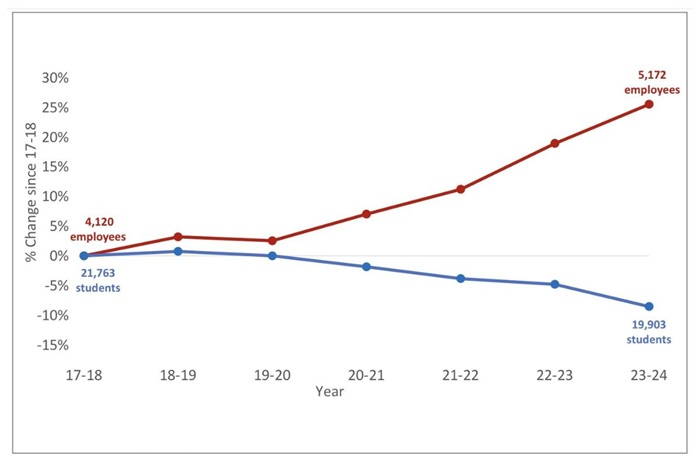
Toledo’s leaders are right about one thing: They face hard choices. They may well need to go the route of Columbusand Cleveland and explore school closures. And they definitely need to revisit staffing levels as Figure 1 below from the Edunomics Lab at Georgetown makes clear. Toledo added more than 1,000 employees since 2017-18 while enrollment fell by 1800 students.
Figure 1. Toledo staffing versus enrollment trends, cumulative percentage change since 2017–18
Four-day school weeks are popular—at least at first. They make adults happy. They sound modern and flexible. But the evidence shows that they don’t save much money, don’t solve staffing problems, and harm student learning—especially for the students who need schools the most.
Ohio’s goal should be more learning, not less. More consistency, not clever calendar tricks. And policies that put students—not adult convenience—first.
Toledo should take a hard pass on the four-day school week.
With Thanksgiving in the rearview mirror and Christmas on the horizon, Ohioans are now fully immersed in the holiday season. Between shoveling snow and checking the kids’ Christmas lists, most folks aren’t thinking about their plans for the new year. But given Ohio’sless-than-stellaracademicresults on national and state exams, policymakers definitely should be.
The good news is that lawmakers in the Senate have already done some heavy lifting to create legislation that could help Ohio students. As a matter of fact, Senate Bill 19—which was unanimously passed by the upper chamber just prior to Thanksgiving—is the perfect opportunity for House policymakers to hit the ground running. Here are two reasons why they should put passing Senate Bill 19 at the top of their 2026 to-do list, as soon as the chamber reconvenes.
1. It will help boost math achievement statewide.
Ohio has a math problem. During the 2024–25 school year, just 55 percent of Ohio students scored proficient or above on the state’s math exams. Results are worse in middle school (ranging from 48 to 52 percent for grades 6–8) and just as concerning in high school Algebra I and geometry (59 and 43 percent, respectively). While it’s encouraging that proficiency rates improved in most grades between 2024 and 2025, overall achievement has yet to bounce back to pre-pandemic levels. In fact, gaps between 2019 and 2025 results remain large. Last year’s math proficiency rates fell short of pre-pandemic marks by roughly 5 percentage points in fourth and fifth grade, approximately 7 percentage points in seventh grade and geometry, just over 8 percentage points in sixth grade, and a massive 10 percentage points in eighth grade.
These aren’t just numbers. These are real Ohio kids, and almost half of them are moving from grade to grade without mastering the requisite math skills. Given Ohio’s lackluster graduation requirements, it’s likely they’ll still be awarded diplomas. But then what? Those who go to college may get stuck in remedial math classes that will help them wrack up student debt but not course credit. Students who enter the workforce won’t be prepared to succeed in many of Ohio’s in-demand careers, which require strong math and problem-solving skills. Even basic adulthood tasks—household budgeting, understanding car loans or mortgage rates, doubling a recipe, filing taxes, saving for retirement, calculating costs for a family vacation—could be hard to do.
If Ohio leaders want to do right by current and future students, they need to solve the state’s math problem. Senate Bill 19 offers an evidence-basedpath forward that focuses on curriculum and teachers.
First, it requires the Department of Education and Workforce (DEW) to review core math curricula and establish a list of high-quality instructional materials. Undertaking such a review would assist school leaders when it comes time to purchase new textbooks and materials.
Second, the curricula that schools use in both math and reading would be identified on state report cards. These new expectations should provide families, advocates, and communities with additional transparency.
Third, the bill calls for state officials to establish a new math proficiency exam for teacher candidates in the early grades. Those who fail to demonstrate proficiency can still earn a teaching license, but districts and schools would be prohibited from assigning them to teach math until they earn a proficient score.
Fourth, the bill requires DEW to establish two professional development offerings for current teachers: a course for foundational math knowledge and a series of programs on evidence-based math instruction. Collectively, these provisions should help ensure that current and future educators are well-prepared to teach math.
2. It would help struggling students and high achievers.
When students take Ohio’s state exams, their results fall into one of five performance levels: limited, basic, proficient, accomplished, and advanced. The top three levels (proficient, accomplished, and advanced) are considered passing scores that are at or above grade level. The lowest (limited) is a red flag that students are far behind.
Unfortunately, there are significant numbers of students scoring limited on math exams. In elementary and middle school, the percentage ranges from 23 percent in fourth grade to an eye-popping 39 percent in eighth. To catch up to their peers—and be prepared for adulthood—these students need intensive intervention and support from their schools.
On the other end of the spectrum, accomplished and advanced students are surpassing grade-level standards. Their test scores are a clear indicator that they’re ready to be challenged. And yet, many aren’t given the opportunity to enroll in advanced math courses. This lack of access has an impact on all high achievers across the state, but it’s particularly problematic for low-income students. A recently published Fordham report found that high-achieving, low-income students in Ohio are significantly less likely to attend college than their wealthier peers who had similar academic performance in third grade. Part of the reason why is that they lack access to rigorous learning opportunities such as advanced math coursework.
Students on both ends of the achievement spectrum deserve more support from their schools, and Senate Bill 19 aims to provide it. For struggling students, it establishes a new requirement for public schools to provide evidence-based intervention services to those who score limited on state tests in math or reading. Beginning in 2026–27, schools must also develop a Math Improvement and Monitoring Plan for each student who qualifies for intervention services. Meanwhile, for high-achieving students, the bill requires public schools to enroll students who score accomplished or advanced on their seventh-grade math exam in Algebra I in eighth grade. Students in grades 3–6 who score accomplished or advanced must also be enrolled in advanced math the next year.
***
Between disappointing NAEP scores and lackluster state report card results, Ohio had a rough year in 2025. But the start of a new year brings new opportunities, and Senate Bill 19 is a great one. Here’s hoping that House lawmakers seize the opportunity to strengthen math policy in Ohio and help more students achieve proficiency in the years to come.
School report cards have long played a central role in accountability systems. They provide public transparency around student performance and school quality. When results are substandard, state and local are required to take action. Created in 2021, Ohio’s current report card framework is generally solid, featuring user-friendly ratings and measures that incentivize schools to improve. But as report card elements are implemented and new data come in, policymakers may need to make adjustments that preserve the system’s rigor and integrity. In a series of forthcoming pieces, I’ll take a look at areas that could use some careful refinement. This one examines chronic absenteeism, a serious problem statewide, but an indicator that has not been effectively incorporated into the report card.
How chronic absenteeism fits into the report card
Students who miss more than 10 percent of the school year—almost a month’s worth—are deemed “chronically absent.” In an effort to improve attendance, Ohio added chronic absenteeism rates to the report card in 2018. These data initially appeared in the Achievement component alongside student proficiency rates. During the 2021 overhaul, policymakers sensibly moved chronic absenteeism to the Gap Closing component, which focused Achievement on district- and school-wide proficiency.
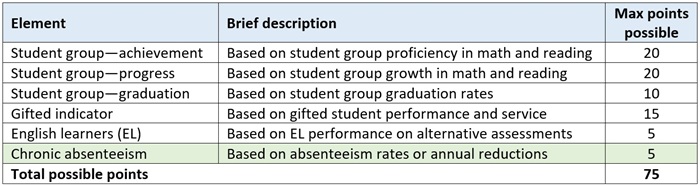
As part of Gap Closing, chronic absenteeism now sits among indicators of various student groups’ performance—e.g., the achievement and growth of low-income pupils. As Table 1 shows, chronic absenteeism is worth five points in the Gap Closing scoring system. The “weight” absenteeism receives varies across districts and depends their demographics and how many student groups they are accountable for. In a district with few student groups, chronic absenteeism carries more weight—it’s worth 10 to 15 percent in many racially homogenous rural districts—while it carries less weight in diverse urban and suburban districts (e.g., 7 percent in Columbus).[1]
Table 1: Structure of Ohio’s Gap Closing component
Notes: The ten student groups, outlined in federal and state law, are: all students, six racial/ethnic groups, English learners, students with disabilities, and economically disadvantaged students. This table shows the points possible assuming a district is accountable for every student group, which does not actually occur in practice. Performance targets to meet various indicators appear in this document. A district’s points earned divided by its points possible determines the Gap Closing rating based on this grading scale.
How high-absenteeism schools get a free pass
Including chronic absenteeism in the report card system highlights the importance of attendance and nudges schools to pay attention to it. But the way the Ohio implements the measure undermines its ability to hold schools accountable and drive significant reductions in chronic absenteeism. The problem boils down to a loose alternative method by which schools can meet the chronic absenteeism indicator and receive the five-point credit.
The first—and non-problematic—way schools can meet the indicator is by meeting a statewide target rate. In 2024–25, the target was 16.4 percent, which roughly two in five districts statewide achieved last year. This is a reasonably strict standard and one that will continue to get tougher each year. By 2029–30, schools will need to register chronic absenteeism rates below 6.9 percent to earn credit through this avenue.
Alternatively, schools can meet the indicator by reducing their chronic absenteeism rates. While the concept is fine, Ohio’s improvement bar is so low that it can present persistent failure as success. For high-absenteeism districts—those with rates above 36.7 percent—all they need to do is reduce chronic absenteeism by 1.1 percentage points versus the year prior.[2] This abysmal standard lets schools off the hook. As Table 2 shows, several districts received full credit even though their chronic absenteeism rates were sky-high and only minimal reductions were made. The full-blown attendance crisis in Columbus was simply ignored just because the district’s absenteeism rate declined by a measly 1.6 percentage points. Note also the satisfactory mark inflated Columbus’ Gap Closing rating. Had it missed the chronic absenteeism indicator, it would have received one star, not two, on this component.
Table 2: Districts meeting the state’s chronic absenteeism indicator despite high rates of absenteeism and minimal reductions
Note: Of the 46 districts with very high chronic absenteeism rates (above 36.7 percent), 19 met the chronic absenteeism indicator through the improvement alternative.
***
To combat the state’s attendance crisis, Ohio must tighten accountability for absenteeism. To this end, the Ohio Department of Education and Workforce should take immediate action to increase the required rate of annual reduction—5 percentage points seems reasonable—to meet the chronic absenteeism indicator.[3] This would raise state expectations for regular attendance, and heighten the urgency to reduce chronic absenteeism rates—something that state leaders have pledged to cut in half over the next few years. If the agency fails to act, state lawmakers should step in to raise the bar through legislation.
The report card remains one of the state’s key levers to drive improvement and align incentives to student learning goals, most notably around math and reading achievement but also, increasingly, attendance. A prolonged absenteeism crisis was not easily foreseeable a few years ago when the current system was being developed. But here we are. It’s time to raise standards for attendance by strengthening implementation of the chronic absenteeism report card indicator.
[1] If a district or school has fewer than 15 students in a particular group, then it is not accountable for its performance as a separate group and the number of points possible is reduced. The actual points possible for districts ranged from 22 to 74 in 2024–25, with the median district having 46 possible points.
[2] For districts with lower rates of chronic absenteeism (below 36.7 percent), the required rate of reduction is 3 percent. The use of a percent change, rather than percentage point change, for lower-absenteeism district appears to address a technical issue when baseline rates are lower (e.g., a 1.1 percentage point decrease is equivalent to a 10 percent decrease versus an 11 percent baseline rate).
[3] Relevant statute (ORC 3302.02 and 3302.03) and administrative rule OAC 3301-28-01/02 do not mention an improvement dimension for the chronic absenteeism indicator, so it appears the agency could change the rate of reduction at its discretion. Of the high-absenteeism districts, two registered declines greater than 5 percentage points last year (East Cleveland and Lockland).
Concern is growing over the impacts ofAI use onstudents’ ability to write complete, coherent, logical essays on their own and to learn from the recursive process of drafting, reviewing, and rewriting. But what if AI’s role is limited to that of the editor, rather than the author or assistant? A new report looks at the impact of an Automated Writing Evaluation (AWE) program on students’ writing performance.
Nine researchers, led by Joshua Wilson of the University of Delaware, use a randomized controlled trial to compare outcomes for middle school students using an AWE system called MI Write to those of a similar group of students who learned via more traditional methods. (Note: MI Write was developed by Measurement Incorporated, a firm that sells numerous assessment and evaluation services to schools nationwide, and two of its staffers are included on the research team that produced this report.) Data come from three unnamed school districts in the mid-Atlantic and southeastern regions of the United States during the 2021–22 school year. One is suburban, one is urban, and one is rural. All three were chosen because they serve a population in which at least 50 percent of students belong to one or more “priority populations”—that is, Black, Hispanic, and/or low-income students, determined by eligibility for free or reduced-price lunch—as defined by the priorities of the Gates Foundation, who funded the study. A total of 37 seventh- and eighth-grade English language arts teachers across those districts opted to participate, and 19 were randomly chosen as the treatment group (n = 1,260 students), while 18 teachers were randomly assigned to the control group (n = 1,277 students).
Control group classrooms experienced “business as usual” ELA instruction. In one district, this consisted of an in-house curriculum that taught one type of writing per quarter and included narrative writing, expository research, and literary analysis. The other two districts used a web-based curriculum called StudySync whose writing component covered a number of writing styles—including argumentative, informative, explanatory, literacy analysis, and narrative—at various times throughout the year.
Treatment group classrooms incorporated MI Write, which uses AI to guide students through recursive cycles of planning, drafting, revising, and editing and can be tailored for any style of writing. Students draft essays in response to MI Write prompts, and while the platform facilitates peer and teacher review, its central feature is an automated feedback system designed to provide almost-immediate analysis of submitted essays across multiple drafts.
Feedback reports include a score of 1.0 to 5.0 on each of six writing traits (development of ideas, organization, style, word choice, sentence fluency, and conventions of a given style), descriptive evaluation and feedback statements, questions for consideration ahead of revision, recommended interactive lessons based on the score for each trait, and text-embedded feedback on grammar and spelling to support editing. There’s much more to it, and interested readers should check out this video demo for additional details.
The researchers examined how students using MI Write compared to their control group peers based on the various grading processes connected to the differing curricula, and whether MI Write students reported greater self-efficacy, greater enjoyment of writing, and more positive beliefs about writing as a recursive process. The two groups of students were broadly similar in grade level (more eighth- than seventh-graders) and gender breakdown (slightly more girls than boys), were plurality Hispanic (more than 42 percent of both groups), and comprised more than 77 percent of “priority population” students.
Overall, the regression analysis showed no statistically significant impact of treatment on students’ writing quality when measured either by human raters or via the MI Write scoring system. Same for all of the survey-based outcomes. However, additional analysis indicated that the three districts implemented MI Write with varying levels of fidelity and frequency. In the district identified as rural, for example, every lesson that research team members observed used MI Write. In that district, small but significant positive impacts were seen on all outcomes. The other two districts were classified as “rarely used” (suburban) and “intermittently used” (urban) and registered null or slight negative impacts (although still significant) across the board. Even in the most-committed district, the report provides the anecdote of a teacher who “routinely struggled with classroom management, reducing effective writing time,” with concomitant lower scores than other classrooms in the same district. Meanwhile, some control group students “seldom wrote beyond brief worksheet answers, and no essays were observed to be drafted” during class. There are more such anecdotes included.
What does all this tell us? Anyone hoping for AI-powered curricula to be a revolution in education is going to run into the same implementation problems that have plagued the much more well-regarded (and much more traditional) science of reading revolution. As Robert Pondiscio puts it: even the highest quality curriculum doesn’t teach itself. And even with the highest fidelity, a revolution is unlikely to occur. Teachers and students are not machines—even when working and learning with machines.