
When school districts run short of money, the temptation to cut corners is strong. Toledo City Schools, staring down a projected $68 million budget shortfall, is now “having a conversation” about moving to a four-day school week, with longer days on Mondays through Thursdays to meet Ohio’s minimum-hours requirement.
This idea is not new. It’s spreading (mostly in rural areas). And it’s a bad idea—especially for a large, urban district serving many disadvantaged students who already lost far too much instructional time during the pandemic.
Let’s be clear about what’s happening. A four-day week is not a proven educational reform. It’s a labor-management strategy masquerading as concern for “mental health,” pitched as a morale booster for adults and a cost-saving device for districts. Don’t believe me? Let’s look at the data.
The fiscal mirage
Start with the money because that’s often where these conversations begin. District leaders routinely suggest that a four-day school week will produce meaningful budget relief by lowering transportation, utility, and hourly staffing costs. The research shows otherwise.
The most comprehensive national analysis, conducted by RAND, finds that districts typically save between 1 and 5 percent of total operating costs after switching to a four-day week. Studies in Oklahoma put average savings at around 2 percent, with reductions concentrated in areas like busing and food service that make up a relatively small share of district budgets. A 2 percent savings in Toledo, given its $439 million budget last year, would generate only $9 million—far short of what’s needed.
Put plainly: A four-day week is not a serious fiscal strategy. It doesn’t come close to solving structural budget problems, especially in large districts like Toledo, where costs like salaries, benefits, special education services, facilities, and debt dominate spending and are mostly unimpacted by the proposed shift.
The recruitment and retention promise falls flat
If the fiscal case is weak, proponents pivot to staffing, arguing that shorter weeks are attractive to educators, and thus can reduce shortages. Here, too, expectations outrun evidence.
A new CALDER working paper examining Missouri, where almost one-third of districts operate on a four-day schedule, finds no evidence that four-day weeks improve teacher recruitment or retention—overall or in hard-to-staff fields like STEM and special education. Using rigorous, multi-year administrative data, the researchers show that adopting a four-day week does not meaningfully reduce teacher turnover or increase the number of new teachers hired.
This finding echoes RAND’s conclusion in an earlier study that, while teachers often like the four-day week, it rarely drives employment decisions and any recruitment advantage tends to disappear as more districts adopt the same calendar.
There’s a lesson here: Districts are substituting a popular perk for harder, more effective solutions—competitive pay, better working conditions, strong leadership, and instructional coherence. The four-day week may make jobs feel nicer at the margins, but it does not fix the underlying labor-market challenges districts face.
Achievement suffers, and Toledo’s students can’t afford that
Even if four-day weeks delivered real fiscal relief and staffing gains—which they don’t—the academic tradeoff would still matter. And here the evidence is clearer.
RAND found that four-day districts typically provide fewer instructional hours over the course of the year, despite longer school days, and that students in those districts experience slower achievement growth, particularly in math and reading. A study of four-day school weeks in Oregon found even more pronounced impacts on academic achievement.
That should give Toledo particular pause.
The district already struggles with low proficiency rates, high chronic absenteeism, and persistent achievement gaps—problems that predate Covid and were exacerbated by it. Large numbers of students are already behind grade level and need more time on task, not less.
A four-day week doesn’t just reduce instructional time on paper. It pushes learning into longer, more exhausting days, disproportionately harms younger students, and leaves many children—especially those without stable childcare—without academic support on the fifth day.
For a district like Toledo, this isn’t trimming fat. It’s cutting into muscle.
Who really benefits
Advocates rarely hide the appeal. As Toledo superintendent Durant reflected to the Blade, “The four-day school week is in the ‘conversation stage’ currently. We are thinking of both staff and students’ mental health status. When you come back to work after a three-day weekend, don’t you feel more refreshed? We think we will have better employees, teachers, and students.”
Why stop there? It’s a safe bet that a four-day weekend would make everyone feel even more refreshed. Sure, teachers like the longer weekends. Administrators hope it eases staffing pressures. Some families enjoy the flexibility—if they have it.
But many don’t. As Toledo’s union leadership has acknowledged, a four-day week raises concerns. “What happens to students who have working parents? What do they do on the fifth day? The addition of time on the other four days also disrupts families. There are more questions than answers.”
The uncomfortable truth is that four-day weeks shift costs from districts to families, with the heaviest burden falling on those least able to absorb it.
The bottom line
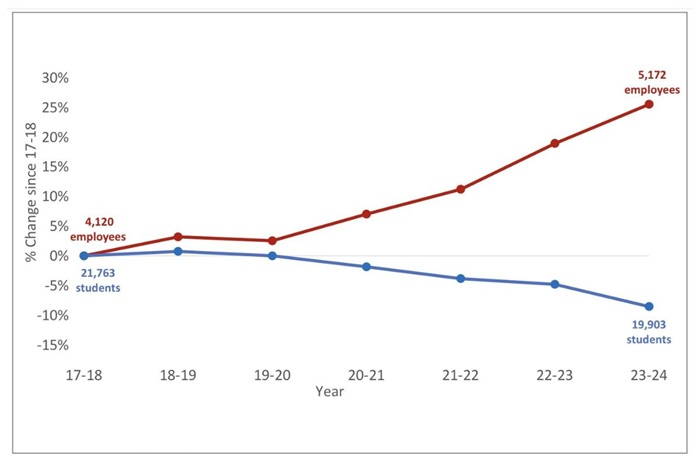
Toledo’s leaders are right about one thing: They face hard choices. They may well need to go the route of Columbus and Cleveland and explore school closures. And they definitely need to revisit staffing levels as Figure 1 below from the Edunomics Lab at Georgetown makes clear. Toledo added more than 1,000 employees since 2017-18 while enrollment fell by 1800 students.
Figure 1. Toledo staffing versus enrollment trends, cumulative percentage change since 2017–18
Four-day school weeks are popular—at least at first. They make adults happy. They sound modern and flexible. But the evidence shows that they don’t save much money, don’t solve staffing problems, and harm student learning—especially for the students who need schools the most.
Ohio’s goal should be more learning, not less. More consistency, not clever calendar tricks. And policies that put students—not adult convenience—first.
Toledo should take a hard pass on the four-day school week.