

School Choice
Debunking the false narrative that Ohio’s school choice programs only help the rich
In another attempt to smear educational choice, hostile advocacy groups have begun to portray private school scholarship programs as
In another attempt to smear educational choice, hostile advocacy groups have begun to portray private school scholarship programs as

In another attempt to smear educational choice, hostile advocacy groups have begun to portray private school scholarship programs as catering to rich, White families. This narrative has emerged in tandem with the state’s recent expansion of EdChoice, which now offers support to all Ohio families regardless of income. What is less acknowledged by critics—who decry the program cost—is that wealthier families receive significantly scaled-back scholarships. Because they receive smaller amounts, less than one-tenth of the $1 billion overall scholarship funds went to high-income students (above 450 percent federal poverty) last year. The vast majority of the aid supported low- and middle-income families who face budgetary constraints that would likely otherwise put private schools out-of-reach.
It’s true: Ohio’s scholarship programs still serve tens of thousands of disadvantaged students. It’s just a bigger tent, one that now looks a whole lot like the demographics of…traditional public schools.
When looking at demographics, we must first discuss inaccurate data on the number of low-income students in Ohio’s scholarship programs. One news station recently ran a headline claiming, “Nearly 90 percent of [scholarship] participants are not low-income.” Stunning, if true. And this number can indeed be found in an Ohio Department of Education and Workforce (DEW) database. But it refers to something else.
How so? The state does not need to and doesn’t collect program-wide income data for students participating in the Cleveland Scholarship or the Traditional EdChoice (“failing schools”) program.[1] In those two programs, only low-income families seeking tuition waivers must report their income to the state. However, numerous private schools participating in those programs—most of them urban Catholic schools—do not charge tuition above the scholarship amount. That means many families have no need to verify their income with the state. DEW labels these students as “not low-income qualified” (emphasis added)—even if they actually come from poor families and just haven’t had gone through income verification.
The Cleveland numbers are a tell-tale sign that something is amiss. In the DEW database, just 3.3 percent of Cleveland Scholarship students are reported as “low-income qualified.” This defies common sense and is a far cry from data reported elsewhere. In another DEW file with subsidized meals numbers, the agency reports that 63 percent of students attending Cleveland Catholic Diocese schools are “direct certified” as low-income and eligible for free meals.[2] Most of these students are likely using a Cleveland scholarship, and while not a precise measure of economic disadvantage in that program, it’s surely a closer approximation than 3 percent.
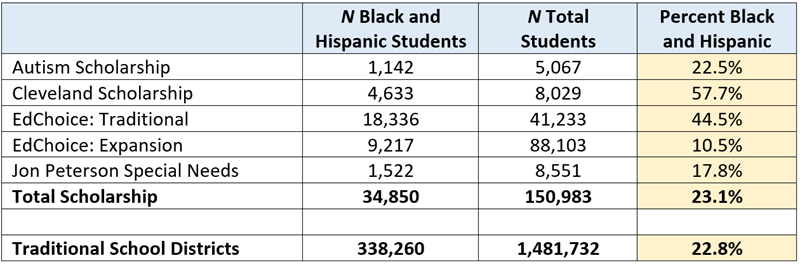
Fortunately, the state reports more accurate and consistent scholarship numbers by students’ race and ethnicity. Though obviously not a direct proxy for economic disadvantage, Black and Hispanic students are more likely to come from low-income households. Here, we find that the percentage of Black and Hispanic students—across all five scholarship programs—is actually a notch above the rate for traditional districts (23.1 versus 22.8 percent).[3] As shown in the table below, the percentages are higher in the Cleveland Scholarship (58 percent) and Traditional EdChoice (45 percent), the latter of which serves mainly students from high-poverty communities such as Cincinnati, Dayton, and Youngstown. Reflecting its wider eligibility pool, a smaller percentage of EdChoice Expansion students are Black or Hispanic (11 percent). Despite the relatively small proportion, it’s worth noting that the expanded program still serves more than 9,000 Black and Hispanic students, roughly equivalent to the enrollment of an entire mid-sized suburban district. In total, all five scholarship programs serve almost 35,000 Black and Hispanic students across the state.
Table 1: Black and Hispanic scholarship students, 2023–24
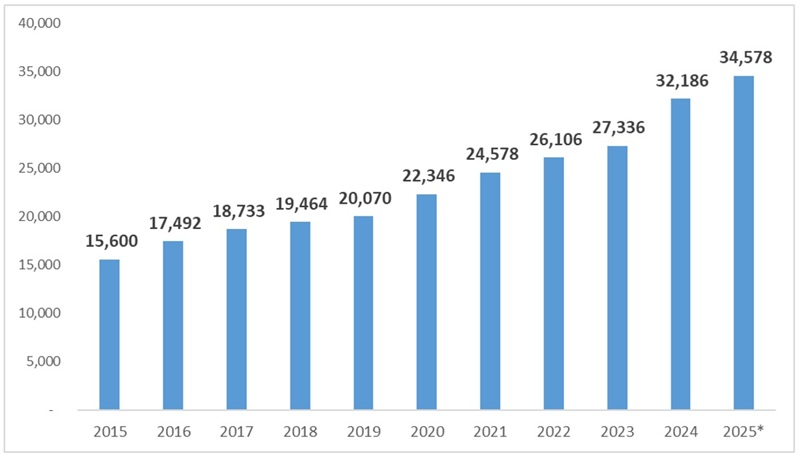
Turning to trends over time, the chart below shows that scholarship programs have consistently attracted more students of color. Taken together, Cleveland and EdChoice (both the traditional and expansion programs) have more than doubled their Black and Hispanic student counts over the past decade. That growth reflects in part expanded eligibility for EdChoice and demonstrates that these efforts haven’t just opened private-school doors for middle-income White households. They’ve also expanded options for families of color.
Figure 1: Black and Hispanic students participating in Cleveland and EdChoice (both programs)
* * *
Ohio’s private school choice programs are more diverse today than ever before. Just like traditional districts, they serve students from all socio-economic backgrounds and all corners of the state. And eligibility expansions have made private school scholarships more readily available for Black and Hispanic students as well. Before denouncing these programs, critics should ponder who exactly they’re attacking. Most are students who need the lifeline to a brighter future that a scholarship can offer. These children—tens of thousands of whom are low-income or students of color—shouldn’t be invisible or vilified in our debates over private school choice.
[1] Income verification is only mandatory for new students applying for EdChoice Expansion. Income is required program-wide to determine the scholarship amount—whether the full amount for families below 450 percent of federal poverty, or a reduced sum above that threshold.
[2] This refers to a process that identifies students as low-income based on their families’ participation in means-tested programs like SNAP, TANF, or Medicaid. The 63 percent calculation is based on Cleveland diocesan schools that participate in Community Eligibility Provision (representing twenty-three of twenty-eight schools).
[3] Public charter schools, whose advocates have not criticized scholarships, are not included in the traditional district headcounts. When charters, which serve primarily urban communities, are included, 25.4 percent of all public school students are Black or Hispanic (district and charter).

Ohio’s budget bill—House Bill 96—has garnered a lot of attention because the legislation will determine the level and distribution of school funding over the next two years. One of the especially controversial elements of the bill would restrict how much money districts hold in reserve (how large their “fund balances” can be), with any “excess” funds returned to taxpayers in the form of lower taxes.
The goal is commendable, but the legislation’s proposed solution is flawed. House Bill 96 would in fact incentivize more wasteful spending and impede districts’ ability to manage their finances responsibly. My own research clearly documents just how costly this lack of financial flexibility has been in the past. There are better ways to ensure that Ohio taxpayers get their money’s worth.
Three problems with House Bill 96’s “excess carry-over balance” provisions
The bill in its current form states that a school district’s general fund balance—the discretionary funds that districts have on hand—can be no greater than 30 percent of their annual operating budgets. Every summer, a county budget commission would determine whether a district exceeds this threshold and by what margin. Districts with “excess carry-over” would have their local tax receipts reduced during the following year through a reduction in the local taxes that residents pay. The aggregate tax reduction would match the excess amount in the general fund.
There are at least three problems with this proposed solution to districts hoarding tax dollars: more bureaucracy, perverse incentives, and costly financial vulnerability.
1. Yet more cumbersome government bureaucracy
The law would impose yet another bureaucratic obstacle that local governments need to overcome as they try to deliver education services to their residents. The burden includes the added time and effort districts must expend to stay under the 30 percent limit, the work of a commission that must determine how much to reduce tax rates, as well as the implementation of this reduced tax rate, including communications with residents. These requirements may seem minimal, but government bureaucracy is dysfunctional in part because we’ve added such rules and procedures annually for decades. Unless there is clear evidence that a regulation would improve outcomes, lawmakers should think twice before imposing it.
2. Perverse incentives to waste taxpayer money
One of the most problematic (and lamented) features of public bureaucracy is the incentive among civil servants to spend as much money as possible. Once a public agency has been created—in this case, a school district—there are incentives for those in the organization to bring in and spend as much money as they can, even if that spending is questionable or outright wasteful. There are some rules governments impose that should limit this tendency, such as Ohio’s requirements that district budgets be publicly available and that residents vote directly on proposed tax increases. But there are some rules that might exacerbate the tendency to maximize wasteful spending. Rules that require agencies to return unspent funds are a prime example.
Such requirements are colloquially referred to as “use it or lose it” budget rules. They create incentives to spend every last dollar, regardless of the returns on that spending. For example, research on federal procurement shows that federal agencies increase spending dramatically just before the end of the fiscal year, and that the contracts they enter into in those final weeks are of substantially lower quality than those entered into earlier in the year. Creating incentives to spend down funds at the end of the fiscal year literally leads to wasteful spending.
The “excess carry-over” provision in House Bill 96 would create a strong incentive for impacted districts to spend down their fund balances to just below the 30 percent threshold, regardless of the circumstances leading to the “excess” fund balance. The incentive is for these districts to burn money rather than exceed the threshold, as doing so would trigger extra work for them, and require them to give money back to taxpayers via tax breaks.
3. Financial vulnerability that can lead to increased costs and lower educational quality
A fundamental problem with the “excess carry-over” rule is the underlying assumption that money districts haven’t spent is money that districts don’t need—that these fund balances are indeed excessive. Districts need reserves to take advantage of opportunities (e.g., launching a new program to address an unanticipated need) and to absorb financial shocks without disrupting operations. Building sufficient reserves is just good management, which is why credit agencies consider fund balances when determining school districts’ bond ratings. That has a direct bearing on how much interest district residents must pay when borrowing for capital projects, for example.
Whether a fund balance above 30 percent is “excessive” will depend on the district, including its risk tolerance and its financial situation. For example, a low-wealth district that is heavily reliant on state funds and that projects future enrollment declines arguably could use more than 30 percent in reserves. Indeed, I argued previously that districts fitting this profile should be far more financially prudent to absorb the hit from expiring federal stimulus funds.
My research indicates that during the Great Recession, Ohio districts with relatively low fund balances (below the median of 22 percent at the time) experienced large declines in student learning simply because of the unanticipated fiscal shortfalls. Not because they subsequently had to spend less, but because they hadn’t anticipated having to spend less. The sudden realization that they faced a deficit required them to make sudden cuts in spending—such as immediately laying off untenured teachers, perhaps without regard to quality—as opposed to making smaller, less harmful cost-reductions over a longer period of time. It also required them to hold new tax referenda, which also disrupt operations by drawing the attention of district staff away from their core function.
Thus, due to a lack of reserves, districts experienced sudden disruptions and delivered an inferior education without saving taxpayers a dime. Only districts in the top third (those with fund balances greater than 29 percent) experienced negligible achievement disruptions. By 2016, the median fund balance among Ohio districts had increased to approximately 30 percent, such that half of Ohio’s districts deemed it prudent to have even larger fund balances.
Increase transparency and let voters decide
One alternative to the proposed legislation is to use budget transparency and tax referenda as mechanisms to hold districts accountable. Voters turn out at higher rates when tax increases are on the ballot than they do merely for school board elections. They notice when school districts try to increase their tax rates. If lawmakers want to make it easier for voters to hold districts accountable for large fund balances, then one option is to make the issue more salient. For example, whenever districts put a proposed tax hike on the ballot, the ballot language could tell voters whether a district’s reserves are above or below some recommended amount. Indeed, one could use the 30 percent threshold to make this determination.
This option would enable Ohio to better meet the preferences of Ohioans while lessening the bureaucracy and perverse incentives that House Bill 96’s “excess carry-over” provisions would introduce. Some voters might consider large district fund balances to be a positive indicator—an example of good fiscal stewardship that makes them more inclined to vote in favor of school funding measures. Others might be more concerned about their own finances and vote down the tax measure if the ballot indicates that the district has reserves in excess of 30 percent. If districts experience opposition, then it’s on them to make their case to voters that they need to carry those balances.
Let’s get out of the way and let those who know best—local voters and school officials—hash it out.

Over the last few years, Ohioans have grown accustomed to headlines declaring that the Buckeye State is poised for massive economic growth. Intel announced plans to spend $28 billion on two chip factories in New Albany. Google is investing an additional $2.3 billion on top of $4.4 billion in prior spending. And earlier this year, Honda announced plans to boost funding for three Ohio auto plants to the tune of $300 million.
All this economic development is good news. But there are some looming questions about whether Ohio is prepared to meet the increasing demand for skilled workers. In a 2024 report titled “Reality Check,” Ohio Excels found that Ohioans can expect the creation of a whopping 645,000 job openings annually by 2031, both from new jobs and those that will open primarily through retirement. The majority of jobs available by then—66 percent—will require postsecondary education. But as of 2022, fewer than 53 percent of Ohio’s working-age adults had a postsecondary degree or credential. That’s a worrisome skills gap—and it won’t go away on its own.
To ensure Ohioans benefit from the significant investments being made by companies like Intel, state leaders need to craft policies that better prepare young people for the future. But where should they start? The Career-Connected Learning Coalition, a cross-sector group of sixteen stakeholders dedicated to expanding and improving career-focused education, has a few recommendations. Let’s take a look at three of the most important ones.
1. Prepare students to make informed decisions
Each year, thousands of students graduate with no idea how to pursue their interests or even what they’re interested in. Current law requires every student in grades nine through twelve who attends a public or chartered non-public school to have a graduation plan that maps their academic pathway to a diploma. But these plans don’t require students to think beyond graduation or consider potential careers. And while state law also requires schools to adopt a policy on career advising, many students don’t receive the kind of coaching and support they need to make informed decisions about their future.
To fix this problem, state lawmakers should take a two-pronged approach. First, they should require public schools to provide students in grades 6–8 with a career exploration course. This course should offer students in-depth opportunities to explore career fields; hands-on learning opportunities like research projects and job shadowing; access to interest and aptitude assessments; and personalized career coaching sessions. Providing students with this kind of explicit instruction will help them identify their interests, connect those interests to careers, and pursue the education they need to work in their chosen field.
Second, public schools should be required to assist students in creating an academic and career plan during eighth grade. Plans should include students’ academic and career goals—which they’ll have a much better handle on thanks to the career exploration course outlined above—and the pathways they plan to take to meet those goals. Parents and guardians should be required to approve final plans, and plans should be revisited annually to monitor progress and make adjustments.
2. Offer pathways to in-demand credentials
Ohio leaders have invested a considerable amount of state funding and political capital into promoting industry-recognized credentials (IRCs). This emphasis is understandable, as high-quality credentials can boost earnings and employment. And the state’s efforts have proven successful on at least one front—more students are earning IRCs than ever before. But there have also been some unintended consequences.
IRCs that can be used to qualify for high school graduation are assigned a point value between one and twelve. Unfortunately, this point value system doesn’t effectively identify credential value or encourage students to earn IRCs that will lead to better long-term outcomes. In fact, thousands of students are obtaining IRCs that are poorly aligned with in-demand, high-value careers. Recent data even suggest that Ohio’s urban districts are routing students into less rigorous IRC programs to ensure they receive high school diplomas.
Ohio lawmakers need to revisit and refine the current system to ensure that it reflects real workforce needs, incentivizes credentials with proven labor market value, and supports meaningful career pathways for students. They should do so by replacing the current point value system with one that places IRCs into tiers based on job outlook, associated wages, value to industry and employers, and employment outcomes for students.
3. Track workforce outcomes
Finally, one of the best ways to ensure that students can smoothly transition between high school, postsecondary education, and the workforce is to ensure that leaders in those sectors are working together to solve problems and implement solutions. Right now, state agencies like the Department of Education and Workforce, the Department of Higher Education, the Department of Job and Family Services, and the Governor’s Office of Workforce Transformation separately collect and analyze a mountain of data on workforce outcomes. But linking these data in a way that effectively drives policy is difficult. And for the average Ohioan, the sheer number of reports and tools being published can be overwhelming enough that they lose their value.
To make Ohio’s education and workforce data more useful to policymakers and the public, lawmakers should establish a cross-agency governing board to oversee a unified data system. This new board should be responsible for identifying and implementing strategies to make data collection and reporting more efficient, supporting initiatives that rely on cross-agency data, and publicly sharing user-friendly data tools like dashboards. This kind of streamlining would go a long way toward supporting data-driven policymaking and helping stakeholders better understand the return on investment of various career pathways.
***
Over the next decade, tens of thousands of well-paying jobs will be available. To seize these opportunities, students will need postsecondary credentials and degrees. But according to recent data, there aren’t enough students on those pathways to meet expected demand. Boosting readiness and attainment will take a considerable amount of hard work. But if policymakers act now by bolstering career exploration and planning, prioritizing in-demand credentials, and improving data tracking, Ohio will be on the right path.

The last several months have seen some behind-the-scenes efforts that, if enacted, would roll back charter school accountability in Ohio by weakening sponsor evaluation, sponsor hopping limitations, and automatic closure provisions. Lawmakers should stop these anti-accountability efforts dead in their tracks. Here’s why:
1. Stronger accountability has moved the charter sector in the right direction…
For many years, Ohio had a nationally-recognized charter school sector—but for all the wrong reasons. To give just a few examples of this troubled past: In fall 2014, more than a dozen startup charters failed spectacularly in a single year. Worrying stories circulated about questionable practices, including claims that charter operators were hiding financial information and allegations of sweetheart facility leasing deals. Then, there was the ECOT meltdown, which made shocking headlines and left thousands of students scrambling midyear to find another school. As for academic outcomes, the results were just not good enough.
Under the leadership of former Governor Kasich, Ohio began a much-needed cleanup by passing a landmark charter reform law in 2015. The legislation strengthened the evaluation system of charter sponsors (a.k.a. authorizers), the entities that oversee and hold schools accountable (of which Fordham is one). The basic premise: Increased pressure on sponsors would incentivize them to shut down underperforming charters and push for improvements in schools that remain open. The bill also put much-needed guardrails around “sponsor hopping”—when low-performing schools on the brink of being forced to close by their sponsor seek a “friendlier” sponsor. And it added much-needed transparency requirements for both sponsors and management companies.
These measures had an almost immediate impact on the sector. Between 2015 and 2022, more than 100 underperforming charters shuttered their doors and dozens of low-capacity sponsors decided to close shop rather than face more stringent oversight. A rigorous study by Ohio State University’s Stéphane Lavertu found that students benefitted from the reforms: Charter performance—as measured by pupil learning gains in math and reading—ticked upward in the wake of these reforms. Some of that progress slowed during the pandemic-era, when accountability writ large was put on pause, but there is evidence from the most recent report card that sector performance is on the upswing again.
2. …But charters still have significant room for improvement
Ohio’s turn toward heightened accountability has stabilized the sector and put it on firmer footing. It’s also helped build policymaker confidence to support path-breaking funding initiatives, including the recent addition of extra dollars for high-performing charters, increased facility aid, and a new equity supplement for all brick-and-mortar charters. These efforts have narrowed longstanding charter funding gaps, and have given schools more resources to expand and serve more students.
This is good news for charters—and the students they educate. But the “mission accomplished” banner shouldn’t be unfurled just yet. Consider a few data points from last year’s report cards (2023–24):
No one—and I mean no one—should be satisfied when a majority of charter students still struggle to achieve proficiency. Yes, progress is being made. But the work isn’t finished.
3. Weakening key accountability policies would be a major setback for Ohio charters
Ohio has three key policy tools that help maintain quality control in the charter sector. Together, the trio form a credible threat of closure when charters underperform, helping to drive urgency and action to improve. They also ensure that chronic poor-performers do actually close. Not unexpectedly, some charter groups push back hard against these policies. Let’s take a look at each more closely, and why softening them would be a setback.
* * *
Responding to years of ridicule and mediocrity, Ohio policymakers rightly committed to stricter charter accountability in 2015. The move has led to significant improvements in charter performance over the past decade and has helped rebuild confidence that the sector is working toward the best interest of students. But all is not yet perfect—there are still too many ineffective charters, and as a recent story of an ugly Cincinnati school closure reminds us, the sector isn’t immune to failure. State leaders need to keep insisting on a responsible and accountable charter sector. That’s the path toward healthy charter schools that give students what they need to succeed in life.
[1] The other two elements are based on sponsors’ compliance with laws and regulations, and adherence to quality practices.

Research shows that students who pass Algebra I by ninth grade are more likely to graduate high school, attend college, and earn higher salaries when they enter the workforce. Since math skills build on each other over successive grade levels, passing Algebra I is predicated on mastery of a lot of prior content, not least of which is eighth-grade-level material. But recent NAEP data indicate that this is not an area where U.S. students currently shine very brightly. What can be done to get students back on track for this vital inflection point in their education? A new report looks at the effectiveness of a curricular support effort to boost students to the algebra starting line.
A team of researchers from TNTP examined three years of data (2021–2024) from more than 2,200 students across the country who used an online learning platform called Teach to One Roadmaps (Roadmaps) developed by New Classrooms. (A disclaimer included in the report implies a connection between the TNTP and New Classrooms organizations related to this project, but the nature of it is unclear.) We are given minimal data on the students in the study but are told specifically that this is not a nationally-representative sample. All were enrolled in an official Algebra I class, with most (66 percent) in ninth grade at the time. The remainder took the class as tenth graders. Their unidentified schools tended to serve higher-than-average proportions of low-income students (as measured by free and reduced-price lunch status and levels of Title I funding) and to have more Black and Hispanic students (23 percent and 50 percent, respectively, on average) than white students (11 percent). While all students were enrolled in Algebra I, their readiness for algebra concepts varied widely based on a beginning-of-year diagnostic assessment within the Roadmaps program. TNTP’s analysis also includes Roadmaps students’ scores on their states’ end-of-year math test per grade level.
The key to Roadmaps, launched in fall 2020, is a rigorous adherence to what is termed the “algebra ladder.” That is, a hierarchy of math skills that reach all the way back to elementary school grade levels and build upon each other sequentially. Mastering skill “A” means one has the prerequisite knowledge to begin learning skill “B.” Years of student achievement data bears out the readiness designation. Each state’s math standards differ, but New Classrooms’ proprietary “algebra ladder” is based on their research into commonalities between many different hierarchies. Details are included in the TNTP report. With a brief initial assessment, the Roadmaps program determines which of the approximately 100 foundational skills[1] a student has mastered and which remain incomplete. Students then receive instruction on the missing skills via text, videos, and practice problems. Short formal assessments follow, with more-nuanced instruction and practice based on the results, until mastery is reached and students can move on to the next missing skill. Formal details on how the Roadmaps work integrates with ongoing classroom instruction in Algebra I are lacking in this report, and that seems important; but more on this in a moment.
First, the findings. Roadmaps assessment results (including both unsuccessful and successful attempts) show that algebra proficiency improves when students master missing algebra-related concepts and skills, especially those from prior grades. Just 7 percent of students who knew fewer than one-third of all the skills from their current and prior grade levels met the passing scores on their state’s math test. By contrast, once students knew around four-fifths of all skills, test passage rates went up to 75 percent or more. Even better, there are some specific early skills that appear to help students build to algebra success more readily than others. That is, mastering every skill is ideal, but if time is short, learning the “key predecessor skills” is a viable alternative highly correlated with test passage success. Finally, students can obtain mastery of specific Algebra I skills (those correlated with the foundational skills they already know) even if they don’t yet know other foundational skills correlated with different Algebra I skills. In fact, students working on the most advanced concept and skill that Roadmaps indicates they’re ready for—even with other knowledge gaps from earlier grade levels—made up ground the fastest compared to peers who started at the bottom and took the ladder one rung at a time.
It sounds like magic, or perhaps lightning in a bottle. More rigorous research will likely be the determining factor of true success (although this analysis is already an extension of a previous study conducted by a different organization with similar findings). But it’s also possible that Roadmaps has unlocked the “science of algebra” (if I may be so bold to coin this phrase), akin to the science of reading which is already shaking up old, bad literacy instruction habits in states across the country to the enormous benefit of students.
We get some glimpses into classroom implementation here (and in related web pages), but there are still too many unanswered questions raised by the report to allow for anything more than speculation at this remove. The program requires a high-quality shared curriculum across all math classes in all grades and extended or double blocks (80-90 minutes) of Algebra I daily. Can schools do that? Money is also likely a factor, both per pupil annual costs and professional development training for teachers who play a primary role in guiding student work through the program.
TNTP’s recommendations reach from the schoolhouse to the statehouse, all geared toward growing student access to Roadmaps. But even with a perfectly smooth policy environment at the highest levels, the changes required in schools and classrooms read like a big deal. However, as with science of reading, it seems that if students were able to reach grade level mastery earlier, less time would be needed for catch-up in later grades. In fact, if Roadmaps is given the time and implementation it needs to work its magic—and if it is indeed as magical as it sounds—more students could be ready for Algebra I sooner than ninth grade, thus getting more students on the path to even more advanced math like calculus and/or statistics in high school. An intriguing but incomplete analysis.
SOURCE: “Unlocking Algebra: What the Data Tells us About Helping Students Catch Up,” TNTP (May 2025).
[1] Teach to One Roadmaps’ total algebra ladder comprises approximately 150 skills: 100 foundational and fifty specific to Algebra I mastery. This is important to note since students are learning both types of skills at the same time in the Roadmaps program.

Pandemic school disruptions, frustrations with ineffective reading methods, and sinking test scores lit a fire under the nascent science of reading movement which has borne fruit across the nation and raised hope that student reading achievement will begin to climb again. The science of reading is a comprehensive effort to change both policy and practice for the benefit of students, but one area that is sometimes overlooked is teacher preparation: ensuring not only that new teachers are trained in the five pillars of early literacy (and all that goes with them) but also that they are not being taught outdated, ineffective, or downright harmful curricula and instructional methods.
Teacher Preparation Inspection-US (TPI-US) has been conducting inspections of teacher preparation programs at colleges and universities across the country since 2013, partnering with the institutions themselves, as well as with state agencies and philanthropy. Literacy instruction was always an area of concern, but it became a central focus for TPI-US inspection teams starting in 2021 due to the raft of bad news coming on the heels of pandemic education disruptions. In partnership with the Barksdale Reading Institute, TPI-US began by reviewing every teacher prep program in Alabama, supplying data-based judgments about how well programs taught the science of reading to their pre-service teachers. These findings formed the basis of their current practice, detailed here. Their latest working paper is an informative snapshot of the changes that have taken place at one university over the last few years, describing two inspections of Southern Arkansas University’s Teacher Education Department (SAU) conducted in 2022 and 2024. It shows what the authors describe as a “shining example” of the positive changes they are working to make.
Among the initial findings in 2022: SAU’s literacy coursework covered the science of reading (including each component of structured literacy) but didn’t include adequate course-embedded connections to real-world practices so that teacher candidates could understand how to apply what they learned. Nor did pre-service teachers have sufficient opportunities to work with elementary students in real classrooms.
In consultation with TPI-US inspectors, SAU officials planned to restructure their literacy courses to integrate practice-based learning throughout the program, including placement in K–1 classrooms for the most junior teacher candidates and placement in grade 3–6 classrooms as they gained teaching experience. Their classroom work was also to include administering assessments, analyzing test results, and assisting in instructional planning using those data. Additionally, SAU staff and students would partner with veteran teachers and elementary school administrators to help review and select high-quality instructional materials to be used in those classrooms.
Returning in 2024, TPI-US found that all of these action items had been completed, and more besides. SAU had also created a structured mentoring program pairing veteran teachers with teacher candidates and now gave students frequent opportunities to observe and analyze recorded lessons using high-quality curricula and teaching methods. This is all good news, but unfortunately the details in the TPI-US working paper grow sparse from here on. We are told that “feedback from district partners” and “individual student growth” are both positive as a result of the revamp, but only the former is expounded on and that only to a vague degree. “District partners have consistently remarked on how much better prepared teaching candidates are to teach literacy and implement high-quality instructional materials in their classrooms effectively” we learn, and “this preparedness has led to districts actively seeking out SAU candidates for hiring, recognizing the value they bring in terms of literacy instruction proficiency and readiness.”
It is not that these findings don’t represent positive movement. Restructuring teacher preparation is a non-negotiable element of successful implementation of the science of reading and we do at least discover that—however it happened—SAU was readily accepting of big changes to their program. That’s not nothing. But measurable improvement of elementary students’ literacy achievement is the true arbiter of a job well done, and those data are conspicuously and unhelpfully absent from the paper. Maybe it’s too early to tell. If so, hopefully reporting that information is on the radar of TPI-US’s researchers sooner rather than later. But it is only in moving the student achievement needle that any policy or programmatic restructuring can be judged as successful. And the clock is ticking loudly for our youngest readers.
SOURCE: “Portrait of Practice: Southern Arkansas University,” TPI-US (April 2025).
NOTES: Today, the Ohio Senate Finance Committee continued hearing testimony on House Bill 96, Ohio’s biennial operating budget. Fordham’s Vice President for Ohio Policy presented interested party testimony on the education-related provisions of the bill. These are his written remarks.
The K–12 provisions in the budget before you present a critical opportunity to address persistent structural issues in school funding, strengthen school choice, bolster literacy and numeracy, and improve career readiness across the state. I’d like to highlight several key areas and offer recommendations for your consideration.
School Funding: Targeting Resources Where They Matter Most
1. Reforming the Funding Formula Inputs
Ohio’s school funding formula must be sustainable and student-centered. We support the governor’s recommendation to fully phase in the Cupp-Patterson formula while controlling the inflationary costs associated with updating its inputs. Instead of allowing local or federal spending decisions outside of the funding formula to drive increases, we recommend the legislature enact a modest base increase of 1.5% in both FY26 and FY27.
2. Fixing Disadvantaged Pupil Impact Aid (DPIA)
DPIA is broken. Due to the Community Eligibility Provision (a federal meals program), current eligibility measures significantly overstate the number of economically disadvantaged students. We urge the Senate to adopt “direct certification” as the standard, which offers a more accurate identification of low-income students. This shift would allow for a meaningful increase in DPIA—from $422 to $775 per pupil—and most importantly better target funds to where they are truly needed.
3. Reducing Reliance on Guarantees
Guarantees, while well-intentioned, now operate as subsidies to districts that have lost students or become wealthier. These provisions—while politically popular—distort funding equity. We recommend an accelerated phase-out: reduce guarantee bases to 90% in FY26 and 80% in FY27 and eliminate “supplemental targeted assistance,” which unfairly compensates districts losing students to choice programs.
None of these recommendations are radical. They are relatively modest in fiscal terms—$53 million more in FY26 and $127 million in FY27 than the governor’s proposal. But they represent a major step forward in policy coherence and fiscal discipline; and most importantly, they help ensure dollars go where the students are and the needs greatest.
Charter Schools: Equity and Accountability
1. Increase Facilities Aid and Streamline Access to Unused Buildings
We commend the governor’s proposed increase in facilities aid and urge the Senate to maintain this vital funding. Charter schools continue to face inequities due to lack of access to local construction funding. We also strongly support restoring the governor’s improvements to the unused facilities law—strengthening enforcement and pricing mechanisms—while adding guardrails to avoid unintended district burdens.
2. Preserve High-Quality Charter School Funding
The current high-quality charter school funding model rewards excellence and should be preserved. The eligibility criteria ensure that only schools demonstrating strong academic results receive additional support. We support embedding this program in statute to help safeguard it against future policy shifts and recommend rolling charter school facilities and quality funding into the main K–12 line item for greater budgetary stability.
Private School Choice: Targeted Improvements
Ohio has made significant strides in recent years in expanding private school choice opportunities across the state. Because of these efforts, we don’t believe that any big changes are needed at this time. We oppose the House’s creation of an Education Savings Account (ESA) for students in non-chartered, non-tax supported private schools. These schools have chosen to operate outside of the state’s accountability and funding systems, based on deeply held religious convictions. While they should be respected for that choice, they have done so knowing that they would not receive taxpayer funding.
We do support a couple of relatively minor changes to private school choice policy. We encourage the Senate to incorporate provisions from SB 191 that create a low-income weight for EdChoice scholarship students. Low-income students require more resources to reach their potential, regardless of school type, and additional scholarship funds will help meet those needs.
We also support aligning the Jon Peterson and Autism scholarships with the charter school funding formula to ensure equity for students with disabilities across sectors. An amendment drafted to SB 44 (Amendment AM_136_0202-2) offers a clear path toward that alignment.
Career Pathways and Workforce Readiness
Ohio’s career education framework is ripe for modernization. We support restoring the governor’s overhaul of industry-recognized credentials, which would tie graduation credit to credentials that align with workforce demand. We also urge rejection of the proposal to allow work-based learning hours to count toward graduation; such a low bar could undermine student preparation.
To enhance early planning, we support requiring all middle school students to complete a structured career exploration course (Amendment SC0530). This ensures students make informed decisions about high school and beyond.
Finally, we encourage the Senate to adopt Amendments SC0531, SC0532, and SC0534, which would restore funding for career awareness, support high school internships, and establish a data-insight board to link education and workforce outcomes.
Together, these actions would build a more coherent, transparent, and effective career-connected learning system—one that truly prepares all Ohio students for life after high school.
Foundational Learning: Strengthening Math and Literacy
We support restoring the governor’s proposal to require universal reading screeners for grades K–3 and encourage inclusion of provisions from Substitute SB 19 (which includes a host of important policy changes) that would require similar screeners in math. Identifying struggling students early is a key to long-term success.
We also recommend requiring districts to report their math curricula and urge DEW to develop a vetted list of high-quality math programs. Transparency and guidance—without mandates—can help districts adopt rigorous materials.
Additionally, we support Amendment SC0543, which would ensure automatic placement of high-achieving students in eighth-grade Algebra I and create a framework beginning in the early grades to give students the support necessary to be successful. This early gateway is critical for postsecondary STEM opportunities.
Educator Pipeline: Better Data, Smarter Decisions
Teacher shortages are a growing concern, yet data on vacancies is sparse. We urge the Senate to restore the governor’s proposal to require DEW to collect and report teacher vacancy data, and build on it by disaggregating the data by school and subject area (Amendment SC0541). We also support provisions to give school leaders greater discretion in teacher placement, rather than defaulting to seniority.
Conclusion
This budget is more than a fiscal document—it is a moral statement about our priorities as a state. The reforms we recommend are modest in cost but powerful in impact. They focus on driving dollars to students who need them, supporting high-performing public schools of all types, and ensuring that Ohio’s education system prepares students for life after graduation.
We urge you to maintain the bold direction of the governor’s proposals, restore what the House removed, and avoid provisions that would backslide on progress. Let’s double down on what works and build a system that truly puts Ohio students first.