In another attempt to smear educational choice, hostile advocacy groups have begun to portray private school scholarship programs as catering to rich, White families. This narrative has emerged in tandem with the state’s recent expansion of EdChoice, which now offers support to all Ohio families regardless of income. What is less acknowledged by critics—who decry the program cost—is that wealthier families receive significantly scaled-back scholarships. Because they receive smaller amounts, less than one-tenth of the $1 billion overall scholarship funds went to high-income students (above 450 percent federal poverty) last year. The vast majority of the aid supported low- and middle-income families who face budgetary constraints that would likely otherwise put private schools out-of-reach.
It’s true: Ohio’s scholarship programs still serve tens of thousands of disadvantaged students. It’s just a bigger tent, one that now looks a whole lot like the demographics of…traditional public schools.
When looking at demographics, we must first discuss inaccurate data on the number of low-income students in Ohio’s scholarship programs. One news station recently ran a headline claiming, “Nearly 90 percent of [scholarship] participants are not low-income.” Stunning, if true. And this number can indeed be found in an Ohio Department of Education and Workforce (DEW) database. But it refers to something else.
How so? The state does not need to and doesn’t collect program-wide income data for students participating in the Cleveland Scholarship or the Traditional EdChoice (“failing schools”) program.[1] In those two programs, only low-income families seeking tuition waivers must report their income to the state. However, numerous private schools participating in those programs—most of them urban Catholic schools—do not charge tuition above the scholarship amount. That means many families have no need to verify their income with the state. DEW labels these students as “not low-income qualified” (emphasis added)—even if they actually come from poor families and just haven’t had gone through income verification.
The Cleveland numbers are a tell-tale sign that something is amiss. In the DEW database, just 3.3 percent of Cleveland Scholarship students are reported as “low-income qualified.” This defies common sense and is a far cry from data reported elsewhere. In another DEW file with subsidized meals numbers, the agency reports that 63 percent of students attending Cleveland Catholic Diocese schools are “direct certified” as low-income and eligible for free meals.[2] Most of these students are likely using a Cleveland scholarship, and while not a precise measure of economic disadvantage in that program, it’s surely a closer approximation than 3 percent.
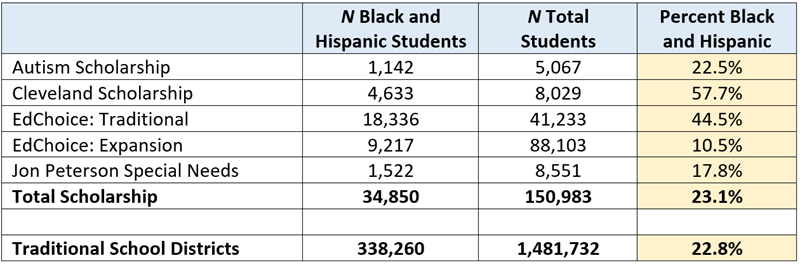
Fortunately, the state reports more accurate and consistent scholarship numbers by students’ race and ethnicity. Though obviously not a direct proxy for economic disadvantage, Black and Hispanic students are more likely to come from low-income households. Here, we find that the percentage of Black and Hispanic students—across all five scholarship programs—is actually a notch above the rate for traditional districts (23.1 versus 22.8 percent).[3] As shown in the table below, the percentages are higher in the Cleveland Scholarship (58 percent) and Traditional EdChoice (45 percent), the latter of which serves mainly students from high-poverty communities such as Cincinnati, Dayton, and Youngstown. Reflecting its wider eligibility pool, a smaller percentage of EdChoice Expansion students are Black or Hispanic (11 percent). Despite the relatively small proportion, it’s worth noting that the expanded program still serves more than 9,000 Black and Hispanic students, roughly equivalent to the enrollment of an entire mid-sized suburban district. In total, all five scholarship programs serve almost 35,000 Black and Hispanic students across the state.
Table 1: Black and Hispanic scholarship students, 2023–24
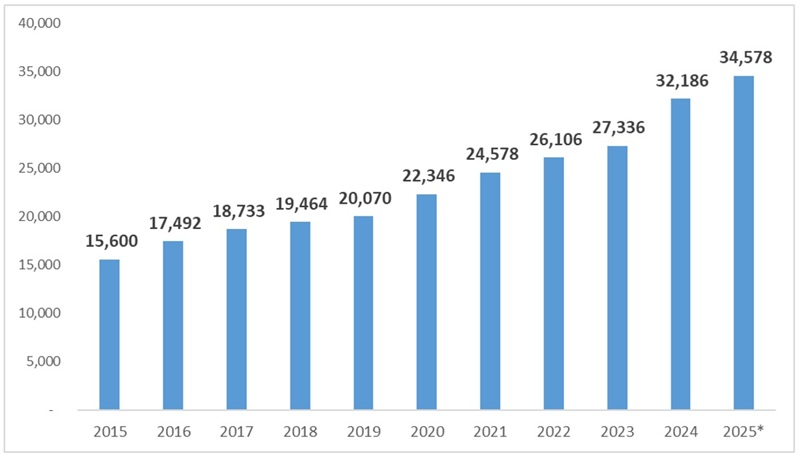
Turning to trends over time, the chart below shows that scholarship programs have consistently attracted more students of color. Taken together, Cleveland and EdChoice (both the traditional and expansion programs) have more than doubled their Black and Hispanic student counts over the past decade. That growth reflects in part expanded eligibility for EdChoice and demonstrates that these efforts haven’t just opened private-school doors for middle-income White households. They’ve also expanded options for families of color.
Figure 1: Black and Hispanic students participating in Cleveland and EdChoice (both programs)
* * *
Ohio’s private school choice programs are more diverse today than ever before. Just like traditional districts, they serve students from all socio-economic backgrounds and all corners of the state. And eligibility expansions have made private school scholarships more readily available for Black and Hispanic students as well. Before denouncing these programs, critics should ponder who exactly they’re attacking. Most are students who need the lifeline to a brighter future that a scholarship can offer. These children—tens of thousands of whom are low-income or students of color—shouldn’t be invisible or vilified in our debates over private school choice.
[1] Income verification is only mandatory for new students applying for EdChoice Expansion. Income is required program-wide to determine the scholarship amount—whether the full amount for families below 450 percent of federal poverty, or a reduced sum above that threshold.
[2] This refers to a process that identifies students as low-income based on their families’ participation in means-tested programs like SNAP, TANF, or Medicaid. The 63 percent calculation is based on Cleveland diocesan schools that participate in Community Eligibility Provision (representing twenty-three of twenty-eight schools).
[3] Public charter schools, whose advocates have not criticized scholarships, are not included in the traditional district headcounts. When charters, which serve primarily urban communities, are included, 25.4 percent of all public school students are Black or Hispanic (district and charter).