Mobile Navigation

  • National
    • Policy
      • High Expectations
      • Quality Choices
      • Personalized Pathways
    • Research
    • Commentary
      • Gadfly Newsletter
      • Flypaper Blog
    • Events
    • Scholars Program
  • Ohio
    • Policy
      • Priorities
      • Media & Testimony
    • Research
    • Commentary
      • Ohio Education Gadfly Biweekly
      • Ohio Gadfly Daily
  • Charter Authorizing
    • Application
    • Sponsored Schools
    • Resources
  • About
    • Mission
    • Board
    • Staff
    • Career
Home
Home
Advancing Educational Excellence

Main Navigation

  • National
  • Ohio
  • Charter Authorizing
  • About

Ohio Menu

  • Topics
    • Accountability & Testing
    • Advanced Education
    • Career & Technical Education
    • Charter Schools
    • Curriculum & Instruction
    • ESSA
    • Evidence-Based Learning
    • Governance
    • Personalized Learning
    • Private School Choice
    • School Finance
    • Standards
    • Teachers & School Leaders
  • Research
  • Policy
  • Commentary
    • Ohio Gadfly Newsletter
    • Ohio Gadfly Blog
    • Events

The Education Gadfly Weekly

Sign Up to Receive Fordham Updates

We'll send you quality research, commentary, analysis, and news on the education issues you care about.
Thank you for signing up!
Please check your email to confirm the subscription.

Ohio Gadfly—Building on Ohio’s career-connected learning foundation

Volume 19, Number 24
12.3.2025
12.3.2025

Ohio Gadfly—Building on Ohio’s career-connected learning foundation

Volume 19, Number 24
view
Workforce readiness bill blog image
Standards & Accountability

Senate Bill 328 would help Ohio build on its career-connected learning foundation

A new bill introduced in the state Senate offers a great opportunity for Ohio to build on the career-connected learning foundation lawmakers have already established. Here’s a look at two key provisions that should help students make a smoother journey from school to career.

Jessica Poiner 12.3.2025
OhioOhio Gadfly Daily

Senate Bill 328 would help Ohio build on its career-connected learning foundation

Jessica Poiner
12.3.2025
Ohio Gadfly Daily

Amid sky-high absenteeism, Columbus shouldn’t yank busing from high school students

Aaron Churchill
11.25.2025
Ohio Gadfly Daily

A time for gratitude

Chad L. Aldis
11.26.2025
Ohio Gadfly Daily

Assessing students’ academic mobility via test-based and non-test-based outcomes

Jeff Murray
12.4.2025
Flypaper

Testimony provided on Senate Bill 19—11/18/25

Chad L. Aldis
11.18.2025
Ohio Gadfly Daily
view
CCS transportation blog image

Amid sky-high absenteeism, Columbus shouldn’t yank busing from high school students

Aaron Churchill 11.25.2025
Ohio Gadfly Daily
view
Gratitude blog image

A time for gratitude

Chad L. Aldis 11.26.2025
Ohio Gadfly Daily
view
Walking up steps

Assessing students’ academic mobility via test-based and non-test-based outcomes

Jeff Murray 12.4.2025
Flypaper
view
Chad Aldis Testimony on SB 19 image

Testimony provided on Senate Bill 19—11/18/25

Chad L. Aldis 11.18.2025
Ohio Gadfly Daily
view
Workforce readiness bill blog image

Senate Bill 328 would help Ohio build on its career-connected learning foundation

Jessica Poiner
12.3.2025
Ohio Gadfly Daily

Over the last few years, career-connected learning has become an increasingly important priority in the Buckeye State. Policymakers have established a variety of initiatives and invested hundreds of millions in career-technical education. Ohio business leaders have called for students to explore careers earlier so they’re better prepared for the future. And recent polling indicates that voters across the political spectrum—parents, in particular—consider better workforce preparation and more robust career exploration to be top priorities.

Clearly, career-connected learning is popular. That’s why it’s a bit of a headscratcher that Ohio lawmakers failed to make it a higher priority in the state budget finalized this summer. There were some important developments within the bill, including a much-needed requirement to revamp the state’s industry-recognized credential framework. But as I wrote in July, lawmakers missed some pretty big opportunities.

The good news is they have a second chance. Senate Bill 328, which was proposed in mid-November, is chock full of workforce readiness initiatives that would help Ohio build on its solid career-connected learning foundation. Let’s take a look at two key provisions.

1. Academic and career plans

Current law requires students in grades nine through twelve to have a graduation plan that maps their academic pathway to a diploma. Unfortunately, graduation is the only goal these plans take into account. Students aren’t expected to consider potential careers when choosing their academic courses, which creates a disconnect between high school and adulthood. As a result, many kids graduate with no idea how to pursue their interests or even what they’re interested in—and that makes finding a job or picking a major a lot more difficult.

Senate Bill 328 seeks to change that by establishing a planning framework that asks students to think beyond high school graduation. Starting with the eighth-grade class in the 2026–27 school year, Ohio students would be required to create an academic and career plan. Each plan must include a list of the student’s strengths, interests, and aptitudes; academic, career, and financial goals; and a description of the pathway the student will take to meet not only diploma requirements but also post-graduation career goals. Plans must be evaluated annually to monitor progress and make adjustments.

There’s a lot to like here. First, the level of detail that’s required in each plan should prevent this policy from becoming a box-checking exercise. Identifying strengths, interests, and aptitudes will require effort from students, as will creating action plans for career and financial goals. (Career exploration courses for students—discussed in detail below—will also help.) Moreover, requiring plans to be reviewed annually gives students plenty of time to accumulate knowledge and adjust their goals accordingly. An annual opportunity to shift course should assuage concerns about students being locked into a pathway they’re no longer interested in.

Second, the bill requires plans to be transferable between schools. For most kids, the only transfer they’ll experience will be between their district’s middle and high school. But in a state with a robust school choice sector—and in communities with high student mobility rates, in particular—ensuring that plans can follow students is crucial. Requiring the Department of Education and Workforce (DEW) to develop a template for plans should make it easy for districts to meet this expectation.

Finally, the bill recognizes the important role that families play in shaping students’ futures. Parents and guardians must be involved in the plan development process and are required to sign off on the final version. Districts must also provide families with at least one update on their student’s progress each year, including a copy of the plan itself and contact information for a person who can answer any questions they may have. Collectively, these expectations should ensure that families are involved and can provide students with an extra layer of support.

2. Career exploration courses

Requiring schools to help students craft career plans is a step in the right direction. But ensuring students have the information and tools they need to take advantage of planning opportunities is critical. That’s where career exploration courses come in.

Beginning with the 2026–27 school year, districts would be required to offer at least one-half unit in career exploration to middle schoolers, who must complete the course by the end of eighth grade. Although districts are free to design their own unique courses, they must include all of the following:

  • Career field exploration, including an overview of the state’s sixteen career clusters.

  • Hands-on learning opportunities such as research projects, guest speakers, and job shadowing.

  • Life budgeting and financial planning exercises.

  • Interest and aptitude assessments.

  • Professional skills development.

  • At least one quality career coaching session per student.

  • Career academic planning, including the completion of each student’s academic and career plan or a preliminary plan if the course is completed prior to eighth grade.

In some districts, career exploration efforts are already underway. Rather than forcing these schools to abandon their work and start from scratch, Senate Bill 328 permits them to submit an alternative career exploration plan to the state. If approved, alternatives are valid for two years and can be renewed.

To ensure rigorous implementation, state leaders need to balance flexibility with oversight. Senate Bill 328 accomplishes this by clearly outlining DEW’s compliance responsibilities. The Department is charged with issuing guidance for schools on acceptable course delivery models, funding eligibility, and reporting requirements. For the sake of transparency, DEW will publicly report the districts that are enrolling students in career exploration courses, districts that have approved alternative plans, and any districts that are out of compliance. The Department will also audit up to 5 percent of schools each year to monitor and enforce compliance through intervention and support measures. These standards should ensure that districts take their new responsibilities seriously—and that students reap the benefits.

***

Ohio policymakers deserve kudos for how they’ve prioritized career-connected learning over the last few years. But they can and should do more. To build on Ohio’s solid foundation, lawmakers should ensure that every student has an opportunity to explore careers and create a plan for the future. Senate Bill 328 would accomplish both.

view
CCS transportation blog image

Amid sky-high absenteeism, Columbus shouldn’t yank busing from high school students

Aaron Churchill
11.25.2025
Ohio Gadfly Daily

In the latest saga at Columbus City Schools, district officials are mulling the elimination of busing for high school students as a cost-cutting measure. State law doesn’t require districts to transport high school students—the state mandate applies only to K–8 students—so the district could legally take this step. But just because something is permissible doesn’t mean it’s wise.

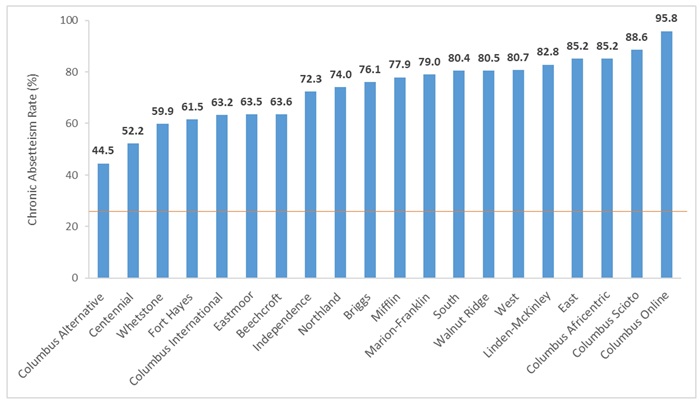
As they consider transportation changes, district leaders should consider the attendance crisis rolling through the city's schools. Figure 1 shows the chronic absenteeism rates of Columbus high schools during the 2024–25 school year. Every high school save one reported that more than half their students were chronically absent. Rates top 70 percent in most of the schools. Such astronomical numbers easily double the statewide absenteeism rate and exceed the districtwide chronic absenteeism rate of 52.6 percent (for all K–12).

Figure 1: Chronic absenteeism rates at Columbus City Schools’ high schools, 2024–25

CCS transportation blog figure 1
Source: Ohio Department of Education and Workforce. Note: The orange line represents the statewide average chronic absenteeism rate of 25.1 percent across all grades. Students are deemed “chronically absent” when they are absent at least 10 percent of the school year—equivalent to missing almost four weeks of school.

Chronic absenteeism is linked to academic problems, which also happen to be widespread in Columbus high schools. Last year, only 22 percent of district students achieved proficiency on the state Algebra I exam, and even fewer did so in geometry (13 percent). Just one in three scored proficient on the state’s high school English exam. Less than one in ten Columbus students met Ohio’s college remediation-free benchmarks on the ACT or SAT.

District leadership has argued that cutting bus routes would allow it to devote more funds towards classroom instruction. That’s a nice thought, and Columbus should be exploring ways to drive dollars into classrooms, including pay raises for its most effective teachers. But it’s also hard to move the achievement needle when students are MIA. Even the best teacher, with a world-class curriculum in hand, will struggle to deliver solid outcomes when attendance is poor. Worsening attendance might also require more high-cost remediation and intervention programs, additional expenses that could easily swamp the savings associated with cutting bus routes.

There are surely other expenditures more deserving of cuts than transportation. That might include an afterschool or tutoring program that is poorly attended or ineffectual. Professional development that does little to sharpen teachers’ skills. Overly generous benefits. Closing half-empty schools. Or cutting administrative fluff. (Columbus had 388 administrators in 2024—25 percent more than a decade ago—even though district enrollment declined by 15 percent over this period.) Meanwhile, district officials should also consider discontinuing programs paid for by its roughly $500 million in federal emergency Covid funds. The expiration of these one-time dollars is likely contributing to its current budget woes.[1] Transportation shouldn’t be a casualty in efforts to revert to pre-pandemic budgetary norms.

Providing reliable transportation is one tool in the ongoing battle against chronic absenteeism—and its harmful impacts on academic performance. Families and students, including high schoolers, count on school districts for busing. When that doesn’t happen, it’s too easy for students to give up on getting to school and stay home instead. Lack of school-provided busing also raises questions about safety getting to and from school (will students have to walk through dangerous neighborhoods or resort to risky ridesharing?). It could also increase students’ commute times and cause headaches for public transit systems, if Columbus decides to rely on COTA for transportation.

Transportation should be a priority in school budgets, not just in Columbus, but other districts, as well. Ohio sends hundreds of millions to districts to help cover the expense, as do local funds in our shared funding model. Columbus should do the right thing and ensure that all students receive busing service. If it doesn’t, lawmakers should consider adding a requirement for high school transportation (at least in districts with high absenteeism). When students aren’t in school, they won’t learn much. Let’s make sure every student who needs a ride gets one.


[1] Columbus City Schools’ local funding increased by $82 million from FY22 to FY25, and its state revenues increased by $12 million during this same period.

view
Gratitude blog image

A time for gratitude

Chad L. Aldis
11.26.2025
Ohio Gadfly Daily

As we approach Thanksgiving, it’s fitting to pause and reflect on the past year—to take stock not only of the challenges we face but also of the progress being made and the people working tirelessly to improve education across our state.

At the Fordham Institute, we spend much of our time pointing out weaknesses in Ohio’s education system—lagging math achievement, uneven reading results, and troubling rates of chronic absenteeism. These realities can be discouraging. Yet this time of year offers a reminder that there’s also much to be thankful for—evidence of commitment, collaboration, and persistence that should give us hope for what’s ahead.

A continued commitment to literacy and the science of reading

Governor DeWine and Director of Education and Workforce Dackin deserve tremendous credit for their steadfast focus on literacy and the science of reading. Ohio’s most recent report card results remind us that far too many students still struggle to read proficiently—only 61 percent of third graders reached proficiency in 2024–25. Yet unlike in years past when research-backed reforms were rolled back when there was a small bump in the road, the administration laudably doubled down after this year’s report card making clear that, “Literacy remains a top priority.”

The DeWine team has implemented a strong, research-based literacy framework: from approving high-quality reading curricula to providing $169 million for teacher training and literacy coaches to requiring teacher-prep audits to ensure future educators are ready to deliver evidence-based instruction. It’s an enormous task, and implementation will take time. But the direction is right, and the resolve is unwavering. For that, I’m thankful.

Renewed focus on math achievement

Math achievement has recovered more slowly post-pandemic in Ohio than reading has, but there’s fresh reason for optimism. Just last week, the Ohio Senate unanimously passed Senate Bill 19, a bipartisan effort to strengthen math education across the state.

The bill represents a comprehensive approach—one that supports struggling learners while also ensuring advanced students are pushed to reach their full potential. Senate Education Chair Andy Brenner deserves recognition for championing this work and crafting legislation that brought every senator on board. In today’s polarized environment, bipartisan cooperation on behalf of kids is no small feat.

This focus on math—and on ensuring all students have access to rigorous, well-taught content—is something to celebrate.

Expanding career-connected learning

Another bright spot in Ohio education has been the sustained effort to strengthen career-connected learning. From a continued commitment to support incentive funding for in-demand credentials to a reexamination of how those credentials count toward graduation, the state continues to take steps that help young people prepare for meaningful careers.

Senator Kyle Koehler’s recently introduced Senate Bill 328 would strengthen career exploration in middle school, bolster career planning supports, and improve our ability to measure the return on investment for career education programs. These efforts reflect a recognition that success after high school can take many forms—and that Ohio’s education system should empower all students to find pathways that fit their interests and strengths.

Cutting red tape to empower educators

Finally, there’s encouraging movement on an issue that rarely makes headlines but matters immensely: regulation. The Ohio House’s unanimous passage of House Bill 455 (sponsored by Representatives Manning and Bird), which reduces unnecessary mandates on public schools, signals a growing understanding that educators need space to teach, not more bureaucracy.

When lawmakers from both parties come together to streamline rules and keep the focus on outcomes rather than micromanaging every detail, that’s a win for schools and students alike. It’s also a reminder that progress often comes from quiet, bipartisan efforts to make the system work better for those on the front lines.

Looking ahead with gratitude

So yes, there are plenty of reasons to be concerned about where Ohio stands, but there’s also reason for gratitude. I’m thankful for state leaders who continue to prioritize literacy, for legislators who see the value in improving math instruction and expanding career readiness, and for the countless educators who make these reforms real every day.

At Fordham, we’ll keep doing what we’ve always done: holding systems accountable, analyzing what works, and advocating for policies that help every child reach their potential. But as Thanksgiving approaches, I’m also taking a moment to simply say thank you to the many Ohioans striving, often behind the scenes, to make our schools stronger and our students’ futures brighter.

Happy Thanksgiving.

view
Walking up steps

Assessing students’ academic mobility via test-based and non-test-based outcomes

Jeff Murray
12.4.2025
Flypaper

There is a widely-held belief that the foremost mission of American public education is to provide a pathway to success for every student, including those who face considerable life obstacles. However, persistent achievement gaps along dimensions of race, income, family education level, and other factors challenge the truth—or at least the practicality—of this conviction. Research, including from Fordham, has shown that these gaps often form early and are persistent or even widen over time. A new CALDER working paper looks at both test-based and non-test-based high school outcomes for a population of third grade students in an effort to locate evidence that initially-low-performing students have the ability to rise.

The longitudinal student-level data for this study come from Washington State, comprising more than 581,000 unique students who entered third grade from 2006 to 2013. These students were followed through 12th grade—the latest cohort reached that milestone in 2022—with data focusing on outcomes such as math and English language arts test scores, college-level course-taking while in high school, absences, disciplinary incidents, GPA, and high school graduation. To keep their analysis consistent, the researchers make a number of adjustments to the wide swath of data to account for changes in testing regimes and for students who come into and out of the various cohorts over time.

“Academic mobility” is defined as how much a student’s rank in the distribution of academic (and non-academic) performance changes during their time in school. An education system with high academic mobility would be one where students’ early-grade ranks are less predictive of their later-grade ranks; one with low academic mobility would see students locked into their early-grade ranks for their entire school career.

The researchers find low evidence of mobility in their sample. Higher performance on third or eighth grade assessments strongly predicts better high school outcomes, including test scores, GPAs, college-level course-taking (in both math and ELA), and graduation rates. Higher performance on these exams also predicts lower rates of absenteeism and disciplinary incidents. And the corollary for low initial performance is true as well. Early achievement in math is even more predictive of high school outcomes than early achievement in ELA, and third grade achievement overall is more predictive than eighth grade achievement, indicating that potential for academic mobility—or lack thereof—sets in early without much capacity for change.

That’s not to say that some students don’t exhibit upward academic mobility after a slow start in third grade. On average, students who score at the 25th percentile of their third grade test score distribution move up to the 31st percentile by high school. But those same students also experience varying degrees of downward mobility in the non-test-based outcomes of college-level course-taking, absenteeism, and disciplinary incidents. Asian students are generally the most upwardly mobile racial/ethnic group, and Black males are generally the least mobile. Gender gaps also vary in size but almost always favor females, regardless of student group or outcome.

The authors point out that there is a missing counterfactual here (“we do not know what achievement would look like in the absence of any existing interventions”), but nonetheless conclude that “five years of elementary and middle school experiences and interventions”—whatever they are in this context—“do little to substantially shift the educational trajectories of students who begin school with low achievement” at third grade. This is bleak and challenges the belief that schools can provide a pathway to success for every student. But it is vital information to know. The road to a student’s ultimate academic outcome begins early, and lowtest scores by third grade should be a clarion call to do everything possible to give those students the best chance of moving up.

SOURCE: Dan Goldhaber, Stephanie Liddle, and Suvekshya Gautam, “Assessing the Academic Mobility on Test and Non-Test Outcomes for Students from Third Grade Through High School,” CALDER Working Paper (November 2025).

view
Chad Aldis Testimony on SB 19 image

Testimony provided on Senate Bill 19—11/18/25

Chad L. Aldis
11.18.2025
Ohio Gadfly Daily

Today, the Ohio Senate Education Committee heard testimony on Senate Bill 19 which aims to establish academic intervention services at public schools and to implement mathematics improvement and intervention plans. Fordham’s vice president for Ohio policy submitted the following testimony in favor of the bill.

Thank you for the opportunity to provide written testimony in support of Senate Bill 19.

At the outset, I want to thank Chair Brenner for his tireless leadership in confronting what can only be described as Ohio’s math crisis. His focus on numeracy—an area too often overshadowed by reading policy—reflects a deep understanding that a strong foundation in mathematics is essential to both our students’ and our state’s future.

The Scope of Ohio’s Math Challenge

Despite recent academic gains, Ohio remains well below pre-pandemic achievement in both reading and math. As Fordham’s recent analyses show, math proficiency remains 5.7 percentage points below 2019 levels, with only 55.3 percent of students proficient (on grade level) statewide.

Statewide proficiency rates in math and reading, 2018–19 (pre-pandemic) to 2024–25

Chad Aldis Testimony on Senate Bill 19 chart


These gaps aren’t just academic—they’re economic. Employers consistently cite quantitative reasoning and problem-solving as top skills for the modern workforce. Whether a student aspires to be a nurse, electrician, or software developer, math is a gatekeeper to opportunity. Without stronger math achievement, Ohio risks leaving a generation of students—and the state’s economic future—behind.

How Senate Bill 19 Addresses the Crisis

Senate Bill 19 takes a systematic, evidence-based approach to improving math outcomes that—if implemented robustly—has the potential to boost math achievement. It includes:

1. Academic Intervention and Monitoring

The bill requires schools to identify and support students scoring “limited” in math or English language arts, providing evidence-based interventions at no cost. This includes high-dosage tutoring, extended learning time, and other targeted supports.

2. Math Improvement Plans for Students and Districts

Beginning in the 2026–27 school year, each struggling student must receive a Math Improvement and Monitoring Plan, developed collaboratively with parents and teachers. Additionally, districts where fewer than 51 percent of students score proficient on the third-grade math assessment must create a Math Achievement Improvement Plan, ensuring leadership-level accountability and strategic intervention.

3. Statewide Oversight and Transparency

SB 19 strengthens state oversight by requiring the Department of Education and Workforce (DEW) to audit 5 percent of schools annually, reviewing the quality and fidelity of intervention programs. These findings will appear on public report cards—providing families and taxpayers with greater transparency.

4. High-Quality Math Curriculum and Instructional Materials

In one of the bill’s most significant provisions, DEW will review core math curricula and publish a list of high-quality, standards-aligned instructional materials by April 2026. Schools’ use of these materials will be publicly reported on state report cards.

5. Strengthening the Teaching Profession

SB 19 recognizes that great instruction begins with great teachers. It calls for new math proficiency assessments for early-grade teacher candidates and state-developed professional development programs focused on evidence-based math instruction. These steps ensure educators have both the content knowledge and tools to deliver high-quality math lessons.

6. Opportunities for Advanced Learners

Finally, the bill opens new doors for high-achieving students by requiring that students who score accomplished or advanced in math on the state assessment be automatically placed in accelerated math or Algebra I courses, with a parental opt-out. This provision ensures that excellence is nurtured, not neglected—a crucial step in closing both the lower and upper ends of Ohio’s achievement gaps.

Why This Matters: Ohio’s Path Forward

Ohio has taken strides to improve literacy through the Science of Reading reforms. But as Fordham has repeatedly emphasized, we must now apply that same urgency to math. The bill reflects a clear understanding that strong math achievement is not optional in today’s economy. It is the foundation for innovation, progress, and workforce readiness. Students who can think mathematically will not only succeed in college but also thrive in trades, technology, and countless real-world applications.

Conclusion

In short, Senate Bill 19 is both timely and essential. It creates a coherent, statewide strategy for improving math outcomes—built on evidence, transparency, and accountability. Most importantly, it affirms that every Ohio student, regardless of ZIP code, deserves access to rigorous math instruction and the opportunity to succeed.

Chair Brenner and members of the Committee, thank you for your leadership in confronting this urgent challenge. The Fordham Institute strongly supports Senate Bill 19, and we urge its swift passage.

Fordham Logo

© 2026 The Thomas B. Fordham Institute
Privacy Policy
Usage Agreement

National

P.O. Box 110
Burke, VA 22009

202.223.5452

[email protected]

Ohio

P.O. Box 82291
Columbus, OH 43202

614.223.1580

[email protected]

Sponsorship

130 West Second Street, Suite 410
Dayton, Ohio 45402

937.227.3368

[email protected]