During his two terms in office, Governor DeWine has prioritized expanding and improving career pathways. Under his leadership, Ohio has established initiatives like TechCred, the High School Tech Internship Program, the Innovative Workforce Incentive Program, and the Industry Sector Partnership Grant. The Department of Education and Workforce launched a communications campaign designed to provide students and families with better information about career-technical education (CTE) opportunities. And in 2023, DeWine persuaded the legislature to invest hundreds of millions to strengthen and expand access to CTE.
In short, it’s been a busy few years for career-connected learning in the Buckeye State. But will that progress continue? Next fall, Ohioans will vote for a new governor—one who will have to decide if and how to sustain DeWine’s efforts.
A recent nationwide poll of registered voters[1] indicates that maintaining and expanding these efforts has significant public support. Let’s take a closer look at three key takeaways that candidates—gubernatorial and otherwise—should keep in mind as they craft their policy agendas.
1. Voters believe that better preparing students should be a top priority.
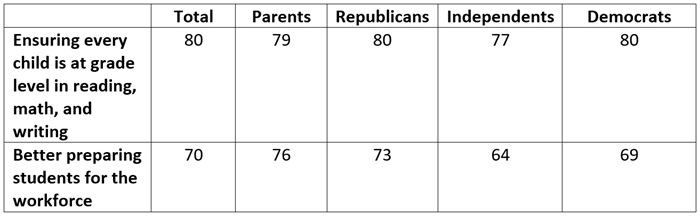
When asked how to improve education in their state, 70 percent of voters said that better preparing students for the workforce should be a “very important” priority. The only option to receive a larger share of support was ensuring that every child performs at grade level in reading, math, and writing, while improving school safety registered as equally important to workforce preparation. Collectively, these results suggest that a strong majority of voters would approve of efforts to improve student preparedness. Parents, in particular, would be supportive, as more than three-fourths of those surveyed (76 percent) rated better preparing students for the workforce as very important. These priorities are also bipartisan, as they have significant support across the political spectrum.
Table 1. Percentage of voters who believe that student preparedness should be a top priority
2. Voters want students to have access to career-connected learning.
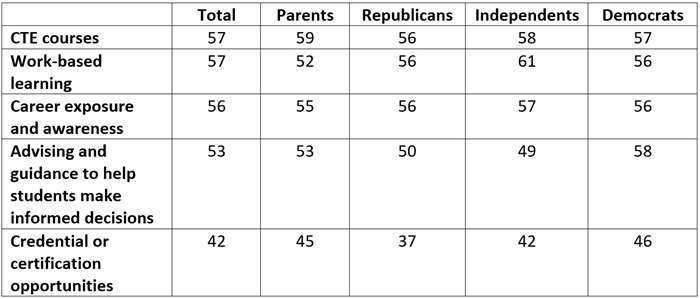
A majority of voters across the political spectrum believe students should have access to career-connected learning opportunities. Table 2 identifies several options and their levels of support. The most popular are CTE courses and work-based learning, both of which clock in at 57 percent overall. Career exposure and awareness isn’t far behind at 56 percent. Meanwhile, credential or certification opportunities have the least amount of support—perhaps a sign that efforts to improve how Ohio identifies credential value are crucial.
Table 2. Percentage of voters who believe students should have access to career-connected learning opportunities
3. Voters value individualized career planning.
According to poll results, there’s overwhelming support for ensuring that every student has “a path and plan that prepares them with the academics and job skills they need for careers.” A whopping 86 percent of voters approve of the path-and-plan idea, with 52 percent indicating that they strongly support it. These sky-high numbers offer ample proof that DeWine was on the right track with his career planning proposal, despite lawmakers failing to include it in the final version of the recent state budget. Ohio’s next governor would be wise to pick up where DeWine left off.
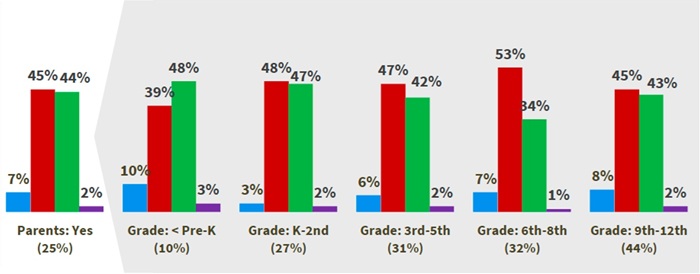
Candidates should also consider calling for career exploration and planning efforts to begin in middle school. Poll results indicate that 47 percent of voters believe that career exploration programming should begin in high school, compared to 40 percent in middle school. But Chart 1 indicates that parents—who are arguably the most invested in kids being prepared—are more supportive of starting in middle school. The parents of middle school students, in particular, seem to recognize the value of offering programming earlier.
Chart 1. When parents believe career exploration programming should begin
***
A hallmark of the DeWine administration has been its emphasis on career pathways. As a result, Ohio has established several promising policies aimed at expanding and improving career-connected learning. Building on those efforts will help kids—and recent polling indicates it’s popular with voters, too. Here’s hoping Ohio policymakers seize the opportunity.
[1] The poll is a national survey of 1,015 registered voters conducted by UpONE Insights and Impact Research between August 21-27.