Mobile Navigation

  • National
    • Policy
      • High Expectations
      • Quality Choices
      • Personalized Pathways
    • Research
    • Commentary
      • Gadfly Newsletter
      • Flypaper Blog
    • Events
    • Scholars Program
  • Ohio
    • Policy
      • Priorities
      • Media & Testimony
    • Research
    • Commentary
      • Ohio Education Gadfly Biweekly
      • Ohio Gadfly Daily
  • Charter Authorizing
    • Application
    • Sponsored Schools
    • Resources
  • About
    • Mission
    • Board
    • Staff
    • Career
Home
Home
Advancing Educational Excellence

Main Navigation

  • National
  • Ohio
  • Charter Authorizing
  • About

Ohio Menu

  • Topics
    • Accountability & Testing
    • Advanced Education
    • Career & Technical Education
    • Charter Schools
    • Curriculum & Instruction
    • ESSA
    • Evidence-Based Learning
    • Governance
    • Personalized Learning
    • Private School Choice
    • School Finance
    • Standards
    • Teachers & School Leaders
  • Research
  • Policy
  • Commentary
    • Ohio Gadfly Newsletter
    • Ohio Gadfly Blog
    • Events

The Education Gadfly Weekly

Sign Up to Receive Fordham Updates

We'll send you quality research, commentary, analysis, and news on the education issues you care about.
Thank you for signing up!
Please check your email to confirm the subscription.

Ohio Gadfly Biweekly—Special state budget edition

Volume 15, Number 6
3.3.2021
3.3.2021

Ohio Gadfly Biweekly—Special state budget edition

Volume 15, Number 6
view
Charters in the budget blog image
School Choice

Four ways to make charter schools a priority in the state budget

It’s state budget time in Ohio, and as experts like to remind us, budgets reflect priorities. In the area of K–12 education, legislators should maintain a focus on empowering parents to take more control of their kids’ education and improving the educational outcomes of less advantaged students.

Aaron Churchill 3.3.2021
OhioOhio Gadfly Daily

Four ways to make charter schools a priority in the state budget

Aaron Churchill
3.3.2021
Ohio Gadfly Daily

How industry-recognized credentials are prioritized in Governor DeWine’s budget

Jessica Poiner
3.11.2021
Ohio Gadfly Daily

Budget bill tackles transportation for choice students

Jessica Poiner
3.5.2021
Ohio Gadfly Daily

Testimony given before the House Finance Committee on HB 110

Chad L. Aldis
3.11.2021
Ohio Gadfly Daily
view
IRCs in the budget blog image

How industry-recognized credentials are prioritized in Governor DeWine’s budget

Jessica Poiner 3.11.2021
Ohio Gadfly Daily
view
Budget tackles transportation blog image

Budget bill tackles transportation for choice students

Jessica Poiner 3.5.2021
Ohio Gadfly Daily
view
Testimony on HB 110

Testimony given before the House Finance Committee on HB 110

Chad L. Aldis 3.11.2021
Ohio Gadfly Daily
view
Charters in the budget blog image

Four ways to make charter schools a priority in the state budget

Aaron Churchill
3.3.2021
Ohio Gadfly Daily

It’s state budget time in Ohio, and as experts like to remind us, budgets reflect priorities. In the area of K–12 education, legislators should maintain a focus on empowering parents to take more control of their kids’ education and improving the educational outcomes of less advantaged students.

On both counts, public charter schools—also known as “community schools”—are answering the call. In terms of meeting parent needs, these independently-run, tuition-free schools have long offered choices that allow families to find a school that works for them. Some have benefitted from specially designed charters that tap into students’ artistic talents or nurture their academic gifts. For others, a charter school has meant a fresh start after rocky experiences in their local district.

Due to longstanding geographic restrictions, Ohio charters serve predominately disadvantaged students. And there is clear evidence that they’re getting results. A study by CREDO found that Black students fare better when they attend an Ohio charter school (as opposed to a district school). Likewise, a more recent report by Ohio State University professor Stéphane Lavertu estimated that the average Black student moves from the 25th to 40th percentile in statewide achievement by attending a brick-and-mortar charter in grades four through eight.

Despite these undeniable benefits, charters are still treated like second-class schools. Ohio’s urban charters receive on average about $4,000 per student less funding than urban traditional districts. The disparity is driven by charters’ lack of access to local tax revenues—which account for on average just over 40 percent of district funding—and the state’s decision not to fill the hole. These funding gaps are problematic in two ways. First, they violate the basic principle of equity. Students of similar backgrounds should be funded at comparable levels, but charters receive far less than their district counterparts to educate the same child. Second, these gaps disadvantage charters in retaining talented teachers, providing essential supports, and ensuring students learn in properly-equipped school buildings.

What can state legislators do to rectify these problems and more fully leverage the charter model to meet parent and student needs? Here are four ideas.

  1. Make the Quality Community School Support Fund permanent. In 2019, Governor DeWine proposed and shepherded through the legislature a new funding stream that supports high-performing charters. During FYs 2020–21, this $30 million per year program provided up to $1,750 per economically disadvantaged student to roughly a quarter of Ohio’s best charter schools. Given the budgetary constraints facing charters, these extra funds are vital to increasing their capacity to scale and serve more students. The governor’s FY 2022–23 budget rightly reauthorizes this program. Legislators should not only approve these funds, but go one step further by making it part of the permanent charter school formula (rather than funding it as a standalone appropriation). 
     
  2. Treat charters fairly in the state funding formula. The current funding formula provides charters with full base amounts in the major components of the formula. For instance, recognizing that charters have no local tax authority, Ohio allots the entire $6,020 per student base amount for their Opportunity Grant—the component that delivers the bulk of state funding to both districts and charters. Even though charters receive full base funding, they still miss out on tens of millions in local revenues. Legislators could narrow funding gaps by setting charters’ base amounts somewhat above districts, or by including a multiplier that applies only to charters. What legislators shouldn’t do is treat charters as inferior, as is the case for House Bill 1—a House rewrite of the school funding formula. Under that proposal, charter schools would receive 10 percent less funding in three of the cost components that determine base amounts. Policies such as these would widen funding gaps, not narrow them.
     
  3. Provide adequate resources for school facilities. As several reports have documented, Ohio charters face an uphill battle securing suitable facilities. Their challenges are rooted in policies that shut charters out of the state’s main school construction program, deny them a share of local capital improvement levies, allow districts to withhold underutilized buildings, and provide them with inadequate facility specific funding. Legislators should pursue various policy avenues to better meet facility needs. First off, they should significantly increase the Community Schools Facilities allowance that currently provides a modest $250 per student—well below annual facility costs. Legislators should also invest in solutions that address capital needs on a broader scale, such as allowing charters to tap state construction dollars. Lastly, legislators should consider programs that lower the cost of debt through “credit enhancement,” as other states have done.

  4. Ensure local tax dollars follow students to their school. Courageous lawmakers could get to the root of the problem—charters’ lack of local funding—and require local tax revenues to follow students to public charter schools. This would adhere to the principle that funds—yes, all funds—should follow students to the schools they actually attend. It would also be fairer to charter school parents who pay local taxes, whether directly or through rent. To be sure, this would be a heavy political lift and likely require technical changes to the state’s charter funding model (to account for newfound local revenues). But a true “fair funding” plan for all public school students—and their parents—would guarantee that dollars from every level of government follow students to the school they attend. 

***

Ohio legislators should be laser focused on empowering parents and accelerating learning for needy students. By further leveraging the proven power of the charter school model, Ohio will take strides in creating a more student- and parent-centered system of public schools.

view
IRCs in the budget blog image

How industry-recognized credentials are prioritized in Governor DeWine’s budget

Jessica Poiner
3.11.2021
Ohio Gadfly Daily

Improving the technical skills of Ohioans to meet changing workforce demands has been a priority for Governor DeWine since taking office in 2019. During his first budget, he introduced several policies aligned with this goal, including a statewide initiative aimed at helping businesses upskill current and potential employees, as well as funding to help high schoolers earn industry-recognized credentials (IRCs).

The governor’s second budget proposal is now before the House. It follows in the footsteps of its predecessor by prioritizing credentials in both familiar and new ways. Here’s a look at three of the proposals.

Credentials and graduation requirements

During the last budget cycle, the General Assembly enshrined a new set of graduation requirements into law. As part of these requirements, students in the class of 2023 and beyond who do not achieve a competency score on algebra I and English II end-of-course exams can demonstrate their readiness in other ways.

One way is by earning an IRC and meeting other workforce-related criteria. The state maintains a list of credentials that high school students can earn, and assigns them point values ranging from one to twelve. For example, the health care field includes dozens of options. Some of them—such as CPR First Aid—are valuable but don’t necessarily give students a leg up in the workforce, so they’re worth only one point. Others—such as the Phlebotomy Technician Certification—are more rigorous and tied more directly to a career pathway, so they’re worth the maximum twelve points.

Under previous graduation requirements, students could earn a diploma by obtaining a credential, or a group of credentials in the same career field, worth twelve points. The new graduation standards put in place during the last budget cycle, however, were interpreted to mean that students must earn a single, twelve-point credential. The governor’s proposed budget seeks to clarify the requirements and allow students to earn a group of credentials that add up to the twelve points needed for graduation. The budget would also permit students to earn a group of credentials as part of their graduation seals, a separate requirement under the new standards. Both changes should help clarify the state’s expectations and provide students with more options.

IRC funding targeted at high schools

The budget also sets aside money to support the attainment of IRCs. It does this in a couple ways. First, schools whose students earn an IRC or a journeyman certificate recognized by the U.S. Department of Labor can apply for reimbursements that cover the costs of these programs. Schools have up to six months after the student graduates to seek payment, and the budget allocates $8 million each year for this purpose. The budget also incentivizes high schools to offer additional credential opportunities through the Innovative Workforce Incentive Program. This program was originally created in the previous budget, but wasn’t officially established thanks to the Covid-19 pandemic and resulting budget cuts. Now, the state is giving it another go. Under the proposed budget, the Ohio Department of Education and the Governor’s Office of Workforce Transformation would be permitted to use up to $12.5 million each year to establish and operate the program. Schools would be paid $1,250 for each qualifying credential that students earn in the school year preceding the fiscal year. The state is responsible for establishing a list of credentials that qualify, and funds will be prorated if demand exceeds the appropriated amount.

TechCred

TechCred was created and funded in the previous state budget. It was designed to help Ohioans earn technology-focused credentials and help businesses upskill both current and potential employees. Over the last two years, the program has proved immensely popular. More than 900 different Ohio employers were awarded funding during the initial five application periods, resulting in 11,941 credentials earned. It’s not much of a surprise, then, that the governor opted to keep it. The executive budget allocates $25 million in both fiscal years 2022 and 2023. These funds would be enough to support a whopping 45,000 credentials.

***

Governor DeWine’s focus on credentials isn’t surprising, given his interest in improving the technical skills of Ohio’s current and future workforce. But it’s praiseworthy to see his office continuing its commitment to career-technical education and workforce development. It’s in Ohio’s best interest to help high schoolers earn meaningful credentials, encourage businesses to upskill their workers, and empower job seekers with more and better training. Fortunately, the proposed budget does all three.

view
Budget tackles transportation blog image

Budget bill tackles transportation for choice students

Jessica Poiner
3.5.2021
Ohio Gadfly Daily

The relationship between traditional public schools and schools of choice—both charter and private—is often strained in Ohio. One of the most consistent sources of tension is transportation. State law requires traditional public districts to transport not only their own K–8 students, but also those who attend charter or private schools (and provides the funds to do so). They are not required to transport high school students.

Districts have been trying to change these laws for years. They’ve been unsuccessful thus far, but much like they’ve done with the right-of-first-refusal law that requires them to offer unused facilities to charter schools prior to selling them to developers, they’ve found plenty of workarounds to avoid transporting charter and private school students.

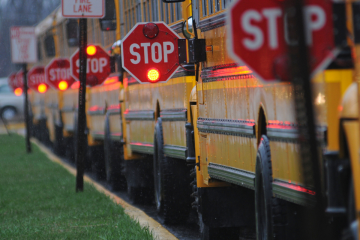
Consider Dayton Public Schools (DPS). In 2019, the district decided to provide its high schoolers with city bus passes in an attempt to improve attendance. When attendance numbers didn’t go up within a year, though, the board voted to scrap that policy and provide DPS high schoolers with the same yellow bus transportation as their younger peers. To make room for this sudden influx of students—and to maintain their contract with the area’s Rapid Transit Authority—DPS planned to force K–8 students who attended charter and private schools to ride city buses. District officials didn’t discuss this change with those schools’ leaders prior to voting on it, and they waited so long to announce the change that they prevented the schools from finding a safer transportation alternative for their elementary-aged children.

DPS has a history of disastrous transportation policies, so this latest kerfuffle isn’t exactly surprising. What is surprising, though, is that it might have a serious impact on statewide school choice transportation policies for years to come. The recently proposed budget includes several provisions aimed at preventing issues like those that cropped up in Dayton. Here’s a look at three of the most significant.

Limiting the use of mass transit

In what appears to be a direct response to the Dayton debacle, the proposed budget would prohibit districts from using a mass transit system to transport K–8 students who attend charter or private schools unless the students’ school willingly enters into an agreement with the district. To preempt any potential loopholes, the budget explicitly states that the agreement is “not effective” unless the school of choice approves it. Districts are permitted, with some stipulations, to use mass transit to get high schoolers to and from school, but that was never the issue. For charter and private school leaders, the issue was forcing their youngest students to ride city buses with the general public. This provision would prevent that. 

Transportation plans

One of the reasons transportation is a sticking point between districts and schools of choice is that coordinating logistics is hard to do across sectors. The proposed budget attempts to fix this by mandating the creation of transportation plans. Charters and private schools would be required to establish their school day start and end times by June 1, and then communicate those times to the district. Districts would then use this information to develop transportation plans for students no later than July 1. Plans must include routes and schedules, and must ensure that students arrive to school no more than one hour before the start time and are picked up no later than one hour after the end time. There doesn’t appear to be anything that prevents districts from changing these plans after the deadline, but that’s probably wise given that student transportation requires a certain level of flexibility.

The budget language also includes an exception for districts that have twenty or more charter or private schools operating within their boundaries. In such cases, a designated ESC—either the ESC the district has a contract with or the one with the most territory in the district’s county—would be required to convene a meeting between the district and all charter and private schools and approve a plan no later than July 15.    

Overall, these provisions address several issues. First, by providing a deadline by which routes and schedules must be set, the plans could help prevent last-minute changes that leave parents and school leaders scrambling. Second, they force district, charter, and private school leaders to actually work together. Finally, the requirement for districts with sizeable school choice sectors to work with ESCs should lessen the bureaucratic burden placed on large districts and provide all sides with a (hopefully) objective third party to oversee the process.

Monitoring compliance

None of these provisions matter if there’s no way to enforce them. The budget tackles that issue, too, and requires the Ohio Department of Education to monitor districts’ compliance with all of the major transportation changes included in the budget bill. If department officials determine that a district has been in “a consistent or prolonged period of noncompliance,” then state officials can deduct transportation funding from the district as a penalty. The deduction would equal the total daily amount of the district’s payments for student transportation and would include each day the district is not in compliance. This oversight mechanism should ensure that districts follow the law rather than search for workarounds.

***

The provisions included in the proposed budget won’t fix everything that ails school choice transportation in Ohio. But they are a positive step forward that would ensure students who attend charter and private schools don’t get the short end of the stick when it comes to school transportation.

view
Testimony on HB 110

Testimony given before the House Finance Committee on HB 110

Chad L. Aldis
3.11.2021
Ohio Gadfly Daily

NOTE: On Thursday, March 11, 2021, members of the House Finance Committee heard testimony on House Bill 110, legislation creating state’s next biennial budget. Chad L. Aldis, Fordham’s Vice President for Ohio Policy, gave interested party testimony before the committee on a number of important education provisions in the bill. These are his written remarks.

Thank you Chair Oelslager, Vice Chair Plummer, Ranking Member Crawley, and House Finance Committee members for giving me the opportunity today to provide interested party testimony today on House Bill 110.

My name is Chad Aldis, and I am the Vice President for Ohio Policy at the Thomas B. Fordham Institute. The Fordham Institute is an education-focused nonprofit that conducts research, analysis, and policy advocacy with offices in Columbus, Dayton, and Washington, D.C. Our Dayton office, through the affiliated Thomas B. Fordham Foundation, is also a charter school sponsor.

HB 110, at least as it pertains to education, is a bit unusual for a budget bill in that it isn’t filled with hundreds of policy changes. We salute Governor DeWine for taking this step and urge you to follow his lead.

Nevertheless, HB 110 still makes a number of significant changes. In the interest of brevity, I’ll offer praise or raise concerns on a few issues without going into too much detail.

School funding formula

Governor DeWine did not propose a new school funding formula in HB 110. Instead, he proposed continued funding at FY19 levels for another two years. Given the work that this chamber and your colleagues in the Senate have done on school funding, the governor’s deference makes sense. I’m optimistic and hopeful that you’ll reach a positive result on school funding before June 30 as schools need to be funded based on the students they’re serving and not through the current hodgepodge of caps and guarantees. We’d urge you to incorporate HB 1 into this bill before passage. To be clear, while we support many of the principles encompassed in HB 1, we think that it can still be improved. My testimony to Chair Richardson’s subcommittee last week reflects what we believe to be the bill’s strengths and weaknesses. I won’t repeat that for this committee but would be happy to expound further if there are questions.

Quality community school support fund

Governor DeWine’s budget increased spending for this important initiative from $30-million-per-year this biennium to $54 million per year in FY 22 and FY 23. We urge to retain this important program that provides up to an additional $1,750 per economically disadvantaged student to charters that qualify based on academic performance. These dollars help narrow funding gaps, provide extra resources that enable charters to serve more students, and make Ohio a more attractive locale for excellent national charter networks. We also encourage you to shift this from a line-item appropriation and include it in permanent law with direct funding from the state.

Transportation for charter and private school students

HB 110 makes a host of changes regarding district transportation of charter and private school students. We support the governor’s recommendations. Everyone knows that transporting students across a city isn’t easy, but over the last couple of years a number of districts (even pre-pandemic) started breaking from their long-recognized responsibility to transport choice students. HB 110 would directly address many of the most troubling issues including placing limits on the use of mass transit for our youngest students, requiring the development of transportation plans each year, providing additional time for choice schools to opt to provide their own transportation, and putting teeth in the law when a district—however rarely—acts in bad faith.

Graduation requirements

After many years of debate, the legislature passed new less test-focused graduation requirements last year. The requirements were the result of a coming together of a variety of groups and represented a smart compromise. HB 110 makes a number of clarifying changes to the graduation requirements and most are okay. However, the changes around graduation seals would be a huge setback.

As a quick refresher, to earn a diploma, students now need to do three things: complete state required courses, show competency in math and English, and earn two seals from 12 options that show mastery or deeper engagement in a specific area. The bill modifies the citizenship and science seals to give them to any student who simply passes a class in the subject area with a B or better. Currently, a student needs to pass an EOC, AP, or IB exam (or pass a College Credit Plus course) to demonstrate a deeper learning of government or science. By awarding a seal for passing required classes, HB 110 would eviscerate any potential benefit seals were supposed to have. It would be preferable to simply eliminate the seals requirement and the accompanying bureaucracy altogether than to make them meaningless.

FAFSA as a graduation requirement

HB 110 makes a variety of changes to encourage and facilitate higher FAFSA completion rates. These are well-intentioned, and we support the underlying efforts. Many high school students incorrectly believe that education post high school is beyond their financial reach. This is often not the case, and if federal discussions around increasing the size of the Pell Grant come to fruition—it could be even less true. The biggest nudge to increase FAFSA completion is making it a graduation requirement. Judging by the experience in other states, this can dramatically increase completion rates. HB 110 contains some exemptions if parents refuse or are unavailable to complete the forms. These are important, so we’d urge to keep these in the bill for families who—despite the nudge being provided by the state—choose to keep their finances private. The goal, after all, is for the FAFSA requirement to open doors to higher education and not be a barrier to high school graduation.

Thank you for the opportunity to provide testimony on HB 110.

Fordham Logo

© 2026 The Thomas B. Fordham Institute
Privacy Policy
Usage Agreement

National

P.O. Box 110
Burke, VA 22009

202.223.5452

[email protected]

Ohio

P.O. Box 82291
Columbus, OH 43202

614.223.1580

[email protected]

Sponsorship

130 West Second Street, Suite 410
Dayton, Ohio 45402

937.227.3368

[email protected]