Mobile Navigation

  • National
    • Policy
      • High Expectations
      • Quality Choices
      • Personalized Pathways
    • Research
    • Commentary
      • Gadfly Newsletter
      • Flypaper Blog
    • Events
    • Scholars Program
  • Ohio
    • Policy
      • Priorities
      • Media & Testimony
    • Research
    • Commentary
      • Ohio Education Gadfly Biweekly
      • Ohio Gadfly Daily
  • Charter Authorizing
    • Application
    • Sponsored Schools
    • Resources
  • About
    • Mission
    • Board
    • Staff
    • Career
Home
Home
Advancing Educational Excellence

Main Navigation

  • National
  • Ohio
  • Charter Authorizing
  • About

Ohio Menu

  • Topics
    • Accountability & Testing
    • Advanced Education
    • Career & Technical Education
    • Charter Schools
    • Curriculum & Instruction
    • ESSA
    • Evidence-Based Learning
    • Governance
    • Personalized Learning
    • Private School Choice
    • School Finance
    • Standards
    • Teachers & School Leaders
  • Research
  • Policy
  • Commentary
    • Ohio Gadfly Newsletter
    • Ohio Gadfly Blog
    • Events

The Education Gadfly Weekly

Sign Up to Receive Fordham Updates

We'll send you quality research, commentary, analysis, and news on the education issues you care about.
Thank you for signing up!
Please check your email to confirm the subscription.

Ohio Gadfly Biweekly—Ohio should follow Maryland’s lead on Covid relief spending

Volume 16, Number 5
2.28.2022
2.28.2022

Ohio Gadfly Biweekly—Ohio should follow Maryland’s lead on Covid relief spending

Volume 16, Number 5
view
OH should follow MD blog image
School Funding

Ohio should follow Maryland’s lead on spending federal Covid relief dollars

Over the course of the pandemic, the federal government has sent billions of dollars in emergency funding to states via three separate relief acts. A large portion of the appropriated funds within each act were earmarked for K–12 education, with the largest available funding stream being the Elementary and Secondary School Emergency Relief Fund, or ESSER.

Jessica Poiner 2.28.2022
OhioOhio Gadfly Daily

Ohio should follow Maryland’s lead on spending federal Covid relief dollars

Jessica Poiner
2.28.2022
Ohio Gadfly Daily

Grade promotion standards and the Third Grade Reading Guarantee

Aaron Churchill
2.28.2022
Ohio Gadfly Daily

The hypocrisy of school districts saying they’re “open to all”

Jessica Poiner
2.22.2022
Ohio Gadfly Daily

“Doing science” boosts academic achievement

Jeff Murray
2.24.2022
Flypaper

Online credit recovery and long-term earnings potential

Jeff Murray
2.24.2022
Flypaper
view
TGRG promotion blog image

Grade promotion standards and the Third Grade Reading Guarantee

Aaron Churchill 2.28.2022
Ohio Gadfly Daily
view
Anti-voucher hypocrisy blog image

The hypocrisy of school districts saying they’re “open to all”

Jessica Poiner 2.22.2022
Ohio Gadfly Daily
view

“Doing science” boosts academic achievement

Jeff Murray 2.24.2022
Flypaper
view

Online credit recovery and long-term earnings potential

Jeff Murray 2.24.2022
Flypaper
view
OH should follow MD blog image

Ohio should follow Maryland’s lead on spending federal Covid relief dollars

Jessica Poiner
2.28.2022
Ohio Gadfly Daily

Over the course of the pandemic, the federal government has sent billions of dollars in emergency funding to states via three separate relief acts. A large portion of the appropriated funds within each act were earmarked for K–12 education, with the largest available funding stream being the Elementary and Secondary School Emergency Relief Fund, or ESSER.

Ohio schools have received more than $6 billion, most of it arriving courtesy of the final relief act, the American Rescue Plan (ARP). To access these funds, the U.S. Department of Education required states to submit plans detailing how they would spend ESSER dollars—including the 10 percent “set-aside” reserved for state-led initiatives. Ohio’s approved plan wasn’t very specific about how it intended to use the set-aside, likely to retain maximum flexibility. The plan did promise to do exactly what the law permits, and reserve at least 5 percent of its total ESSER allocation for evidence-based interventions that address the academic impact of lost time, at least 1 percent for summer learning and enrichment programs, and another 1 percent for comprehensive afterschool programs. It also offered a cursory glance at some current and potential interventions within each category.

Ohio’s plan was approved months ago, so most of the state’s set-aside dollars have already been spoken for. But there’s likely still some remaining, and districts and schools have hundreds of millions in allocations at their disposal. How they choose to spend this money matters immensely. And if they’re looking for inspiration, they should look no further than Maryland.

Maryland’s State Department of Education (MSDE) recently announced the launch of Maryland Leads, a grant program that provides districts with access to the state’s $133 million in ESSER funds through a single, non-competitive grant process. It focuses on seven evidence-backed strategies aimed at addressing learning loss and narrowing achievement gaps. It’s up to districts to decide which strategies to implement, but MSDE has calculated funding amounts to guarantee that each district receives enough money to implement programs related to at least two. For each strategy, the department has identified possible focus areas, potential uses for funding, partnership requirements, and resources for how the strategy is currently being practiced in the field.

There are lessons here for Ohio. At the state level, leaders could use any remaining set-aside funds—and perhaps even some ARP funding that wasn’t specifically designated for schools—to launch a similar initiative. Unlike Maryland Leads, which is non-competitive, Ohio could create a competitive program that awards funding to public schools committed to implementing high-leverage strategies patterned after the Maryland model. At the local level, schools could spend their relief funding on implementing those same strategies. And to have the biggest impact, Ohio should whittle Maryland’s seven ideas down to the following three.

Grow your own staff

Although staff shortages aren’t a Covid-caused problem, the pandemic has exacerbated the issue. Schools are struggling to stretch adults to meet kids’ needs, and some districts have even temporarily closed schools or switched to remote learning due to shortages. Down the road, it could become even more difficult to fill already hard-to-staff positions in subjects like math, science, special education, bilingual education, and CTE.

Many of the best solutions to the staffing shortage problem take a considerable amount of time and money—far more than a short-term grant program funded by temporary federal relief dollars can offer. But Ohio could use an ESSER-funded competitive grant program to help districts launch initiatives aimed at growing pipelines of teachers and professional staff. The Ohio Department of Education has already issued several grants to create or expand grow-your-own programs, so there are local blueprints for getting it done. ESSER funding could help. Possible initiatives include:

  • Establishing a year-long, paid residency that offers prospective teachers clinical training and a clear path toward a state-approved teaching license.

  • Creating job shadowing and internship programs for high school students interested in education, perhaps by expanding the reach of Educators Rising.

  • Creating or expanding programs that offer support, financial assistance, and training to individuals interested in changing careers into the education field.

  • Developing programs that help teaching assistants and support staff become teachers.

The science of reading

Everyone agrees—and research shows—that learning how to read proficiently is critical for young children. But how students are taught to read has historically been a controversial topic. Prior to Covid, the science of reading and the importance of properly preparing teachers to use it was already gaining ground. The pandemic—and its associated learning loss—seems to have increased that interest, so it makes sense that providing K–3 educators with rigorous professional development aligned to the science of reading is included as one of Maryland’s high-leverage strategies. Districts that choose this strategy must implement all three focus areas identified by MSDE. Ohio should follow suit and require districts that win grant funding to implement the following:

  • Contract with a service provider to provide training on the science of reading directly to all K–3 teachers.

  • Identify and implement high-quality and content-rich curricula, instructional materials, and assessment tools that are aligned to the science of reading.

  • Create systems for progress monitoring that ensure all students are reading by the end of third grade, and if not, that they have the appropriate supports in higher grade levels.

High-quality school day tutoring

In a 2020 piece for Brookings, Matthew Kraft and Michael Goldstein argued that high-dosage tutoring has a “sizeable body of gold-standard evidence” that proves it can produce the kinds of large learning gains needed in the wake of the pandemic. Unlike the ad hoc afterschool tutoring programs available in most schools, high-dosage tutoring requires trained tutors to work with the same students at a single school throughout the entire school year. Students meet with their tutor daily during school hours, and the program is universally available to the entire student body. Content is personalized, and student-tutor ratios are limited to ensure one-on-one attention.

Ohio could heed this research and distribute ESSER funds to districts willing to design programs that offer high-dosage tutoring. Funding could be used to: 

  • Restructure the school day and embed tutoring into typical school hours.

  • Recruit or provide stipends to high-quality tutors such as paraeducators, college students, non-teaching professionals, or tutoring providers.

  • Provide rigorous and content-specific training for tutors.

***

To overcome learning loss, Ohio and its schools are going to have to get creative. A competitive grant program and district-led initiatives that use federal relief funds to implement evidence-based, high-level strategies have enormous potential to help students catch up. Ohio should take advantage.  

view
TGRG promotion blog image

Grade promotion standards and the Third Grade Reading Guarantee

Aaron Churchill
2.28.2022
Ohio Gadfly Daily

Reading is essential to functioning in today’s society. Job applications, financial documents, and instruction manuals all require basic literacy. Above that, our lives are greatly enriched when we can effortlessly read the printed word. Thankfully, most of us don’t struggle to read, but roughly 43 million American adults—about one in five—have poor reading skills. Of those, 16 million are “functionally illiterate.”

Given the vast importance of literacy, a central task of schools is to help children learn to read. It’s one reason why we spend billions to support K–12 education. It’s also why a number of states, including Ohio, have policies that aim to ensure that their youngest students get a strong start in reading. As studies indicate, children who are poor readers early in life usually don’t catch up.

Here in Ohio, the Third Grade Reading Guarantee has been on the books since 2012. The guarantee’s most well-known provision requires schools to retain third graders and give them intensive interventions if they don’t meet reading standards. Other policies included in the overall package are mandatory diagnostic testing, parental notification when students are off-track, and intervention guidelines.

Ten years into implementation, state policymakers continue to debate the guarantee, with some seeking to remove the retention provision. With data showing that more children are faltering in reading due to the pandemic, the time is ripe to revisit the policy and make sure that it’s as strong as possible. What are its strengths and weaknesses? And how might it be improved? This analysis focuses on the retention requirement, while a future one will look at other provisions in the guarantee.

First, why retention? The primary aim is to give struggling students more time and support to build the foundational reading skills needed for lifelong success. Unfortunately, that “gift of time” hasn’t always been available due to the habit of “social promotion,” whereby students advance to the next grade regardless of their skills and abilities. In the years before the guarantee was enacted, it was exceedingly rare for Ohio third graders to be retained—usually just 1 percent. Now that the guarantee is in place, around 5 percent are held back. Another critical goal of the retention policy is to encourage schools to adopt effective reading practices—naturally, no one wants to hold back a child—thus lifting achievement more broadly for all children in the early grades.

Despite these important purposes, critics claim that retention does students little good or may even do harm. But rigorous studies from places like Florida and Chicago find that retention, especially when paired with effective interventions, gives students a significant boost. Although no comparable study has been done in Ohio, the state’s rising third grade reading scores prior to the pandemic suggest that the policy might be having a positive impact.

The retention requirement is a crucial lever to ensuring that all children gain necessary reading skills, and it ought to remain a centerpiece of the reading guarantee. Nevertheless, some of the policy details could use refinement. Here are three areas that lawmakers should focus on.

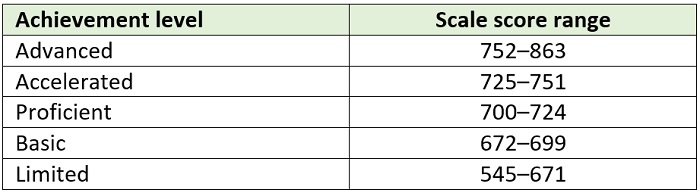
1. Establish a fair, permanent promotional standard. In an effort to ease-in the new retention requirement, the guarantee law calls for a steadily increasing test score that third graders must achieve in order to be promoted to fourth grade. For 2013–14—the first year of implementation—the State Board of Education was required to set an initial promotional standard somewhere above the limited achievement level on the third grade ELA exam. Each year thereafter, statute directs the Board to increase that bar until it reaches the minimum proficiency score for the 2024–25 school year (a date established just last year by HB 82). The achievement levels and corresponding scale score ranges on the state’s third grade ELA exam are displayed below.[1]

TGRG promotion blog chart 1

​The Board has used its discretion to take only small steps to lift the bar. By 2018–19, the promotional standard was just five points above the limited level (677) and the current score is 683, slightly less than halfway between basic and proficient. Due to covid-related legislation, the retention requirement has been completely waived for 2019–20, 2020–21, and 2021–22. The slow phase-in—not to mention the waivers—has spared schools from having to intervene in more children’s educations. But it also means that the Board will need to significantly raise the promotional score over the next two years to match the proficiency standard (700) by 2024.

In my view, the absurdly long phase-in period was poor policy design. It’s made the promotional standard a moving target each year, and has opened annual debates over where the “cut score” should be set. While the phase-in is scheduled to finally end, the looming proficiency requirement could instigate outcries from schools that, due to the Covid-slide, face the prospect of retaining a quarter to more than half of their third graders. On last year’s state ELA tests, for example, more than 75 percent of third graders in Cleveland, Columbus, Dayton, Toledo, and Youngstown did not reach proficiency. Offering high-quality interventions to so many students would be a Herculean job—likely amounting to adding another grade level.

While proficiency is a clear and admirable standard, retention should probably focus on children with the greatest reading deficiencies. Moving the bar to proficient could result in schools spreading intervention resources too thin, and it also risks a bitter debate that could ramp up pressure to eliminate the retention requirement altogether. One possible option is to permanently set a promotional test score of 683—the present cut off—a standard that would still ensure that struggling readers are identified and given extra supports.

2. Tighten the exemptions from the promotional requirements. Under current law, many special education and English language learners are exempt from the state’s retention requirements. Of course, there are certainly cases where an exception is warranted—for instance, a child with severe cognitive disabilities—but the loophole seems too large. In 2018–19, 6.2 percent of third graders statewide were exempt, and in seventy-eight Ohio districts, more than 10 percent were exempt. In a handful of districts, more than 20 percent of their third graders were exempt from promotional requirements, suggesting that some children with mild disabilities such as dyslexia were excused.

These excusals are troubling, as children with special needs or from immigrant families need to be able to read just the same as their peers. Some may believe that it’s too harsh to expect children with disabilities, however moderate, to reach comparable academic standards. But that’s not the view of most experts. A recent Ohio Department of Education report, informed by educators and parents, notes that, “Except for a very small number, students with disabilities are as cognitively able as their nondisabled peers.” The National Center for Learning Disabilities and Learning Disabilities Association writes, “Students with disabilities, as a whole, should not be automatically exempted from these [reading retention] policies.” As for English language learners, there is evidence that retention yields academic benefits, especially for immigrant children. In sum, Ohio lawmakers should carefully review and potentially narrow the exemption provisions to ensure that special-needs children are not being written off and instead receive the helps and supports they need.

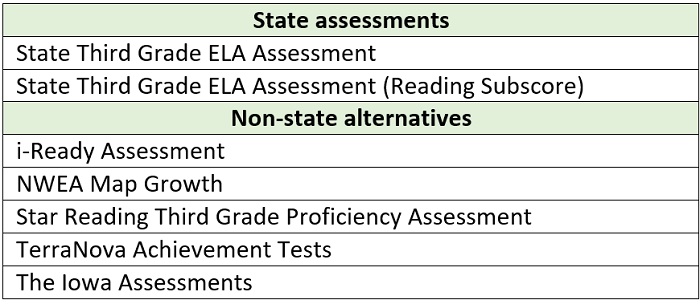
3. Address alternative assessments. Third graders, as they should, have multiple opportunities to meet the promotional standard on their state ELA exam—whether via mandatory fall or spring assessments or an optional summer administration. But state law also allows promotion if third graders demonstrate an “acceptable level of performance” on a non-state, alternative assessment. Districts may choose to administer (or not) these alternatives, and they may be given up to three times per year. For the current year, ODE has approved six alternatives, of which five are vendor assessments. A sixth option, technically an alternative, is the reading section of the state’s third grade ELA exam which also includes writing. The table below displays the testing alternatives.
 

TGRG promotion blog chart 2

​In 2018–19, 3.3 percent of Ohio third graders—just shy of the 5.0 retention rate—were promoted based on an alternative, having fallen short of the promotional standards on their state ELA exams. Whether these students have the same reading capabilities as those who achieved the promotional score on the state test is an open question. How exactly does the Ohio Department of Education (ODE) determine the “acceptable levels” of performance on these alternatives? Does a passing score on the Star test mean the same thing as a passing score on the Ohio state test? And what indeed are the pass rates on the alternatives, and how do they compare to state exams?

State lawmakers have a few options to deal with these uncertainties. The most straightforward approach is to simply eliminate them, thus enforcing a true statewide standard for promotion. Absent that, they could continue to permit alternative assessments but add language requiring ODE to demonstrate that promotional scores on the alternatives are equivalent to the state exam standard (akin to an ACT and SAT “concordance” analysis). Lastly, also as a matter of transparency, ODE should release data by district and school on the percentage of students meeting promotional standards via alternatives, something it does not currently do. So long as alternatives remain available, this information should be made public. Doing so might help to flag any school that is using them to circumvent state standards, a possibility if some tests are less rigorous than the state exam.

* * *

Teaching children to read is one of the basic responsibilities of schools, and state policymakers have a duty to ensure that this is happening in Ohio’s schools. The Third Grade Reading Guarantee has the right aims and includes important policies such as mandatory retention for children having difficulty reading. With some tweaks to the policy details, legislators would further strengthen the policy and ensure that all children are on track to becoming good readers.  


[1] With only minor exceptions at the very top and bottom of the overall scale, these ranges have been the same between 2015–16, the first year Ohio implemented its current state tests, and 2021–22.


view
Anti-voucher hypocrisy blog image

The hypocrisy of school districts saying they’re “open to all”

Jessica Poiner
2.22.2022
Ohio Gadfly Daily

Earlier this year, a coalition of traditional public school districts filed a lawsuit that they hope will spell the end of EdChoice, Ohio’s largest voucher program. The majority of their claims are focused on Article VI, Section 2 of the Ohio constitution, which calls for a “thorough and efficient system of common schools throughout the State.” The plaintiffs argue that the term “common” refers to “non-sectarian, publicly-funded schools” and not private schools that require applications and tuition payments. As part of their argument, they claim that “the common school accepts all comers.”

But that’s not true in many places in Ohio, most notably the state’s wealthier suburbs. Traditional public schools in those areas aren’t open to everyone. They’re open to the students who live within their district boundaries, boundaries that are rooted in real estate redlining that’s had a lasting effect on American society. While they don’t require an application, they do require proof of residency. And instead of tuition, they require payment in the form of a hefty mortgage and property taxes, or sky-high rent, a price tag that’s often far out of the reach of low- and middle-income families.

Consider how this works in the Columbus metro area. Columbus City Schools (CCS), the largest district in the state and one of the named plaintiff districts filing suit, served over 45,000 students during the 2020–21 school year. On the 2018–19 state report card—the last full school year before Covid took over our lives—the district posted an overall grade of D. That was an improvement from the previous year, when the district earned an F, but the results for individual measures weren’t much better. In 2018–19, the district had an F in both achievement and progress, and a four-year graduation rate of 82 percent that earned them a D. The district also earned Ds and Fs on these measures in 2015–16 and 2016–17. Approximately 80 percent of the classes of 2019 and 2020 took the ACT, but only 8.3 percent earned remediation-free scores. Nearly 24 percent of students participated in AP in 2018–19, but less than 5 percent earned a score of three or better on their exams. And while a whopping 99 percent of third graders were promoted to fourth grade that year, only 23 percent proved they could read proficiently on the state ELA exam.

Now, imagine you’re a parent living in Columbus. You want to make sure your child has the best education possible, and the data above—likely combined with your own experience—have convinced you that CCS isn’t the best option. You still want your child to attend a public school, though, so you start looking around. Ohio’s school district map shows that there are over a dozen districts that share borders with CCS, and because you have reliable transportation, they’re all viable options. A close look at 2018–19 report cards reveals that eight of the identified districts had overall grades of C or higher and no Ds or Fs on individual measures: Bexley, Gahanna-Jefferson, South-Western, Grandview Heights, Upper Arlington, Dublin, Worthington, and Westerville.

You decide to focus your efforts on these eight districts. Your first move is to look into open enrollment, because even though your assigned district is academically low-performing, you like your neighborhood and you’d rather not move. Unfortunately, though, open enrollment isn’t an option. None of these eight districts allow students who live outside their borders to enroll in their schools.

If you want to enroll your child at one of these higher-performing districts, you’ll have to move. But that’s easier said than done. Thanks in large part to the impacts of Covid, the housing market is insanely competitive. And even if it wasn’t, purchasing a home in the districts that surround Columbus is financially out of reach for many city residents. The table below lists the median household income between 2015 and 2019 along with the typical home value in each district as of this writing. Every single one has a significantly higher median income than Columbus. The smallest difference—between Columbus and South-Western—is more than $20,000. The same is true for typical home values. The closest difference, also between Columbus and South-Western, is over $52,000.

Anti-voucher hypocrisy blog chart 1​

It’s also important to keep in mind that this table shows median incomes—there are thousands of Columbus households that make far less than $53,745 a year. The same is true for typical home values. Wealthier enclaves within Columbus—neighborhoods like Clintonville and Victorian Village—are driving up the average home value for the rest of the city. And don’t forget, thousands of Columbus residents are renters, not homeowners. That means they don’t have any home equity to help with a down payment on a new house. It’s possible that these families could rent, rather than buy, their way into the suburbs. But the current rental market is just as competitive as the housing market. And as the table below shows, average rents at the time of this writing are higher in the suburbs, too.

Anti-voucher hypocrisy blog chart 2​

As a last resort, you look for family and friends who are living in the districts you prefer but can’t afford. Your loved ones are residents, and they pay taxes, so maybe your children can list those addresses as their proof of residency. But a quick Google search reveals that that’s a really bad idea. Apparently several of the districts on your list hire private investigators to tail parents and make sure they’re actually residents. In other parts of the state, parents have been sent to jail for enrolling their students in districts where they don’t reside. As much as you want your kids to have a better education, doing jail time is a steep price to pay.

The upshot? You’re stuck. The districts that claim they’re open to all aren’t actually open because you don’t make enough money to live there. You can’t send your children to temporarily live with family or friends because districts have teams of lawyers and private investigators to hunt you down. And although Ohio has a statewide open-enrollment policy that approximately 80 percent of districts participate in, the affluent, high-performing districts that surround cities like Columbus are almost exclusively closed.

And that’s what makes the establishment’s “we’re open to all” argument particularly galling. They know not all districts are open. They know that only certain kids are fortunate enough to attend the high-performing districts that they hold up as exemplars of public education. But it’s not enough for them to just close their borders and be hypocrites. They also want to intervene in family decisions and prevent kids from attending any and every school that’s not under the control of a district. That’s why they cherry-pick data to criticize charter schools. That’s why they’ve filed a lawsuit to eliminate the EdChoice program. And that’s why, when parents dared to express concern over a lawsuit that could upend their lives and their kids’ futures, the establishment’s callous response was that families “do not have sufficient knowledge about either the Ohio Constitution or the EdChoice Voucher Program to be of any use to the Court in deciding this case.” (It’s unclear why these particular parents don’t know enough to be heard but the parents named in their lawsuit do. Perhaps there’s a test of some sort?)

The bottom line is this: If you’re rich enough to buy or rent a home in a high-performing school district, you get to choose where to send your kid to school. The world is your oyster. If, however, you can’t afford to pay your way into a high-performing district, then most—if not all—high-performing public schools are closed to you. You can either resign yourself to the assigned district that, for myriad reasons, doesn’t work for your child, or you can take advantage of school choice programs. But beware—if you exercise your right to choose how to educate your own child, the establishment will brand you as a traitor. Because after all, these are their kids.

view

“Doing science” boosts academic achievement

Jeff Murray
2.24.2022
Flypaper

In 2017, a team of researchers from Finland and Michigan State University who were eager to improve science instruction for secondary students launched a field trial for Crafting Engaging Science Environments (CESE), a project-based curriculum they created and aligned with the Next Generation Science Standards (NGSS). During the 2018–19 school year, the team conducted a controlled efficacy trial in a number of high schools across the United States. Its new report looks at the academic outcomes of the students who participated in that trial.

CESE is focused specifically on chemistry and physics and consists of six units (three for each discipline) ranging from the periodic table to conservation of matter to maglev technology. On average, teaching the full curriculum takes twelve to sixteen weeks. In each unit, students are required to construct models and connect them with evidence-based explanations of phenomena, incorporating on-the-job practices of scientists and engineers. Students are supported in learning about identifying system components and the relationships among them, and modeling can take many forms, including mathematical formulae, diagrams, and computer simulations. Each unit concludes with a comprehensive assessment, although the results of these were not incorporated into the research design. Two detailed curricular examples are provided in the report.

Before implementation, treatment group teachers spent three in-person days learning about the NGSS and project-based learning goals and walking through the first two units in chemistry and physics, acting as students while the CESE team taught them. Facilitators returned before the start of each of the remaining units for a briefer prep session. Team members were also available via video conference, phone, and email to help teachers daily throughout the project. Control group teachers met in person with the research team at the beginning of the school year for a one-day workshop on the NGSS but made no changes to their typical curricula.

The initial sample comprised a diverse group of seventy schools in Los Angeles Unified School District, San Diego County Office of Education, Detroit Public School Community District, and a handful of other districts across Michigan. However, attrition claimed nine buildings before the end of the treatment window. The reasons for this—fiscal problems, a teacher strike, medical emergencies, and “mismatch between the course timeline and student abilities”—are perhaps not relevant to the ultimate findings, but they do indicate that certain aspects of the school environment can stunt the best-intentioned innovations. The final analytic sample therefore included sixty-one schools (thirty treatment and thirty-one control), 119 teachers, and 4,238 students (2,127 treatment and 2,111 control).

All students in both groups were given a pretest drawn from NAEP’s question bank to get a baseline science achievement level and a summative assessment at the end of the intervention timeline. The exam consisted of items developed by the Michigan Department of Education for use on the state’s eleventh grade science assessment and was designed to encompass both grade-level NGSS standards and the three dimensions of science learning as articulated in the NGSS.

Results show that treatment students, on average, performed 0.20 standard deviations higher than control students on the summative assessment. There was minimal variation among students of different genders and racial and ethnic groups, an important indicator that the CESE curriculum was equally engaging to diverse students. Post-participation surveys showed an across-the-board increase in student interest in pursuing science education beyond high school, as well. The summative assessment, while also aligned to NGSS, is not specific to the CESE curriculum. Thus the positive outcomes seem to reflect the generalizability of CESE, but more research is needed to confirm this connection.

In the end, the researchers are buoyed by the outcome of this efficacy trial, which makes sense considering they created CESE! As scientists themselves in a number of disciplines, they feel that their push to get students and teachers to “do science” as a means of teaching both the method and the discipline is supported by the findings. The next step? Hopefully expansion of the curriculum.

SOURCE: Barbara Schneider, et. al., “Improving Science Achievement—Is It Possible? Evaluating the Efficacy of a High School Chemistry and Physics Project-Based Learning Intervention,” Educational Researcher (January 2022).

view

Online credit recovery and long-term earnings potential

Jeff Murray
2.24.2022
Flypaper

The Covid slide has both expanded the need for students to take remedial classes and produced greater familiarity with remote learning. As a result, online credit recovery options have become more necessary and readily accessible at the same time. But pre-Covid concerns that these courses don’t actually improve academic achievement persist. Now comes some timely research looking at the long-term labor market prospects of students who complete high school graduation requirements via online credit recovery. The results add more bad news to the pile.

Data come from a large, unnamed urban school district in the Midwest that began offering online credit recovery in 2010. The researchers started by identifying all of the nearly 12,000 district graduates from the 2010–11 to the 2017–18 school years who had failed at least one high school course. Using administrative records, the researchers identified those who recovered at least one of those lost credits via the district’s online vendor and defined them as the “treatment” group. Students who were identified as having retaken the failed course(s) in a traditional classroom setting were the control.

The final sample includes over 8,700 students in both groups whose education and employment records could be connected one year following graduation—5,154 in the treatment group and 3,559 in the control group. Black students were more likely to engage in online credit recovery in this district during the time period, as were students who were absent more frequently, had lower grade point averages, and earned fewer credits overall. White and Asian students, English learners, and those with disabilities were more likely to recover failed credits in traditional classrooms. The researchers identified a subsample of both groups whose employment data were available up to four years after high school graduation.

The researchers ran an instrumental variables estimation, which showed that, initially, students in the treatment group had earnings on par with those in the control group. Over time, however, a large negative differential emerged. By the fourth year post-graduation, students who recovered credits online were earning an average of almost $3,000 less annually than their peers who recovered credits traditionally. At the same time, there were no statistically significant differences in the likelihood of graduates in either group being employed or retaining employment. Thus the earnings gap was likely a case of lower wages and/or a slower rate of increase in earnings over time.

In discussion, the researchers note that the observed pattern fits with existing labor market research. A high school diploma is, in itself, a signal to employers about an individual’s work potential. And since high school transcripts do not specify how a course was passed or a credit earned, the same signal is sent by both groups’ diplomas. However, human capital theory insists that individual ability is gradually revealed over time in the labor market. If so, it seems that online credit recovery is a weaker preparation for work than more traditional means of remediating a failed course. (Although not having thousands of students failing courses during high school would be better than both of those options.) While we do not know how or why students sorted into the two credit recovery pathways, the researchers do caution that the continued expansion of online credit recovery could lead to a devaluation of all high school diplomas if its time-honored signal of work readiness is drawn into question in this manner.

SOURCE: Carolyn J. Heinrich and Huiping Cheng, “Does Online Credit Recovery in High School Support or Stymie Later Labor Market Success?,” Journal of Policy Analysis and Management (January 2022).

Fordham Logo

© 2026 The Thomas B. Fordham Institute
Privacy Policy
Usage Agreement

National

P.O. Box 110
Burke, VA 22009

202.223.5452

[email protected]

Ohio

P.O. Box 82291
Columbus, OH 43202

614.223.1580

[email protected]

Sponsorship

130 West Second Street, Suite 410
Dayton, Ohio 45402

937.227.3368

[email protected]