Mobile Navigation

  • National
    • Policy
      • High Expectations
      • Quality Choices
      • Personalized Pathways
    • Research
    • Commentary
      • Gadfly Newsletter
      • Flypaper Blog
    • Events
    • Scholars Program
  • Ohio
    • Policy
      • Priorities
      • Media & Testimony
    • Research
    • Commentary
      • Ohio Education Gadfly Biweekly
      • Ohio Gadfly Daily
  • Charter Authorizing
    • Application
    • Sponsored Schools
    • Resources
  • About
    • Mission
    • Board
    • Staff
    • Career
Home
Home
Advancing Educational Excellence

Main Navigation

  • National
  • Ohio
  • Charter Authorizing
  • About

National Menu

  • Topics
    • Accountability & Testing
    • Advanced Education
    • Career & Technical Education
    • Charter Schools
    • Curriculum & Instruction
    • ESSA
    • Evidence-Based Learning
    • Facilities
    • Governance
    • Personalized Learning
    • Private School Choice
    • School Finance
    • Standards
    • Teachers & School Leaders
    • Think Again
  • Research
  • Commentary
    • Gadfly Newsletter
    • Flypaper Blog
    • Gadfly Podcast
  • Events
  • Scholars Program

Reports

Displaying 151-180 of 258 results
Report
2.16.2011
Standards

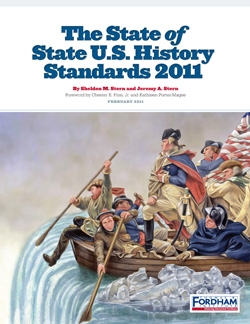
The State of State U.S. History Standards 2011

Jeremy A. Stern, Sheldon M. Stern

Reviewers evaluated state standards for U.S. history in grades K-12. What they found is discouraging: Twenty-eight states—a majority—deserve D or F grades for their academic standards in this key subject. The average grade across all states is a dismal D. Among the few bright spots, South Carolina earns a straight A for its standards and six other jurisdictions—Alabama, California, Indiana, Massachusetts, New York and the District of Columbia—garner A-minuses. (The National Assessment's "framework" for U.S. history also fares well.) Read on to learn how your state scored.
Report
1.6.2011
School Finance

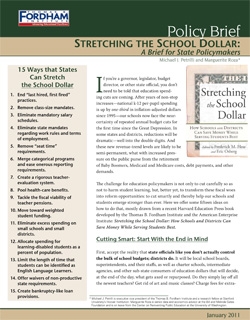
Stretching the School Dollar

Michael J. Petrilli, Marguerite Roza, Ph.D.

This policy brief lists fifteen concrete ways that states can "stretch the school dollar" in these difficult financial times. It is written by Marguerite Roza, senior data and economics advisor at the Bill & Melinda Gates Foundation and Michael J. Petrilli, executive vice president at the Fordham Institute.

Report
12.14.2010
Accountability & Testing

Are Bad Schools Immortal?

David A. Stuit

This study from the Thomas B. Fordham Institute finds that low-performing public schools—both charter and traditional district schools—are stubbornly resistant to significant change. After identifying more than 2,000 low-performing charter and district schools across ten states, analyst David Stuit tracked them from 2003-04 through 2008-09 to determine how many were turned around, shut down, or remained low-performing. Results were generally dismal. Seventy-two percent of the original low-performing charters remained in operation—and remained low-performing-five years later. So did 80 percent of district schools. Read on to learn more.

Report
9.7.2010
School Finance, Governance

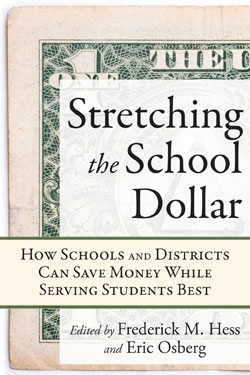
Stretching the School Dollar: How Schools and Districts Can Save Money While Serving Students Best

Eric Osberg

In this volume, a diverse group of experts—scholars, educators, journalists, and entrepreneurs—offer wisdom and advice on how schools and districts can cut costs, eliminate inefficient spending, and better manage their funds in order to free up resources to drive school reform.

Report
8.27.2010
Accountability & Testing

2009-10 Ohio Report Card Analysis

Emmy L. Partin, Terry Ryan, Bianca Speranza

Each year the Thomas B. Fordham Institute conducts an analysis of urban school performance in Ohio. We found that in 2009-10, 26 percent of public school students (district and charter) in Ohio's Big 8 urban communities attended a school rated A or B by the state, 28 percent attend a C-rated school, and 47 percent attended a school rated D or F.

Report
8.24.2010
School Finance, Charter Schools

America's Best (and Worst) Cities for School Reform: Attracting Entrepreneurs and Change Agents

Stafford Palmieri, Janie Scull

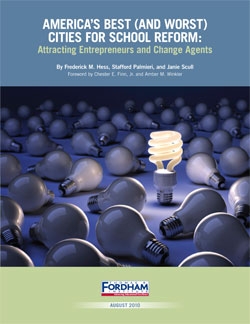
This study tackles a key question: Which of thirty major U.S. cities have cultivated a healthy environment for school reform to flourish (and which have not)? Nine reform-friendly locales surged to the front. Read on to learn more.

Report
7.21.2010
Standards

The State of State Standards—and the Common Core—in 2010

Sheila Byrd Carmichael, W. Stephen Wilson, Kathleen Porter-Magee, Gabrielle Martino

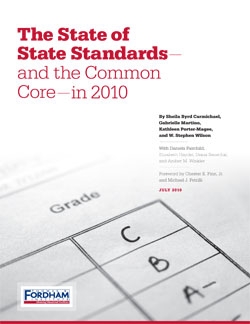
This study weighed existing state education standards against the Common Core education standards. The findings? The Common Core standards were clearer and more rigorous than English language arts standards in 37 states and math standards in 39 states.

Common Education Standards
Report
6.23.2010
Standards

Common Education Standards: Tackling the Long-Term Questions

How should the "common core" state standards be governed? Who will "own" these standards (and related assessments) 20 years from now? To stir smart thinking about important aspects of these issues, the Fordham Institute invited knowledgeable experts to write background papers.

Common Education Standards
Report
3.23.2010
Standards

Review of the Draft K-12 Common Core Standards

Sheila Byrd Carmichael, Kathleen Porter-Magee, W. Stephen Wilson, Chester E. Finn, Jr., Gabrielle Martino, Amber M. Northern, Ph.D.

The Fordham Institute's expert reviewers have analyzed the draft Common Core K-12 education standards (made public on March 10) according to rigorous criteria. Their analyses lead to a grade of A- for the draft mathematics standards and B for those in English language arts. Read on to find out more.

Report
12.10.2009
Advanced Education

Tracking and Detracking: High Achievers in Massachusetts Middle Schools

Tom Loveless

Brookings scholar Tom Loveless examines tracking and detracking in Massachusetts middle schools, focusing on changes that have occurred and the implications for high-achieving students. Among the findings: detracked schools have fewer advanced students in math than tracked schools and detracking is more popular in schools serving disadvantaged populations.

Report
11.20.2009
Accountability & Testing, Charter Schools

Seeking Quality in the Face of Adversity: 2008-09 Fordham Sponsorship Accountability Report

Kathryn Mullen

As a charter school sponsor (authorizer), Fordham submits an accountability report to the Ohio Department of Education at the end of November each year. The report includes profiles of each Fordham-sponsored school, as well as graphics comparing the achievement data of our schools, their home districts, and statewide averages. You'll also find pertinent information on Ohio charter school spending over the last decade, and in the introduction, a timely analysis of the political and legislative environment impacting Ohio charters in 2008-09 that explains why the title, "Seeking Quality in the Face of Adversity," is befitting.

Report
10.8.2009
Standards

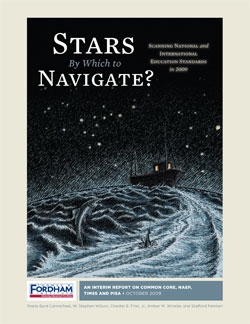
Stars by Which to Navigate? Scanning National and International Education Standards in 2009

Sheila Byrd Carmichael, W. Stephen Wilson, Chester E. Finn, Jr., Stafford Palmieri, Amber M. Northern, Ph.D.

Expert reviewers appraise the Common Core drafts -- which outline college and career readiness standards in reading, writing, speaking and listening, and in math -- and also evaluate the reading/writing and math frameworks that undergird the National Assessment of Educational Progress (NAEP), the Trends in International Mathematics and Science Study (TIMSS) and the Programme for International Student Achievement (PISA). How strong are these well-known models?

Report
9.8.2009
Governance

From Schoolhouse to Courthouse

From Schoolhouse to Courthouse: The Judiciary's Role in American Education examines the role of the courts in modern American K-12 education. From race to speech, from religion to school funding, few aspects of education policy have escaped the courtroom. In this book, experts describe just what the impact of judicial involvement has been. Published jointly by Fordham and Brookings Institution Press.

Report
8.27.2009
Standards

International Lessons about National Standards

Sharif Shakrani, Richard Houang, William H. Schmidt

Whether the United States should embrace national standards and tests is perhaps today's hottest education issue. For guidance in addressing it, this report looks beyond our borders. How have other countries navigated these turbid waters? What can we learn from them? Expert analysts examined national standards and testing in Brazil, Canada, China, France, Germany, India, the Netherlands, Russia, Singapore and South Korea.

Report
7.29.2009
Governance

The Great Graduation-Rate Debate

This paper aims to promote a clearer understanding of the graduation-rate debate by distilling the policy developments and controversy surrounding the measurement of these rate. Why are there so many different ways to calculate graduation rates? How do these different rates account for the multiple pathways to graduation? What are the data sources used in the various dropout-rate calculations, and what are their pros and cons?

Report
4.29.2009
Advanced Education

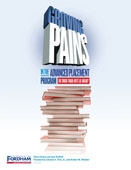
Growing Pains in the Advanced Placement Program: Do Tough Trade-Offs Lie Ahead?

Steve Farkas, Ann Duffett

Over the past five years, the number of students taking at least one Advanced Placement exam rose by more than half. This news is celebrated but is there a downside? To find out, Fordham commissioned the Farkas Duffett Research Group to survey AP teachers in the US. The AP program remains popular with its teachers. But there are signs that the move toward "open door" access to AP is starting to cause concern.

Report
3.24.2009
Accountability & Testing

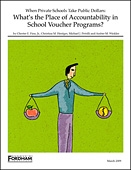
When Private Schools Take Public Dollars: What's the Place of Accountability in School Voucher Programs?

Michael J. Petrilli, Chester E. Finn, Jr., Christina Hentges, Amber M. Northern, Ph.D.

Voucher opponents often argue that it's unfair to hold public schools accountable for results under the No Child Left Behind Act and various state rules while allowing private schools that participate in school voucher programs to receive taxpayer dollars without similar accountability. In pursuit of a reasonable middle ground, we sought the advice of twenty experts in the school-choice world. This paper presents their thoughts and opinions, as well as Fordham's own ideas.

Report
2.19.2009
Accountability & Testing

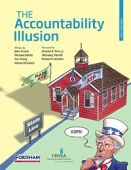
The Accountability Illusion

Yun Xiang, Michael Dahlin, John Cronin, Donna McCahon

In this study of the No Child Left Behind Act system and Adequate Yearly Progress (AYP) rules for 28 states, we selected 36 real schools that vary by size, achievement, diversity, etc. and determined which ones would or would not make AYP when evaluated under each state's accountability rules. If a school that made AYP in Washington were relocated to Ohio, would it still make AYP?

Report
12.18.2008
Governance

An Open Letter to President Obama, Secretary Duncan and the 111th Congress

Michael J. Petrilli, Chester E. Finn, Jr.

In this exciting, unique and challenging time, the Thomas B. Fordham Institute wants to congratulate President-Elect Obama and other new federal leaders. The federal government has a key role to play in creating a world-class education system in America but it's challenging to get that role right. This letter provides some guidance. Fordham experts review the current education policy landscape and its main players and offer their view of the ideal K-12 federal role. They also address the ten big policy battles looming on the horizon. The hope is that the letter will provide critical advice, insights and ideas for the new federal education leaders who are about to take on a big job.

Report
11.19.2008
Accountability & Testing, Charter Schools

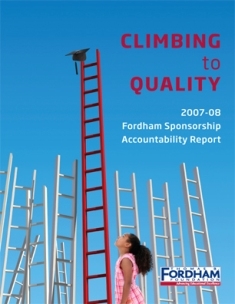
Climbing to Quality 2007-2008 Fordham Sponsorship Accountability Report

Kathryn Mullen

This yearly report covers Fordham's sponsorship practices throughout the year as well as newsworthy events related to our sponsored charter schools. You can also find detailed reports on all of Fordham-sponsored schools. Each school report contains information on the school's academic performance, educational philosophy, and compliance for the 2007-2008 school year.

Report
11.17.2008
Governance

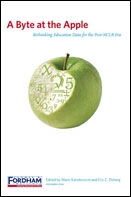
A Byte at the Apple: Rethinking Education Data for the Post-NCLB Era

Eric Osberg, Marci Kanstoroom, Ph.D.

In A Byte at the Apple, leaders and scholars map the landscape of education data providers and users and explore why what's supplied by the former often fails to meet the needs of the latter. Most important, it explores potential solutions--including a system where a "backpack" of achievement information accompanies every student from place to place.

Report
10.2.2008
Governance

The Red Tape Report: An Exploratory Study of the Regulatory Interference Faced by School Leaders in Five States

Nathan Gray, Matthew Carr, Marc Holley

In public education today, individual schools are accountable under the federal No Child Left Behind Act as well as myriad state and local policy regimens for their students achievement and other vital outcomes. Increasingly, school leaders find their own job tenure and compensation tied to those outcomes as well. But do they possess the authority they need to lead their schools to heightened performance? Numerous surveys (conducted by Public Agenda, the Thomas B. Fordham Institute, and others) suggest that many school leaders feel they do not. Thus an important public policy question arises: what factors help or hinder school leaders in exercising their authority and in which areas?

Report
8.25.2008
Accountability & Testing

Education Olympics 2008: The Games in Review

Stafford Palmieri, Amber M. Northern, Ph.D.

This report has a simple aim: to present results from international assessments so readers can judge for themselves how American students stack up globally. It shows how the U.S. has performed internationally in education in recent years, and it provides a glimpse of how education looks in several top-performing nations.

Report
8.15.2008
Curriculum & Instruction

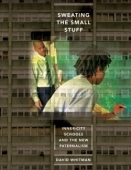
Sweating the Small Stuff: Inner-City Schools and the New Paternalism

David Whitman

The most exciting innovation in education policy in the last decade is the emergence of highly effective schools in our nation's inner cities, schools where disadvantaged teens make big gains in academic achievement. In this book, David Whitman takes readers inside six of these secondary schools—many of them charter schools—and reveals the secret to their success: They are paternalistic.

Report
6.18.2008
Advanced Education

High-Achieving Students in the Era of No Child Left Behind

Steve Farkas, Ann Duffett, Tom Loveless

This publication reports the results of the first two (of five) studies of a multifaceted research investigation of the state of high-achieving students in the No Child Left Behind (NCLB) era. Part I examines achievement trends for high-achieving students since the early 1990s; Part II reports on teachers' own views of how schools are serving high-achieving pupils in the NCLB era.

Report
4.10.2008
Private School Choice

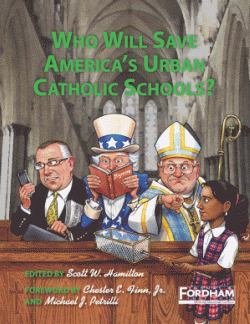
Who Will Save America's Urban Catholic Schools?

Scott Hamilton

America's urban Catholic schools are in crisis. Over 1,300 of them have shut down since 1990, mostly in our cities. As a result, some 300,000 students have been displaced--double the number affected by Hurricanes Rita and Katrina. This report, which includes a comprehensive survey of the attitudes of U.S. Catholics and the broader public towards inner-city Catholic schools, examines this crisis and offers several suggestions for arresting and perhaps reversing this trend in the interests of better education.

Report
3.12.2008
School Finance

Fund The Child: Bringing Equity, Autonomy, and Portability to Ohio School Finance

Ohio can boast of praiseworthy gains over the past decade in making school funding more equitable across districts, but there is more work to be done. To mitigate the school-finance inequities that remain within districts and gear school funding toward the realities of student mobility, school choice and effective school-based management, this report recommends that Ohio embrace Weighted Student Funding (WSF), which allocates resources based on the needs of individual students and by sending dollars directly to schools rather than lodging most spending decisions at the district level.

Report
3.5.2008
Governance

Too Good to Last: The True Story of Reading First

Sol Stern

Too Good to Last: The True Story of Reading First is an in-depth and alarming study of Reading First's betrayal. Under the leadership of White House domestic policy chief Margaret Spellings and with support from Congress, Reading First was to provide funding to primary-reading programs that were based on scientific research. Backlash and brouhaha followed. Aggrieved whole-language program proprietors complained bitterly that their wares couldn't be purchased with Reading First funds. Then the administration turned its back on Reading First, allowing the program to be gutted and starved of funding.

Report
2.14.2008
Governance, Teachers & School Leaders

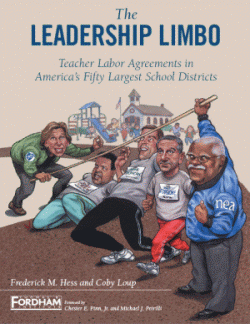
The Leadership Limbo

Coby Loup

In the era of No Child Left Behind, principals are increasingly held accountable for student performance. But are teacher labor agreements giving them enough flexibility to manage effectively? The Leadership Limbo: Teacher Labor Agreements in America's Fifty Largest School Districts, answers this question and others.

Report
11.13.2007
Advanced Education

Advanced Placement and International Baccalaureate: Do They Deserve Gold Star Status?

Sheila Byrd Carmichael, Lucien Ellington, Paul Gross, Carol Jago, Sheldon Stern

This report examines whether the reputation the Advanced Placement and International Baccalaureate programs have for academic excellence is truly deserved. Our expert reviewers looked at the four AP and IB courses most similar to the core content areas in American high schools--English, history, math, and science--and found that, in general, the courses do warrant praise. In a few cases, they deserve gold stars.

Pagination

  • First page « First
  • Previous page ‹ Previous
  • Page 1
  • Page 2
  • Page 3
  • Page 4
  • Page 5
  • Current page 6
  • Page 7
  • Page 8
  • Page 9
  • Next page Next ›
  • Last page Last »

Type

  • Book (10)
  • Commentary (17478)
  • Event (51)
  • Podcast (380)
  • (-) Report (258)
  • Video (98)

Topics

  • Accountability & Testing (44)
  • Advanced Education (15)
  • Career & Technical Education (4)
  • Charter Schools (45)
  • Curriculum & Instruction (34)
  • ESSA (6)
  • Evidence-Based Learning (4)
  • Governance (78)
  • Personalized Learning (4)
  • Private School Choice (8)
  • School Finance (30)
  • Standards (49)
  • Teachers & School Leaders (37)

Date

  • 2026 (8)
  • 2025 (7)
  • 2024 (8)
  • 2023 (9)
  • 2022 (5)
  • 2021 (7)
  • 2020 (6)
  • 2019 (7)
  • 2018 (7)
  • 2017 (9)
  • 2016 (8)
  • 2015 (4)
  • 2014 (13)
  • 2013 (18)
  • 2012 (17)
  • 2011 (19)
  • 2010 (7)
  • 2009 (9)
  • 2008 (11)
  • 2007 (7)
  • 2006 (9)
  • 2005 (9)
  • 2004 (7)
  • 2003 (9)
  • 2002 (4)
  • 2001 (8)
  • 2000 (9)
  • 1999 (5)
  • 1998 (11)
  • 1997 (1)
Fordham Logo

© 2026 The Thomas B. Fordham Institute
Privacy Policy
Usage Agreement

National

P.O. Box 110
Burke, VA 22009

202.223.5452

[email protected]

Ohio

P.O. Box 82291
Columbus, OH 43202

614.223.1580

[email protected]

Sponsorship

130 West Second Street, Suite 410
Dayton, Ohio 45402

937.227.3368

[email protected]