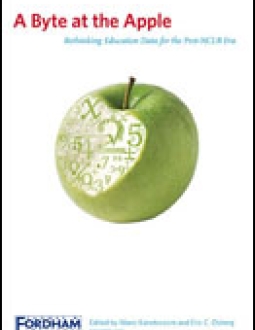
America brims with education data and these days it seems everyone in education claims--or at least wants--to be guided by data. In A Byte at the Apple, leaders and scholars map the landscape of data providers and users and explores why what's supplied by the former too often fails to meet the needs of the latter. It documents the barriers to collecting good information, including well-meaning privacy laws and the maze of overlapping government units and agencies. Most important, it explores potential solutions--including a future system where a "backpack" of achievement information would accompany every student from place to place.
Among the book's main points:
America has made significant gains in education data.
No Child Left Behind, while much-criticized, has led to important strides in the creation of and demand for student achievement data. New technologies are making data entry, collection, analysis and dissemination vastly easier.
Yet many education-data systems remain archaic, cumbersome and non-comparable.
For instance, higher ed data typically don't align with elementary-secondary. Students who change schools get lost. Finance data are a mess. And some information, such as which pupils are taught by which teachers, isn't even gathered. Key definitions, such as "dropout" and "graduate" remain unsettled. Leaders also need better ways of digging through mounds of existing data to identify useful information that will actually tell them "what works" in education.
Barriers to quality data are tough but surmountable.
California has struggled to develop a statewide data repository, hampered by politics, bureaucracy, and human foible. Yet Kansas and Virginia have found ways to overcome such challenges to make solid advances in their education data systems.
There are data 'gaps' to be filled.
American education craves more longitudinal data and value-added analyses. Educators and analysts seek information that tracks student achievement over time. Policymakers yearn for better means of investigating the sources of school effectiveness. Many want to link student and teacher data. Some, however, have good data that they can't use to meet their needs. Knowing what to do with education data--and why--is as important as having them.
The mission IS possible.
Getting the education data America needs to the people who need it will not be easy, but it is doable. Other countries and other sectors suggest some possibilities. Innovations like "dashboards" showing school management data, and savvier uses of technology would lead to dramatically better information about our schools and our students, helping us understand what works and what we can improve.
"A Byte at the Apple" BOOK CONTENTS
Foreword
Marci Kanstoroom, Eric C. Osberg, and Robert D. Muller
Introduction: The Education Data Landscape
Paul Manna
Why We Don't Have the Data We Need
Getting FERPA Right: Encouraging Data Use While Protecting Student Privacy
Chrys Dougherty
Federalism and the Politics of Data Use
Kenneth K. Wong
Political Roadblocks to Quality Data: The Case of California
RiShawn Biddle
Innovations and Promising Practices
States Getting It Right: The Cases of Kansas and Virginia
Nancy Smith
The Student Data Backpack
Margaret Raymond
Balanced Scorecards and Management Data
Frederick M. Hess and Jon Fullerton
Circling the Education-Data Globe
Daniele Vidoni and Kornelia Kozovska
Cutting-Edge Strategies from Other Sectors
Bryan C. Hassel
The Way Forward
From Building Systems to Using Their Data
Aimee Rogstad Guidera
Education Data in 2025
Chester E. Finn, Jr.
More Resources
"A Byte at the Apple" in a nutshell: This one-page PDF document offers an overview of the book's main points
"A Byte at the Apple" video, Panel 1 discussion: Why We Don't Have the Data We Need
Paul Manna, via video
Chrys Dougherty
Nancy Smith
Discussant: Mark Schneider
Moderator: Checker Finn
"A Byte at the Apple" video, Panel 2 discussion: Innovations and Promising Practices
Jon Fullerton
Macke Raymond
Bryan Hassel
Discussant: Kevin Carey
Moderator: Mike Petrilli
"A Byte at the Apple" video, Panel 3 discussion: The Way Forward
Aimee Guidera
Checker Finn
Discussants: John Deasy & Glynn Ligon
Moderator: Eric Osberg
"A Byte at the Apple" video, panel highlights
FERPA music video: The tragic tale of one harried education researcher's quest for data.