Mobile Navigation

  • National
    • Policy
      • High Expectations
      • Quality Choices
      • Personalized Pathways
    • Research
    • Commentary
      • Gadfly Newsletter
      • Flypaper Blog
    • Events
    • Scholars Program
  • Ohio
    • Policy
      • Priorities
      • Media & Testimony
    • Research
    • Commentary
      • Ohio Education Gadfly Biweekly
      • Ohio Gadfly Daily
  • Charter Authorizing
    • Application
    • Sponsored Schools
    • Resources
  • About
    • Mission
    • Board
    • Staff
    • Career
Home
Home
Advancing Educational Excellence

Main Navigation

  • National
  • Ohio
  • Charter Authorizing
  • About

National Menu

  • Topics
    • Accountability & Testing
    • Advanced Education
    • Career & Technical Education
    • Charter Schools
    • Curriculum & Instruction
    • ESSA
    • Evidence-Based Learning
    • Facilities
    • Governance
    • Personalized Learning
    • Private School Choice
    • School Finance
    • Standards
    • Teachers & School Leaders
    • Think Again
  • Research
  • Commentary
    • Gadfly Newsletter
    • Flypaper Blog
    • Gadfly Podcast
  • Events
  • Scholars Program

School Finance

Displaying 151-169 of 169 results
Report
2.14.2013
School Finance, Governance

When Teachers Choose Pension Plans: The Florida Story

Matthew M. Chingos, Martin R. West

In an era of budgetary belt tightening, state and local policy makers are finally awakening to the impact of teacher pension costs on their bottom lines. Recent reports demonstrate that such pension programs across the United States are burdened by almost $390 billion in unfunded liabilities. Yet, most states and municipalities have been taking the road of least resistance, tinkering around the edges rather than tackling systemic (but painful) pension reform. Is the solution to the pension crisis to offer teachers the option of a 401(k)-style plan (also known as a "defined contribution" or DC plan) instead of a traditional pension plan? Would this alternative appeal to teachers? When Teachers Choose Pension Plans: The Florida Story sets out to answer these questions.

Report
12.11.2012
School Finance, Governance, Teachers & School Leaders

Strategies for Smarter Budgets and Smarter Schools

Nathan Levenson

This new policy brief by Nathan Levenson, Managing Director at the District Management Council and former superintendent of Arlington (MA) Public Schools, offers informed advice to school districts seeking to provide a well-rounded, quality education to all children in a time of strained budgets. Levenson recommends three strategies: prioritize both achievement and cost-efficiency; make staffing decisions based on student needs, not student preferences; and manage special-education spending for better outcomes and greater cost-effectiveness.

Report
7.20.2012
School Finance, Governance

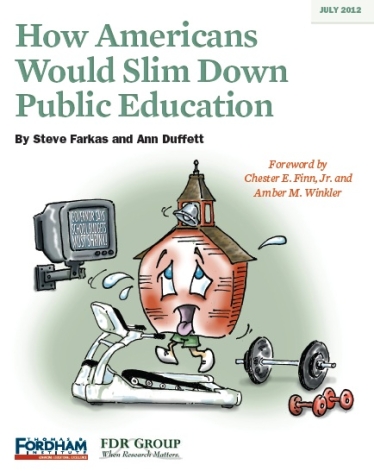
How Americans Would Slim Down Public Education

Steve Farkas, Ann Duffett

Education budgets are tight and state and district leaders must make tough decisions about where to save. But is the public willing to accept cuts? If so, where? According to the results of this new survey, many Americans are open—selectively open—to dramatic changes in how school districts do business.

Report
5.24.2012
School Finance, Governance

Putting a Price Tag on the Common Core: How Much Will Smart Implementation Cost?

Patrick J. Murphy, Elliot Regenstein

The Common Core State Standards (CCSS) for English language arts and mathematics represent a sea change in standards-based reform and their implementation is the movement’s next—and greatest—challenge. Yet, while most states have now set forth implementation plans, these tomes seldom address the crucial matter of cost. This report estimates the implementation cost for each of the forty-five states (and the District of Columbia) that have adopted the Common Core State Standards and shows that costs naturally depend on how states approach implementation.

Report
4.11.2012
School Finance, Governance

How School Districts Can Stretch the School Dollar

Michael J. Petrilli

The "new normal" of tougher budget times is here to stay for American K-12 education. So how can local officials cope? This policy brief, by Mike Petrilli, provides a useful tool for navigating the financial challenges of the current school-funding climate, complete with clear dos and don'ts for anyone involved in or concerned with local education budgets.

Report
1.9.2012
School Finance

The Costs of Online Learning

The latest installment of Fordham's Creating Sound Policy for Digital Learning series investigates one of the more controversial aspects of digital learning: How much does it cost? In this paper, the Parthenon Group uses interviews with more than fifty vendors and online-schooling experts to estimate today's average per-pupil cost for a variety of schooling models, traditional and online, and presents a nuanced analysis of the important variance in cost between different school designs.

Report
11.16.2011
School Finance

School Finance in the Digital-Learning Era

Paul T. Hill

Will the move toward virtual and “blended learning” schools in American education repeat the mistakes of the charter-school movement, or will it learn from them? The Thomas B. Fordham Institute, with the support of the Charles and Helen Schwab Foundation, has commissioned five deep-thought papers that, together, address the thorniest policy issues surrounding digital learning. The goal is to boost the prospects for successful online learning (both substantively and politically) over the long run.

Report
10.20.2011
School Finance, Governance

Halting a Runaway Train: Reforming Teacher Pensions for the 21st Century

Mike Lafferty

When it comes to public-sector pensions, writes lead author Mike Lafferty in this report, "A major public-policy (and public-finance) problem has been defined and measured, debated and deliberated, but not yet solved. Except where it has been." As recounted in "Halting a Runaway Train: Reforming Teacher Pensions for the 21st Century," these exceptions turn out to be revealing—and encouraging. As leaders around the country struggle to overhaul America's controversial and precarious public-sector pensions, this study draws on examples from diverse fields to provide a primer on successful pension reform. Download to find valuable lessons for policymakers, workers, and taxpayers looking for timely solutions to a dire problem.

Report
6.22.2011
School Finance, Charter Schools

Charting a New Course to Retirement: How Charter Schools Handle Teacher Pensions

Amanda Olberg, Michael Podgursky

In this "Ed Short" from the Thomas B. Fordham Institute, Amanda Olberg and Michael Podgursky examine how public charter schools handle pensions for their teachers. Some states give these schools the freedom to opt out of the traditional teacher-pension system; when given that option, how many charter schools take it? Olberg and Podgursky examine data from six charter-heavy states and find that charter participation rates in traditional pension systems vary greatly from state to state. When charter schools do not participate in state systems, they most often provide their teachers with defined-contribution plans (401(k) or 403(b)). But some opt-out charters offer no alternative retirement plans at all for their teachers. Read on to learn more.

Report
1.6.2011
School Finance

Stretching the School Dollar

Michael J. Petrilli, Marguerite Roza, Ph.D.

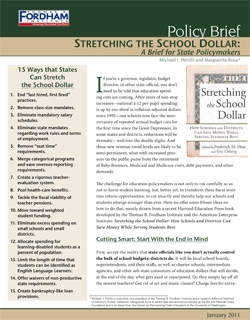
This policy brief lists fifteen concrete ways that states can "stretch the school dollar" in these difficult financial times. It is written by Marguerite Roza, senior data and economics advisor at the Bill & Melinda Gates Foundation and Michael J. Petrilli, executive vice president at the Fordham Institute.

Report
9.7.2010
School Finance, Governance

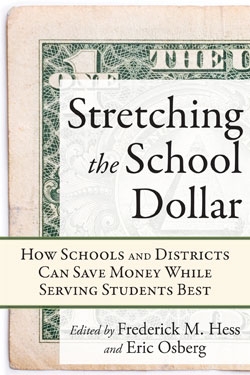
Stretching the School Dollar: How Schools and Districts Can Save Money While Serving Students Best

Eric Osberg

In this volume, a diverse group of experts—scholars, educators, journalists, and entrepreneurs—offer wisdom and advice on how schools and districts can cut costs, eliminate inefficient spending, and better manage their funds in order to free up resources to drive school reform.

Report
8.24.2010
School Finance, Charter Schools

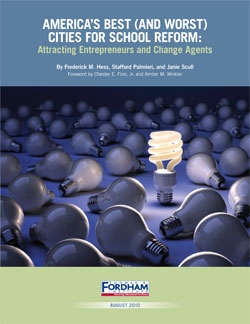
America's Best (and Worst) Cities for School Reform: Attracting Entrepreneurs and Change Agents

Stafford Palmieri, Janie Scull

This study tackles a key question: Which of thirty major U.S. cities have cultivated a healthy environment for school reform to flourish (and which have not)? Nine reform-friendly locales surged to the front. Read on to learn more.

Report
3.12.2008
School Finance

Fund The Child: Bringing Equity, Autonomy, and Portability to Ohio School Finance

Ohio can boast of praiseworthy gains over the past decade in making school funding more equitable across districts, but there is more work to be done. To mitigate the school-finance inequities that remain within districts and gear school funding toward the realities of student mobility, school choice and effective school-based management, this report recommends that Ohio embrace Weighted Student Funding (WSF), which allocates resources based on the needs of individual students and by sending dollars directly to schools rather than lodging most spending decisions at the district level.

Report
6.27.2006
School Finance, Governance

Fund the Child

Everyone agrees that education funding today is a mess. But a broad, bipartisan coalition now urges a new method of funding our public schools--one that finally ensures the students who need the most receive it, that empowers school leaders to make key decisions, and that opens the door to public school choice. It's a 100 percent solution to the most pressing problems in public school funding--and it's called Weighted Student Funding.

Report
8.24.2005
School Finance, Charter Schools

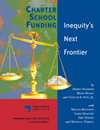
Charter School Funding: Inequity's Next Frontier

Sheree Speakman, Chester E. Finn, Jr., Bryan C. Hassel

Of all the controversies swirling around the nation's charter schools, none is more hotly contested than the debate over funding. Into the fray leaps Charter School Funding: Inequitys Next Frontier, the most comprehensive and rigorous study ever undertaken of how public charter schools are funded, state by state, and how their revenues measure up to dollars received by district-run schools.

Report
10.24.2003
Accountability & Testing, School Finance, Charter Schools

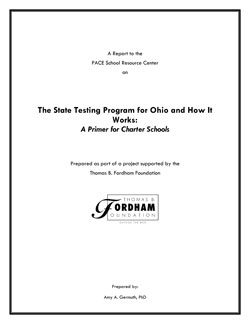
The State Testing Program for Ohio and How It Works: A Primer for Charter Schools

Amy Germuth

With the passage of the politics-governance Act (NCLB), states have had to adjust their accountability systems to comply with federal law. As a result, in the summer of 2003 Ohio's Governor Taft signed House Bill 3, which dramatically changed the state's assessment system and what it means for charter schools. This report helps charter school leaders coordinate their testing and data reporting procedures to meet state and federal guidelines, in the hope that all students might surpass Ohio's academic expectations.

Report
12.1.2001
School Finance, Governance

Seven Studies in Education Philanthropy

John Barry, Peter Frumkin, Joe Williams, Leslie Lenkowsky, Lew Solomon, Paul T. Hill, Margaret Raymond, Emily Spencer, Bruno V. Manno

The Thomas B. Fordham Foundation asked experts to share their knowledge and ideas on topics related to effective education philanthropy. Here are seven papers that answer some of philanthropists' most important questions in the education reform arena.

Report
9.1.2001
School Finance, Governance

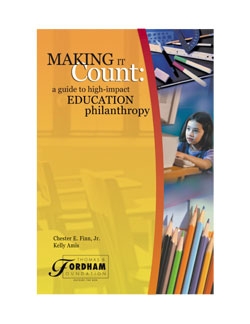
Making it Count: A Guide to High-Impact Education Philanthropy

Chester E. Finn, Jr., Kelly Amis

Charitable giving in the U.S. is at an all-time high, as is the public's concern with the state of our K-12 education system. This guide provides practical advice for the philanthropist who is fed up with the status quo and eager to support effective education reforms. Making it Count reviews the state of U.S. public education, examines different ways that philanthropists are trying to improve it, explains why some strategies work better than others, profiles a number of education philanthropists, and recounts the experiences of the Thomas B. Fordham Foundation.

Report
4.1.2000
School Finance, Governance

Can Philanthropy Fix Our Schools? Appraising Walter Annenberg's $500 Million Gift to Public Education

Carol Innerst, Alexander Russo, Raymond Domanico

According to this new study, Ambassador Annenberg's gift has left only small footprints on the urban school systems it set out to reform. Good intentions and a generous checkbook were not enough to transform troubled urban schools. This report includes case studies of New York (by Raymond Domanico), Chicago (by Alexander Russo) and Philadelphia (by Carol Innerst) and an afterword by Chester E.Finn Jr. and Marci Kanstoroom.

Pagination

  • First page « First
  • Previous page ‹ Previous
  • Page 1
  • Page 2
  • Page 3
  • Page 4
  • Page 5
  • Current page 6

Type

  • Book (1)
  • Commentary (121)
  • Event (1)
  • Podcast (16)
  • Report (30)

Topics

  • Accountability & Testing (504)
  • Advanced Education (267)
  • Career & Technical Education (84)
  • Charter Schools (1117)
  • Curriculum & Instruction (1594)
  • ESSA (129)
  • Evidence-Based Learning (837)
  • Facilities (25)
  • Governance (1416)
  • Personalized Learning (51)
  • Private School Choice (140)
  • (-) School Finance (169)
  • Standards (190)
  • Teachers & School Leaders (1456)

Date

  • 2026 (17)
  • 2025 (16)
  • 2024 (22)
  • 2023 (24)
  • 2022 (12)
  • 2021 (22)
  • 2020 (23)
  • 2019 (5)
  • 2017 (1)
  • 2015 (1)
  • 2014 (3)
  • 2013 (5)
  • 2012 (5)
  • 2011 (4)
  • 2010 (2)
  • 2008 (1)
  • 2006 (1)
  • 2005 (1)
  • 2003 (1)
  • 2001 (2)
  • 2000 (1)
Fordham Logo

© 2026 The Thomas B. Fordham Institute
Privacy Policy
Usage Agreement

National

P.O. Box 110
Burke, VA 22009

202.223.5452

[email protected]

Ohio

P.O. Box 82291
Columbus, OH 43202

614.223.1580

[email protected]

Sponsorship

130 West Second Street, Suite 410
Dayton, Ohio 45402

937.227.3368

[email protected]