Report
School Finance, Governance
Milwaukee: Saved by Act 10...For Now
One of three technical reports on retirement costs and school-district budgets.
One of three technical reports on retirement costs and school-district budgets.
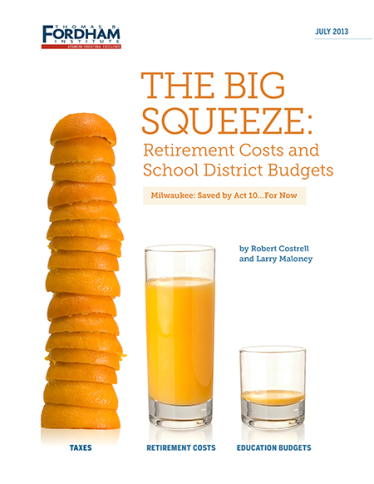
When it comes to pension reform in the education realm, it’s hard to stay positive. Here, we’re saddled with a bona fide fiscal calamity (up to a trillion dollars in unfunded liabilities by some counts), and no consensus about how to rectify the situation. No matter how one slices and dices this problem, somebody ends up paying in ways they won’t like and perhaps shouldn’t have to bear. All we can say is that some options are less bad than others.
As the challenges of education governance loom ever larger and the dysfunction and incapacity of the traditional K-12 system reveal themselves as major roadblocks to urgently-needed reforms across that system, many have asked, “What’s the alternative?”
When charter schools first emerged more than two decades ago, they presented an innovation in public school governance. No longer would school districts enjoy the “exclusive franchise” to own and operate public schools, as chartering pioneer and advocate Ted Kolderie explained. Charters wouldn’t gain all of the independence of private schools—they would still report to a publicly accountable body, or authorizer—but they would be largely freed from the micromanagement of school boards, district bureaucracies, and union contracts. Autonomy, in exchange for accountability, would reign supreme.

In an era of budgetary belt tightening, state and local policy makers are finally awakening to the impact of teacher pension costs on their bottom lines. Recent reports demonstrate that such pension programs across the United States are burdened by almost $390 billion in unfunded liabilities. Yet, most states and municipalities have been taking the road of least resistance, tinkering around the edges rather than tackling systemic (but painful) pension reform. Is the solution to the pension crisis to offer teachers the option of a 401(k)-style plan (also known as a "defined contribution" or DC plan) instead of a traditional pension plan? Would this alternative appeal to teachers? When Teachers Choose Pension Plans: The Florida Story sets out to answer these questions.
Many proponents of private school choice take for granted that schools won’t participate if government asks too much of them, especially if it demands that they be publicly accountable for student achievement. Were such school refusals to be widespread, the programs themselves could not serve many kids. But is this assumption justified? A new Fordham Institute study—to be released on January 29—provides empirical answers. Do regulations and accountability requirements deter private schools from participating in choice programs? How important are such requirements compared to other factors, such as voucher amounts? Are certain types of regulations stronger deterrents than others? Do certain types schools shy away from regulation more than others?

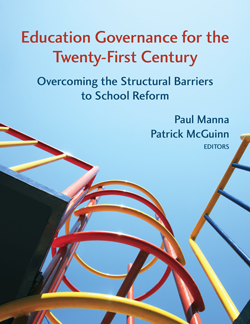
America’s fragmented, decentralized, politicized, and bureaucratic system of education governance is a major impediment to school reform. In Education Governance for the Twenty-First Century: Overcoming the Structural Barriers to School Reform, a number of leading education scholars, analysts, and practitioners show that understanding the impact of specific policy changes in areas such as standards, testing, teachers, or school choice requires careful analysis of the broader governing arrangements that influence their content, implementation, and impact.
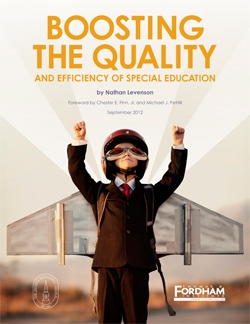
This new policy brief by Nathan Levenson, Managing Director at the District Management Council and former superintendent of Arlington (MA) Public Schools, offers informed advice to school districts seeking to provide a well-rounded, quality education to all children in a time of strained budgets. Levenson recommends three strategies: prioritize both achievement and cost-efficiency; make staffing decisions based on student needs, not student preferences; and manage special-education spending for better outcomes and greater cost-effectiveness.

This timely study represents the most comprehensive analysis of American teacher unions’ strength ever conducted, ranking all fifty states and the District of Columbia according to the power and influence of their state-level unions.

This groundbreaking study uses the largest database of information on special education spending and staffing ever assembled to uncover significant variance in how districts staff for special education. The report concludes that if the high-spending districts studied reduce their staffing in this area to the national median the public could save $10 billion and offers clear recommendations for improving special-education quality and efficiency.
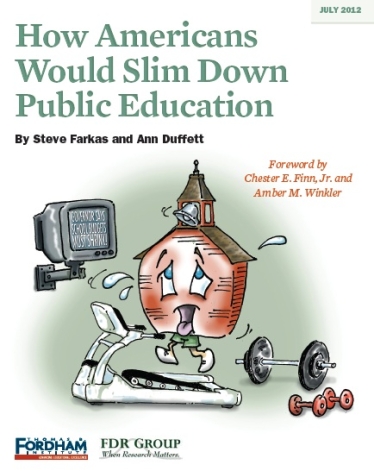
Education budgets are tight and state and district leaders must make tough decisions about where to save. But is the public willing to accept cuts? If so, where? According to the results of this new survey, many Americans are open—selectively open—to dramatic changes in how school districts do business.
The Common Core State Standards (CCSS) for English language arts and mathematics represent a sea change in standards-based reform and their implementation is the movement’s next—and greatest—challenge. Yet, while most states have now set forth implementation plans, these tomes seldom address the crucial matter of cost. This report estimates the implementation cost for each of the forty-five states (and the District of Columbia) that have adopted the Common Core State Standards and shows that costs naturally depend on how states approach implementation.

Can we be smarter about taking high-quality online and blended schools to scale—and to educational success? Yes, says this volume, as it addresses such thorny policy issues as quality control, staffing, funding, and governance for the digital sector. Read on to learn more.
The "new normal" of tougher budget times is here to stay for American K-12 education. So how can local officials cope? This policy brief, by Mike Petrilli, provides a useful tool for navigating the financial challenges of the current school-funding climate, complete with clear dos and don'ts for anyone involved in or concerned with local education budgets.

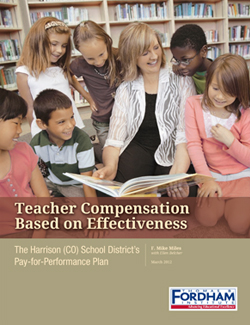
This report, authored by Superintendent Mike Miles, takes a detailed look at the Harrison (CO) School District 2's Pay-for-Performance Plan. The Harrison Plan confronted the dual challenges of defining an effective teacher and identifying all the things that demonstrate her effectiveness. This how-to guide is meant to serve as a tool and model for Ohio’s school districts.
In this paper, John Chubb examines how local school district control retards the widespread use of instructional technologies. He argues that the surest way to break down the system’s inherent resistance to technology is to shift control from the local district—and thus the school board—and put it in the hands of states. Download the paper to read the ten steps Chubb argues will get us to this brave new governance system.
Will the move toward virtual and “blended learning” schools in American education repeat the mistakes of the charter-school movement, or will it learn from them? The Thomas B. Fordham Institute, with the support of the Charles and Helen Schwab Foundation, has commissioned five deep-thought papers that, together, address the thorniest policy issues surrounding digital learning. The goal is to boost the prospects for successful online learning (both substantively and politically) over the long run. In this first of six papers on digital learning commissioned by the Thomas B. Fordham Institute, Frederick M. Hess explores the challenges of quality control.
Will the move toward virtual and “blended learning” schools in American education repeat the mistakes of the charter-school movement, or will it learn from them? The Thomas B. Fordham Institute, with the support of the Charles and Helen Schwab Foundation, has commissioned five deep-thought papers that, together, address the thorniest policy issues surrounding digital learning. The goal is to boost the prospects for successful online learning (both substantively and politically) over the long run.
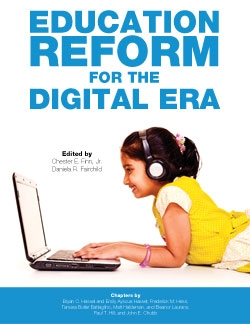
School reforms abound today, yet even the boldest and most imaginative among them have produced—at best—marginal gains in student achievement. What America needs in the twenty-first century is a far more profound version of education reform. Instead of shoveling yet more policies, programs, and practices into our current system, we must deepen our understanding of the obstacles to reform that are posed by existing structures, governance arrangements, and power relationships. Yet few education reformers—or public officials—have been willing to delve into this touchy territory.
This Fordham Institute publication—co-authored by President Chester E. Finn Jr. and VP Michael J. Petrilli—pushes folks to think about what comes next in the journey to common education standards and tests. Most states have adopted the Common Core English language arts and math standards, and most are also working on common assessments. But...now what? The standards won't implement themselves, but unless they are adopted in the classroom, nothing much will change. What implementation tasks are most urgent? What should be done across state lines? What should be left to individual states, districts, and private markets? Perhaps most perplexing, who will govern and own these standards and tests ten or twenty years from now?
This national survey of education school professors finds that, even as the U.S. grows more practical and demanding when it comes to K-12 education, most of the professoriate simply isn't there. They see themselves more as philosophers and agents of social change, not as master craftsmen sharing tradecraft. They also resist some promising reforms such as tying teacher pay to student test scores. Still, education professors are reform-minded in some areas, including tougher policies for awarding tenure to teachers and financial incentives for those who teach in tough neighborhoods. Read on to find out more.

More than 1.7 million American children attend what we've dubbed "private public schools"—public schools that serve virtually no poor students. In some metropolitan areas, as many as one in six public-school students—and one in four white youngsters—attends such schools, of which the U.S. has about 2,800.
When it comes to public-sector pensions, writes lead author Mike Lafferty in this report, "A major public-policy (and public-finance) problem has been defined and measured, debated and deliberated, but not yet solved. Except where it has been." As recounted in "Halting a Runaway Train: Reforming Teacher Pensions for the 21st Century," these exceptions turn out to be revealing—and encouraging. As leaders around the country struggle to overhaul America's controversial and precarious public-sector pensions, this study draws on examples from diverse fields to provide a primer on successful pension reform. Download to find valuable lessons for policymakers, workers, and taxpayers looking for timely solutions to a dire problem.
In this Fordham Institute paper, analysts examine public data and find that the proportion of students with disabilities peaked in 2004-05 and has been declining since. At the state level, Rhode Island, New York, and Massachusetts have the highest rates of disability identification, while Texas, Idaho, and Colorado have the lowest. Read on to learn more.
Political leaders hope to act soon to renew and fix the Elementary and Secondary Education Act (ESEA, also known as No Child Left Behind). In this important paper, Thomas B. Fordham Institute President Chester E. Finn, Jr. and Executive Vice President Michael J. Petrilli identify 10 big issues that must be resolved in order to get a bill across the finish line, and explore the major options under consideration for each one. Should states be required to adopt academic standards tied to college and career readiness? Should the new law provide greater flexibility to states and districts? These are just a few of the areas discussed. Finn and Petrilli also present their own bold yet "reform realist" solutions for ESEA. Read on to learn more.
In this volume, a diverse group of experts—scholars, educators, journalists, and entrepreneurs—offer wisdom and advice on how schools and districts can cut costs, eliminate inefficient spending, and better manage their funds in order to free up resources to drive school reform.
From Schoolhouse to Courthouse: The Judiciary's Role in American Education examines the role of the courts in modern American K-12 education. From race to speech, from religion to school funding, few aspects of education policy have escaped the courtroom. In this book, experts describe just what the impact of judicial involvement has been. Published jointly by Fordham and Brookings Institution Press.
This paper aims to promote a clearer understanding of the graduation-rate debate by distilling the policy developments and controversy surrounding the measurement of these rate. Why are there so many different ways to calculate graduation rates? How do these different rates account for the multiple pathways to graduation? What are the data sources used in the various dropout-rate calculations, and what are their pros and cons?
In this exciting, unique and challenging time, the Thomas B. Fordham Institute wants to congratulate President-Elect Obama and other new federal leaders. The federal government has a key role to play in creating a world-class education system in America but it's challenging to get that role right. This letter provides some guidance. Fordham experts review the current education policy landscape and its main players and offer their view of the ideal K-12 federal role. They also address the ten big policy battles looming on the horizon. The hope is that the letter will provide critical advice, insights and ideas for the new federal education leaders who are about to take on a big job.
In A Byte at the Apple, leaders and scholars map the landscape of education data providers and users and explore why what's supplied by the former often fails to meet the needs of the latter. Most important, it explores potential solutions--including a system where a "backpack" of achievement information accompanies every student from place to place.