Mobile Navigation

  • National
    • Policy
      • High Expectations
      • Quality Choices
      • Personalized Pathways
    • Research
    • Commentary
      • Gadfly Newsletter
      • Flypaper Blog
    • Events
    • Scholars Program
  • Ohio
    • Policy
      • Priorities
      • Media & Testimony
    • Research
    • Commentary
      • Ohio Education Gadfly Biweekly
      • Ohio Gadfly Daily
  • Charter Authorizing
    • Application
    • Sponsored Schools
    • Resources
  • About
    • Mission
    • Board
    • Staff
    • Career
Home
Home
Advancing Educational Excellence

Main Navigation

  • National
  • Ohio
  • Charter Authorizing
  • About

National Menu

  • Topics
    • Accountability & Testing
    • Advanced Education
    • Career & Technical Education
    • Charter Schools
    • Curriculum & Instruction
    • ESSA
    • Evidence-Based Learning
    • Facilities
    • Governance
    • Personalized Learning
    • Private School Choice
    • School Finance
    • Standards
    • Teachers & School Leaders
    • Think Again
  • Research
  • Commentary
    • Gadfly Newsletter
    • Flypaper Blog
    • Gadfly Podcast
  • Events
  • Scholars Program
Quality Choices

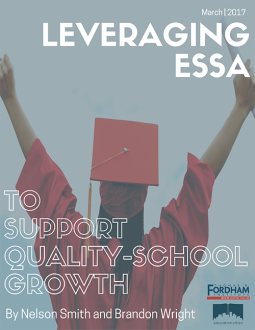
Leveraging ESSA to Support Quality-School Growth

Nelson Smith Brandon L. Wright
3.30.2017
3.30.2017

Under the Every Student Succeeds Act, the federal School Improvement Grants program is gone, but the goal of school improvement remains. States must now use seven percent of their Title I allocation for these efforts, but are no longer constrained by a prescribed menu of intervention options.

That represents a powerful opportunity for states—one that stakeholders at the city and state level would be wise to leverage.

To help guide efforts, the Thomas B. Fordham Institute and Education Cities partnered to offer insight into evidence-based school-improvement turnaround efforts that have been successful throughout the country. Authors Nelson Smith and Brandon Wright deconstruct key provisions in ESSA and dig into three promising approaches that can be supported via the Title I set-aside:

  1. Charter expansion: where states support the creation of new, high-quality charter schools to serve communities with low-performing district schools;

  2. State turnaround districts: where a state withdraws control of struggling schools from their districts and consolidates them under a state-led entity; and

  3. State-led, district-based solutions: where a state vests authority over existing districts or individual schools in a single individual who enjoys many of the powers usually exercised by district superintendents and school boards.

Leveraging ESSA to Support Quality-School Growth demonstrates that states need not do the same-old same-old when it comes to school improvement. Now the question is whether states will seize the opportunity.  

Policy Priority:
Quality Choices
Topics:
ESSA
Charter Schools
Governance
Tags: Every Student Succeeds Act School Improvement Grant
DOWNLOAD PDF
Nelson Smith

Brandon Wright is the Editorial Director of the Thomas B. Fordham Institute. He is the coauthor or coeditor of three books: Failing our Brightest Kids: The Global Challenge of Educating High-Ability Students (with Chester E. Finn, Jr.), Charter Schools at the…

View Full Bio

Related Resources

view
High Expectations

The State Education Agency: At the Helm, Not the Oar

Juliet Squire 4.21.2014
NationalReport
Fordham Logo

© 2026 The Thomas B. Fordham Institute
Privacy Policy
Usage Agreement

National

P.O. Box 110
Burke, VA 22009

202.223.5452

[email protected]

Ohio

P.O. Box 82291
Columbus, OH 43202

614.223.1580

[email protected]

Sponsorship

130 West Second Street, Suite 410
Dayton, Ohio 45402

937.227.3368

[email protected]