
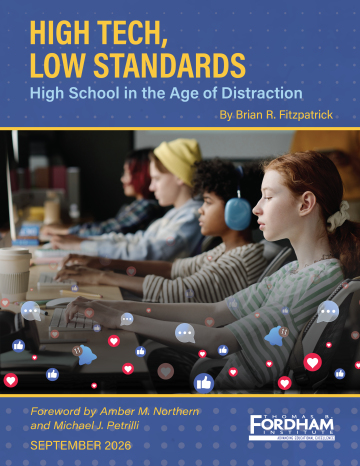
High Tech, Low Standards: High School in the Age of Distraction
A new national survey finds that school-issued devices, AI misuse, and grade inflation are undermining learning and leaving many students feeling unprepared for the future.
Does School Board Leadership Matter?
Are the nation’s 90,000-plus school board members critical players in enhancing student learning? Are they part of the problem? Are they harmless bystanders? Among the takeaways are the following:

Common Core in the Districts: An Early Look at Early Implementers
by Katie Cristol and Brinton S. Ramsey Foreword by Amber M. Northern and Michael J. Petrilli

Knowledge at the Core: Don Hirsch, Core Knowledge, and the Future of the Common Core
Children cannot be truly literate without knowing about history, science, art, music, literature, civics, geography, and more. Indeed, they cannot satisfactorily comprehend what they read unless they possess the background knowledge that makes such comprehension possible.

Public accountability & private-school choice
The Fordham Institute supports school choice, done right. That means designing voucher and tax-credit policies that provide an array of high-quality education options for kids that are also accountable to parents and taxpayers.

Financing the Education of High-Need Students
School districts face an enormous financial burden when it comes to educating our highest-need students. Financing the Education of High-Need Students focuses on three specific challenges that are often encountered when districts—especially small ones—grapple with the costs of serving their highest-need special-education students.
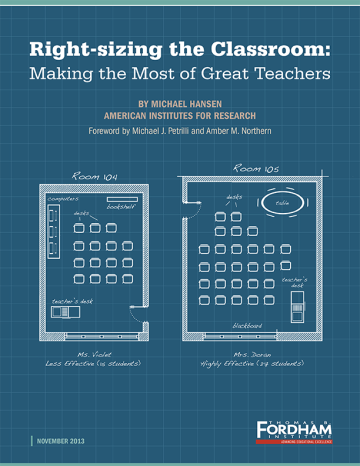
Right-sizing the Classroom: Making the Most of Great Teachers
In the overwhelming majority of American classrooms, pupils are divided roughly equally among teachers of the same grade in the same school. Parceling them out uniformly is viewed as fair to teachers—and doing otherwise might be seen as unfair. Parents might wonder, too.
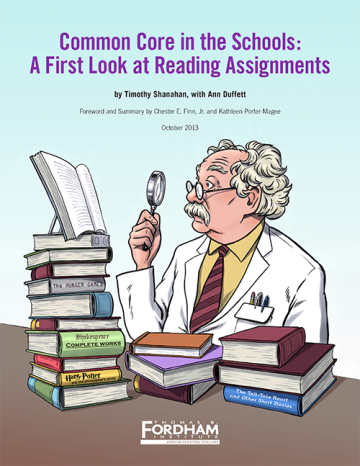
Common Core in the Schools: A First Look at Reading Assignments
In Common Core in the Schools: A First Look at Reading Assignments, researchers analyze what texts English teachers assign their students and the instructional techniques they used in the classroom.
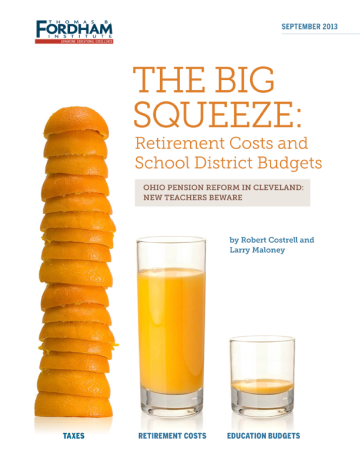
Ohio Pension Reform in Cleveland: New Teachers Beware
At first glance, the recent teacher-retirement reforms in Ohio seem to bring good fiscal news to school systems in the Buckeye State. Thanks to Senate Bills 341 and 342—and a series of cutbacks on retiree healthcare—the Cleveland Metropolitan School District is projected to spend less on retirement costs in 2020 than it does today. But these reforms come at a big price.

What Parents Want: Education Preferences and Trade-offs
This groundbreaking study finds that nearly all parents seek schools with a solid core curriculum in reading and math, an emphasis on science, technology, engineering, and math (STEM) education, and the development in students of good study habits, strong critical thinking skills, and excellent verbal and written communication skills.
Commentary on Appendix L: Alignment of the Next Generation Science Standards with the Common Core State Standards for Mathematics
Among the shortcomings of the NGSS is its acute dearth of math content, even in situations where math is essential to the study and proper understanding of the science that students are being asked to master. Also problematic is the alignment of NGSS math with the Common Core State Standards for mathematics. Appendix L of the NGSS seeks to explain the alignment and apply math more thoroughly to NGSS science. This commentary by Johns Hopkins mathematician appraises that appendix. Download Commentary on Appendix L: Alignment of the Next Generation Science Standards with the Common Core State Standards for Mathematics to read the appraisal.
Exemplary Science Standards: How Does Your State Compare?
With states weighing whether to adopt the Next Generation Science Standards (NGSS), a new analysis from the Thomas B. Fordham Institute compares the existing science standards of thirty-eight states with the NGSS and with exemplary standards from three other states. (The thirty-eight are those states with standards that are either “clearly inferior” to the NGSS or “too close to call,” based on our Final Evaluation of the Next Generation Science Standards and The State of Science Standards 2012.)

Milwaukee: Saved by Act 10...For Now
One of three technical reports on retirement costs and school-district budgets.