For years, Alabama’s schools were dismissed as a lost cause. But the state has recently made some of the largest literacy gains in the country. So what’s working, and what lessons does it offer the rest of the nation?
To find out, veteran journalist Liana Loewus traveled to Alabama, visited six elementary schools, and conducted dozens of interviews with state and district leaders, literacy experts, administrators, and teachers. Her findings reveal a state that has built an unusually comprehensive system for teaching children to read—anchored in the science of reading and driven by an informed, top-down policy structure; leaders who have stayed the course; and a robust coaching infrastructure.
In short, Alabama’s gains are not the product of any single reform. They reflect decades of work and a sustained commitment to getting reading instruction right, from the statehouse to the classroom.
Download the full report or read it below.
Foreword
By Meredith Coffey and David Griffith
No two states are exactly alike when it comes to K–12 education. Yet, to make progress, state leaders have little choice but to learn from one another’s experiences. Hence our continued interest in the “Southern Surge,” a modest bright spot in an otherwise grim K–12 education landscape, and our decision to report on recent developments in Alabama.
For the past decade, a handful of Southern states have been on an upward academic trajectory (though, as usual, the data are noisy). The most notable reforms associated with this positive trend center on the science of reading (though, as usual, a lot of other things were happening). Still, the journey remains long from “embracing the science” at the policy level to teaching reading effectively in thousands of classrooms. And, while the science of reading is reasonably settled, the science of its implementation is considerably less so.
Mississippi’s education successes have been well documented and much discussed, but far less has been written about its neighbor to the east.
Alabama first adopted literacy coaching in the early 2000s and subsequently saw the needle move on student reading achievement. While Alabama didn’t stick with it, Mississippi took heed and borrowed from its coaching model. Then, in the 2010s, Mississippi’s growing success motivated Alabama policymakers to recommit to a focus on literacy—and to borrow a few things from Mississippi. Judging from the most recent National Assessment of Educational Progress results, Alabama’s students are now starting to reap the benefits.
So, what lessons does the Camellia State’s recharged literacy work have to offer at this point? And are any of its ideas worth replicating elsewhere?
To address these questions, we commissioned Liana Loewus, one of the country’s most knowledgeable reporters on the science of reading, to investigate the status of Alabama’s reforms and report back on what she found.
Dozens of interviews later, she has produced an account of Alabama beating the odds, striking a sensible balance between the continuing need for humility and the necessity of continued forward motion.
Ultimately, she identifies three takeaways from Alabama for states that are looking for direction:
First, evidence-based reading instruction starts at the top, with a state education agency that understands the science and bolsters classroom practice.
Simply put, there are right and wrong ways to teach reading. And they look pretty similar in Huntsville and Mobile—and Boise and Scranton and Cincinnati. So, it’s vital that state leaders push districts, schools, and individual teachers in the right directions (and equally vital that those same leaders get the science right).
Second, state leaders must adopt and stand behind a multifaceted strategy for implementation.
After all, it’s one thing to require K–3 teachers to complete science-of-reading trainings. But it’s another thing entirely to provide a short list of approved curricula, build a sturdy pyramid of dedicated reading coaches, adopt a third-grade reading guarantee that pushes adults to intervene when students struggle, and stay the course when those policies generate pushback.
Finally, effective coaching requires defined roles, ample support, and steady funding.
Skilled reading coaches don’t appear overnight. And they won’t appear at all—and might disappear—if they aren’t properly trained and supported, if the requisite funding doesn’t materialize, or if competing priorities distract them from their primary mission. So, policymakers should do their best to build and fund their coaching corps for the long run.
No, it’s not cheap, financially or politically. But then again, neither is a systemic failure to teach students to read.
Introduction
Over the last several years, many education eyes have focused on Mississippi. The Magnolia State made seemingly miraculous gains in literacy, rising from 45th among states on the fourth-grade National Assessment of Educational Progress (NAEP) in 2015 to 18th in 2019. In 2024, it leapt another five spots toward the top.
Mississippians steeped in the policy changes that drove these gains tend to stress two points: (1) The growth was no miracle—it took many years of work, and (2) the state learned early lessons from its neighbor to the east.
“Mississippi took a lot of cues from Alabama,” says Kelly Butler, the former chief executive officer of the Barksdale Reading Institute, a philanthropically funded effort to train teachers and improve reading instruction across Mississippi. In the early 2000s, “they were doing great stuff.…But they abandoned [those efforts] and we ran with them.”
Now, however, Alabama is riding a second wave of policy reforms, and its scores are on the rise again. It’s part of the so-called “Southern Surge” of states making academic gains since the pandemic.
These states provide rays of hope in what many consider an otherwise bleak national trajectory for learning. A recent report from the Education Scorecard argues that the U.S. has been in a “learning recession” since 2013, when student progress in math and reading began to decline. The achievement losses in the pre-COVID years (2017–19) were as large as those that occurred during the pandemic. Only very recently has some evidence of national recovery emerged for young learners.
And then there’s Alabama. Despite having long been regarded as “America’s educational basement” (to borrow a term from journalist Nicholas Kristof), it has been one of the few states to show academic improvement over the last two rounds of NAEP. After falling below the national average for fourth-grade reading between 2013 and 2022, the state is closing the gap again. Its 2024 average scale score was 213, just two points below the national average (Figure 1). As Butler notes, Alabama has “come full circle…and then some.”
Figure 1. Alabama’s fourth-grade reading score is roughly on par with the national average for the first time since 2011.
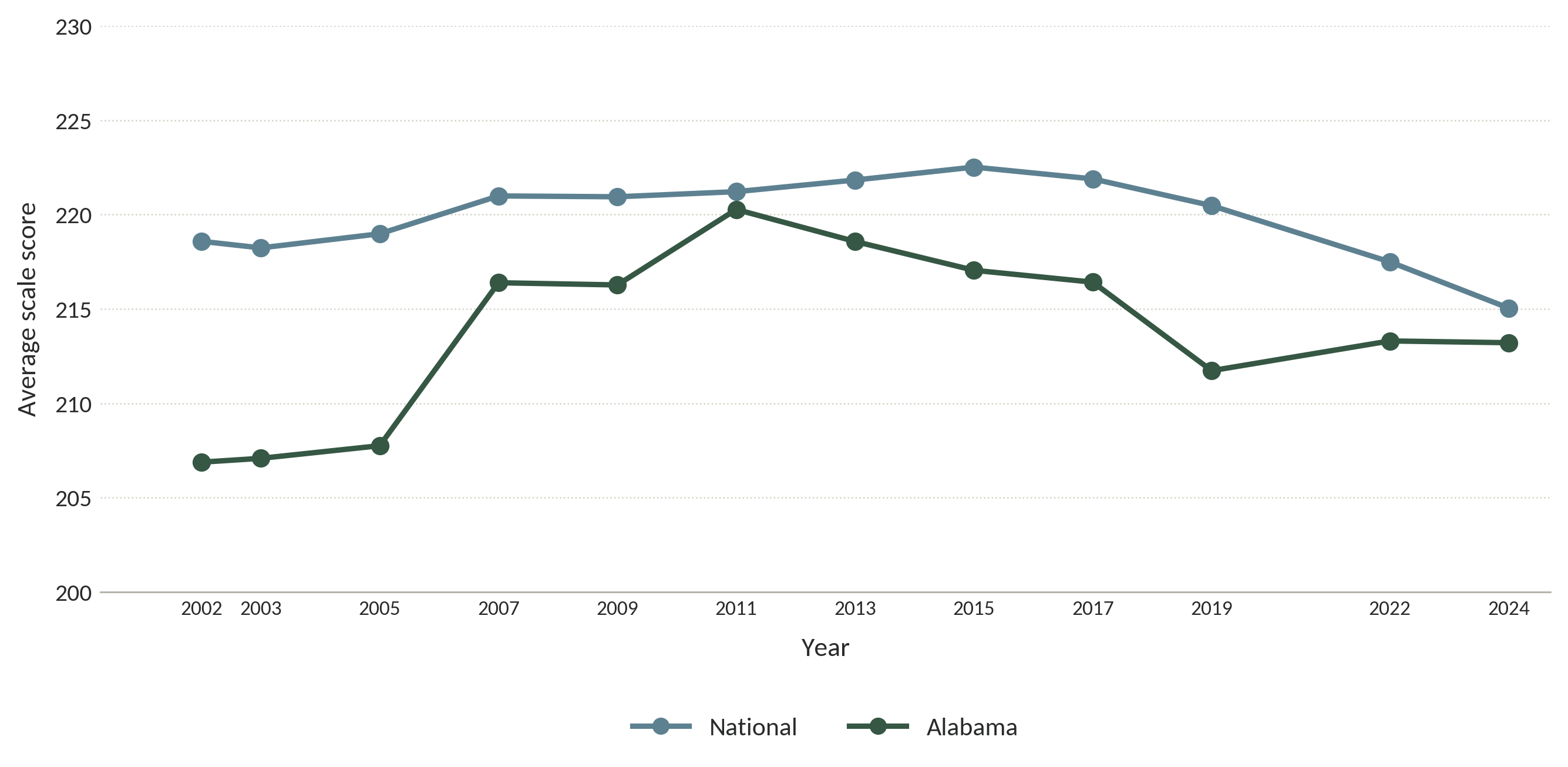
Note: Data come from the NAEP Data Explorer.
In fact, Alabama was one of just two states that not only rose in the rankings but actually improved its fourth-grade NAEP reading scores between 2019 and 2024. (Louisiana was the other.)
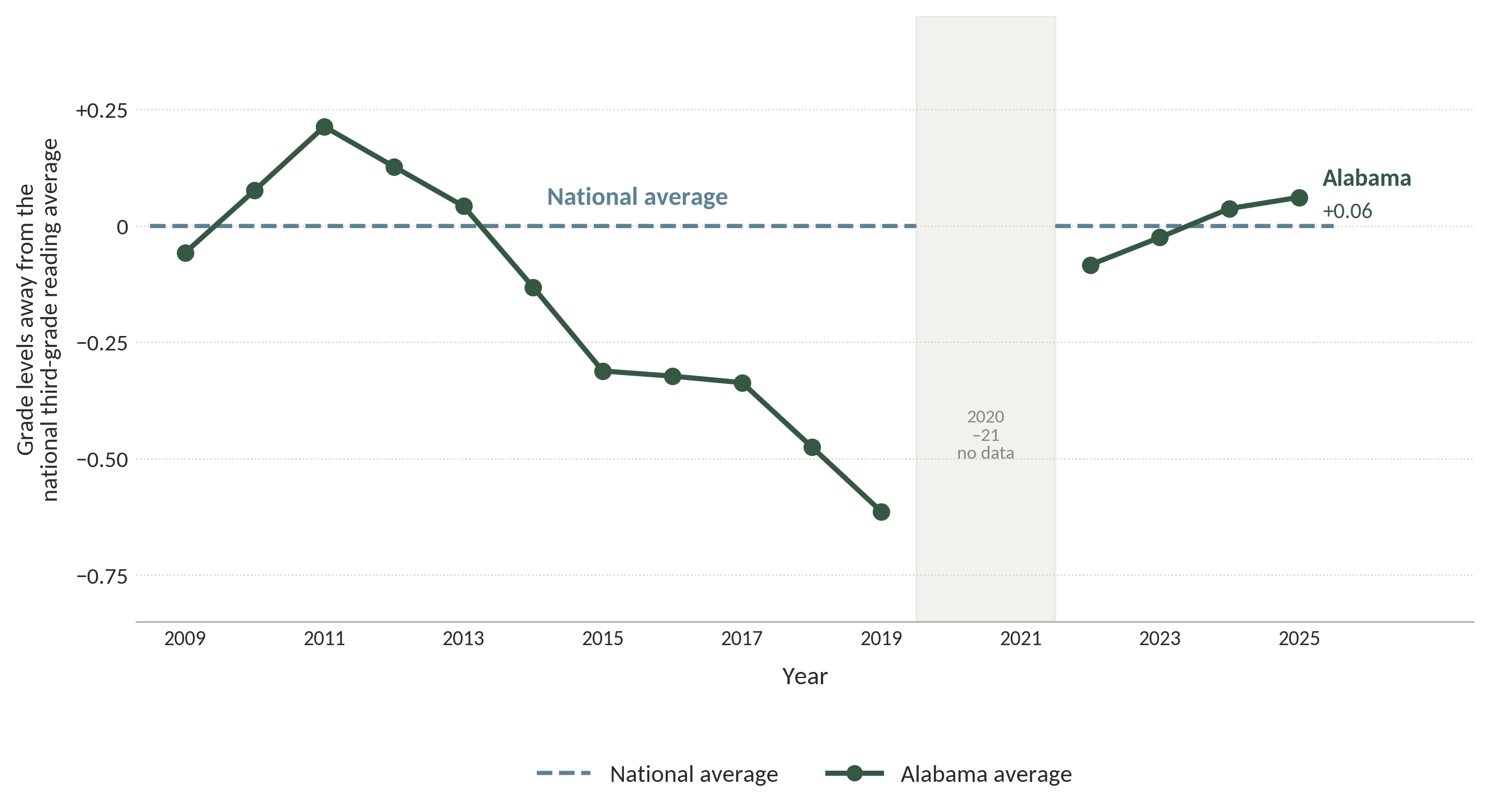
Likewise, data from state assessments (gathered and rendered comparable via the Stanford Education Data Archive) show post-pandemic literacy gains among third graders (Figure 2). In 2019, Alabama third graders were reading about 0.6 grade levels below the national average; as of 2025, they read at 0.06 grade levels above the national average.
Figure 2. State reading assessment scores for Alabama third graders exceeded the national average in 2011, declined, and then rose above the national average again starting in 2024.
Note: Data gathered from the Stanford Education Data Archive and calculated by the Thomas B. Fordham Institute (TBFI) research team. Numbers show grade levels above or below the national third-grade reading average (=0). National average is student weighted, and the 2025 figure is based on 38 reporting states.
Alabama’s recent gains undoubtedly reflect multiple forces operating at once: state literacy policy, dedicated state and local leadership, school accountability, renewed coaching investments, curriculum changes, attendance efforts, and federal pandemic relief, among others. This report should not be read as a causal estimate of any single reform, nor does it seek a silver bullet. Instead, it identifies the policy and implementation conditions that Alabama educators, state leaders, and available data point to as most plausibly connected to the improvements.
This report reviews what’s worked to improve achievement across Alabama since the pandemic. It focuses on kindergarten through third-grade reading, as these years are critical for establishing foundational literacy and at the center of Alabama’s recent state policy changes. Specifically, this report addresses three questions:
- Who were the state leaders championing policy and instructional changes over the years? How did their efforts help create the conditions for the recent achievement gains in reading?
- What policy levers have been most effective in ensuring teachers use evidence-based materials and strategies in teaching reading?
- How have districts adapted to the changes mandated by the state? What implementation challenges remain for local education agencies?
To understand how state policies play out in practice, we draw from interviews with more than 30 experts at both the state and local levels, including current and former state education department officials, state legislators, superintendents, district administrators, curriculum specialists, coaches, teachers, policy experts, and researchers. This approach allows us to examine not only what policies intend to do, but also how district decisions and school-level implementation shape their effects.
Two focal districts, Birmingham City and Butler County, were selected from a larger sample that met certain criteria, including serving at least 2,000 students, having a higher percentage of economically disadvantaged students and students of color than the state average, and showing recent improvement in both reading and math achievement. The author also visited three schools in each district: Birmingham’s South Hampton K–8 School, Hayes K–8 School, and Charles A. Brown Elementary School; and Butler County’s Greenville Elementary School, W.O. Parmer Elementary School, and Georgiana School.
The report is organized as follows: The first section analyzes statewide history and policy from the 1990s until 2018; the second examines the specifics of the landmark 2019 Alabama Literacy Act; and the third and fourth present case studies of two districts: Birmingham City Schools, which serves about 20,000 students, and Butler County School District, which serves about 2,600 students.
Alabama Literacy Policy, 1998–2018
The recent gains in Alabama are rooted in decisions made long ago—efforts that were abandoned as funding priorities shifted, then reignited when the impact of their abandonment became clear.
The Alabama Reading Initiative
Alabama’s literacy leaders say that their state’s current literacy efforts started with Katherine Mitchell, the “grandmother” of the Alabama Reading Initiative (ARI) and an early adopter of what’s now referred to as the science of reading. In 1979, Mitchell came to the Alabama State Department of Education with the idea that she could help get all kids reading. She’d spent her doctoral studies looking at whole language versus explicit phonics-based approaches to instruction, and the evidence was definitive: Children needed to learn phonics systematically to become readers.
Mitchell had implemented this approach in New York City and was ready to bring it to her home state. After nearly two decades in other roles at the department, she finally got her chance. In 1998, she pulled together $1.5 million in fundraising from unlikely allies—the nonpartisan A+ Education Partnership and the conservative Eagle Forum—and ARI was born.
At the time, whole language “had a total grip on the state,” says Mitchell, who retired in 2008. Having two politically dissimilar groups come together to support her idea of moving to a phonics-based approach was a huge benefit to the cause.
“I had two advocates. Two political, traditional opponents, but they both wanted the same thing,” says Mitchell. “They wanted kids to read in Alabama.”
As of 1998, NAEP results showed that 44 percent of Alabama’s fourth graders were reading below the basic level. (Nationally, 39 percent of fourth graders performed below basic.) Among eighth graders, 34 percent scored below the basic level.
ARI began with 16 participating schools (14 elementary, one middle, and one high school) and no staff. “Nobody in the state knew anything about phonemic awareness and phonics. Nobody in the state knew anything about effective intervention,” says Mitchell. She assembled a panel of teachers to create training modules on reading comprehension and wrote the foundational skills sections herself.
This was just before the National Reading Panel released its seminal report in 2000, which confirmed the need for explicit, systematic phonics instruction, along with phonemic awareness, vocabulary, fluency, and comprehension. The panel’s report is at the heart of the science-of-reading movement, which journalist Emily Hanford highlighted and propelled in her 2018 radio documentary Hard Words and subsequently her Sold a Story podcast.
The initial ARI effort was by many counts a success. Reading scores rose faster at the 16 “literacy demonstration sites” than at nonparticipating schools. The percentage of struggling readers decreased, and special education referrals declined.
In light of this success, then-state superintendent Ed Richardson pushed for continued ARI funding. The state legislature awarded the program $6 million for the 1999–2000 school year, allowing it to expand significantly.
Coaching became central to ARI’s efforts, and by the mid 2000s, every elementary school in Alabama had a reading coach who was paid and trained by the state. Coaches received intensive, systematic professional learning in research-based instructional practices and worked side by side with teachers.
“It was incredibly successful and became a national model,” says Mark Dixon, who has served as president of the A+ Education Partnership since 2019.
In 2007, Joe Morton, then state superintendent of education, pushed ARI to focus on K–3. At the time, the federal Reading First program was also focused on improving reading achievement in those grades.
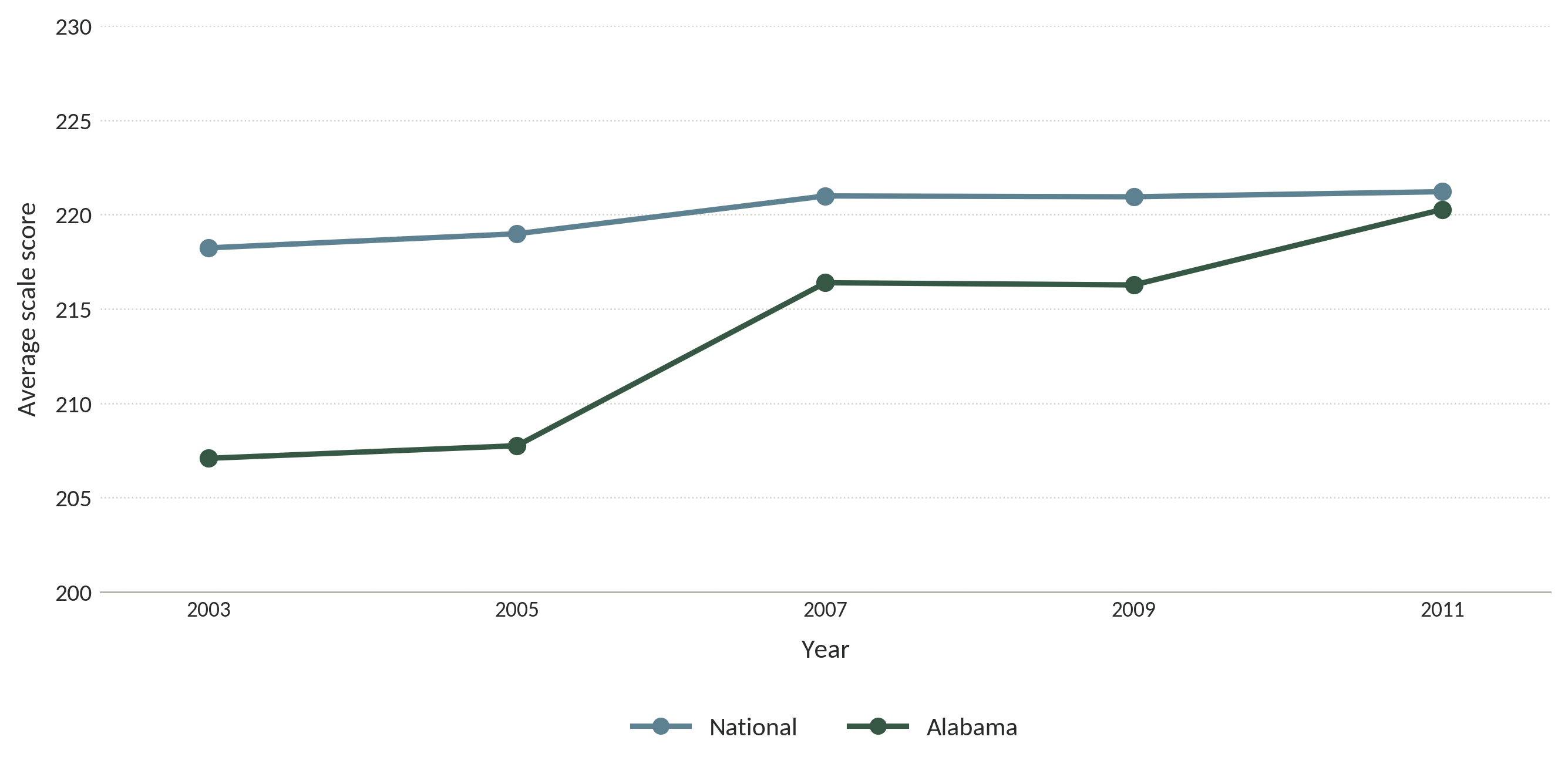
Further NAEP gains suggested that the national attention Alabama was receiving was merited. From 2005 to 2007, fourth-grade reading scores jumped by eight points (from 208 to 216)—the largest increase in the country over that period (Figure 3). Between 2003 and 2011, Alabama’s fourth-grade reading scores went up 13 points (from 207 to 220), bringing the state effectively on par with the national average (221) for the first time.
Figure 3. Alabama’s fourth-grade literacy performance improved between 2003 and 2011.
Note: Data come from the NAEP Data Explorer.
A Loss of Focus
And then, in the 2010s, the wheels began to come off.
First, under the directive of then-state superintendent Thomas (Tommy) Bice, ARI expanded to all K–12 grades in 2012, meaning reading coaches at each school had more duties and less time to work with individual teachers and students. Upper-grade teachers were, in some cases, resistant to the focus on reading instruction and the support from coaches.
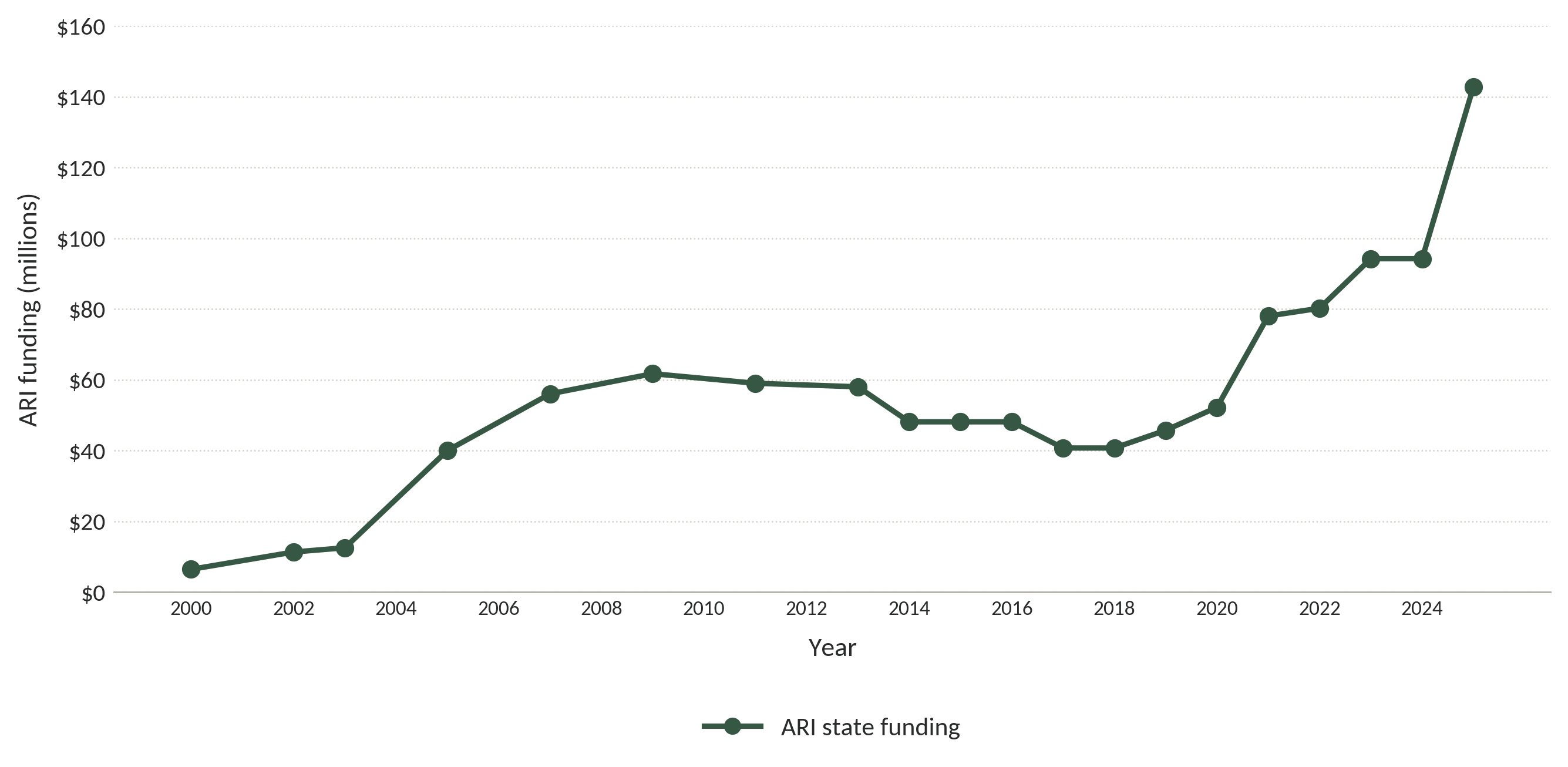
Second, the state legislature’s allocation for ARI fell from $58 million in 2013 to $40.7 million in 2018.
By changing ARI coaches’ roles, “we shot ourselves in the foot,” says Sonya Yates, the associate policy director for literacy at the nonprofit ExcelinEd and a key contributor to the Alabama Literacy Act. “Not intentionally.”
A report on ARI’s outcomes from 1999–2015 by the Auburn Center for Evaluation found that the “widened focus and the move from a K–3 to a K–12 coaching model…had a negative impact on teacher buy-in, support for early grade readers, and for enthusiasm for the program among many teachers.” It also found that expanding to K–12 had the “unintended consequence” of putting teachers with less reading expertise into coaching roles, making them less effective.
“We kind of took our eyes off the ball with reading instruction,” says Thomas Spencer, a senior research associate for the Public Affairs Research Council of Alabama (PARCA). “We did not make that the central focus, and we started seeing that downward drift.”
Subsequently, Alabama’s fourth-grade reading scores on NAEP dropped below the national average again in 2013 and continued their decline. By 2019, the state ranked last in the country in fourth-grade reading—at a time when national achievement scores were drifting downward, especially for the lowest-performing students.
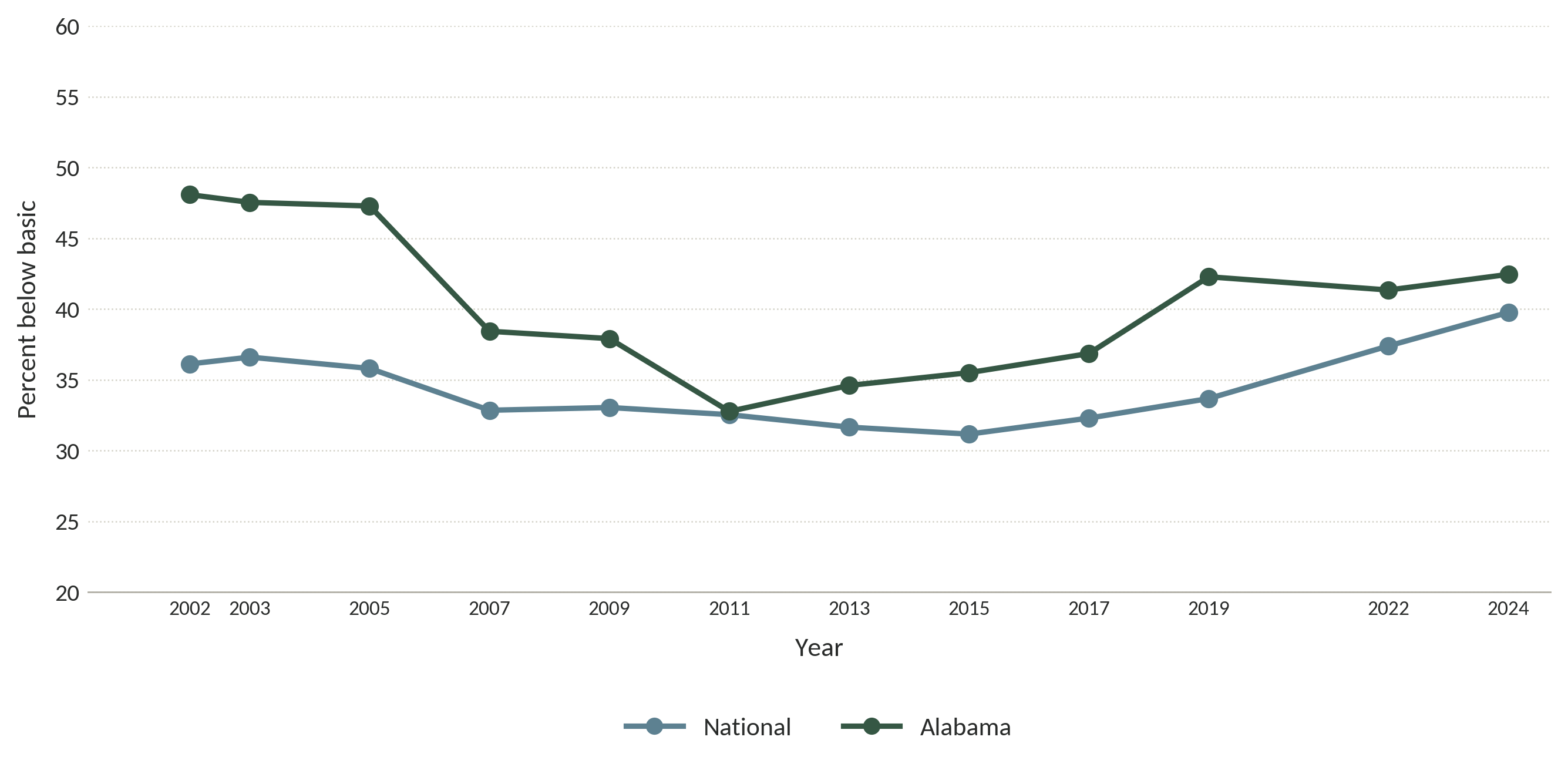
The percentage of Alabama students performing below the basic level on NAEP also increased between 2011 and 2022, climbing well above the national average (Figure 4).
Figure 4. After a decade of progress, the share of Alabama students who were reading below the basic level began rising starting in 2011.
Note: Data come from the NAEP Data Explorer.
Spurred to Action
By 2018, Mississippi had made huge gains in reading and had become the benchmark to meet. Not wanting to be outdone by their next-door neighbors, and driven at least partly by state pride, Alabama’s literacy advocates took action.
“When Mississippi was passing us, we called attention to that,” says Spencer of PARCA. “That inspired us to get back to basics.”
A group of Alabama legislators, education department staff, state board members, and advocates went to the Magnolia State to see what was working there.
Representative Terri Collins, then chair of the House Education Policy Committee, was among those to make the trip. She returned certain that Alabama needed a literacy law to improve coaching, professional development, curriculum, and assessments. And like Mississippi’s 2013 literacy law, she thought, any forthcoming legislation needed a provision ensuring that third graders who were not proficient readers would not be promoted to fourth grade.
“If you pass a child who can’t read out of the third grade, you’re failing that individual child,” she says. The policy instills “that sense of urgency.”
Following the trip, Alabama began piloting a teacher training program used in Mississippi known as Language Essentials for Teachers of Reading and Spelling (LETRS), with 200 teachers taking the course in 2018.
That same year, the state’s new accountability system took effect. Championed by Collins and passed by the legislature six years prior, the system uses student achievement, academic growth, chronic absenteeism, progress in English-language proficiency, graduation rates, and college and career readiness to calculate A–F grades for schools and districts.
The Alabama Literacy Act, or ARI “on Steroids”
In 2019, Collins and Representative Alan Baker cosponsored the Alabama Literacy Act. With the exception of A+ Education, most education advocacy groups opposed the bill, with particular controversy around its third-grade retention provision. There was a sense of confidence among its opponents that the bill would not pass.
Yet, many legislators had been swayed by the Mississippi visit and, some say, a moving (and uncomfortable) simulation Yates did for the House education committee on what it feels like to struggle with reading. Yates, then president of the Alabama Dyslexia Advisory Council (created by the state board of education in 2015), asked legislators to read a copy of “Little Red Riding Hood” written in Old English. She role-played the “mean teacher,” ridiculing lawmakers when they struggled to decode the text.
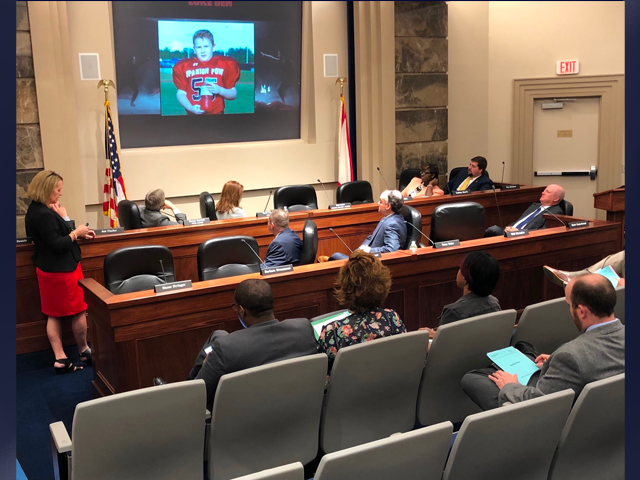
The bill passed the legislature overwhelmingly—92–3 in the House and 26–0 in the Senate—and Governor Kay Ivey signed it into law that June.
But when it came to implementing the Literacy Act, which Collins called “ARI on steroids,” the real battle began.
“It took a while to get everyone going in the same direction,” says Yates, who from 2021 to 2023 chaired the Alabama Literacy Task Force, a group created by the Literacy Act to vet curricula and assessments. “I don’t want to portray that it was easy, because it was not easy.”
There were disagreements between the task force and state board about how many curricula should make the approved list from which the law requires districts to choose. Some educators pushed back on the new training requirements. The retention mandate posed the biggest hurdle. Many teachers and administrators feared having to hold back a large percentage of third graders, particularly since COVID had interrupted learning. State Superintendent of Education Eric G. Mackey expressed concerns about the provision as well.
In February 2021, the legislature passed a bill to delay retaining any third graders for two years (until 2024–25)—a move supported by the Alabama Education Association and the School Superintendents of Alabama. Ivey issued a rare veto, saying the state needed to stay the course until seeing more data. She later approved a bill with a one-year delay on holding students back.
Table 1 summarizes the law’s major pillars.[1] See also How Alabama’s Literacy Law Compares to Others.
Table 1. The Alabama Literacy Act expanded and strengthened the state’s prior efforts.
| Policy Area | Key Regulations |
|---|---|
| Educator preparation and licensure | Educator-prep programs (EPPs) must require at least nine hours of coursework on the science of reading, and new teachers must pass an exam aligned to the science of reading. |
| Coaching | Coaches must be trained on the science of reading, and schools are prohibited from assigning coaches other responsibilities. |
| Curriculum | K–3 core reading programs must be based on the science of reading. Districts must select programs from an approved list. |
| Retention | Students who do not demonstrate reading sufficiency by the end of third grade will not be promoted to fourth grade (with numerous good-cause exemptions). |
| Assessment | K–3 students must be assessed at least three times a year on foundational reading skills. |
| Parent notification | Parents must be notified within 15 days if their child exhibits a reading deficiency. |
| Intervention | K–3 students who exhibit a reading deficiency or signs of dyslexia must be given an appropriate, science-based reading intervention and a reading improvement plan. Districts must offer summer reading camps for these students. |
Note: The law went into effect in September 2019, but the retention mandate was postponed due to COVID-related learning disruptions. The latter went into effect in the 2023–24 school year.
Since the law’s passage, three powerful champions—Superintendent Mackey, Representative Collins, and Governor Ivey—have pushed hard to keep the state focused on literacy outcomes.
The state superintendent’s work on the ground has been key to motivating swift compliance with the Literacy Act. Mackey, who began his career as a teacher and has served in his current role since 2018, has prioritized face time with district leaders, speaking with superintendents daily and meeting with groups of a dozen leaders weekly. He remains adamant that the state be viewed as a source of support, not a threat.
“Even though we may have that authority from the legislature [to direct policy], we don’t abuse it. Because we see all our superintendents, our school boards, as partners,” he says. “We want them to buy in. We show up when they call.”
Collins has long championed accountability based on student results and, as a member of the education budget committee, has consistently pushed hard for increasing ARI funding.
Ivey, who worked as a high school teacher early in her career, has held fast to her commitment to high expectations, including with her unexpected veto of the delay on retention. With Ivey’s support, lawmakers have also continued to increase investment in ARI. For 2026–27, the initiative is funded at $152 million.
The following sections examine four of the act’s pillars that Alabama leaders point to as powerful levers for change: teacher preparation, coaching, curriculum, and third-grade retention.
Educator-Preparation Programs
As more states and districts have adopted curricula and instructional practices aligned with well-established cognitive science, many educator-preparation programs (EPPs) have been slower to make changes. But in Alabama, the process has accelerated recently.
That’s because the state became more prescriptive about how EPPs need to prepare teachers, evaluated all programs for alignment, and put funding on the line for programs that fail to deliver.
Alabama has 19 public and six private EPPs. The Alabama Literacy Act states that programs “leading to the attainment of an initial elementary teaching certification shall require no less than nine credit hours of reading or literacy coursework, or both, based on the science of learning to read, including multisensory strategies in foundation reading skills.” Under the law, EPPs also need to offer approved dyslexia-therapy courses.
To gauge whether EPPs’ courses were aligned to the science of reading, the state education department hired experts from Mississippi’s Barksdale Reading Institute to lead an external review in the spring of 2020. The reviewers agreed to publicly release results in aggregate, with no school names attached.
The $1.4 million Barksdale study found that just 31 of the 133 individual early-literacy courses reviewed (23 percent) were fully aligned to evidence-based instructional practices. About half of the courses were inconsistently aligned, “reflecting a confusing mix of SOR and non-SOR practices,” the report states, and 16 percent were not aligned at all. (About 10 percent did not provide sufficient information to determine alignment.)
Of the 93 college textbooks in use across the state, the reviewers found that 83 percent promoted “non-explicit methods for teaching reading and writing,” which is in contrast to the science.
Butler of the Barksdale Reading Institute presented the findings to the state board in 2022, saying that many courses were still using whole language or balanced literacy practices in addition to science-based instruction.
Higher education was hesitant, many say, to alter their courses and textbooks. “Some EPPs were still struggling with the internal, is this another pendulum swing? Where is this going?,” says Lauren Brannan, an ARI regional literacy specialist and former assistant professor at the University of South Alabama.
That same year, however, the state added teeth to the law, imposing a penalty of at least $1 million on programs that did not comply by January 2, 2023. The threat of losing funding “got the presidents of the colleges involved,” says Yates.
Moreover, in 2024, the Alabama state board of education adopted new standards for teacher preparation based on the International Dyslexia Association’s knowledge and practice standards.
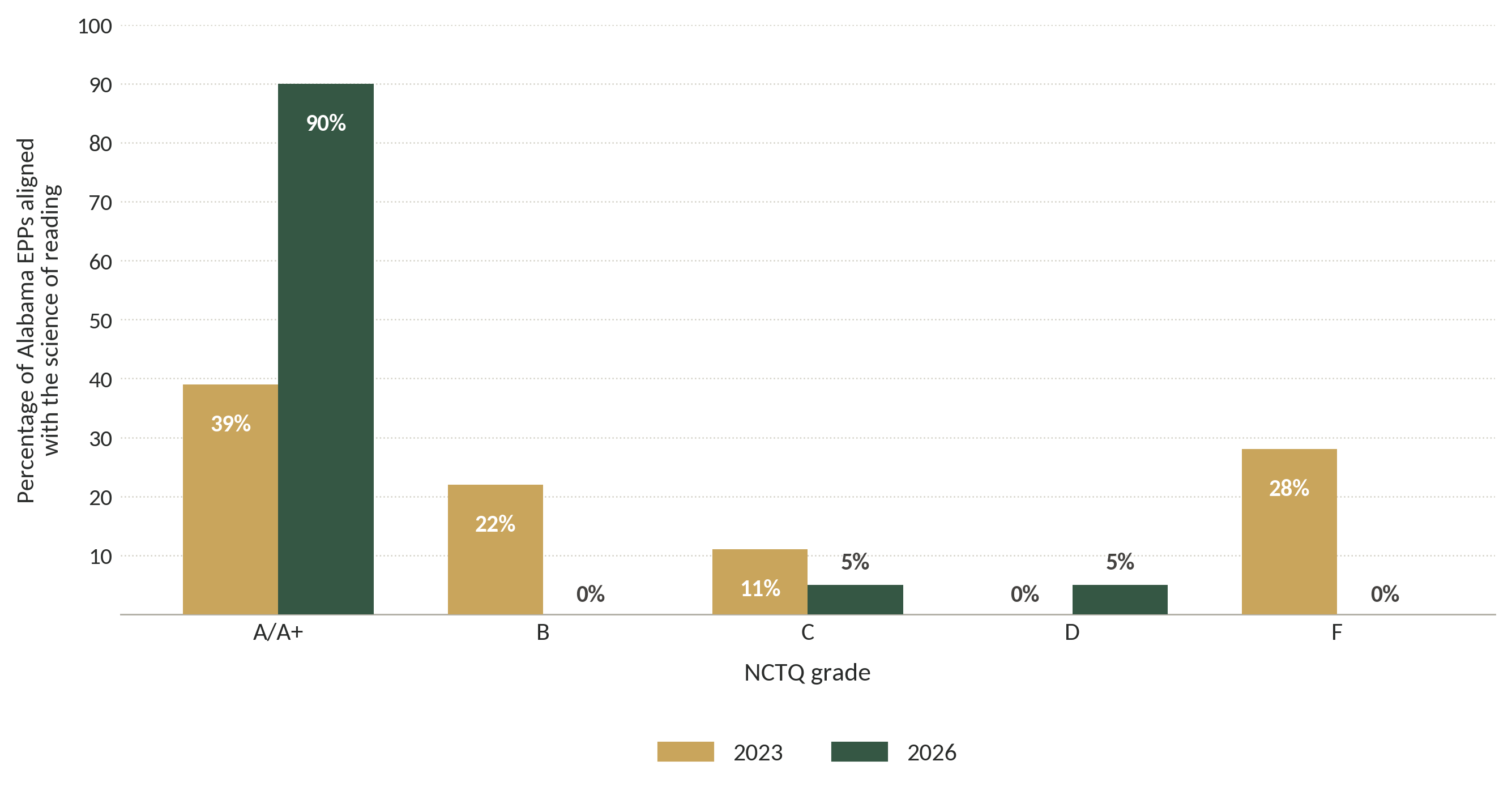
Today, according to a June 2026 review of EPPs by the National Council on Teacher Quality (NCTQ), 18 of the 20 Alabama EPPs evaluated (90 percent) earn an A for alignment to scientifically based reading instruction.[2] That’s up from 7 out of 18 (39 percent) earning an A in NCTQ’s 2023 report (Figure 5).[3]
Figure 5. The percentage of Alabama EPPs aligned with scientifically-based reading instruction has more than doubled in the last three years, an NCTQ study found.
Note: Data come from NCTQ’s Teacher Prep Review: Decoding Progress in Reading Preparation (2026).
ARI has also recently begun offering coaching for professors at teacher colleges. Many professors have taken LETRS training, and others have joined “research-to-practice labs,” where they observe other professors’ classes to see how colleagues implement research-based strategies with teacher-candidates. Currently, two regional literacy specialists, including Brannan, spend half their time supporting EPPs in better aligning their syllabi and courses to research-based practices.
“The beautiful thing about ARI is we get to be the support. The Alabama Literacy Act and our certification office, ALSDE [the Alabama State Department of Education]—they are the pressure,” says Brannan. “When we go into EPPs, we’re not there to evaluate them. We’re just there to be a partner. We’re there to listen, find out what it is they need, and find out how we can support them in meeting their goals and being compliant with the law.”
Adds Mackey: “Our institutions have come around to adopting better college textbooks, better reading strategies, training their own professors in LETRS and the science of reading. We’re going to see better teachers graduate because of that.”
Many leaders are hopeful, but it’s too early to tell whether the changes to EPP coursework are paying off in student learning.
Coaching: An Individualized Approach to Teacher Training
Nearly 30 years ago, when Mitchell began training reading experts at schools, she balked at calling them specialists. “It reeks of special,” she says, “and I believe every teacher has to know how to do this job. That’s why I called them coaches.” The term also made sense in the football-centric state.
As noted earlier, the achievement declines of the 2010s coincided with the rapid expansion of coaches’ duties. “In that effort to expand it and share it, we watered it down,” says Yates.
It’s a mistake that experts across the state are hoping will not be repeated.
That’s because there’s strong evidence that supports teacher coaching: A 2018 meta-analysis by Matthew Kraft and Dylan Hogan of Brown University and David Blazar of Harvard University found large positive effects of coaching on teachers’ instructional practices, as well as positive effects on student achievement.
“I think lawmakers have hopefully learned the lesson…that the reading coach position is not one you can repurpose for other things,” says Spencer of PARCA. “It has to be sustained over time. It’s not a situation where you train a particular set of teachers that is going to be able to carry it out in perpetuity. Because there’s a lot of [teacher] turnover, and coaching’s a continuous thing.”
Indeed, Alabama’s new literacy law is specific about the kind of training that coaches need. That includes “advanced coursework or professional development in the science of reading, such as multisensory language instruction” and “a knowledge of scientifically based reading research, special expertise in quality reading instruction and intervention, dyslexia specific interventions, and data analysis.”
These days, the state formally refers to school-based coaches as local reading specialists, but the role, for the most part, still reflects Mitchell’s early vision: The coaches sit side-by-side with teachers, providing mentoring, helping write instructional plans, modeling lessons, monitoring student progress, and analyzing classroom data to help differentiate instruction. Coaching is especially crucial in a state with a growing percentage of emergency-certified teachers, who tend to lack formal training. About 6 percent of Alabama teachers held emergency certification in 2024–25, the most recent year for which there are federal data. That’s up from 1 percent in 2018–19.
The law also lays out what coaches are not allowed to do. It states that a local reading specialist “may not perform administrative functions such as serving as an evaluator, substitute teacher, assessment coordinator, or school administrator.”
Rooted in Alabama’s decades-long history of coaching, and strengthened through the Literacy Act, the ARI coaching model has two distinctive features.
1. Building-Level Coaches
For about two decades, the state has funded a literacy coach at every elementary school. “It’s consistent throughout the state,” says Yates. “It’s equitable. Just because you live in one of the more affluent school districts doesn’t mean that you get better coaching than you would get if you were in a more rural, high-poverty area.”
(Some educators argue, however, that one coach per school is not truly equitable, since the number of teachers per school varies greatly.)
With one in every elementary school, about 750 of these building-level coaches work across Alabama. Another 100 or so regional literacy specialists support the building-level coaches and principals. And at the top of the coaching ladder is the ARI state team of about ten specialists (Figure 6). All reading coaches are trained in research-based instructional practices, as the state’s literacy law requires.
To have this many state-funded employees devoted solely to literacy sets Alabama apart from other states. Many states don’t have even one fully dedicated education department lead focusing on literacy.
Figure 6. Alabama mandates a robust coaching ladder.
Note: Information comes from the Alabama State Department of Education’s 2025 Semi-Annual Report.
Coaches are clearly an investment (Figure 7). Schools are allocated $85,000 each to pay their building-level coach. Coaching “is the most expensive part of my budget,” says Short, the ARI director. “It’s where most of my money goes. It’s people, not programs, that are going to make a difference in the life of a kid.”
Figure 7. ARI funding dipped after 2013 but has risen dramatically since 2019.
Note: Data come from the Alabama State Department of Education’s 2025 Semi-Annual Report.
A new and crucial stipulation in the Alabama Literacy Act is the state-level commitment to protecting coaches’ time. Mackey is unequivocal: Before giving districts their funding allocation for building-level coaches, he requires superintendents to sign a memorandum of understanding stating that these coaches “may not perform administrative functions such as serving as an evaluator, substitute teacher, assessment coordinator, school administrator, full-time interventionist, or instructional coach above third grade.”
Mackey says he gets calls when district administrators aren’t adhering to the agreement. And he makes changes as needed.
2. Coaches for the Coaches
Those school-based coaches have coaches as well. Known as regional literacy specialists, they offer support and mentoring. While regional specialists generally serve multiple schools, the Literacy Act instituted a form of triage: The lowest-performing 5 percent of elementary schools each receive a dedicated regional literacy specialist who works there until the school has improved. Other schools receive “limited support” from a regional literacy specialist who serves multiple schools.
As noted, ARI also employs ten state-level specialists, who in turn support the regional specialists. (ARI is also training 150 dyslexia therapists, per state law.)
The tiered coaching structure means everyone has someone to turn to for personalized feedback. A regional literacy specialist may work with a school-based coach to plan a coaching cycle that the school-based coach then carries out with an individual teacher. Or the regional specialist might sit in on a few coaching sessions with the teacher and offer feedback to the school-based coach. “True implementation happens in the side by side, in the doing,” says Short. “It’s not just coaching in the literacy instruction but also making sure that the coaches know how to coach.”
“Alabama has always done such a great job with their coaching model, their framework of making sure that it’s seen as a support rather than something that’s negative,” says Yates.
This state attention to struggling schools has been impactful, many say. Of the 55 schools designated as needing intensive support in 2019, 35 (or nearly 65 percent) moved into limited support status by 2022.
Curriculum
The Literacy Act mandates that districts use state-approved curricula aligned to the science of reading. Since 2023, Alabama’s list of approved reading curricula for K–5 has been short, with just two programs: Core Knowledge Language Arts (CKLA) by Amplify and Open Court Reading by McGraw-Hill.
With limited curricular options, the state keeps the reins tight. By comparison, many state-approved lists of K–5 reading curricula include a dozen or more programs. Louisiana’s list of recommended curricula, for instance, includes 20 programs from ten different companies.
Both CKLA and Open Court are well accepted among proponents of research-based literacy practices. The programs teach foundational skills explicitly and systematically, with attention to phonemic awareness, phonics, vocabulary, fluency, and comprehension.
CKLA was developed between 2010 and 2014 by the nonprofit Core Knowledge Foundation. It is based on the work of education researcher E.D. Hirsch, Jr., who has long argued for a knowledge-rich curriculum that teaches students about history, science, and the world. Nearly a quarter of American K–3 schools use Amplify CKLA, according to a recent Thomas B. Fordham Institute survey. Teachers trained in the curriculum also tend to know more about the science of reading than those who received state-sponsored professional development on the science of reading or no professional development at all.
Open Court first gained attention in the early 2000s during the $6 billion federal Reading First program, through which schools received grants to implement scientifically based reading programs. Los Angeles Unified, among other districts, adopted Open Court, a structured, phonics-based program. Many teachers pushed back on its highly scripted nature. A federal study of the Reading First program ultimately showed it helped students learn to decode but did not improve K–3 reading comprehension, though experts say the results were complicated by uneven implementation.
Some districts have opted to use local funds to purchase alternate curricula rather than choosing from the approved list. According to the most recent state data, 17 districts, or about 10 percent of all districts, are not using approved textbooks for K–3 reading.
In addition to the two approved core programs, the state has approved five intervention programs for K–3, generally aimed at students with dyslexia.
In practice, though, many classrooms are using a mix of materials. While the approved core curricula tend to be at the center of instruction, within small-group activities and stations, students may use a range of supplemental materials—approved interventions, teacher-created resources, commercial games, online learning platforms, and even materials from prior curricula.
That is, despite efforts from the state department and ARI to support districts with compliance, implementation at the local level remains inconsistent. Putting high-quality materials at the core of instruction has certainly helped bring teaching more in line with research-based practices. But variations in classroom implementation make it difficult to separate the materials’ contribution to student outcomes from that of teacher knowledge, coaching, and other factors.
Retention
Third-grade retention laws are inevitably unpopular with parents and educators and controversial among analysts (see Research on Retention).
However, the gains in Mississippi, which had its own retention law, were compelling to Alabama’s legislature. Even many dyslexia advocates eventually got behind the retention provision, says Yates, because of the multiple avenues of support for students who are at risk of being retained, including intensive interventions and district-run summer camps.
The Alabama law states that third graders must demonstrate “sufficient reading skills” to be promoted to fourth grade. They can do so by scoring “above the lowest achievement level” on a board-approved assessment, earning an “acceptable score” on an alternate assessment, or through a student reading portfolio, for which a teacher collects work samples to demonstrate that the student has mastered the necessary reading standards. (The state says less than 1 percent of students have been promoted based on portfolio evidence.)
The bar for sufficiency is lower than grade level, and not the same as proficiency, as veteran Alabama education reporter Trisha Powell Crain explains in the Alabama Daily News. In spring 2024, 91 percent of Alabama third graders met the reading sufficiency benchmark, yet only 63 percent reached proficiency on the state test. The state board, which sets the cut score for sufficiency, raised the benchmark in 2024–25 and a higher bar will go into effect in 2026–27.
The retention provision also contains a host of good-cause exemptions, including for English learners and students with disabilities (Table 2).
Table 2. In 2024–25, a total of 3,454 of Alabama’s 57,098 third graders (about 6 percent) did not demonstrate reading sufficiency but were promoted for good cause.
| Good-Cause Exemption Category | Number of Third-Grade Students Promoted |
|---|---|
| English learners | 692 |
| Students with disabilities | 2,533 |
| Students who have received intensive reading intervention for 2+ years | 229 |
Note: Information comes from the Alabama State Department of Education’s 2025 Semi-Annual Report. See the report for additional details on criteria for good-cause exemptions.
Ultimately, many educators and policy experts acknowledge that this controversial provision is the most consequential step the state has taken recently to improve reading achievement. Its impact, they say, does not come from the number of students actually held back. In 2024–25, just 836 third graders, or 1.5 percent, were retained due to the Literacy Act’s requirements, and many schools boast that they’ve retained no students at all for reading reasons. (By comparison, that year 2.6 percent of third graders were retained for other reasons, which could include chronic absenteeism or disrupted schooling.)
Rather, the retention law works because “No. 1, it’s a recognition that every child needs to read on grade level and we’re doing a child a disservice without having that foundational skill,” says Dixon of A+ Education. “And the other [reason] is, frankly, just accountability that scares adults into doing what they need to do.”
Factors Beyond the Alabama Literacy Act
In addition to the Literacy Act, local officials attribute Alabama’s most recent turnaround to at least two other features of the state’s education policy.
Early Childhood Education
Alabama is unusual in having a distinct state agency focused on children from birth to age eight: the Department of Early Childhood Education. The agency operates separately from the state education department and has its own budget.
Alabama’s pre-K program has long been considered a bellwether among state-funded initiatives. Unlike many states, Alabama requires both lead and assistant pre-K teachers to meet specific coursework and training requirements. The state has maintained its high standards for pre-K for the last 20 years, and has been recognized by the National Institute for Early Education Research as having a perfect record for meeting quality benchmarks over that time.
Today, the pre-K program serves 40 percent of four-year-olds across the state. Yet demand significantly outpaces enrollment; a 2025 brief by researchers at the University of Alabama found that 5,200 four-year-olds remained on waitlists, and enrollment rates varied dramatically from county to county (19 percent to 95 percent).
In the minds of many Alabama educators, there’s no doubt the growth of the state’s lauded pre-K program has helped with literacy improvement. On the ground at individual schools that have opened pre-K programs, teachers and administrators say the students who attend come into kindergarten with more pre-literacy and social-emotional skills than their peers who did not.
But drawing a line between the state-run early-childhood program and third- or fourth-grade test scores is not easy, given that the former serves just two in five four-year-olds. Kindergarten is also not mandatory in the state, though 90 percent of students attend.
Attendance
Chronic absenteeism, generally defined as students missing 10 percent or more of the school year, has been an acute challenge nationwide since the pandemic. Rates reached a high point in the 2021–22 school year, when about 28 percent of students nationally were chronically absent, according to a tracker from FutureEd, an independent think tank at Georgetown University’s McCourt School of Public Policy.
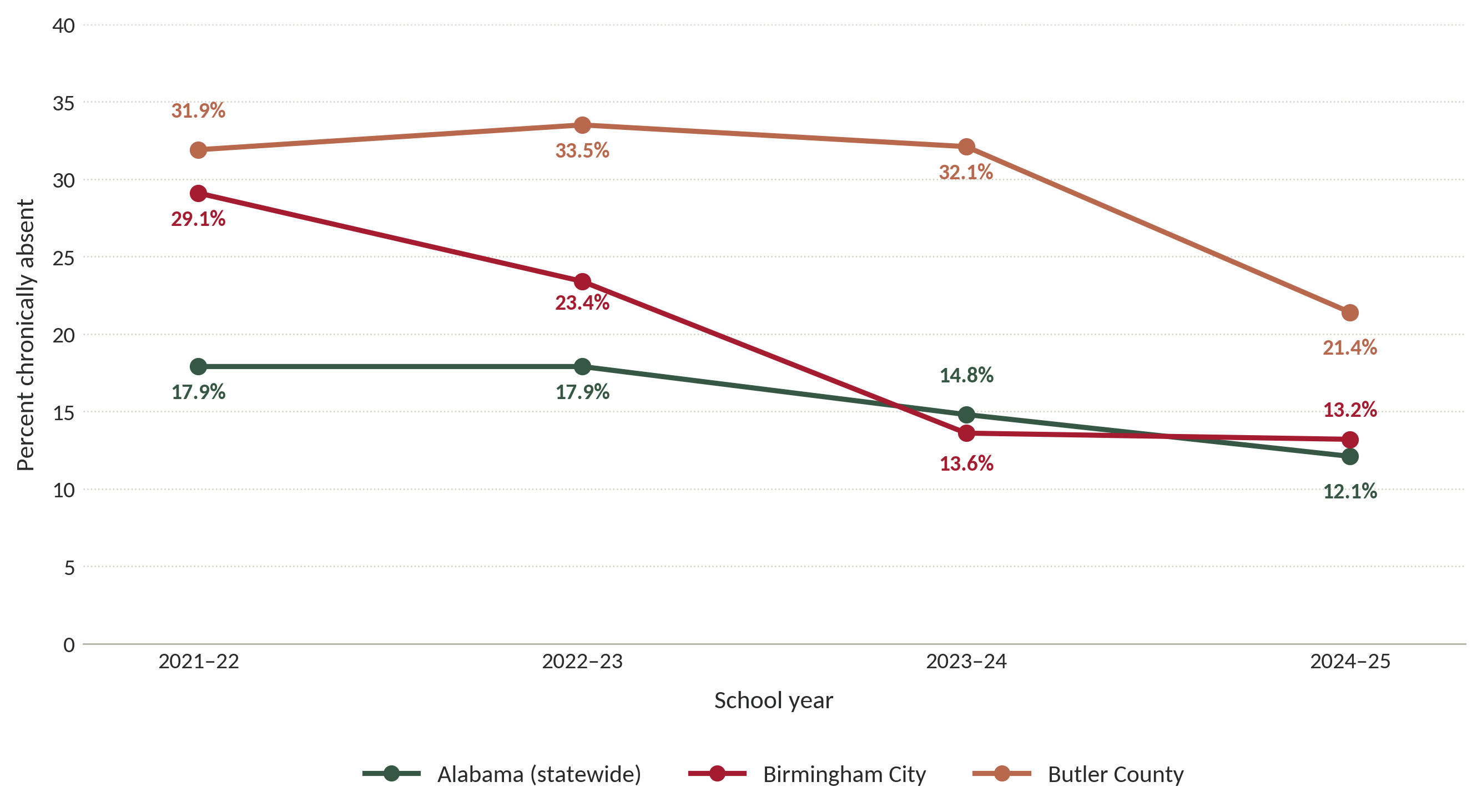
No state has returned to pre-pandemic levels of chronic absenteeism, but Alabama has come closest. In 2024–25, about 12 percent of its students were chronically absent, down from a high of nearly 18 percent in 2022–23 (Figure 8).
Figure 8. Chronic absenteeism is on the decline in Alabama.
Note: Data come from Alabama’s federal report cards.
Chronic absenteeism accounts for a significant portion of a district’s letter grade within the state’s accountability system: 10 percent. That’s made improving absenteeism a priority across districts.
“Certainly you need kids to be in school to learn,” says Mackey. “A lot of credit goes to the most local level—superintendents but even more principals. Principals have dug into that [and] been able to affect chronic absenteeism in a positive way.”
Still, the indicator’s weight in the accountability system remains controversial. Collins, who sponsored the 2012 A–F school grading bill, recently advocated reducing the weight of absenteeism in the grading formula. She argues schools don’t have much control over chronic absenteeism, and that the indicator just hurts high-poverty schools.
The low rates of chronic absenteeism in the state are worth celebrating. Much research has shown that students who are chronically absent have lower achievement levels. But for now, the state has left reducing absenteeism up to local decision makers, which leads to disparate implementation and makes it difficult to draw conclusions about the state policy’s effectiveness.
Deep Dive: Birmingham City
To walk through downtown Birmingham is to come face to face with images memorialized by the Civil Rights movement—and to confront the country’s history of discrimination and racial violence.
In his 1963 “Letter from Birmingham Jail,” Martin Luther King, Jr. called Birmingham “probably the most thoroughly segregated city in the United States.” Shaped by racist zoning laws and redlining, Birmingham remains majority Black, while several neighboring suburbs are almost all white.
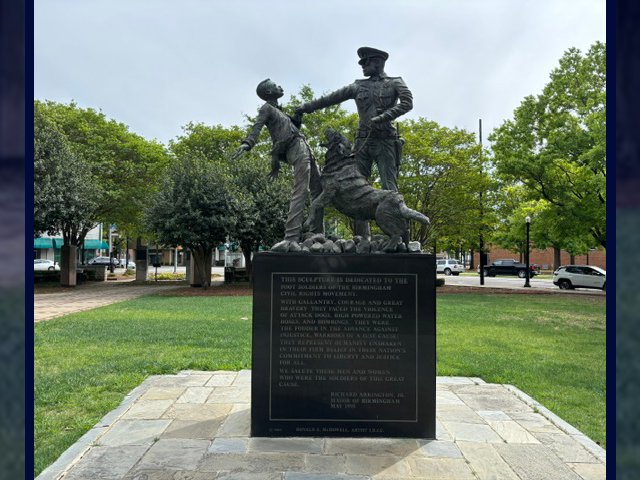
Just a few blocks from the central office of Birmingham City Schools is the Sixteenth Street Baptist Church, the first Black church in the city and the site of the 1963 bombing that killed four young Black girls. Across the street are the Birmingham Civil Rights Institute, a museum and educational center, and Kelly Ingram Park, a public green space that was a gathering point for protests in the 1960s and is now home to sculptures depicting powerful scenes from the era.
The city’s history is close to the surface at all times.
The Birmingham City school district has 43 schools, including five specialty schools with selective enrollment, a K–12 virtual school, an alternative school, and a newcomer center. It’s tied for the seventh-largest district in Alabama. (The greater metropolitan area of Birmingham includes about 1.1 million people; however, the city itself is much smaller, with just 200,000 residents.) Of Birmingham’s 20,000 students, about 84 percent are Black and 14 percent are Latino or Hispanic. The majority of students—85 percent—are economically disadvantaged.
While just one in five teachers across the state is Black, in Birmingham the ratio is closer to four in five. (Research points to benefits from student-teacher race matching.)
Birmingham has long been a low-performing district. In 2011, its third-grade reading scores were a full grade level below the national average, according to an analysis from the Educational Opportunity Project at Stanford University (Figure 9). And by 2019 they were more than three grade levels below the national average.
Since 2023, however, the district has shown impressive growth in both reading and math—and garnered attention for it.
A 2025 analysis from the Education Scorecard, a collaboration between the Center for Education Policy Research at Harvard University and the Educational Opportunity Project at Stanford University, highlighted Birmingham City as a “district on the rise.” Between 2023 and 2025, the district’s third- through eighth-grade reading achievement increased sharply while similar districts’ fell. In math, the gains were even larger: about half a grade level.
Figure 9. After a decade of decline, Birmingham narrowed the gap between its third-grade students’ performance and the national average.
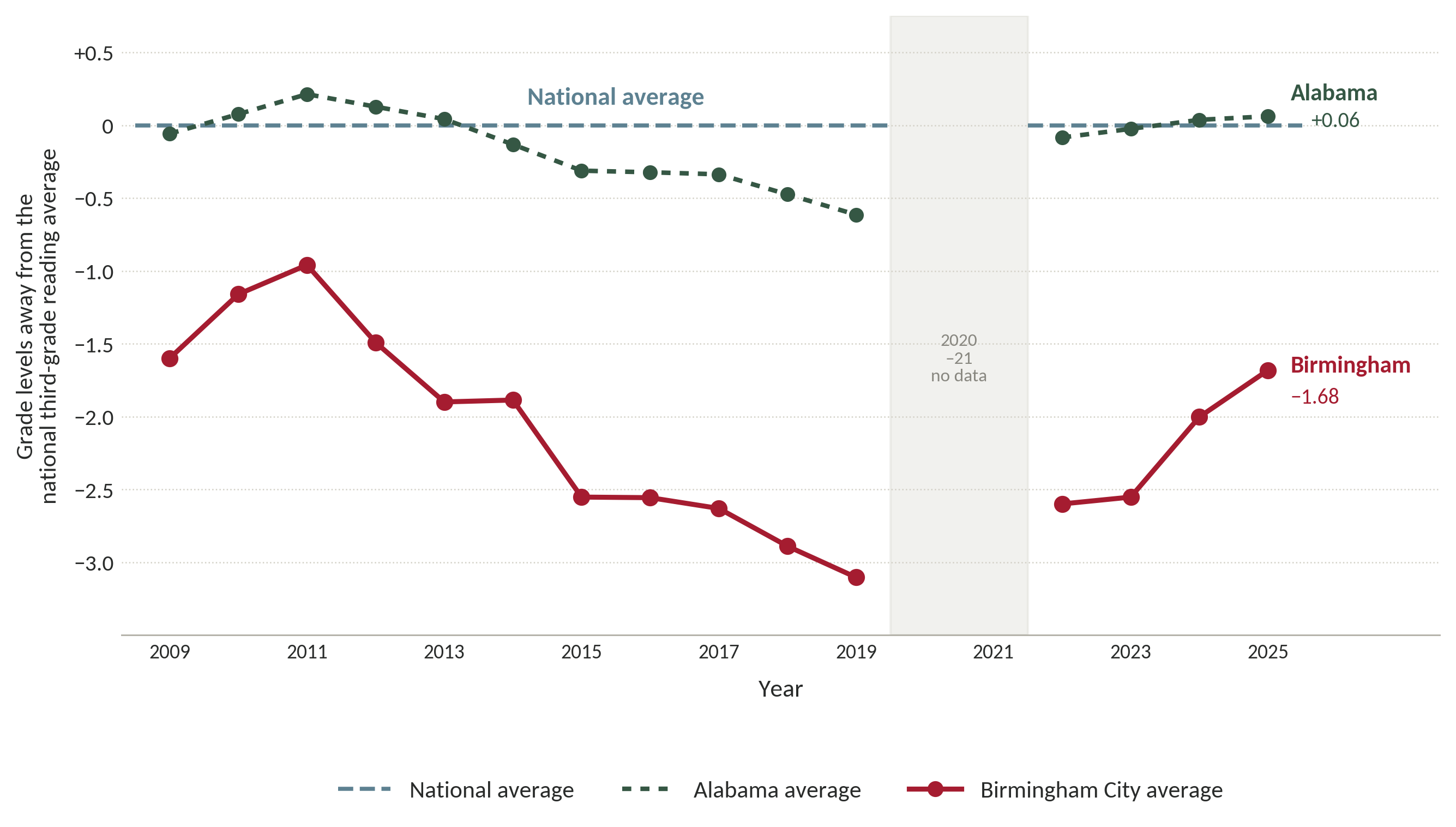
Note: Data gathered from the Stanford Education Data Archive and calculated by the TBFI research team. Numbers show grade levels above or below the national third-grade reading average (=0). National average is student weighted, and the 2025 figure is based on 38 reporting states.
The district is still well below the state and national averages for third-grade reading, but its trajectory has buoyed educators and leaders across the city.
Among the many changes Birmingham has made in recent years, cohesive curriculum and innovative leadership are especially worth highlighting, according to those on the ground.
Cohesive Curriculum
With the state retention law in place, the stakes are high for K–3 reading teachers—and administrators in Birmingham are not taking chances.
The district aims to get all teachers and principals trained in LETRS. But with new teachers frequently entering the system, many with emergency certification or from out of state, it’s a work in progress.
In 2023–24, the district transitioned from Savvas K–12 English language arts materials to Amplify CKLA, one of the two state-approved programs. But even with CKLA, administrators say they saw gaps in covering the state standards.
That’s why Jacqueline Dent, the district’s K–5 literacy and humanities coordinator, alters the CKLA-developed slideshows and sends the updated versions to K–3 teachers and school-based coaches. Having consistent, aligned slides “makes everything more seamless,” she says.
Modifying lessons allows Dent to use districtwide data to inform pacing and skills dosage. For example, when the benchmark testing data show needs in phonemic awareness, she alters the lessons accordingly.
“In a district this large, we can’t work in isolation,” she says.
While many curriculum providers and science-of-reading advocates would advise against altering programs, there’s also recognition that pacing needs can differ dramatically from place to place.
Teachers, for the most part, seem appreciative of the effort, as it takes much of the workload that is associated with lesson planning off their plates. School and district leaders, meanwhile, are encouraged that consistency across classrooms sets a floor for instruction. The state’s heavy hand, it seems, has spurred a cohesive response across the large district.
Innovative Leadership
Mark Sullivan was named interim superintendent of Birmingham City Schools in May 2020, just two months into the COVID pandemic. The school board made the appointment official that August.
Sullivan grew up in Birmingham and attended its public schools. He spent more than 25 years in the district as a teacher, principal, and district-level leader before taking the top job. He is energetic and excitable—the kind of leader who hears about an idea that’s working elsewhere and immediately puts a team on bringing it to Birmingham. Among his initiatives are efforts to extend students’ instructional time and increase data-driven decision-making.
When he took office, the community was in the thick of the COVID pandemic. The district was hard hit: Eight staff members ultimately died of the virus.
Birmingham schools stayed mostly virtual in 2020–21. Sullivan knew teachers would need to make up for a lot of lost time that next year. “I was watching [CNN journalist] Fareed Zakaria…and he said, the three-month calendar is an aberration on the world stage, that no other country uses three months off during the summer,” he says. “Most industrialized countries are in school for about 200 days. And so, I wanted to go back to school in July of that year.”
The school board would not budge. Teachers, parents, and students also rejected the idea in surveys.
So Sullivan took another tack, instituting what he called “intersessions.” After the first nine weeks of school, students would get a week off, during which they could choose to keep attending. Sullivan used ESSER funds to pay teachers, custodians, bus drivers, and all other needed staff.
Just 1,800 students showed up to the first fall intersession in 2021. By the end of the school year, about one-third of students were attending intersessions. Then the district held a longer summer intersession, and 10,000 students—half the district—showed up. (By contrast, about 15 percent of students nationally participate in academically oriented summer programs.)
“What we found was, parents don’t want to be told year-round school, but if you told them, ‘Would you want your child to have extended learning opportunities?,’ everybody wants extended learning,” he says. Students who go to intersessions can get an extra 20 days of instruction. A 2024 report from PARCA found that Birmingham students who attended intersession improved more in reading and math than those who didn’t.
Sullivan says that the ESSER funds were critical to getting the ball rolling with intersessions. “People say that money can’t solve a problem, and we had about $119 million in this [ESSER] money,” he says. “When you work in environments where kids have been historically underfunded, when you bring them up to normal funding, you’d be surprised what money can do.”
The Education Scorecard 2025 analysis notes that gains in many high-poverty districts in Alabama were driven by federal pandemic relief. The state received a total of about $3.1 billion.
Of course, ESSER funds have since dried up, but the state has allocated more money to keep intersessions going and support the district’s continued academic growth. Birmingham held 2026 summer and fall intersessions, and another is scheduled for this winter.
Sullivan’s leadership has also played a role in Birmingham City’s reduction in chronic absenteeism. While districts and schools across Alabama have been eager to improve student attendance, especially since chronic absenteeism makes up a significant portion of their A–F grades, Birmingham City stands out.
The district’s chronic absenteeism rate declined by 16 percentage points between 2021–22 and 2024–25. At 13 percent, it’s now just above the state average of 12 percent—and well under the national average of 22 percent.
District leaders chalk up the improvements to a multilayered approach, including digging into the underlying reasons for absences and offering creative incentives for attendance (see School Spotlight).
Through a partnership with the district attorney’s office called the Helping Families Initiative, case managers identify and help ease the root causes of students’ absenteeism, such as housing instability or a lack of clean clothing.
The district has also teamed up with the local housing authority to offer cash prizes to parents and students who live in public housing. Each month, students with 100 percent attendance are entered into a drawing for $300.
“Three hundred dollars could be paying your rent for that month. It could be paying a bill or just taking your kids out to a movie that you probably could not afford,” says Sullivan of the initiative, called Every Day Counts. “When we started this process, we had five families that were eligible for the prize.” Now hundreds are eligible every month.
The goal is to reduce barriers to attendance and help families rather than penalize them. “I don’t think anybody doesn’t want their child to go to school,” Sullivan says. “But if you’ve got social issues that impede that, like if you’re living in your car, that can be problematic.”
Another initiative Sullivan credits with the district’s improvement is the Breakthrough Results program. Founded by John Jong-Hyun Kim, a senior lecturer at Harvard Business School, the program engages teachers in a ten-week sprint toward specific, data-based goals. Sullivan heard Kim speak about it during a summer program at Harvard and was captivated.
Teams at participating schools work with a Breakthrough performance coach. The district piloted the program in 2023, and the next year chose to focus on improving third-grade reading fluency and comprehension. Students’ scores, based on i-Ready assessments, went up in both. Although the Breakthrough coaches have completed their terms, some schools continue the work in-house.
Sullivan’s many efforts, it seems, have paid off. Under his leadership, the district went from 15 F-rated schools in 2023 to just one in 2025. Its chronic absenteeism rate, which accounts for 10 percent of the grade, also declined from 29 percent to about 13 percent over those two years.
In short, Sullivan’s creativity and focus on meeting his community’s unique needs, coupled with the state’s accountability push and new expectations for literacy instruction, helped lay the foundation for increased achievement.

Deep Dive: Butler County
About 45 miles southwest of Montgomery lies Greenville, Alabama, a small town known for its camellia-lined streets and lawns.
With a population of about 7,000, it’s the largest town in Butler County, a rural region spanning 775 square miles of Alabama’s Black Belt. Originally so-called for its dark, nutrient-rich soil, the Black Belt now also colloquially refers to the region’s history of slavery and its high concentration of African American residents.
Automotive manufacturing and forestry are among the main industries in rural Butler County, but many will tell you that opportunities are limited for young people who stay.
Butler County School District has six schools, serving about 2,600 K–12 students. Nearly two-thirds of students are Black, and one-third are white. Less than 1 percent of students are English learners, and about 80 percent are economically disadvantaged.
Butler County’s third-grade reading scores have fluctuated but generally remained 1 to 1.5 grade levels below the state average (Figure 10). Since 2023, however, scores have been comparable to the state and national averages for the first time in the 16-year span for which data are available.
Figure 10. Butler County is closing the gap between its third-graders’ reading performance and state and national averages.
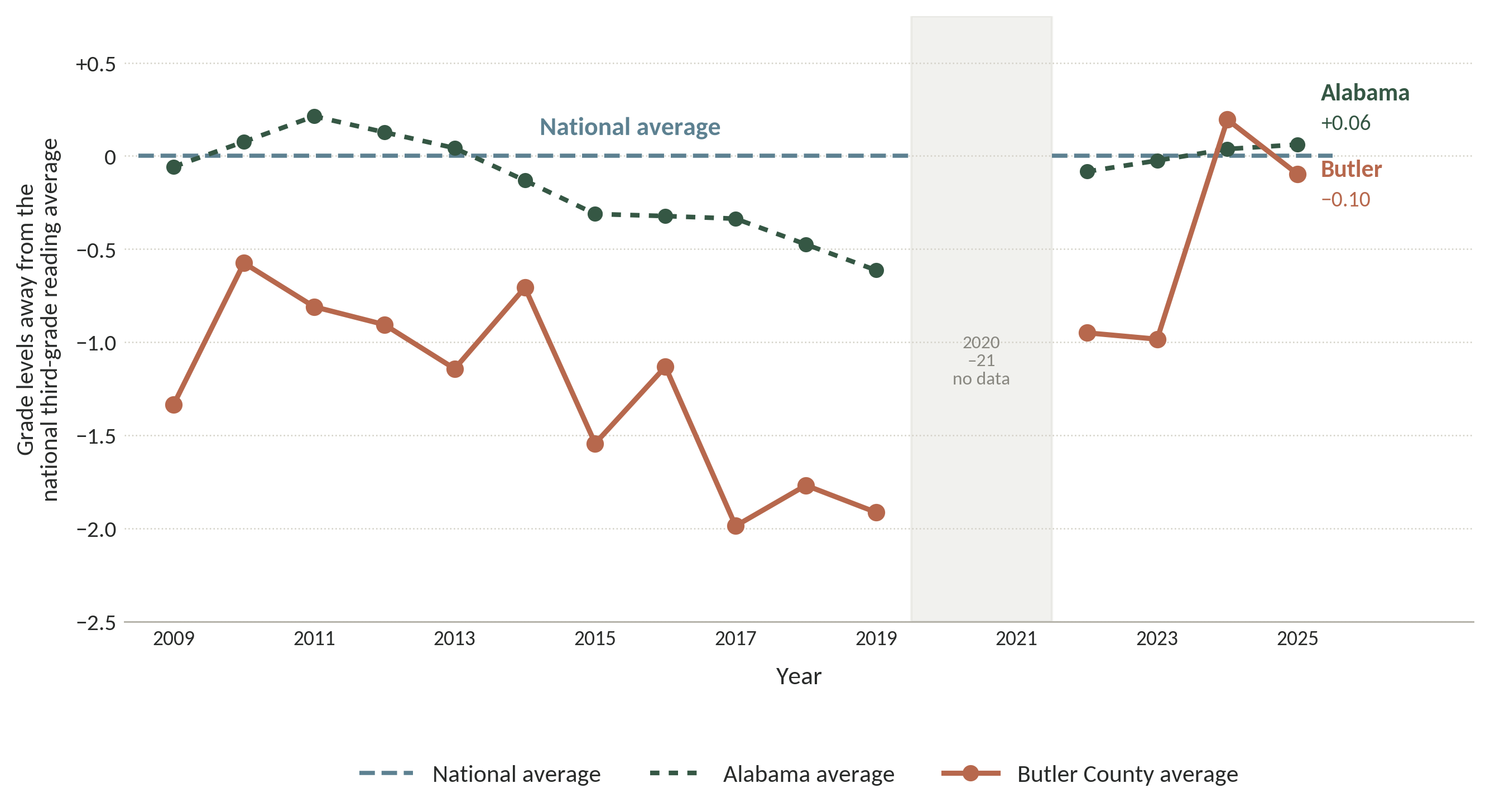
Note: Data gathered from the Stanford Education Data Archive and calculated by the TBFI research team. Numbers show grade levels above or below the national third-grade reading average (=0). Butler County estimates carry wide standard errors due to small enrollment, so year-to-year swings should be interpreted with caution. National average is student weighted, and the 2025 figure is based on 38 reporting states.
“The gains we made one year past COVID were a great shot in the arm,” says Joe Eiland, who has been superintendent since 2020. “That really inspired teachers to say, ‘Dang, we did do something good.’”
Because Butler is a relatively small district, its results should be interpreted with caution. Still, in The 74’s 2025 analysis of reading scores vs. poverty levels, two of six Butler County schools—Greenville Elementary School and Georgiana School—surpassed expectations in literacy achievement given their high poverty rates.
Strategies apparent in Butler County schools include supports from the state, such as coaching and evidence-based curriculum adoption; attendance efforts similar to Birmingham City’s; and a special focus on tracking data for intentional grouping.
State Support
Butler County’s rural setting feels far removed from metropolitan Montgomery. And yet the state as an entity is ever-present in the schools.
First, there are all the personnel supported by the state.
“I’m not the kind of person who likes to stroke the state department. But…they did a phenomenal job preparing me for this role,” says Jessica Byrd, the district’s curriculum specialist for the primary grades. Her first year as an administrator was chock-full of state-mandated trainings, including LETRS and a foundational numeracy course.
ARI’s pyramid structure for reading coaches ensures that everyone has somewhere to turn for help. “Every reading coach has a coach. Even I have a reading coach,” says Byrd. “Bonnie [Short] is at the top of that pyramid. They’ve been very not state department-y. They’re here to support you.…I could call my reading coach right now and say something monumentally disastrous [happened] and she’d say, ‘OK, let’s fix this together.’”
The system is far from flawless, though. “I have a reading coach in every school. Where it’s wonky is that I have a reading coach in every school,” says Byrd. “I have one that has four teachers and one that has 24.”
Even so, she appreciates the value of having a go-to specialist in every school—something many districts would struggle to fund on their own.
The state has also shaped the district’s curriculum selection. Butler County uses Open Court, one of the two approved core curricula. However, administrators note, and a visit to numerous classrooms confirms, that teachers are using a variety of other materials to supplement the core program.
“One of the things we use is the Open Court scope and sequence with the instructional delivery method of Phonics First,” says Byrd. “We’re teaching the new sounds and letters in Open Court but using the strategies to teach from Phonics First. We’re also integrating Heggerty into that as well as the beginning part of that lesson.”
Phonics First by Brainspring, one of Alabama’s approved intervention programs, is based on Orton-Gillingham, an approach long considered the gold standard for students with dyslexia. Heggerty is not on the list, and recent research has questioned its usefulness; one study found no effects on word reading or fluency.
At the beginning of each year, Butler County coaches and administrators walk teachers through the district’s instructional framework, including when to use which program. That’s partly because educator-preparation training is uneven.
While EPPs in Alabama are now largely aligned to the science of reading as the state requires, many teachers are entering the profession through other routes. Butler County has suffered from teacher shortages, and 13.5 percent of teachers there held emergency certificates in the 2024–25 school year. (Alabama requires just a bachelor’s degree from an accredited institution to become emergency certified.) Statewide, by comparison, 6 percent of teachers were emergency certified that year, up from 1 percent in 2018–19.
“When [new teachers] arrive to work, they may not even know what a phoneme is. They were managing an Arby’s last week,” says Byrd. “Until they feel competent and secure in the content, we encourage them to do the curriculum as we’ve laid it out.”
Focus on Attendance
When asked about post-pandemic changes in the district that may have contributed to early-grades reading achievement gains, administrators in Butler County often point to local efforts to reduce absenteeism. As in Birmingham, many leaders in the small district have responded to the state’s accountability for attendance.
“If your players are not on the field, you can’t win the game,” says Eiland. There are data to back this: NAEP results show a strong relationship between chronic absenteeism and low reading performance.
Greenville Elementary School, which serves third and fourth graders, celebrates students who reach attendance goals. The students run through the halls with music blaring, high-fiving classmates and teachers who are lined up along the way. At Georgiana, students who don’t come to school may get a home pickup by a staff member.
“We’ve done a great job incentivizing students and parents to have their children present, and that’s been a game-changer,” says Eiland.
The district’s chronic absenteeism rate fell from 32 percent in 2023–24 to 21 percent in 2024–25. The gains, though, were not evenly dispersed.
Greenville High School skewed the average, with chronic absenteeism plummeting from 57 percent to 17 percent over that year. At W.O. Parmer Elementary School, which serves pre-K through second grade, the rate decreased from 33 percent to 26 percent.
However, next door at Greenville Elementary School, chronic absenteeism rose from 19 percent to 25 percent.
These schools are small, though, so changes in circumstances for a few families can cause big swings in the data. And given that the state offers little practical assistance for reducing absenteeism, it’s generally up to principals to find solutions that fit their communities’ evolving needs.
Progress Monitoring and Intentional Grouping
As in Birmingham, Butler County leadership has built on the state’s pivot to evidence-based literacy instruction. Both teachers and administrators in the district are committed to using data to inform reading instruction—and it wasn’t always this way.
Teachers previously grouped students for instruction based on a vague assessment of their skills: essentially, whether a student was a non-reader, progressing, or fluent.
“Now we’re grouping kids by, you don’t know your letter sounds, this is the letter-sound group,” says Byrd. “I can go into my computer and look at the exact skill any kid needs.”
The focus on data has completely altered instructional planning, administrators say. And the ARI-funded-and-trained coaches have been a huge part of that.
Before passage of the Literacy Act in 2019, teachers “really didn’t have that grasp of understanding what it means to be targeted with your instruction and what it means to use that data as a guide to inform your instruction and plans,” says Eiland. Now, school-level coaches sit with teachers and administrators in data meetings, digging into assessments and student work to pinpoint individual needs. (For more on how the Literacy Act inspired mathematics legislation, see The Alabama Numeracy Act (2022) and Math Gains.)
The district uses i-Ready by Curriculum Associates and Star Reading by Renaissance, among other formative tools, to track student progress consistently.
Judy Smith, the elementary special education teacher at Georgiana, who is retiring (again) after more than three decades in the classroom, sees the district’s move to progress monitoring every two weeks as a positive shift. “I think the thing that’s changed the most is more accurate data in real time,” she says. With computer-based progress monitoring, “we sit with a kid and get real-time data. We can start getting feedback and put in plans immediately.”
The literacy law’s retention provision has only heightened the emphasis on data, many say. There’s urgency to stay updated on what skills individual students need to master, and fill in gaps immediately based on frequent progress monitoring between the formal state-mandated assessments. As of spring 2026, no Georgiana students had been retained due to the literacy law requirements.
Takeaways and Conclusion
Alabama’s story points to the urgency of a powerful role for the state, stable leadership, and educator support.
1. Evidence-based reading instruction should start at the top, with a state education agency that understands the science and bolsters classroom practice.
The state is a powerful entity in Alabama. “When you look at that balance of local control or state directed, we’ve decided we have to be a lot more state-directed,” Mackey says. “Historically in this state, a lot of things have been state-directed.”
Today, the state education department has a daily presence in schools. It puts coaches in every elementary school. It gives districts just two core literacy curricula to choose from—far fewer than other states with similar lists. Its threat of third-grade retention seems to have propelled parents and teachers into action. And Mackey himself is a regular presence among the state’s 140 or so superintendents.
Alongside the department of education, the state board has played a crucial role, from holding EPPs accountable to keeping the bar high on state tests.
By making the big instructional decisions and providing coaches to help implement them, the state frees up administrators in districts like Birmingham and Butler to innovate around the edges. They can focus on meeting their community’s specific needs while adhering to state-defined priorities.
2. Resolute state leadership is essential for consistent implementation.
Across three decades in Alabama, key state leaders have championed science-based reading instruction. Katherine Mitchell, Ed Richardson, and Joe Morton were all early advocates for ARI and its continued funding. When leadership changed course—reducing coaches’ focus on early reading and lowering ARI funding—student achievement fell.
Four more recent champions have had relatively long tenures, which has been key to keeping messaging and policy pointed in one direction: toward science-based practices.
- Governor Kay Ivey has been in office since 2017, making her the longest consecutively serving governor in the state’s history (and the longest serving female governor in American history). She has consistently pushed for strict implementation of the literacy law, including its third-grade retention provision.
- Representative Terri Collins, who was first elected to the Alabama House of Representatives in 2010 and is retiring this year, has been unwavering in the fight for improving reading outcomes. She chaired the House Education Policy Committee from 2011 to 2026, pushed for ARI funding as a member of the education budget committee, and, along with Representative Alan Baker, cosponsored the 2019 Alabama Literacy Act.
- State Superintendent Eric Mackey, first appointed by Alabama’s board of education in 2018, has now outlasted most of his peers in other states. Mackey says that change takes eight to ten years—longer than most political cycles. When he interviewed for the superintendent position, he told Governor Ivey and the state board that he wanted to commit for at least that long.
- Bonnie Short, who joined ARI in 2020 and became its director in 2021, has brought strong and coherent programmatic leadership, which experts agree has been key for advancing consistent, research-based practices.
3. Effective coaching requires defined roles, ample support, and steady funding.
Alabama’s literacy coaching structure is remarkable for several reasons.
First, every elementary school has a coach. That kind of staffing guarantee is unheard of in most K–12 systems.
Second, the coaches are paid and trained by the state. They’re not susceptible to local funding ups and downs, and their knowledge base is consistent.
Third, as teachers and administrators in Alabama will tell you, “every coach has a coach.” The coaching ladder runs from each school building up to regional literacy specialists up to the ARI state team. At every layer, there is opportunity for feedback and support.
Lastly, and perhaps most critically, the state protects coaches’ time. The education department’s directive that coaches stay focused on mentoring teachers, rather than taking on other roles, is powerful and unique, and it has a clear impact on classroom instruction.
Conclusion
Some aspects of Alabama’s story are unlikely to be replicated. But its experience still suggests lessons for other states. Stalwart state leadership sets the vision and keeps efforts on course. Every classroom is shaped by top-down guidance and guardrails, informed by the evidence. Coaching is impactful when the roles are defined, layered, and protected.
Even with all this in place, experts say, consistent implementation is an ongoing challenge. State and district leaders must remain unified in their mission to get all kids reading and vigilant in their on-the-ground monitoring and support. “Don’t think because you pass [a literacy bill] you’re going to get results,” says Yates. The implementation “has been hard work and with lots of pitfalls and obstacles.”
Are the gains sustainable? Can they be built upon? Leadership turnover, after all, is inevitable in the next few years. Representative Collins’s retirement becomes official in November 2026. Governor Ivey’s second full term ends in January 2027. Superintendent Mackey, eight years into the job, has already outlasted most of his peers.
When asked about the upcoming turnover, literacy advocates say they are concerned. And yet, ARI has been around nearly 30 years. And while it’s faced turmoil and misdirection at times, it’s now better-funded and more powerful than ever.
“We do become complacent sometimes, and we want to make sure that doesn’t happen,” says Yates. “I don’t see that in Alabama right now. I see them still going full force ahead.”
Watch: How Alabama Beat the Odds in Reading
Endnotes
[1] The legislature passed an additional bill in 2026 banning the use of three-cueing in K–12 classrooms and educator-preparation programs. Three-cueing is a discredited theory associated with whole language and balanced literacy. It posits that students should use multiple signals, including pictures and context clues, to identify a word, rather than just the letters. At least 15 states have banned the cueing model.
[2] To earn an A, a program must teach all five core components of the science of reading (phonemic awareness, phonics, fluency, vocabulary, and comprehension) and no more than three practices contrary to the science of reading (such as three-cueing or using leveled texts).
[3] National Council on Teacher Quality, Teacher Prep Review: Decoding Progress in Reading Preparation (Washington, D.C.: National Council on Teacher Quality, June 2026), https://www.nctq.org/research-insights/decoding-progress-in-reading-preparation/.
About this Study
This report was made possible through funding from the Gates Foundation, Charles and Lynn Schusterman Family Philanthropies, and our sister organization, the Thomas B. Fordham Foundation. The views expressed in this report are those of the author alone and do not necessarily reflect those of the foundations that supported this work.
We are grateful to author Liana Loewus for her thoughtful work and commitment to the project. External advisor Shelley Vail-Smith provided helpful feedback on the draft report. Here at Fordham, we thank Meredith Coffey and David Griffith for analyzing data, managing the project, and editing the report; Chester E. Finn, Jr., Michael J. Petrilli, and Amber M. Northern for providing feedback on the draft; Stephanie Distler for managing report production and design; and Victoria McDougald for overseeing dissemination and media relations. The author would also like to thank Trisha Powell Crain, whose years of reporting on Alabama education provided invaluable insights.