Mobile Navigation

  • National
    • Policy
      • High Expectations
      • Quality Choices
      • Personalized Pathways
    • Research
    • Commentary
      • Gadfly Newsletter
      • Flypaper Blog
    • Events
    • Scholars Program
  • Ohio
    • Policy
      • Priorities
      • Media & Testimony
    • Research
    • Commentary
      • Ohio Education Gadfly Biweekly
      • Ohio Gadfly Daily
  • Charter Authorizing
    • Application
    • Sponsored Schools
    • Resources
  • About
    • Mission
    • Board
    • Staff
    • Career
Home
Home
Advancing Educational Excellence

Main Navigation

  • National
  • Ohio
  • Charter Authorizing
  • About

National Menu

  • Topics
    • Accountability & Testing
    • Advanced Education
    • Career & Technical Education
    • Charter Schools
    • Curriculum & Instruction
    • ESSA
    • Evidence-Based Learning
    • Facilities
    • Governance
    • Personalized Learning
    • Private School Choice
    • School Finance
    • Standards
    • Teachers & School Leaders
    • Think Again
  • Research
  • Commentary
    • Gadfly Newsletter
    • Flypaper Blog
    • Gadfly Podcast
  • Events
  • Scholars Program
High Expectations

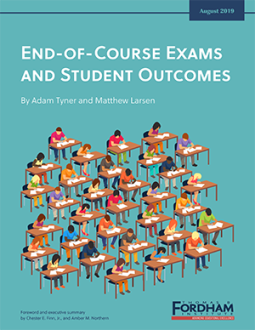
End-of-Course Exams and Student Outcomes

Adam Tyner, Ph.D. Matthew Larsen
Foreword by:
Chester E. Finn, Jr.
Amber M. Northern, Ph.D.
8.27.2019
8.27.2019

Beginning in the late 1990s, many states took it upon themselves to institute end-of-course exams (EOCs) at the high school level, tests specifically designed to assess students’ mastery of the content that various subject-matter courses covered. But was this testing policy good for students?

End-of-Course Exams and Student Outcomes, co-authored by Fordham’s Adam Tyner and Matthew Larsen, an assistant professor of economics at Lafayette College, provides a rich longitudinal look at state policies related to EOCs over the past twenty years and the effects of administering EOCs in different subjects on high school graduation rates and college entrance exam scores.

The study yielded five findings:

  1. The use of EOCs increased dramatically starting in the late 1990s, but in the past few years has declined somewhat.
  2. EOCs have been most widely used in math and science courses, but their use in English courses has risen fastest in the past decade.
  3. Most states use EOCs for a mix of school and student accountability.
  4. Unlike exit exams, EOCs are generally positively correlated with high school graduation rates.
  5. When analyzing EOCs by subject area, there is no statistically significant correlation with college entrance exam scores, but students in states with the most EOCs appear to outperform other students on these exams.

The report includes three recommendations for state-level policymakers:

  1. Embrace EOCs to leverage the potential benefits associated with external assessments without encountering the concerns raised about exit exams.
  2. Consider building high school accountability systems around EOCs, given the suggestive evidence that they can help improve student outcomes.
  3. Use EOCs to encourage students to put more effort into their own studies, perhaps by linking them to graduation or including them in course grades or on report cards.

The use of high-quality, content-linked external assessments could help push our education system toward mastery rather than seat time—a coveted goal, especially among advocates of competency-based and personalized models. That’s unlikely to happen, however, in the absence of external measures that schools and employers can trust. Adroitly deployed, EOCs can play this role.


This report was made possible through the generous support of the Charles and Lynn Schusterman Family Foundation and our sister organization, the Thomas B. Fordham Foundation.

Policy Priority:
High Expectations
Topics:
Accountability & Testing
Tags: English
DOWNLOAD PDF

Adam Tyner was a member of the Fordham Institute's national research team from 2017 to 2025. In 2025 he became executive director of the Oklahoma Center for Education Policy at the University of Oklahoma.

Matthew Larsen, assistant professor of economics at Lafayette College in Easton, Pennsylvania

Matthew Larsen is an assistant professor of economics at Lafayette College in Easton, Pennsylvania.

In The Media

States With End-of-Course Exams See Gains in Student Graduation Rates, Fordham Report Finds

8.27.2019

Report: More end-of-course exams linked to higher grad rates

8.27.2019

Are End-of-Course Exams an Alternative to Exit Exams? Maybe

8.27.2019

Related Resources

view
High Expectations

Gotta Give 'Em Credit: State and District Variation in Credit Recovery Participation Rates

Adam Tyner, Ph.D., Nicholas Munyan-Penney 11.29.2018
NationalReport
view
High Expectations

Rampant grade inflation is harming vulnerable high schoolers

Brandon L. Wright 2.13.2019
NationalFlypaper
view
High Expectations

Rethinking high school

Chester E. Finn, Jr. 10.14.2013
NationalFlypaper
Fordham Logo

© 2026 The Thomas B. Fordham Institute
Privacy Policy
Usage Agreement

National

P.O. Box 110
Burke, VA 22009

202.223.5452

[email protected]

Ohio

P.O. Box 82291
Columbus, OH 43202

614.223.1580

[email protected]

Sponsorship

130 West Second Street, Suite 410
Dayton, Ohio 45402

937.227.3368

[email protected]