Mobile Navigation

  • National
    • Policy
      • High Expectations
      • Quality Choices
      • Personalized Pathways
    • Research
    • Commentary
      • Gadfly Newsletter
      • Flypaper Blog
    • Events
    • Scholars Program
  • Ohio
    • Policy
      • Priorities
      • Media & Testimony
    • Research
    • Commentary
      • Ohio Education Gadfly Biweekly
      • Ohio Gadfly Daily
  • Charter Authorizing
    • Application
    • Sponsored Schools
    • Resources
  • About
    • Mission
    • Board
    • Staff
    • Career
Home
Home
Advancing Educational Excellence

Main Navigation

  • National
  • Ohio
  • Charter Authorizing
  • About

National Menu

  • Topics
    • Accountability & Testing
    • Advanced Education
    • Career & Technical Education
    • Charter Schools
    • Curriculum & Instruction
    • ESSA
    • Evidence-Based Learning
    • Facilities
    • Governance
    • Personalized Learning
    • Private School Choice
    • School Finance
    • Standards
    • Teachers & School Leaders
    • Think Again
  • Research
  • Commentary
    • Gadfly Newsletter
    • Flypaper Blog
    • Gadfly Podcast
  • Events
  • Scholars Program

The Education Gadfly Weekly

Sign Up to Receive Fordham Updates

We'll send you quality research, commentary, analysis, and news on the education issues you care about.
Thank you for signing up!
Please check your email to confirm the subscription.

The Education Gadfly Weekly: Work instead of school: A better approach for our lowest performing students?

Volume 22, Number 11
3.17.2022
3.17.2022

The Education Gadfly Weekly: Work instead of school: A better approach for our lowest performing students?

Volume 22, Number 11
view
High Expectations

Work instead of school: A better approach for our lowest-performing students?

High school-age Americans struggling mightily with academics aren’t well served by our current approach to secondary education. But there may be a better model that would give them a more worthwhile experience and lead to better long-term outcomes: Let them take jobs while still in high school—during the school day, during both their junior and senior years, full pay included, no strings attached.

Michael J. Petrilli 3.17.2022
NationalFlypaper

Work instead of school: A better approach for our lowest-performing students?

Michael J. Petrilli
3.17.2022
Flypaper

Civic education and the battle for Ukraine

Chester E. Finn, Jr.
3.17.2022
Flypaper

San Francisco’s detracking experiment

Tom Loveless
3.17.2022
Flypaper

Lessons from a pilot tutoring project

Jeff Murray
3.10.2022
Ohio Gadfly Daily

Education Gadfly Show #811: How one district scouts for talent for its gifted programs

3.16.2022
Resource

Cheers and Jeers: March 17, 2022

The Education Gadfly
3.17.2022
Flypaper

What we're reading this week: March 17, 2022

The Education Gadfly
3.17.2022
Flypaper
view

Civic education and the battle for Ukraine

Chester E. Finn, Jr. 3.17.2022
Flypaper
view

San Francisco’s detracking experiment

Tom Loveless 3.17.2022
Flypaper
view
Online tutoring pilot SR image

Lessons from a pilot tutoring project

Jeff Murray 3.10.2022
Ohio Gadfly Daily
view

Education Gadfly Show #811: How one district scouts for talent for its gifted programs

Michael J. Petrilli, David Griffith, Ph.D., Amber M. Northern, Ph.D., April Wells 3.16.2022
Resource
view

Cheers and Jeers: March 17, 2022

The Education Gadfly 3.17.2022
Flypaper
view

What we're reading this week: March 17, 2022

The Education Gadfly 3.17.2022
Flypaper
view

Work instead of school: A better approach for our lowest-performing students?

Michael J. Petrilli
3.17.2022
Flypaper

Several weeks ago, I asked whether America’s present strategy for serving our lowest performing high school students is really the best we can do. This wasn’t a rhetorical question; possibly the answer is yes. That strategy is to try much harder than in years past to keep such students from dropping out, while also allowing them to earn course credit through online credit recovery if they fail to pass their classes the traditional way. It’s a combination of doing more to encourage and support struggling students (hooray!) while also—let’s be honest—lowering the bar for what it takes to graduate (boo!).

The last half of that equation is regrettable. But it’s almost surely the case that most students are better off staying in school than dropping out, even if it means deflating the diploma’s value along the way—especially if dropping out means turning kids into “disconnected youth” with no involvement in the education system or the labor market. That generally leads to nothing good. So maybe we should simply celebrate the fact that our high school graduation rate was at an all-time high before the pandemic struck, and redouble our efforts on every strategy that was working to make it so.

But allow me to make the case for trying something very different for high school-age Americans who struggle mightily with academics—say, those in the bottom 10 percent of the national distribution—one that might provide a much better experience for them during their adolescent years and lead to better long-term outcomes. Put simply: Let these young people take jobs while still in high school—during the school day, during both their junior and senior years, full pay included, no strings attached—akin to Jobcorps or Jobstart, but before kids drop out.

I’m not talking about fancy apprenticeships or internships. That’s the European model, and it’s a great option for kids with relatively high levels of academic skills, generally leading to further education in technical institutes or community colleges and to bona fide certifications in well-paying careers. No, here I’m talking about teenagers who have been failed by the system, haven’t learned much in elementary or middle school, and are struggling in high school, too. And I’m talking about $10–$15-an-hour jobs, the kind that these students, for better or worse, have a realistic chance of attaining, in industries like food service, hospitality, caregiving, or construction. Let them get started on these jobs as soon as they turn sixteen, but under the guidance of a school-provided career coach/mentor/therapist, and with the hope that they build valuable real-world skills that will quickly lead to greater pay and more opportunities.

In effect, this is a compromise between dropping out and staying in school. It allows these teenagers to move forward into the world of work, while still remaining connected to the school system in a real way.

I know this idea will strike some as fatalistic and defeatist, if not classist or racist. It amounts to giving up on young people, they will say. I respectfully disagree. In my mind, it means freeing some young people from a prison of our own creation, from “credit recovery jail” that boosts schools’ graduation rates without doing much good for the kids stuck inside.

The time we make these kids spend in bogus academics carries real opportunity costs. Because, in today’s system, what we don’t spend time doing is actually preparing young adults to succeed on the day after high school graduation. We don’t help them find a job that is a good fit with their strengths and interests—a job that is actually available where they live or want to move. Once these kids are in the real world, they must try to figure out how to show up on time every day, manage through workplace challenges, deal with a difficult boss, figure out how to ask for a raise, and decide whether they should look elsewhere for better opportunities. But by then we’ve kicked them out of the school system. They are on their own in the jungle.

And many don’t survive. As AEI’s Nicholas Eberstadt has chronicled so effectively, the number of men, in particular, who are neither in school nor working has skyrocketed in recent years. The labor force participation rate for never-married American-born men who dropped out of high school now hovers around 50 percent.

The kind of “job study” program I have in mind would be appropriate only for a limited population, to be sure. It would be nuts to encourage most students to take this path, students who are great, good, or even just decent at school, and have the academic skills to succeed in high-quality college prep or career and technical education programs. For them, more formal education is well worth the time and effort.

Yet however much we wish it weren’t so, millions of teenagers in America do not fit this description. After suffering from years of low expectations in K–8, they entered high school three or four grade levels behind in reading, writing, and math, struggle to pass classes, and generally hate school and everything about it. It is these students who might relish, and benefit from, a ticket out.

I won’t sugarcoat it: The career prospects for such students in a knowledge economy are not great. High-tech sectors are out of bounds for them. Most professional settings will be a reach. Yet the American economy continues to create millions of job opportunities for people with limited academic skills. They don’t pay great. Though thanks to a hot labor market and rising minimum wages in many states and localities, they pay better than they used to. Our (more generous than most people think) social safety net further boosts the value of such jobs. And as low-wage workers gain on-the-job skills, they typically see their wages grow. Orderlies can become nursing assistants, and upward and onward from there. Dishwashers can move onto food preparation, eventually line cooking, and so forth. These aren’t easy paths, but they sure beat poverty or prison.

So the right question to ask, in my opinion, is how to help our lowest-performing students successfully make the transition into the world of work and get launched in a way that will help them make their way in the adult world.

Why not start the process while still under the tough-love care of high school educators? Isn’t that at least worth trying?

Imagine if we spent the $15,000 or $20,000 or $25,000 that we currently plow into their education every junior and senior year, and invest that instead in adults, working for the school system, whose job it is to help these students successfully transition into the workplace. We might even subsidize local employers for taking on the students as workers or for supplementing their pay. The students would spend most of their week at work—say, thirty hours or so—and would also meet a few times a week one on one and in small groups with their mentor/counselor/career coach. If they want to participate in school sports and extracurricular activities, that could be worked into their schedules. Think of summer jobs programs, but during the school year instead.

No doubt, we would need to work out a ton of programmatic details. Which students should be eligible to participate? Should we start with a pilot? Should we give these students a standard diploma, a GED, or something else?

By embracing such an approach, we wouldn’t be giving up on kids’ college dreams. College was never in the cards for high school students who are reading, writing, and doing math at the 10th percentile. The real question is whether a job is a better alternative for these junior and seniors than simply dropping out or painfully trying to follow the “credit recovery track” so many are on today. It’s a question worth answering.

view

Civic education and the battle for Ukraine

Chester E. Finn, Jr.
3.17.2022
Flypaper

We’re all watching the news and hating what we’re seeing, the one big exception being the patriotic heroism of millions of Ukrainians (and the much smaller but still impressive collection of others who have been traveling to Ukraine to join the fight for freedom).

My granddaughter and I happened to be at the opera in Chicago the other evening, and before they started Tosca, they announced that the opera company contained a number of people with Ukrainian ties, whereupon the curtain opened and a mighty chorus sang the Ukrainian national anthem, the (English) words of which bear attention, including the attention of U.S. civics educators:

The glory and freedom of Ukraine has not yet perished
Luck will still smile on us brother-Ukrainians.
Our enemies will die, as the dew does in the sunshine,
and we, too, brothers, we'll live happily in our land.

We’ll not spare either our souls or bodies to get freedom
and we’ll prove that we brothers are of Kozak kin.

Observe in that anthem the pride in country, the willingness to fight, the love of freedom, the unabashed patriotism—and pause to wonder why so many Americans in the education realm, including many K–12 and university educators, are squeamish about those heartfelt sentiments when it comes to their own land. It wasn’t just Trump and MAGA. This attitude arose long before.

While we cheer on the Ukrainians and do what we can to assist from far away (perhaps send money, perhaps urge our own government to do more), we might ask whether it’s also time for a reckoning in the education of young Americans, a reckoning that undoes the squeamishness about patriotism without succumbing to the craziness of jingoism.

In the aftermath of 9/11 and on some of its anniversaries, we at Fordham mustered colleagues around the country to focus on such things. Sure, that was more about the threats of terrorism than the depredations of Putin and his ilk. But at some level, state-sponsored terrorism merges with state-sponsored imperial-style conquest. And today’s kids need education about this much as yesterday’s needed to understand why the World Trade Center was attacked and how (and why) to see that it doesn’t happen again.

More recently, Mike Petrilli and I were pleased to organize and co-edit How to Educate an American: The Conservative Vision for Tomorrow’s Schools. Several of the essays included therein, including superb pieces by Eliot Cohen, Bill Damon, and Jonah Goldberg, deal with history and civics and patriotism in the context of K–12 education.

Several of the admirable recent pushes by other groups and organizations to revive and revitalize civics education would also, whether the authors acknowledge it or not, give young Americans at least a solid foundation atop which informed patriotism can comfortably lodge. But public education across much of the U.S. has a very long way to go before it can be said even to supply the fundamental knowledge, skills, and dispositions of citizenship. That, sadly, was a major finding of Fordham’s recent review of state standards for civics and U.S. history.

The present nightmare in Ukraine also recalled to my mind the period after the Berlin wall fell when I was privileged to join a group sponsored by the American Federation of Teachers and personally led by the late Albert Shanker. We traveled about Eastern Europe—Hungary, Czechoslovakia (as it still was), Hungary, and Romania, in my case—giving talks and seminars for teachers on “education for democracy.” Those teachers had for decades been forbidden to tackle such topics in their classrooms and they hungered for both content and encouragement.

The Shanker Institute website today offers a proper account—titled “Fighting for Freedom Around the World”—of Al’s and the AFT’s tireless work in this realm, perhaps the noblest and farthest-reaching of his many legacies and work that we at Fordham were proud to contribute to.

Educating for democracy may be a challenge in tomorrow’s Ukraine, too, but we can be confident that Ukrainian teachers and their fellow citizens will do their utmost to keep that flame burning. Read their national anthem again and you’ll know why.

May God give them strength in this time of peril. And may our country help them to prevail.

view

San Francisco’s detracking experiment

Tom Loveless
3.17.2022
Flypaper

Editor's note: This post was originally published on tomloveless.com.

The San Francisco Unified School District (SFUSD) adopted a detracking initiative in the 2014–15 school year, eliminating accelerated middle and high school math classes, including the option for advanced students to take Algebra I in eighth grade. The policy stands today. High schools feature a common math sequence of heterogeneously-grouped classes studying Algebra I in ninth grade and Geometry in tenth grade. After tenth grade, students are allowed to take math courses reflecting different abilities and interests.

Implementing the Common Core was provided as the impetus for the change. When first proposed, district officials summed up the reform as, “There would no longer be honors or gifted mathematics classes, and there would no longer be Algebra I in eighth grade due to the Common Core State Standards in 8th grade.” Parents received a flyer from the district reinforcing this message, explaining, “The Common Core State Standards in Math (CCSS-M) require a change in the course sequence for mathematics in grades 6–12.” Phi Daro, one of Common Core’s coauthors, served as a consultant to the district on both the design and political strategy of the detracking plan.

The policy was controversial from the start. Parents showed up in community meetings to voice opposition, and a petition urging the district to reverse the change began circulating. District officials launched a public relations campaign to justify the policy. Focused on the goal of greater equity, that campaign continues today. SFUSD declared detracking a great success, claiming that the graduating class of 2018–19, the first graduating class affected by the policy when in eighth grade, saw a drop in Algebra 1 repeat rates from 40 percent to 8 percent and that, compared to the previous year, about 10 percent more students in the class took math courses beyond Algebra II. Moreover, the district reported enrollment gains by Black and Hispanic students in advanced courses.

Important publications applauded SFUSD and congratulated the district on the early evidence of success. Education Week ran a story in 2018, “A Bold Effort to End Tracking in Algebra Shows Promise,” that described the reforms with these words: “Part of an ambitious project to end the relentless assignment of underserved students into lower-level math, the city now requires all students to take math courses of equal rigor through geometry, in classrooms that are no longer segregated by ability.” The National Council of Teachers of Mathematics (NCTM) issued a policy brief portraying the detracking effort as a model for the country. Omitted from these reviews was the fact that the “lower-level math” to which non-algebra eighth-graders were assigned was Common Core Eighth Grade Math, which SFUSD and NCTM had spent a decade depicting as a rigorous math course, as they do currently.

Jo Boaler, noted math reformer, professor at Stanford, and critic of tracking, teamed up with Alan Schoenfeld, Phil Daro and others to write “How One City Got Math Right” for The Hechinger Report, and Boaler and Schoenfeld published an op-ed, “New Math Pays Dividends for SF Schools” in the San Francisco Chronicle.

In this public relations campaign, there was no mention of math achievement or test scores. Course enrollments and passing grades were presented as meaningful measures by which to measure the success of detracking.

They are bad measures. Course enrollments are a means to an end—student learning—not an end unto themselves. If a district enrolls students in courses that fail to teach important content, nothing has been accomplished. Boosting enrollment in advanced courses, therefore, is of limited value.1 It’s also a statistic, along with grades, that is easily manipulated. No matter the school district, if word spreads that the superintendent would like to see more kids enrolled in higher math classes and fewer D and F grades in those classes, enrollments will go up and the number of D’s and F’s will go down.

Families for San Francisco

Families for San Francisco, a parent advocacy group, acquired data from the district under the California Public Records Act (the state’s version of the Freedom of Information Act). The group’s analysis calls into question the district’s assertions. As mentioned previously, repeat rates for Algebra I dropped sharply after the elimination of Algebra I in eighth grade, but whether the reform had anything to do with that is questionable. The falling repeat rate occurred after the district changed the rules for passing the course, eliminating a requirement that students pass a state-designed end of course exam in Algebra I before gaining placement in Geometry. In a presentation prepared by the district, speaker notes to the relevant slide admit, “The drop from 40 percent of students repeating Algebra 1 to 8 percent of students repeating Algebra 1, we saw as a one-time major drop due to both the change in course sequence and the change in placement policy.”

The claim that more students were taking “advanced math” classes (defined here as beyond Algebra II) also deserves scrutiny. Enrollment in calculus courses declined post-reform. The claim rests on a “compression” course the district offers, combining Algebra II and precalculus into a single-year course. The Families for San Francisco analysis shows that once the enrollment figures for the compression course are excluded, the enrollment gains evaporate. Why should they be excluded? The University of California rejected the district’s classification of the compression course as “advanced math,” primarily because the course topics fall short of content specifications for precalculus.

Smarter Balanced scores

The conventional way to measure achievement gaps—and progress towards closing them—is with scores on achievement tests. California students take the Smarter Balanced assessments in grades three through eight and in grade eleven. Following SFUSD’s analytical strategy, let’s compare scores from 2015, the last cohort of eleventh-graders under the previous policy, and 2019, the last cohort with pre-pandemic test scores.2 Please be alerted, however, that both analyses, SFUSD’s and the one presented here, fall far short of supporting causal claims. The purpose of the current analysis is to illustrate that SFUSD’s public relations campaign omitted crucial information to determine what’s going on.

As displayed in Table 1, SFUSD’s scores for eleventh-grade mathematics remained flat from 2015 (scale score of 2611) to 2019 (scale score of 2610), moving only a single point. Table 1 shows the breakdown by racial and ethnic groups. Black students made a small gain (+2), Hispanic scores declined (-14), White students gained (+17), and Asian students registered the largest gains (+22).

Table 1. San Francisco Unified School District Smarter Balanced Scores, grade 11, 2015–19
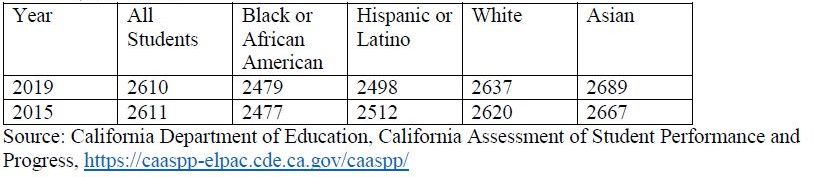
tl t1

Table 2 offers some context for interpreting the scores. Smarter Balanced is vertically scaled so that scores can be compared across grades. On Smarter Balanced results from twelve states, the mean fifth-grade math score was 2498, well above the 2479 score for eleventh-grade Black students in SFUSD and the same as the 2498 score registered by eleventh-grade Hispanics students.3 The mean Smarter Balanced sixth-grade score was 2515, well above the scores of both groups of eleventh graders in SFUSD.

Table 2. 2019 Smarter Balanced summative assessment scores, mathematics, by grade
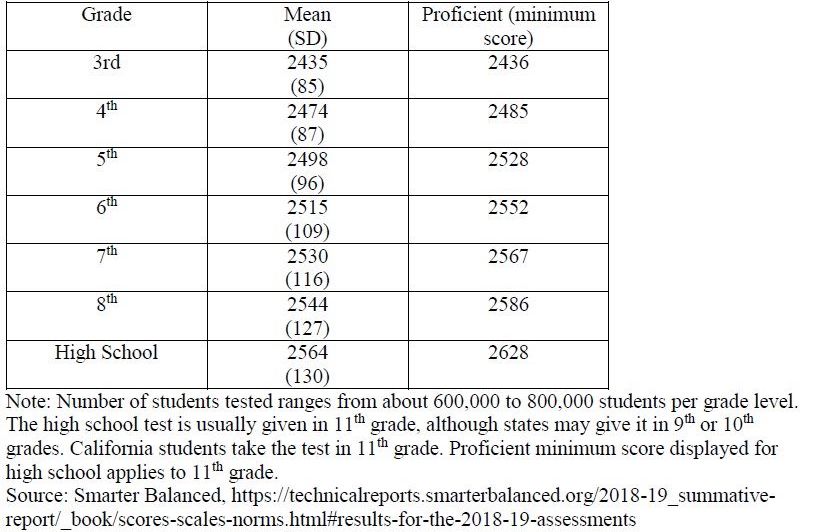
tl t2

Summing up: Black and Hispanic eleventh-graders in San Francisco score about the same as or lower than the typical fifth-grader who took the same math test. Black eleventh-graders fall just short of the threshold for being considered proficient in fourth-grade math and well below the cut point for demonstrating fifth-grade proficiency. The situation is appalling.

Are test score gaps narrowing?

Contrary to the district’s spin, the trend towards greater equity is not headed in the right direction. Gaps are widening. Perhaps this trend is statewide and not just a SFUSD phenomenon.

Table 3 supplies the gap calculations from the data above in Table 1, along with a comparison to statewide trends. For example, at the state level, the eleventh-grade Black-White gap grew by 11 points—from 94 to 105—while in SFUSD, the gap expanded by 15 points (from 143 to 158). The Hispanic-White gap provides a more dramatic contrast. The state level gap grew by only 5 points, but in San Francisco, it expanded by a whopping 31 points. Glancing back at Table 2 again will provide context. The 31-point expansion is larger than the 20-point difference in mean scores for Smarter Balanced’s eighth-grade and high school assessments. That’s a big change.

With both gaps, SFUSD evidenced greater inequities than state averages in 2015, and that relative underperformance worsened by 2019. The district’s anti-tracking public relations campaign, by focusing on metrics such as grades and course enrollments, diverts attention from the harsh reality that SFUSD is headed in the wrong direction on equity.

Table 3. Black-White and Hispanic-White gap, grades 11, California and San Francisco, 2015–19, by Smarter Balanced scale scores, mathematics

tl t3

Could the situation be even worse?

Finally, as bad as the preceding data look, the reality of the district’s poor math achievement is probably worse. SFUSD has exceptionally low rates of test participation on the state test, especially among Black and Hispanic students. Don’t forget: This is the test that state and district officials use for accountability purposes. Participation is mandated by both federal and state law. If the students who don’t take the test tend to be low achievers—usually a fair assumption—the district’s test score performance could fall even lower once those students are included.

Table 4. 11th-grade students tested as a percentage of students enrolled
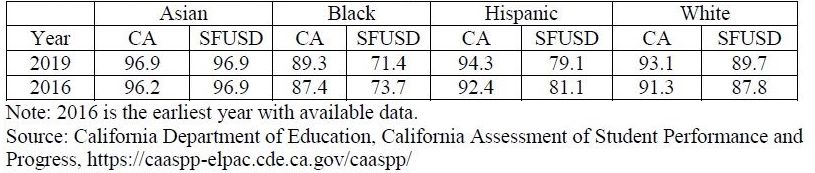
tl t4

Conclusion

San Francisco Unified School District embarked on a detracking initiative in 2015, followed by an extensive public relations campaign to portray the policy as having successfully narrowed achievement gaps. The campaign omitted assessment data indicating that the Black-White and Hispanic-White achievement gaps have widened, not narrowed, the exact opposite of the district’s intention and of the story the district was selling to the public. Only SFUSD possesses the data needed to conduct a formal evaluation that would credibly identify the causal factors producing such dismal results.

Whether detracking can assist in the quest for greater equity is an open question. It could, in fact, exacerbate inequities by favoring high achieving children from upper-income families—who can afford private sector workarounds—or with parents savvy enough to negotiate the bureaucratic hurdles SFUSD has erected to impede acceleration. As I have written elsewhere, the voluminous literature on tracking is better at describing problems than in solving them. The evidence that detracking promotes equity is sparse, mostly drawing on case studies that are restricted in terms of generalizability of findings to other settings and with research designs that do not support causal inferences.

If SFUSD would now approach tracking with an open mind, officials need not look far to discover equitable possibilities. Across the bay, David Card, a scholar at University of California, Berkeley, won the 2021 Nobel Prize in Economics for his research applying innovative econometrics to thorny public policy problems. Card’s recent studies, conducted with colleague Laura Giuliano, investigate tracking. In 2014, Card and Giuliano published a paper evaluating an urban district’s tracking program based on prior achievement. In particular, disadvantaged students and students of color benefitted from an accelerated curriculum, with no negative spillover effects for students pursuing the regular course of study. Card and Giuliano concluded, “Our findings suggest that a comprehensive tracking program that establishes a separate classroom in every school for the top‐performing students could significantly boost the performance of the most talented students in even the poorest neighborhoods, at little or no cost to other students or the District’s budget.”

Card and Giuliano’s current project studies two large urban districts in Florida, predominantly Black and Hispanic, that provide mathematically talented students with the opportunity to accelerate through middle school math courses. When these students enter high school, they will have already completed Algebra I and Geometry. They begin high school two years ahead of students in San Francisco, opening up greater opportunities to take Advanced Placement (AP) courses in later years.

Which system is more equitable?

______________

1An analysis that I conducted in 2013 showed a steadily increasing percentage of students who had taken Algebra II; however, NAEP scores for students who had taken Algebra II also steadily declined concurrent with the increased enrollments.

2 California employs “Black or African American” and “Hispanic or Latino” as reporting categories. After Table 1, for the sake of clarity, the terms are shortened to “Black” and “Hispanic” in both tables and the narrative.

3 Using 2018 scores, the cohort of eleventh-graders first affected by detracked eighth-grade courses in 2015, would not change the analysis significantly except for one aspect: The achievement gaps associated with race and ethnicity were larger in 2018 because of higher scores for White students. 2018 scores were Asian (2682), Black or African American (2479), Hispanic or Latino (2497), White (2650).


view
Online tutoring pilot SR image

Lessons from a pilot tutoring project

Jeff Murray
3.10.2022
Ohio Gadfly Daily

Folks who have “tutoring” as the hoped-for winning square on their post-Covid bingo card will want to pay close attention to a recent report detailing a field experiment in virtual tutoring. A group of researchers led by Sally Sadoff of the University of California San Diego created the pilot program and tested its efficacy via a controlled experiment. While the price tag was low, the academic boost observed was negligible, and any effort to scale it up will require much that’s still in short supply more than two years into the pandemic.

In the experiment, sixth- to eighth-grade students from one middle school in Chicago Heights, Illinois, were randomly selected to receive virtual tutoring from college students via the CovEducation (CovEd) program. CovEd was created during the early days of the pandemic in 2020, intended to support K–12 students in need of academic and social-emotional support. Tutors were college students, specifically recruited from “top-tier research universities,” who worked as volunteers (hence the low cost of the effort). A total of 230 tutors participated in the pilot from forty-seven institutions. About three-fourths of them were women; 40 percent were White, 34 percent were Asian, 20 percent were Hispanic, and 5 percent were Black. About 70 percent were science or engineering majors. Prior to the start of the program (March 2021), CovEd provided tutors with a three-hour training on pedagogical techniques, relationship building, and educational resources. During the program, CovEd offered tutors weekly peer mentoring sessions to troubleshoot challenges, share best practices, and build community.

Nearly 100 percent of Chicago Heights Middle School (CHMS) students were from low-income households; almost two-thirds were Hispanic, and just less than one-third were Black. Prior to the pandemic, just one quarter of students in the school were meeting grade level standards in math and reading. In February 2021, CMHS students were offered a choice to remain fully remote or participate in a hybrid model where they attend school in person part-time and learn remotely part-time. Only students who chose the hybrid option (approximately 58 percent of the total school population) were eligible to participate in the pilot. A total of 560 students were involved in the experiment, randomly assigned to either treatment (264) or control groups (296). Control group students participated in regular advisory period activities whereas treatment group students received tutoring. No demographic breakdown of students in each group was provided in the report. Treatment students were offered thirty minutes of one-on-one virtual tutoring twice per week—one virtual session while in person at school and another while remote at home. Thus, over the twelve-week program, students had a maximum of nine hours during which to attend tutoring. However, students were added to the treatment group in three waves, and those who joined in later weeks had fewer participation opportunities available.

Glitches occurred right off the bat. Eighteen percent of those assigned to the treatment group did not attend a single minute of tutoring. On average, participants attended just 3.1 hours. Low take-up was ascribed to weak overall attendance during this “transitional period” from fully-remote to hybrid learning, a common story in schools across the country. Student achievement in math was measured via the Illinois Assessment of Readiness test—the state’s standardized test—and in reading via iReady, a formative assessment used to track student progress. Bottom line: The pilot program produced consistently positive but very small and statistically insignificant effects on student achievement on both tests compared to the control group.

The researchers run intent-to-treat models and report that if more students had spent more time on tutoring, they would likely have done even better on the tests. Even though this seems somewhat obvious—the same could likely be said of attending more actual school—they use it as the basis for their contention that the tutoring program could be scaled to produce stronger academic outcomes. However, it must be noted that there was an extensive social-emotional aspect to the pilot program that is entirely undocumented here. Having no data on how much time was actually spent on academic support in each session versus building relationships or other SEL priorities muddies the water in terms of ROI.

Those who led the pilot remain optimistic about scaling it up, but that won’t be easy. The supply of free college student labor is finite, and even more finite when limited to research universities. And ardor for the remote option utilized here will wane as the “old normal” reasserts itself. And student absenteeism—an ongoing problem with regular school—will continue to dog any voluntary program such as this one. It seems likely that the kids who might have the greatest need of tutoring are most apt to skip, or be unable to participate in, those sessions. All of these together could serve to keep the tiny academic effects seen in the pilot at exactly the same level—at a higher cost—in a larger effort.

SOURCE: Matthew Kraft, John List, Jeffrey Livingston, and Sally Sadoff, “Online Tutoring by College Volunteers: Experimental Evidence from a Pilot Program,” The Field Experiments Website (February 2022).

view

Education Gadfly Show #811: How one district scouts for talent for its gifted programs

3.16.2022
Resource
 

On this week’s Education Gadfly Show podcast, April Wells, Gifted Coordinator in Illinois School District U-46 and author of Achieving Equity in Gifted Programming: Dismantling Barriers and Tapping Potential, joins Mike Petrilli and David Griffith to discuss how her district scouts for talented students early on, and from all backgrounds. Then, on the Research Minute, Amber Northern examines a survey of district and charter network leaders about staffing challenges they’ve faced this school year.

Recommended content:

  • A 2021 Hechinger Report piece on April’s district and how it reformed its approach to gifted education: “An Illinois district proved gifted programs can be racially diverse.”
  • April’s 2019 book: Achieving Equity in Gifted Programming: Dismantling Barriers and Tapping Potential.
  • The study that Amber reviewed on the Research Minute: Heather L. Schwartz and Melissa Kay Diliberti, “Flux in the Educator Labor Market: Acute Staff Shortages and Projected Superintendent Departures,” RAND Corporation (2022).

Feedback welcome!

Have ideas or feedback on our podcast? Send them to our podcast producer Pedro Enamorado at [email protected].

view

Cheers and Jeers: March 17, 2022

The Education Gadfly
3.17.2022
Flypaper

Cheers

  • Adults are turning public education into a political battlefield. But for our democracy’s sake, we need to make this about the kids. —George Packer
  • Here’s an agenda to make post-pandemic schooling “rigorous, challenging, engaging, and joyous.” —Rick Hess
  • “Chicago’s stellar selective enrollment schools must be protected from attack.” —Chicago Tribune
  • Denver public schools are using pandemic relief funds to roll out high-dosage—and for the first time, outcomes-based—tutoring programs. —Chalkbeat Colorado
  • Joshua Ojo, engineer and alum of Bronx’s KIPP Academy Middle School, was proud to give back to his community by helping his company build a new facility for KIPP. —News12 Connecticut

Jeers

  • New Jersey Governor Phil Murphy, a Democrat, blocked almost two-thirds of requests to expand charter schools in his first term, and is continuing to stifle their growth in his second. —Jason L. Riley
  • “Alabama officials consider suspending Praxis teacher test requirement.” —AL.com
view

What we're reading this week: March 17, 2022

The Education Gadfly
3.17.2022
Flypaper
  • More data confirm the severity of the post-pandemic literacy crisis, especially for students in impoverished communities. —New York Times
  • Sociological research on thousands of teenagers finds that religious faith and communities are correlated with students’ academic success. —New York Times
  • Schools are desegregating in wealthy neighborhoods in Piedmont, California. But what will happen to schools in neighboring districts? —Jay Caspian Kang
  • The College Board warns that state bans on discussing content, if interpreted to interfere with AP courses, could cost students AP credit. —Education Week
Fordham Logo

© 2026 The Thomas B. Fordham Institute
Privacy Policy
Usage Agreement

National

P.O. Box 110
Burke, VA 22009

202.223.5452

[email protected]

Ohio

P.O. Box 82291
Columbus, OH 43202

614.223.1580

[email protected]

Sponsorship

130 West Second Street, Suite 410
Dayton, Ohio 45402

937.227.3368

[email protected]