Mobile Navigation

  • National
    • Policy
      • High Expectations
      • Quality Choices
      • Personalized Pathways
    • Research
    • Commentary
      • Gadfly Newsletter
      • Flypaper Blog
    • Events
    • Scholars Program
  • Ohio
    • Policy
      • Priorities
      • Media & Testimony
    • Research
    • Commentary
      • Ohio Education Gadfly Biweekly
      • Ohio Gadfly Daily
  • Charter Authorizing
    • Application
    • Sponsored Schools
    • Resources
  • About
    • Mission
    • Board
    • Staff
    • Career
Home
Home
Advancing Educational Excellence

Main Navigation

  • National
  • Ohio
  • Charter Authorizing
  • About

National Menu

  • Topics
    • Accountability & Testing
    • Advanced Education
    • Career & Technical Education
    • Charter Schools
    • Curriculum & Instruction
    • ESSA
    • Evidence-Based Learning
    • Facilities
    • Governance
    • Personalized Learning
    • Private School Choice
    • School Finance
    • Standards
    • Teachers & School Leaders
    • Think Again
  • Research
  • Commentary
    • Gadfly Newsletter
    • Flypaper Blog
    • Gadfly Podcast
  • Events
  • Scholars Program

The Education Gadfly Weekly

Sign Up to Receive Fordham Updates

We'll send you quality research, commentary, analysis, and news on the education issues you care about.
Thank you for signing up!
Please check your email to confirm the subscription.

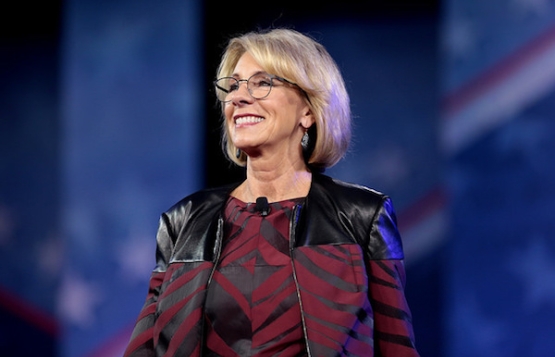
The Education Gadfly Weekly: Secretary DeVos has earned our respect—and a dignified return to private life

Volume 18, Number 44
11.7.2018
11.7.2018

The Education Gadfly Weekly: Secretary DeVos has earned our respect—and a dignified return to private life

Volume 18, Number 44
view

Secretary DeVos has earned our respect—and a dignified return to private life

The results are in, and this time the polls were mostly right: The Republicans lost the House but strengthened their control of the Senate, setting the stage for a new chapter in our country’s uncivil war. At the state level, the Blue Ripple gave Democrats gubernatorial victories in Illinois, Michigan, and Wisconsin, though it wasn’t enough to flip Florida or Ohio.

Michael J. Petrilli 11.7.2018
NationalFlypaper

Secretary DeVos has earned our respect—and a dignified return to private life

Michael J. Petrilli
11.7.2018
Flypaper

Education as a public good in a time of choice and diversity

Chester E. Finn, Jr.
11.7.2018
Flypaper

The new Perkins Act is a great opportunity to invest in work-based learning

Jessica Poiner
11.7.2018
Flypaper

How test-based retention affects high school outcomes

Amber M. Northern, Ph.D.
11.7.2018
Flypaper

How to better translate research for the classroom

Jessie McBirney
11.7.2018
Flypaper

The Education Gadfly Show: Much about the midterms

11.7.2018
Podcast
view

Education as a public good in a time of choice and diversity

Chester E. Finn, Jr. 11.7.2018
Flypaper
view

The new Perkins Act is a great opportunity to invest in work-based learning

Jessica Poiner 11.7.2018
Flypaper
view

How test-based retention affects high school outcomes

Amber M. Northern, Ph.D. 11.7.2018
Flypaper
view

How to better translate research for the classroom

Jessie McBirney 11.7.2018
Flypaper
view

The Education Gadfly Show: Much about the midterms

Michael J. Petrilli, David Griffith, Ph.D., Amber M. Northern, Ph.D. 11.7.2018
Podcast
view

Secretary DeVos has earned our respect—and a dignified return to private life

Michael J. Petrilli
11.7.2018
Flypaper

The results are in, and this time the polls were mostly right: The Republicans lost the House but strengthened their control of the Senate, setting the stage for a new chapter in our country’s uncivil war. At the state level, the Blue Ripple gave Democrats gubernatorial victories in Illinois, Michigan, and Wisconsin, though it wasn’t enough to flip Florida or Ohio.

None of this will have a huge impact on K–12 education policy, given that there’s not been much policymaking happening anyway. Yes, in combination with a red-hot economy and state finances in better shape than they’ve been in years, the shift to the left may portend greater school spending in 2019 in a few states. Otherwise expect mostly gridlock and a focus on pre-K and postsecondary education.

In Washington, vengeful Democrats are surely salivating over the chance to haul Secretary DeVos in front of multiple oversight committees, and to do that as often as possible. Congress may have forgotten how to make policy, but it adores giving grief to those who do. Here, once again, the most consequential issues relate to topics outside of elementary-secondary education, especially oversight of the student loan industry, the handling of for-profit colleges, and the right approach to sexual assault complaints on college campuses. But Democrats will want to attack DeVos on K–12 topics too, especially regarding civil rights enforcement (the treatment of transgender children and the federal role in discipline reform), but also the implementation of the Every Student Succeeds Act.

The question facing Secretary DeVos is whether to participate in these show trials. She has another option, one she has earned through her flinty resolve these past twenty-three months: She can choose to step down and gracefully exit a thankless, no-win scene.

Rumors are starting to circulate that her departure is imminent, I assume on her own volition. In my opinion, now is a good time for her to leave Washington, not just for her own blood pressure, but also for the sake of the education reform movement and her own (and the president’s) agenda at the U.S. Department of Education, which has a better chance of surviving the next two years if she passes the baton. The fact that Democrats will be disappointed if she does so tells you most of what you need to know.

***

No one can deny that DeVos got off to a weak start with her inadequately rehearsed confirmation hearing. Given that the Resistance chose her as the first target of its ire, forcing Vice President Pence to cast a deciding vote to make her secretary, a less resolute person might have quit before she even started. That she didn’t do so showed the grit and the commitment to better education that’s no surprise to friends and colleagues who have known her long before she came to Washington. She was made fun of on Saturday Night Live, bullied by the teachers unions, and yet she persisted.

While there’s some truth that you never get a second chance to make a good first impression, she worked hard at overcoming her bumpy start and grew into the role as secretary. She built a strong team—not an easy task in the Trump administration, or with a Senate this slow to confirm anybody—and got to work mastering the policy and politics of K–12, postsecondary, and CTE education. She made a few mistakes along the way, but for someone with little “in front of the cameras” experience, she learned fast. And most importantly, she pushed education policy in the right direction—empowering states, cutting red tape, and working to promote greater parental choice and personal responsibility.

In the court of public opinion, of course, none of this mattered because the media and the left were never going to give her a fair shake. It was too easy to play up the stereotype of a woman born to privilege—even worse, an earnest Christian conservative—to consider that she might have relevant experience from her years toiling in the school choice vineyard, her active participation in Republican politics, and her decades in the Michigan maelstroms.

Secretary DeVos may decide that, if only to spite her detractors and as a matter of personal character, she wants to serve out the remaining two years of Trump’s term. She has earned that right. But I hope she chooses otherwise. Here’s why.

First, she can take some wind out of the crazy-left’s sails by allowing someone else to make the trip to Capitol Hill for the oversight hearings that lie ahead. Chairman Bobby Scott and his colleagues will have a lot less fun—and get a lot less media—attacking someone like a Secretary Susana Martinez than they would with click-bait Secretary DeVos.

Second, she can take a talking point away from the unions and other anti-reformers by returning to private life. Politico reports that Democrats aired $3 million worth of television ads featuring DeVos—no doubt in support of candidates who despise school choice. In California, a late-hitting (and false) ad tied reform hero Marshall Tuck to DeVos. (As of publication time the race is too close to call.) Stepping out of the spotlight would be particularly beneficial to reform-minded Democrats and the prospects for reviving a more bipartisan approach to ed reform.

Secretary DeVos has proven that she’s a fighter. Now, with two years of service under her belt, and a Democratic House licking its lips, this would be more than a respectable time to step down. And those of us fighting for reforms in the trenches could use her support from the outside. (She was fantastic as head of the American Federation for Children, chair of the Philanthropy Roundtable, and so much more.)

DeVos has earned our thanks, and our respect. And if she decides to go back to Grand Rapids, she will have earned that too.

view

Education as a public good in a time of choice and diversity

Chester E. Finn, Jr.
11.7.2018
Flypaper

The distinguished Stanford education historian David F. Labaree recently published a perceptive, provocative essay in the Kappan that I found myself nodding in agreement with about three-quarters of the time and shaking my head the other quarter. His thesis: Over time, American K–12 education has largely replaced its commitment to advancing the public good with a more selfish focus on securing private gains of various kinds.

His account of the need for a robust form of “common” education in the early days of the nation is compelling: “As the founders well knew, the survival of the American republic depended on its ability to form individuals into a republican community in which citizens were imbued with a commitment to the public good.” But as the “common school movement” evolved during the first half of the nineteenth century, it also had to contend with “the possessive individualism of the emerging free-market economy.”

As “public education” spread across the land, therefore, its mission “wasn’t just to teach young people to internalize democratic norms but also to make it possible for capitalism to coexist with republicanism.” (There is, of course, a very different historical narrative to be found in works such as Boston University professor Charles Glenn’s The Myth of the Common School.)

By the late nineteenth century, U.S. schooling—Roman Catholics were by then going off on their own—was still mostly portrayed as a “public good,” and in important ways still was, notably in the Americanization of immigrants. But, explains Labaree, the stability of the republic was no longer in much jeopardy, and education had taken on an important additional mission, which was preparing young people for productive roles in a modern industrial economy.

There’s a public element to that, too, of course, for as it equips individuals with skills and habits, it also builds human capital, strengthens the nation’s economic competitiveness, makes the next generation self-sufficient, and so on. But as it readies people for jobs and careers of their own, the “private good” aspect of schooling also comes into sharper relief. Which is why most economists, rather than agonize over whether education is exclusively a public or a private good, simply recognize that it’s both. The two, however, must remain in some sort of equilibrium if both missions are to be successfully conducted. And Labaree clearly thinks they’ve lost that balance.

“All but gone,” he writes, “is the assumption that the purpose of schooling is to benefit the community at large. Less and less often do Americans conceive of education as a cooperative effort in nation-building or a collective investment in workforce development.”

He’s surely correct that it isn’t much talked about in those terms nowadays. Indeed, schools are pummeled today from both sides of our schismatic polity, pushed to celebrate diversity (with the unum often buried under the pluribus), to be culturally sensitive, to individualize education, to give families more choices, to operate “portfolios” of schools rather than “school systems,” and much, much more.

All true, and in its way both good and bad.

But it’s not the whole story, and Labaree seems to ignore the other important chapter: the push for higher academic standards, for closing achievement gaps, for building a “common core” into the curriculum, and for holding schools—all schools, at least all schools that call themselves “public”—to account for their students’ achievement as measured on common statewide metrics. All of this is true, too, and yes it also has both good and bad elements. But it’s a powerful push toward the “common” side of schooling and toward an overall K–12 system that meets the larger society’s needs, not just those of self-absorbed individuals and helicopter parents.

The two great thrusts of education reform in my lifetime have been, on the one hand, the push for more choice, and on the other, the push for more rigorous and uniform standards and the higher levels of achievement—for all kids, not just some—that are intended to accompany them.

Yes, there’s tension between those endeavors. And yes, I’ve also come to think (and have written) that in important ways they’re interdependent, not antitheses, and that we need both—in some sort of equilibrium—if either is to succeed. That duality parallels, in just about every respect, the tension between private and public that Labaree correctly identifies. But from where I sit, we’ve still got both, they’re very much still in a state of tension, and that’s a good thing. What he’s plainly correct about is that we don’t talk much nowadays about “common schooling,” and most schools’ curriculum pays far too little heed to what should be its civic dimensions. And that, sadly, is vividly demonstrated in the words and actions of far too many of today’s so-called adults.

view

The new Perkins Act is a great opportunity to invest in work-based learning

Jessica Poiner
11.7.2018
Flypaper

This summer, President Trump signed the Strengthening Career and Technical Education for the 21st Century Act into law. The legislation, often referred to as Perkins V, is the long-awaited reauthorization of the Carl D. Perkins Career and Technical Education Act of 2006. It governs how states implement and expand access to career and technical education (CTE) programs and provides over a billion dollars in federal funding.

Perkins V included a variety of changes and additions to previous law. (Check out this brief from the Alliance for Excellent Education for a detailed overview.) These changes include new requirements regarding what must be included in state plans submitted to the feds for approval. Last week, the U.S. Department of Education’s Office of Career, Technical, and Adult Education released for public comment its first official guidance on state plans. The public comment window closes on December 24, and finalized guidance will likely be released after the start of 2019.

Within his introduction to the guidance, Assistant Secretary Scott Stump shared his hope that states would use implementation of the new law as an opportunity to “rethink” CTE. He offered a variety of suggestions for doing so, including a call for states to examine “how to make work-based learning, including ‘earn and learn’ programs such as apprenticeships, be the rule and not the exception.”

This suggestion should come as no surprise. Secretary DeVos has expressed her admiration of the apprenticeship system in Switzerland, and the president signed an executive order for worker training that includes a focus on expanding apprenticeship programs. The apprenticeship model and CTE in general enjoy broadly bipartisan support. And most importantly, apprenticeships have value: A 2012 Mathematica study found that those who participated in registered apprenticeships had substantially higher earnings than nonparticipants, and that the social benefits were much larger than the costs.

But touting apprenticeships from the bully pulpit is different than creating, funding, and implementing high quality apprenticeship programs at the state and local level. And apprenticeships aren’t the only form of work-based learning out there. Perkins V defines work-based learning as “sustained interactions with industry or community professionals in real workplace settings...or simulated environments at an educational institution that foster in-depth, firsthand engagement with the tasks required in a given career field.” There are all kinds of models that fit this description.

Nevertheless, Assistant Secretary Stump is right that the new Perkins law is a great opportunity for states to invest in work-based learning programs. Here are a few ideas on how interested states could make it work.

Follow the lead of other states

There are plenty of states that have already invested considerable time, talent, and money into work-based learning programs. For instance, PrepareRI is an initiative of the Rhode Island state government that operates in partnership with businesses, schools, universities, and non-profits throughout the state. It is based on a strategic plan with eight priorities aimed at improving career readiness, and work-based learning is one of them. Specifically, PrepareRI calls for all high school students to have access to work-based learning at school by 2020. The state recognizes multiple varieties—including internships, service learning, and industry projects—and has published detailed guidance about each.

Another great example is Delaware, where the Delaware Pathways program provides high school and postsecondary students with work-based learning opportunities for in-demand careers. The program recently received a $3.25 million grant from Bloomberg Philanthropies to, among other things, expand the Office of Work-Based Learning at Delaware Technical Community College.

Wisconsin is also doing good work. The Badger State has established a youth apprenticeship program as part of its statewide school-to-work initiative. It is designed specifically for high school students and integrates school-based and work-based learning within local programs in a variety of career fields.

Focus on partnerships and cross-sector collaboration

Perkins V allows states to use certain funds to establish statewide partnerships between middle and high schools, higher education institutions, employers, and other partners. In states like Rhode Island and Delaware, these partnerships already exist. But in places where they don’t, states should take advantage of the law’s flexibility and funding to establish them.

Take advantage of resources and tools

Whether states are looking to create new programs and frameworks or simply build on what already exists, there’s no need to start from scratch. Jobs for the Future, a national nonprofit that focuses on reforming both education and the workforce, has created a work-based learning framework and has published reports and a host of other resources through its Center for Apprenticeship and Work-Based Learning. New America recently examined the link between college and work-based learning and published eight recommendations for how to more effectively tie together apprenticeships and higher education. And this summer, the American Enterprise Institute released a report that examines how community colleges could play a more active role in growing apprenticeship opportunities.

In 2017, the National Center for Innovation in Career and Technical Education created a Work-Based Learning Tool Kit for state and local program administrators. It’s a treasure trove of data and information, including summaries of how work-based learning fits into federal legislation like Perkins, ESSA, and the Workforce Innovation and Opportunity Act; recommendations for engaging employers, collecting data, and scaling programs; and links and resources from states that are leading the charge in work-based learning, such as North Carolina and Tennessee.

Incentivize businesses to participate

It’s a no-brainer that to make work-based learning viable, businesses will have to be involved. There are plenty of business that will jump at the chance to partner with schools and programs, but others may need additional enticement. That’s why states should consider creating a tax-credit program that would allow employers to reduce their state tax liabilities based on the number of students who complete work-based learning opportunities with their organization. By doing so, states could recruit new business and corporations to participate and help employers bear the costs of training and supervision, as well as wages in the case of apprenticeships.

***

Obviously, the information outlined here is not exhaustive. There are plenty of other resources out there and plenty of programs and partnerships that are already doing great work. But the most important thing to keep in mind is why work-based learning deserves to be a priority in every state: It provides students with meaningful opportunities to develop academic and career skills, it unites a broad range of partners—businesses, secondary and postsecondary education institutions, and community partners—in achieving a shared goal, and it has the potential to improve the state’s bottom line, as well as those of participants. Sounds like a win-win to me.

view

How test-based retention affects high school outcomes

Amber M. Northern, Ph.D.
11.7.2018
Flypaper

Test-based retention policies require students to repeat a grade if they do not meet a minimum level of academic performance on, you guessed it, a test. These policies have been around a long time and continue to sow division, with some believing that repeating a grade allows students time to develop the skills needed for the subsequent grade while others posit that the potential costs (like heightened behavioral problems and higher dropout rates) are too high.

RAND lends some empirical fodder to the debate in their latest study on the topic. They examine the causal effects of retention that occurred in grades three through eight on student behavior and various other high school outcomes. Specifically, they use twelve years of student data from New York City, ending in 2011–12, to determine the effect of retention on suspensions, absenteeism, dropout rates, credit accumulation, and graduation. Their sample included nearly 93,000 students.

The district policy required that students who scored in the lowest performance category (Level 1) on either the math or English language arts state standardized test be assigned to mandatory summer school unless they demonstrated at least a Level 2 performance through a “portfolio” (unfortunately, we’re not told what that entails). At the end of summer school, students took a second test in the subjects on which they had scored at Level 1 in the spring. Students still scoring at Level 1 are retained unless a portfolio review of their summer work evidences Level 2 performance or they get a principal’s exemption. (Yes, all of this sounds quite squishy!)

Policy squishiness aside, RAND is able to use a regression discontinuity design (RDD) that allowed them to compare students scoring at the Level 1/Level 2 cut-off on the end-of-summer test. In the RDD design, students are expected to be similar, save that their test scores fall just above or just below the cut-off to be eligible for retention. The study examines outcomes for both Level 1 and Level 2 students at the boundary. There were three key findings.

First, analysts found no systemic evidence that retention impacted suspensions (being suspended or the number of days suspended) for up to three years after retention. Similarly, no effects were found on school attendance or chronic absenteeism. When each grade was examined individually, a few isolated, temporary effects were found when students transitioned into and out of middle school, but they didn’t amount to much.

Second, retained students averaged fewer accumulated credits over their time in high school. Students retained in middle school (grades six through eight) were more negatively impacted than those retained in elementary school (grades three through five). Likewise, students retained in elementary schools were no more likely to drop out than were the promoted students; however, students retained in middle school were more likely than their promoted counterparts to drop out once they passed their on-time graduation year.

Last, retention did not improve the likelihood of graduating. There was no significant difference in the eventual graduation rates between retained and promoted students after the retained ones had the opportunity to also reach grade twelve.

Bottom line: If schools must retain kids, it’s better to do it in the elementary than secondary grades (other studies find benefits to third-grade retention). The seventeen states and numerous districts that now have retention policies should keep that in mind. But that also means that we need to figure out how to help older students who have fallen behind. Our current methods, like “alternative pathways” and credit recovery, clearly aren’t cutting it.

SOURCE: Louis T. Marian et al., “How Does Repeating a Grade Impact Students' High School Persistence and Behavior? The Case of New York City,” RAND Corporation (July 2018).

view

How to better translate research for the classroom

Jessie McBirney
11.7.2018
Flypaper

When it comes to using data to enact meaningful changes at the school level, few of us know where to begin. That’s why the University of Chicago Consortium on School Research (UChicago Consortium) just published a new report based on its own experiences translating research to the classroom. The paper, titled “Practice-Driven Data” and written by Eliza Moeller, Alex Seeskin, and Jenny Nagaoka, draws best practices from UChicago’s partnership with the Chicago Public School system (CPS) and the Network for College Success (NCS) to improve educational attainment for Chicago high schoolers. It is particularly timely given the Bill and Melinda Gates Foundation’s current effort to fund similar “school improvement networks” nationwide.

The paper lays out five lessons the partnership has learned since its formation in 2006. The examples they use and the recommendations they make are meant to be scalable, but the authors do note that every locality will face unique circumstances that may affect how they collect and analyze data in their own district.

1. Prepare: Build the capacity to facilitate hard conversations.

Schools can’t use data to guide practice until they have a framework to analyze new information and implement new strategies. The authors recommend developing two key roles: a data strategist and a charismatic team leader who “can bring data to life” for educators. Both individuals can help facilitate discussion among teachers and field questions about necessary changes within a school. The UChicago Consortium also builds issue-specific teams within CPS schools, each focusing on the data in an area, such as freshman success and instructional leadership.

2. Focus: Prioritize research-based indicators.

Once a data-collection infrastructure exists, the almost-limitless supply of new information is more likely to overwhelm than to help educators. Selecting which data points are most valuable, and knowing how to display them effectively, allows teachers to understand how to adapt their day-to-day practice.

Which data points should we prioritize? The authors suggest the most critical ones are predictive, clear and usable, regularly available, causally linked to outcomes, and actionable at the school- or classroom-level. For example, in the high schools the UChicago Consortium works with, daily attendance is a strong predictor of on-time graduation and is more actionable for teachers in real time than, say, eighth-grade test scores. Thus attendance is a better data point to highlight.

3. Make meaning: Develop shared ownership over the implications of research.

The authors here are concerned about a loss of context as new research-based initiatives infiltrate classrooms too rapidly. They explain, “When indicators reach educators without the research as context, educators have a tendency to approach indicators from a perspective of complying with mandates, rather than useful data to solve an important problem.” Most of the meaning-making battle involves communication with teachers, including in-person meetings and visual data tools to highlight the “why” behind new requirements. Sometimes replicating research findings in one’s own school can reinforce the stakes of a new project.

4. Strategize: Use the right data at the right time.

Specialized teams can focus on different types and granularities of data, but the UChicago Consortium also encourages its schools to highlight certain data points at particular times during the school year. For example, they suggest reviewing student demographics and prior achievement in early September so teachers learn the general background of their new students, school-level common assessment data during December, and college application data for seniors in January and again in March. Short- and long-term data analyses create different and overlapping cycles of reflection and improvement within schools.

5. Disrupt: Identify and stop inequity.

The increased availability of data allows educators to identify achievement and behavior trends across demographic subgroups within a single school, much as it does at the national level. But the authors warn against disaggregation without direct and immediate examination of the practices that might lead to such differing outcomes; otherwise, differences in graduation rates across races, for example, may only demoralize the communities that see themselves at the bottom of the graph. One practice the authors recommend is disaggregating data both by race and by prior achievement, so teachers may understand how their own practices are directly affecting students of differing backgrounds.

***

Because the UChicago Consortium and NCS write this guide from their own experience translating research into the school- and district-levels, it reads much more practically than many best-practices resources available to educators. Their frequent use of examples reminds the reader that every school district will be a little different and that data really can shape our school reform efforts.

SOURCE: Moeller, Eliza, Alex Seeskin, and Jenny Nagaoka. “Practice-Driven Data: Lessons from Chicago’s Approach to Research, Data, and Practice in Education.” University of Chicago Consortium on School Research, October 2018.

view

The Education Gadfly Show: Much about the midterms

11.7.2018
Podcast

On this week’s podcast, Andy Rotherham, co-founder and partner at Bellwether Education Partners, joins Mike Petrilli and David Griffith to discuss the midterms’ effects on education policy. On the Research Minute, Amber Northern examines how voucher regulations impact program participation and school quality.

Amber’s Research Minute

Corey DeAngelis et al., “Do Voucher Regulations Reduce Anticipated Voucher Program Participation and School Quality?” The University of Arkansas, Department of Education Reform (October 2018).

Fordham Logo

© 2026 The Thomas B. Fordham Institute
Privacy Policy
Usage Agreement

National

P.O. Box 110
Burke, VA 22009

202.223.5452

[email protected]

Ohio

P.O. Box 82291
Columbus, OH 43202

614.223.1580

[email protected]

Sponsorship

130 West Second Street, Suite 410
Dayton, Ohio 45402

937.227.3368

[email protected]