Mobile Navigation

  • National
    • Policy
      • High Expectations
      • Quality Choices
      • Personalized Pathways
    • Research
    • Commentary
      • Gadfly Newsletter
      • Flypaper Blog
    • Events
    • Scholars Program
  • Ohio
    • Policy
      • Priorities
      • Media & Testimony
    • Research
    • Commentary
      • Ohio Education Gadfly Biweekly
      • Ohio Gadfly Daily
  • Charter Authorizing
    • Application
    • Sponsored Schools
    • Resources
  • About
    • Mission
    • Board
    • Staff
    • Career
Home
Home
Advancing Educational Excellence

Main Navigation

  • National
  • Ohio
  • Charter Authorizing
  • About

National Menu

  • Topics
    • Accountability & Testing
    • Advanced Education
    • Career & Technical Education
    • Charter Schools
    • Curriculum & Instruction
    • ESSA
    • Evidence-Based Learning
    • Facilities
    • Governance
    • Personalized Learning
    • Private School Choice
    • School Finance
    • Standards
    • Teachers & School Leaders
    • Think Again
  • Research
  • Commentary
    • Gadfly Newsletter
    • Flypaper Blog
    • Gadfly Podcast
  • Events
  • Scholars Program

The Education Gadfly Weekly

Sign Up to Receive Fordham Updates

We'll send you quality research, commentary, analysis, and news on the education issues you care about.
Thank you for signing up!
Please check your email to confirm the subscription.

The Education Gadfly Weekly: Could breaking up the Education Department actually improve federal education policy?

Volume 26, Number 11
3.19.2026
3.19.2026

The Education Gadfly Weekly: Could breaking up the Education Department actually improve federal education policy?

Volume 26, Number 11
view
U.S. Department of Labor

Could breaking up the Education Department actually improve federal education policy?

The Trump administration has been shifting programs from the Department of Education to other parts of the federal government. This may be driven by politics, but it raises an intriguing question. What if the real issue is not whether the Department of Education survives intact, but whether some federal education programs might actually work better outside it?

Bruno V. Manno 3.19.2026
NationalFlypaper

Could breaking up the Education Department actually improve federal education policy?

Bruno V. Manno
3.19.2026
Flypaper

AI makes human writing more valuable—and changes how schools should teach it

Brandon L. Wright
3.19.2026
Flypaper

Should states go back to paper-and-pencil testing?

Dale Chu
3.19.2026
Flypaper

When teachers move for money, their effectiveness may lag

Meredith Coffey, Ph.D.
3.19.2026
Flypaper

A meta-analysis of the economic returns to an additional year of K–12 education

Jeff Murray
3.17.2026
Ohio Gadfly Daily

Can we agree on teacher diversity? | Episode 1010 of The Education Gadfly Show

3.18.2026
Podcast
view
Robot holding a pencil

AI makes human writing more valuable—and changes how schools should teach it

Brandon L. Wright 3.19.2026
Flypaper
view
Scantrons

Should states go back to paper-and-pencil testing?

Dale Chu 3.19.2026
Flypaper
view
Dollar sign on a chalkboard

When teachers move for money, their effectiveness may lag

Meredith Coffey, Ph.D. 3.19.2026
Flypaper
view
Returns to Education Meta-Study SR image

A meta-analysis of the economic returns to an additional year of K–12 education

Jeff Murray 3.17.2026
Ohio Gadfly Daily
view

Can we agree on teacher diversity? | Episode 1010 of The Education Gadfly Show

Michael J. Petrilli, David Griffith, Ph.D., Amber M. Northern, Ph.D. 3.18.2026
Podcast
view
U.S. Department of Labor

Could breaking up the Education Department actually improve federal education policy?

Bruno V. Manno
3.19.2026
Flypaper

Republicans have spent decades promising to abolish the U.S. Department of Education. Usually, the threat has been more symbolic than serious. It’s been a reliable applause line in conservative politics, rarely followed by serious structural change.

The Trump administration, however, has moved beyond slogans. It has not offered a blueprint for reorganizing federal education policy—beyond returning the K–12 parts to the states. But through a series of interagency agreements, it has begun shifting education programs to other agencies of the federal government.

According to Education Week, 118 programs have been transferred, including initiatives related to community schools, family engagement, workforce preparation, and international higher-education oversight.

This appears driven more by politics than by any carefully reasoned theory of governance. Critics are right to see in it the familiar GOP hostility toward this department in particular that proceeds the Trump administration, layered onto this administration’s broader desire to hollow out the federal bureaucracy. Rick Hess has rightly described the effort as uneven and improvised. Simply moving a program from one agency to another does not automatically shrink Washington’s footprint or return authority to states and localities. Money, rules, and regulations can remain very much in place.

Still, even clumsy political action can surface a legitimate policy question. Which makes this moment interesting. What if the real issue is not whether the Department of Education survives intact but whether some federal education programs might actually work better outside it?

That is not a crazy question. In fact, it is one that the country has wrestled with previously. Before Congress created ED in 1979, federal education programs were spread across the federal government, primarily within the old Department of Health, Education, and Welfare, but also in agencies connected to labor, research, and foreign affairs. The creation of a standalone department was meant to elevate education as a national priority and give it a stronger institutional home. But it was not universally embraced. (Nor did all that much consolidating actually occur.)

Checker Finn reminds us that the opposition included serious thinkers and public figures, not just anti-government ideologues. Harvard sociologist David Riesman opposed the move, as did teachers union president Albert Shanker and Senator Daniel Patrick Moynihan, for whom Finn was then working. Their concern was not that education lacked national importance. It was that isolating it within a single agency might obscure how deeply it is connected to other domains of public life: work, family, health, research, citizenship, and economic development. Consolidation also implied, Riesman noted, that there’d be just one funding spigot that could be turned off rather than many, which he saw as particularly risky for research universities.

That older debate now feels newly relevant. The Department of Education today serves as the central administrative hub for K–12 aid, college student loans and grants, civil rights enforcement, research, and a wide array of grants to states, districts, colleges, and nonprofits. Some of those responsibilities may logically belong together in one department—for example, K–12 grants to schools serving low-income students and K–12 grants to schools for special education services.  

But not every K–12 grant program in the department’s current portfolio has this same close alignment. Take workforce preparation. Over the past decade, policymakers across the political spectrum have emphasized the need for stronger links between education and employment. Career pathways, apprenticeships, industry-recognized credentials, and career-connected learning are no longer peripheral concerns. They are central to how many states, districts, and postsecondary institutions are thinking about opportunity.

If some of those functions were housed in the Department of Labor, that would not necessarily weaken them. It might well strengthen them. Programs meant to connect students and workers to jobs could benefit from living closer to employment data, labor-market strategy, and workforce systems. In that case, education policy would be treated not just as schooling or college policy but as part of a broader opportunity agenda tied to work and mobility.

The same logic of placing programs in existing federal departments or agencies applies to programs involving family engagement, wraparound services, and community schools. These efforts often depend on coordination with health systems, youth services, mental health supports, and family assistance programs. Those systems are typically housed outside the education world already. Locating some of these initiatives closer to the Department of Health and Human Services could, at least in theory, create stronger alignment between what schools are being asked to do and the agencies better equipped to support those functions.

Even some higher-education or international-exchange functions may fit awkwardly inside a department whose identity is still shaped largely by domestic K–12 schooling and student aid. So a more distributed structure might make sense for certain specialized programs, depending on their purpose.

Seen one by one, these transfers may look like administrative housekeeping. Seen together, they suggest a more provocative possibility. Some education programs may work better when embedded in the policy domains they actually touch.

That does not mean the case for distribution is open-and-shut. Far from it. The strongest argument for a cabinet-level Education Department was always coherence. Put related programs in one place, reduce fragmentation, and create a visible institutional champion for education inside the executive branch.

Ironically, as Finn points out, the creation of the new Department of Education didn’t create this coherence because it didn’t consolidate federal education programs in that new department. He writes, “…how random (and political) it was back in 1979 to decide what would go into that newborn agency.” Many education-related programs remain dispersed to this day across a host of federal Departments and agencies, creating “a true conundrum.”

That point should not be lost on what is happening today. Once programs begin scattering across agencies, lines of authority blur. Coordination gets harder. States, districts, and colleges may have to navigate multiple federal bureaucracies rather than one. And programs housed in agencies with different missions can lose focus.

That last risk is especially important. A labor agency may emphasize efficiency and placement over educational quality. A health agency may see schools mainly as service-delivery sites rather than academic institutions. Education, after all, is not just a supporting instrument for other policy goals. It has its own purposes and obligations. These are not trivial objections. They help explain why Congress created the department in the first place.

All of this is why this debate should not be reduced to a familiar binary of “save the department” versus “shut it down.” The more useful question is functional. Which federal responsibilities genuinely benefit from being centralized in a Department of Education? And which might be better positioned elsewhere, where they can connect more directly to the systems or parts of society that they are supposed to influence? That is a harder question than partisans on either side usually want to ask. It requires distinguishing between symbolic attachment to an agency and serious thinking about institutional design.

For now, the Trump administration’s program transfers do not amount to a coherent reform agenda. They remain a patchwork administrative experiment, and perhaps a temporary one. Moreover, Congress is not close to abolishing the Department of Education. A future administration could reverse much of what has been done.

But this much-argued episode has done one useful thing: It has reopened a debate that has been dormant for too long. It’s a debate conservatives ought to want. And it is one that liberals should also be willing to have. Because if Washington is going to keep playing a major role in education, and it will, the least it can do is make sure that role is organized on purpose rather than by habit.


view
Robot holding a pencil

AI makes human writing more valuable—and changes how schools should teach it

Brandon L. Wright
3.19.2026
Flypaper

The rise of AI has caused anxiety about the future of writing instruction. If the technology can write—or help people write—quickly and coherently on nearly any topic, and will likely get better and better at this, do we still need to teach students how to write?

I’m quite certain the answer among educators and school leaders is, overwhelmingly, yes—of course we do. But their rationale, from what I’ve seen, tends to point to cognitive benefits: organizing one’s thoughts, constructing persuasive arguments, faithfully reproducing observations and events on the page, anticipating objections, and the like.

All of that is true. But it’s missing another emerging, less intuitive reason why this instruction is crucial: AI is likely to make good human writing—whether produced independently or with assistance from a large language model (LLM)—rarer and more valuable. But producing authentically human content while using the technology calls for strong traditional writing and editing skills, as well as the ability to apply those skills in chatbot prompts. Schools should therefore teach students to write both with and without AI.

“Well sure,” you might say, “but very few people need to write well in life, regardless whether they use AI, so who cares?” I think that’s wrong for several reasons. There are the obvious cases like students who want to go into careers that require lot of writing—journalists, academics, lawyers, policy wonks like me. Some also want all American students to receive a good liberal arts education, which often entails writing well, being able to spot poor prose, and offering suggestions on how to improve it.

But the value of good human writing is broader than that. Rightly or wrongly, people are beginning to use chatbots for personal tasks, such as composing eulogies and serious messages to loved ones. As these uses become more common—and more available—we’d all be better off if people knew how to shape that content so it reflects genuine human thought and effort and signals that they didn’t merely outsource it entirely to AI and then claim that it represents their own thoughts and feelings. That they did, in fact, spend time writing it, even if they used a chatbot to help them. The skills needed to do that well are the same skills I’m talking about.

Consider what happens when a good writer works with an AI writing tool. They understand what makes a compelling opening, can spot awkward transitions, and have a good eye for sentence and paragraph structure and a good ear for voice. They know writing is stronger when it’s specific, when it draws on experience and concrete examples. So when someone with these skills uses a LLM, they craft prompts that generate better first drafts, and they can see which sections need or would benefit from human refinements—and know how to make them. The result is a sort of symbiotic relationship that produces writing that’s both good and human.

But what about someone who never learned to write effectively? With a simple AI prompt, they can generate passable text instantly, but they have a harder time recognizing when the chatbot has produced overgeneralizations, logical leaps, contradictions, or the kind of bland, repetitive prose that screams chatbot. They also have more trouble knowing what questions to ask or how to guide the AI toward more sophisticated, clearer thinking. And that’s because writing and editing are skills built over time through practice and exposure to good writing. Kids don’t know how to hit a baseball when they pick up a bat for the first time. It takes lots of work. Writing is no different.

This matters because low-quality machine-generated content—“slop,” as it’s called today—is already so widespread and tiresome as to become a sort of background noise unworthy of serious attention or consideration. This applies to virtually everything: images, code, applications, videos, tweets—and longer-form writing, with an explosion of content that’s technically competent but forgettable and lacking humanity. In my role as Fordham editor, I’ve recently been sent essay submissions and policy reports from prominent organizations that do little besides summarize existing information and propose vague, generic, almost meaningless recommendations—complete with LLMs’ tell-tale style. There is also, apparently, a deluge of academic papers that sound rigorous and correct but are actually based on fake, AI-generated data.

In this environment, content that’s recognizably human—that bears the unmistakable marks of individual thinking, personal experience, and authentic voice—will become increasingly valuable. Some readers can already distinguish between writing that emerges from genuine human engagement with ideas and writing that’s been assembled by a machine, and people’s eye for this will likely improve as their patience for it decreases. I believe people will come to gravitate toward and appreciate content that feels truly authored. Part of this will, I hope, be because such content is better. But probably more important is that such a human touch will signal that whoever made it cared enough to spend time on it—that it wasn’t lazily produced and passed off as their own.

If I’m right, schools should double-down on writing instruction. Recognize that writing has all the aforementioned cognitive benefits, but understand what else we’re preparing students for—and explain that to them. Organizing one’s thoughts and communicating clearly are important goals, but so is teaching them how to be effective partners with AI so they can create content that is distinctly human in an increasingly slop-filled world. This means learning to write independently while also learning to use AI productively—as a drafting assistant rather than a substitute for thinking.

Notably, this means students will need to develop sophisticated editorial judgment, in addition to basic writing competency. They should learn how to spot strong arguments, evaluate evidence, and understand how style and tone shape a reader’s experience. They have to know when AI-generated content serves their purposes and when it needs significant human intervention. And most crucially, they must develop their own authentic voice—the kind of distinctive thinking and expression that can’t be replicated by LLMs. One way to do this could be the use of “mentor texts” in writing instruction. Classes study effective human writing—a good op-ed from a prestigious publication or a chapter from an acclaimed novel—and then imitate its specific structures and styles in their own drafts.

The students who master these skills will be better equipped to thrive in an AI-dominated world. They’ll use AI tools to amplify their capabilities, to be extensions of themselves, while ensuring their written words remain human—and therefore worthy of people’s attention and appreciation. Meanwhile, students who never develop strong writing and editing abilities will have less professional options and be less able to create content that is compelling, valuable, or their own. The stakes are, I believe, larger than people think.

view
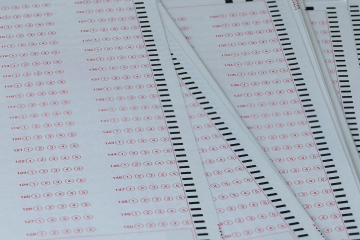
Scantrons

Should states go back to paper-and-pencil testing?

Dale Chu
3.19.2026
Flypaper

Next month, my 11-year-old will join her classmates to take the state assessment. Like nearly every student across the country, she’ll do so on a school-issued Chromebook—a device that has become nearly ubiquitous in K–12 classrooms. Paper-and-pencil testing, once the staple of state accountability systems, has largely vanished. The transition to screen-based assessments began in earnest in the mid-2010s, accelerated by the rollout of Common Core–aligned exams from PARCC and Smarter Balanced. At the time, the shift seemed sensible. Computers eliminated the need to print and ship test booklets, allowed for adaptive questions, and made more complex item types possible. But given everything we’ve learned about screens, attention, and technology in schools, is it worth asking whether the move away from paper was a mistake?

Sonja Santelises, the CEO of Baltimore City Schools, certainly seems to think so. As part of an effort to reduce screentime in classrooms, the district is trying to scale back student device use. But third graders will still receive their own laptops because state assessments are administered digitally, and she doesn’t want Baltimore students at a disadvantage. Santelises isn’t happy about it, though. She has called it “absolutely absurd” to have “eight- and nine-year-olds with their earphones on, sitting and plugging into a computer to be able to tell whether they read or not.” State education agencies often defend digital tests as a way to return results faster, yet nationwide, scores routinely take longer to reach families today than they did in the paper-and-pencil era.

If there’s one certainty in education, it’s that assessment drives instruction. As David Coleman, the CEO of the College Board, once put it:

Teachers will teach towards the test. There is no force strong enough on this Earth to prevent that. There is no amount of handwaving. There is no amount of saying, “They teach to the standards, not the test”… The truth is teachers do. Tests exert an enormous effect on instructional practice, direct and indirect.

When state exams moved onto screens, that pull extended far beyond the spring testing window. Schools felt pressure to make sure students were comfortable reading, writing, and navigating tasks on a computer—often starting at very young ages. This dynamic is further amplified by the fact that the gold-standard NAEP is also administered digitally. The irony is hard to miss. At a time when national reading scores are falling—and literacy experts suspect screens play a role—our major reading assessments are themselves delivered on screens. Taken together, these forces have created a subtle but powerful incentive structure that nudges instruction onto digital devices.

Indeed, the shift to computer-based testing helped fuel the massive push for 1:1 device programs. In a recent piece for Education Next, my colleague Meredith Coffey traced the meteoric rise of the ed tech boom:

By 2016, half of K–12 schools had given students 1:1 devices. Many other schools, including the one where I was teaching English language arts, offered access to carts of shared laptops or tablets. Another 12.6 million devices⸺enough for a quarter of that year’s public-school student population⸺shipped to K–12 buildings. Apple offered an astonishing 80,000 “educational” apps. By the following year, the New York Times was sounding alarms about the “Googlification of the classroom,” and educational technology investments reached $9.5 billion.

Districts bought laptops and tablets not only to administer state tests but also under the promise of personalized learning and preparation for 21st-century skills. A vicious cycle ensued. The more instruction and assessment happened on screens, the more schools felt compelled to integrate technology into everyday learning. Today, that reliance is baked in: Roughly half of teachers report that their school’s core curriculum requires students to complete assignments online. Now, with artificial intelligence entering the classroom, that digital grip feels even harder to loosen.

Could states realistically reverse course and return to paper-and-pencil testing? The short answer is not easily. Much of the infrastructure that once supported large-scale paper testing—secure printing contracts, distribution logistics, and trained personnel—has atrophied, and rebuilding it would be costly and time-consuming. Even if logistics weren’t a barrier, switching back would slow everything down: Testing windows would be longer, scores would take more time to compile, and the potential for manual processing errors would increase. A return to paper would also feel like a step backward, a move toward Luddite-style resistance to technology that many educators and policymakers would likely resist. And beyond the practical challenges, there’s the political calculus. There is little constituency for slower, pricier tests simply to improve the student experience.

Even assuming states could overcome these hurdles, any academic gains would likely be modest. Research on “mode effects” suggests that students, on average, perform slightly better on paper than on screens, but the improvements are small and uneven. Yet the potential second- and third-order effects—reduced screen time and fewer technological frustrations—could benefit students’ mental health and help rewire schools for belonging and achievement.

Ultimately, reverting to paper-and-pencil testing would not solve these problems on its own. The logistical and political hurdles are enormous, and the immediate effect on test results would likely be small. But the discussion is worth having because it surfaces a broader issue, which is: What kind of learning environment do we want for our children? Even small changes in how and where students engage with assessments can ripple through instruction, classroom culture, and student well-being. As Santelises warned, “Technology eats executive functioning for breakfast, but we’re giving it to kids every day.” While few are likely to call for a return to the days of analog testing, the growing attention to screentime suggests that educators and policymakers are concerned with creating calmer, less device-dominated school days. Whether these efforts will be enough to slow—or even halt—the march toward digital everything without rethinking digital assessments remains an open question.

view
Dollar sign on a chalkboard

When teachers move for money, their effectiveness may lag

Meredith Coffey, Ph.D.
3.19.2026
Flypaper

In recent years, states and especially districts have turned to financial incentives to encourage high-performing teachers to work in low-performing or otherwise hard-to-staff schools. The idea is appealing—let’s reward great educators for helping students who need them most—and so far, the research seems promising. We know, for example, that when teachers independently choose to transfer to a new school, they remain at least as effective as they were previously, and we know that when incentives bring high-performing teachers to low-performing schools, those schools receive better teachers than they would have without the incentive. In a new contribution to this body of work, a recent study published by the Annenberg Institute explores whether teachers remain as effective when they transfer schools in response to a large financial incentive.

As my colleague Amber Northern discussed on Fordham’s podcast, the study relies on data from the Transfer Talent Initiative (TTI), a 2009–11 study funded by the federal Institute of Education Sciences. The TTI researchers selected ten large, economically diverse districts with at least forty elementary schools, at least ten of which were low-poverty and at least fifteen of which were high-poverty. Within each district, schools were defined as low-performing if they were in the bottom 23 percent of either average student achievement or school accountability ratings. Chosen from the other 77 percent of schools, high-performing teachers were defined as those performing in the top 20 percent of similar subject-grade teachers, based on their impact on student academic growth over a three-year period. These teachers were then eligible to apply for vacancies at the low-performing schools in the same district, with a $20,000 transfer stipend as an incentive ($30,000 in 2025 dollars). They would commit to remain at that school for at least two years. Out of 1,520 identified candidates, 330 applied, and ultimately 80 elementary and middle school teachers participated in either the 2009–10 cohort (seven districts) or the 2010–11 cohort (three districts). The present study relies on the TTI data, district-level data, and survey data from the incentive-eligible teachers. The data, however, do not extend beyond 2011.

The researchers compare the “incentivized-transfer teachers” to “control vacancy-filling teachers,” who filled vacancies without any special incentive. Compared to their control-group peers, the incentivized teachers had previously been more effective, and their transfers led to a larger change in the characteristics of students whom they taught (e.g., achievement, poverty, and minority status). In the first year following the transfer, the change in performance among control-group teachers was not statistically significant, whereas the effectiveness of incentivized teachers dropped, on average, from the 85th percentile to the 66th. The decrease in teacher value-added was larger in math (-0.15 standard deviations) than in English language arts (-0.09 standard deviations). According to one of the analysts’ models, the second year saw these teachers recover almost all their effectiveness in ELA, though very little in math; another model found that their effectiveness did not recover at all.

The study identifies three main drivers of the effectiveness drop among incentivized teachers:

  1. Student-specific human capital. Incentivized teachers were more likely to go to a school with a student population significantly different from what they were accustomed to. When students’ needs and skill levels are different, the work of teaching becomes different—and in this case probably more difficult, since these teachers were necessarily moving into lower-performing schools.
  2. Teacher-school match. When teachers freely choose a new school, they take into consideration factors like curriculum, technology use, and overall school culture. They may prioritize choosing a school that aligns with their individual strengths and preferences. Here, however, the incentivized teachers’ options were limited not only to the bottom 23 percent of schools, but also by the TTI research managers, who further narrowed applicants’ options in order to expedite hiring for the purposes of the study.
  3. Indirect school effects. The teachers’ new schools tended to have less favorable systemic conditions for teaching. For example, incentivized teachers were less satisfied with their new schools’ discipline policies, resources, opportunities for autonomy, and parental involvement.

Notably, neither changes in adult human capital (i.e., quality of colleagues) nor direct school effects (e.g., tutoring, extended days, or other activities with a direct impact on students) seemed to have a substantial impact on effectiveness.

So, if the top teachers lose effectiveness when they follow financial incentives into low-performing schools, should states and districts forget about these programs? Not necessarily, for three reasons. First, the incentivized teachers remained more effective than those whom the schools would otherwise have hired (and, as was reported at the time, elementary school achievement rose—though middle school performance did not). Second, the study didn’t track data after the second year, so it’s entirely possible that the teachers continued to improve as they learned to work with a new student body and in a new setting. Finally, if the TTI process had not nudged incentive applicants toward specific schools, they might have chosen schools that were a better match, thereby better supporting their effectiveness.

Note, though, that even with a large incentive, few teachers pursued the opportunity. As Amber noted years ago, only 5 percent of the total eligible pool participated. Eighty jobs across ten large districts isn’t a lot. In a small or medium-sized district, there likely wouldn’t be enough movement to make much difference.

State and large-district leaders contemplating such a program should thus consider: How much can they reasonably afford to spend on incentives, and will it be enough to motivate potential candidates? How much need is there in the lowest-performing schools? And to what extent can receiving schools foster conditions that will best support incentivized teachers? Paying high-performing teachers to work in low-performing schools can benefit the students most in need—but education leaders ought to weigh the logistical and financial tradeoffs.

SOURCE: Matthew A. Kraft, John P. Papay, Jessalyn James, and Manuel Monti-Nussbaum, “Is Teacher Effectiveness Fully Portable? Evidence from the Random Assignment of Transfer Incentives,” Annenberg Institute at Brown University (February 2026).

view
Returns to Education Meta-Study SR image

A meta-analysis of the economic returns to an additional year of K–12 education

Jeff Murray
3.17.2026
Ohio Gadfly Daily

Researchers have long been interested in quantifying how inputs like school quality and years of education translate into personal earnings over time and individual contributions to the larger economy. The common consensus is that more school leads to more human capital, as demonstrated by higher wages for those with more formal education than their peers. A recent meta-study aggregates dozens of research reports on the topic and finds reason to question this prevailing belief.

An international trio of economics researchers focuses specifically on studies that exploit administrative changes—such as a change in the minimum school-leaving age for a state or country or labor law revisions that raise the minimum age that children can legally work—to identify causal relationships between individuals with more/less schooling and their later life earnings. They find 79 independent estimates of these types of relationships from 53 separate papers published around the world. The various studies involved data collected from 1945 into the 21st century, mainly in Western democracies, and affecting students between 10 and 16 years of age.

Overall, the combined findings mirror the common consensus, averaging an 8.2 percent boost in individual income for an additional year of education. But this robust return masks several rigorous studies that actually found null effects. The researchers also provide evidence that there are “missing” findings that have gone unpublished which would serve to reduce the impacts of more education even further. The authors argue that if there is a “true positive effect” of education—whatever percentage boost that may be—the findings of numerous studies on this effect, when mapped all together, should resemble a bell curve clustering around the “true number.” Some papers will show larger impacts, some smaller, and maybe even some negative results, but the distribution should be close to a normal one. However, these 79 sets of findings form a curve that is accurate at the top end but becomes irregular as it approaches zero and drops off sharply below zero.

The researchers’ analysis indicates that studies showing null or negative effects of increased time in school rarely see the light of day, and they attribute this fact to two forms of publication bias: a greater likelihood of a report being published when it is statistically significantly positive, as well as authors building or tweaking methodologies in order to get positive results which will be published.[1]

After correcting for both of these types of bias—essentially, constructing a normal distribution by filling in the missing portions of the curve—the authors conclude that the real effect of an additional year of schooling on individual earnings is likely somewhere in the 0 to 3 percent range. Much lower than the published research consensus. The report does not delve into reasons why additional time in school might not lead to higher earnings, but it may have to do with higher-quality studies that typically control for academic ability, given that kids who are better at school would likely be the ones staying in school longer.

In their conclusion, the report’s authors focus most strongly on the implications for economics research, noting that evidence of publication bias in favor of positive results is not new, and that its ongoing existence is a drag on the field’s integrity. But for education researchers and reformers, the likelihood that the economic return for an additional year of schooling is small to nothing should be the headline.

Manhattan Institute Fellow Robert VerBruggen, for example, writes in a recent Substack post that he sees three implications from these findings. First, indiscriminately pushing all kids to get the maximum amount of K–12 education possible does not seem to be a supportable policy position. Second, although pushing kids to the maximum amount isn’t the answer, the impacts of more school don’t go negative even after correcting for publication bias, so it follows that the amount of education students are receiving is probably just about right. Third, the point at which any given student has “enough” education to max out their future earnings—especially in relation to the postsecondary college vs. career debate—is still unknown and should be the focus of future analysis.

SOURCE: Gregory Clark, Christian Alexander, and Abildgaard Nielsen, “The Returns to Education: A Meta-Study,” Kyklos, the International Review for Social Sciences (February 2026).


[1] The authors did not uncover a drawer full of unpublished papers with null findings—that type of bias is implied—but they did observe use of many “weak instruments” in the published papers engineered to ignore or minimize null findings as “outliers”.

view

Can we agree on teacher diversity? | Episode 1010 of The Education Gadfly Show

3.18.2026
Podcast
 

Mike Petrilli takes a solo turn to tackle teacher diversity, a topic at the center of today’s debates over DEI. Should schools recruit teachers whose backgrounds reflect those of their students? What does the research say about how shared life experiences shape student outcomes? And how can schools promote diversity while maintaining high standards for academic excellence?

Then on the Research Minute, Amber Northern examines new research on Arkansas’s LEARNS Act, which raised the state’s minimum teacher salary to $50,000, and what it reveals about teacher pay and retention.

Recommended content:

  • The Right Way to Boost Teacher Diversity —Michael J. Petrilli for AEI
  • Can left and right find middle ground on teacher diversity? —Michael J. Petrilli, SCHOOLED
  • In defense of teacher diversity —Michael J. Petrilli, SCHOOLED
  • Raising the Floor: Teacher Retention Effects of a Statewide Minimum Salary Increase —Gema Zamarro, Andrew M. Camp, Josh McGee, Taylor Wilson, and Miranda Vernon, CALDER (2026)

Feedback Welcome: Have ideas for improving our show? We would love to hear them. Send them to [email protected]

Fordham Logo

© 2026 The Thomas B. Fordham Institute
Privacy Policy
Usage Agreement

National

P.O. Box 110
Burke, VA 22009

202.223.5452

[email protected]

Ohio

P.O. Box 82291
Columbus, OH 43202

614.223.1580

[email protected]

Sponsorship

130 West Second Street, Suite 410
Dayton, Ohio 45402

937.227.3368

[email protected]