Mobile Navigation

  • National
    • Policy
      • High Expectations
      • Quality Choices
      • Personalized Pathways
    • Research
    • Commentary
      • Gadfly Newsletter
      • Flypaper Blog
    • Events
    • Scholars Program
  • Ohio
    • Policy
      • Priorities
      • Media & Testimony
    • Research
    • Commentary
      • Ohio Education Gadfly Biweekly
      • Ohio Gadfly Daily
  • Charter Authorizing
    • Application
    • Sponsored Schools
    • Resources
  • About
    • Mission
    • Board
    • Staff
    • Career
Home
Home
Advancing Educational Excellence

Main Navigation

  • National
  • Ohio
  • Charter Authorizing
  • About

National Menu

  • Topics
    • Accountability & Testing
    • Advanced Education
    • Career & Technical Education
    • Charter Schools
    • Curriculum & Instruction
    • ESSA
    • Evidence-Based Learning
    • Facilities
    • Governance
    • Personalized Learning
    • Private School Choice
    • School Finance
    • Standards
    • Teachers & School Leaders
    • Think Again
  • Research
  • Commentary
    • Gadfly Newsletter
    • Flypaper Blog
    • Gadfly Podcast
  • Events
  • Scholars Program

The Education Gadfly Weekly

Sign Up to Receive Fordham Updates

We'll send you quality research, commentary, analysis, and news on the education issues you care about.
Thank you for signing up!
Please check your email to confirm the subscription.

The Education Gadfly Weekly: Could an AI-driven “job apocalypse” push the best and brightest into teaching?

Volume 25, Number 25
6.26.2025
6.26.2025

The Education Gadfly Weekly: Could an AI-driven “job apocalypse” push the best and brightest into teaching?

Volume 25, Number 25
view
College graduates
High Expectations

Could an AI-driven “job apocalypse” push the best and brightest into teaching?

As recent college graduates stare down the “AI job apocalypse,” the K–12 education sector gains a golden opportunity to recruit talented new teachers. Smart school and district leaders will take steps to draw the best and brightest graduates into America’s neediest schools.

Michael J. Petrilli 6.26.2025
NationalFlypaper

Could an AI-driven “job apocalypse” push the best and brightest into teaching?

Michael J. Petrilli
6.26.2025
Flypaper

Can the “mod squad” lead on education reform?

Dale Chu
6.26.2025
Flypaper

Which Party Really Has the Edge on Education?

Caitlin Peartree | David Winston
6.26.2025
Flypaper

Terrifying families is indeed bad for children

Meredith Coffey, Ph.D.
6.26.2025
Flypaper

Examining school and community factors to support students experiencing homelessness

Jeff Murray
6.24.2025
Ohio Gadfly Daily
view
Abigail Spanberger

Can the “mod squad” lead on education reform?

Dale Chu 6.26.2025
Flypaper
view
Chalkboard with democrats and republicans

Which Party Really Has the Edge on Education?

Caitlin Peartree, David Winston 6.26.2025
Flypaper
view
empty desks

Terrifying families is indeed bad for children

Meredith Coffey, Ph.D. 6.26.2025
Flypaper
view
Supporting homeless students SR image

Examining school and community factors to support students experiencing homelessness

Jeff Murray 6.24.2025
Ohio Gadfly Daily
view
College graduates

Could an AI-driven “job apocalypse” push the best and brightest into teaching?

Michael J. Petrilli
6.26.2025
Flypaper

Nobody knows for sure whether artificial intelligence will leave millions of Americans without work, but there are already signs that the “AI job apocalypse,” as the New York Times put it, may already have arrived, at least for recent college graduates. 

Graph showing unemployment

If this is the beginning of a trend, and not just a blip, it has huge implications for the education sector, as it raises questions about the kinds of jobs students are being prepared to do.

But even if this phenomenon proves short-lived—for example, if AI-driven innovation soon creates new, good-paying jobs for 22-year-olds—it presents those of us in K-12 education with a golden and very timely opportunity.

No, it’s not to replace teachers with AI. For most K-12 students, human interaction is likely to be as important as ever to helping them learn.

But what it may help us do—at least, create the opportunity for us to do—is recruit more of the most talented college graduates into teaching. Graduates who currently find themselves with fewer job opportunities.

That’s not pure conjecture. A seminal 2020 paper in the prestigious Journal of Labor Economics found that teachers who entered the profession during recessions were unusually effective at boosting student achievement, especially in math. Back in 2019, co-author Marty West of Harvard told The 74 that the number of excellent teachers is “strongly influenced by how attractive teaching is relative to other jobs”: 

When recessions wreak havoc on the private sector, the profession becomes a safe harbor for talented professionals—but as the economic picture brightens, promising candidates look elsewhere, and incumbent educators begin organizing for a better deal.

The country may or may not be heading into a tariff-related recession, but a down labor market for college graduates should provide much the same effect as far as turning the teaching profession into a safe harbor for young people who can’t land jobs elsewhere.

No doubt, not all smart college graduates will be great teachers. But the lesson from other tough labor markets is that the bigger the pool of prospective teachers, the higher the quality of those who end up in classrooms. 

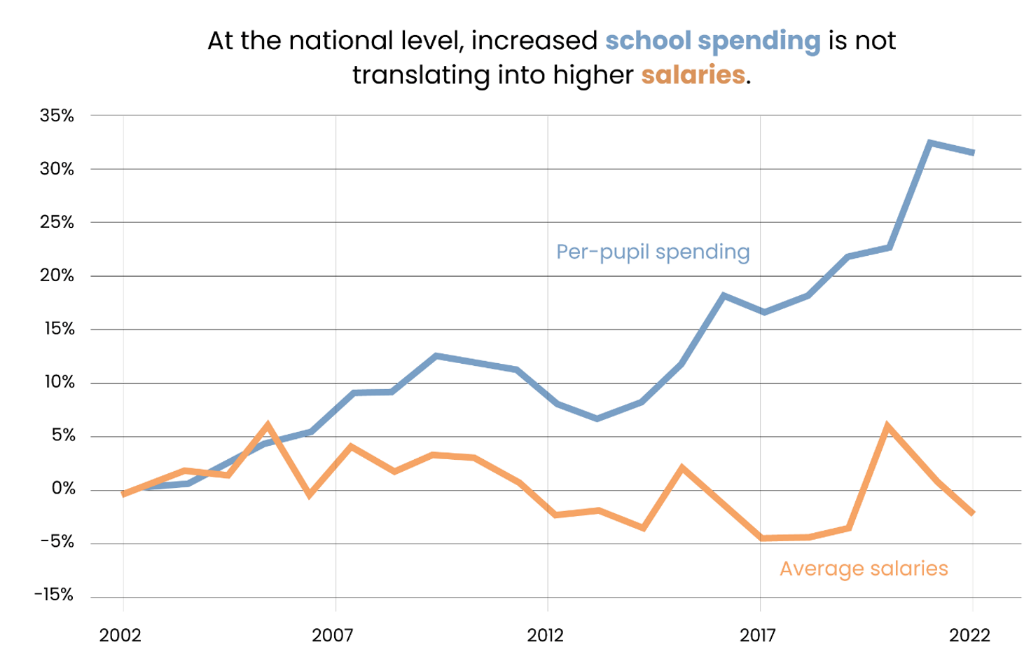
Schools, districts, and states might benefit from this AI-driven surge in teacher recruitment without lifting a finger. But if they wanted to supercharge the dynamic and eliminate teacher shortages altogether, there are specific actions they could take. And the sooner the better. Most importantly, they should raise the pay for new teachers. That’s do-able—but as Chad Aldeman argued recently, it can happen only if administrators start prioritizing teacher quality over teacher quantity—and increasing educators’ salaries over hiring all manner of non-teaching staff. That’s certainly not what schools have been doing in recent decades.

School spending and teacher salaries

As student enrollment declines nationally and in many locations, schools also need to reduce the bloated number of teachers and other staff on their payrolls. Moving to thinner staffs and modestly larger class sizes would free up even more resources that could be plowed into higher salaries. As Eric Hanushek and Macke Raymond wrote earlier this month, such efforts have made a huge difference for students in Washington, D.C., and Dallas, especially when targeted at the best teachers in the neediest schools.

And while AI shouldn’t replace teachers, it might make them more efficient and effective—so much so that schools could do without quite as many teacher aides, administrative staffers and the rest of the army of people who now make up the majority of K-12 employees.

There’s little doubt that AI is causing uncertainty, and probably disruption, in the labor market. That’s not great for young college graduates facing a foggy future. But it can be great for America’s K-12 students, if administrators and policymakers act fast.

view
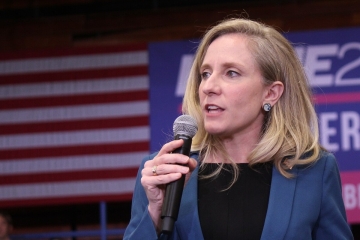
Abigail Spanberger

Can the “mod squad” lead on education reform?

Dale Chu
6.26.2025
Flypaper

In Mikie Sherrill and Abigail Spanberger, Democrats have found two rising stars to carry the banner in this year’s marquee gubernatorial races. Both are suburban moms, military veterans, and consensus-builders—center-left moderates charting a post-2024 course correction away from culture war theatrics and back toward kitchen-table pragmatism. Yet when it comes to education—a perennial concern for voters and a key driver of Republican gains in recent cycles—their platforms feel safe, familiar, and decidedly unambitious. If these candidates represent the future of Democratic leadership, voters should brace for an education agenda long on caution and short on conviction.

Mikie Sherrill: Close to the base, far from bold

Of the two, New Jersey’s Sherrill has taken the more assertive tack—criticizing Trump on the trail and aligning closely with the state teachers union (though she has also made friendly visits to charter schools). While she’s been talking about the abundance agenda, her education rhetoric doesn’t follow suit. She’s firmly opposed to school vouchers and, save for the occasional crumb tossed toward magnet schools, largely uninterested in expanding education choice of any kind. In a state where she herself has noted the uneven distribution of high-quality schools, one might expect a more ambitious effort to build new options—if not brick by brick, then at least family by family.

Sherrill has prioritized more money and staffing for schools but has offered little to suggest that she’s serious about closing ever-widening achievement gaps. Her silence on testing and accountability stands out, particularly given New Jersey’s decision to back off standardized assessments during Covid. At a time when many students are still struggling to recover academically, the absence of a clear position on how to track progress or identify learning gaps speaks volumes.

Her approach to the culture wars has been similarly cautious—more calibrated than conflicted. During a Democratic primary debate, Sherrill was asked whether she would support parents seeking to opt their children out of curriculum materials that include LGBTQ content. Her response: “Parents have a right to opt out of a lot of things, but this is not an area where they should be opting out.” Her remark takes on added significance with the Supreme Court poised to decide Mahmoud v. Taylor, a case challenging the removal of opt-out provisions for LGBTQ-inclusive lessons in Montgomery County, Maryland. The Court is widely expected to side with the parents, affirming broader rights to exempt children from curriculum content that conflicts with their beliefs.

Sherrill’s answer reflects a broader dilemma for Democrats: how to reconcile inclusivity with pluralism in an era of deep cultural polarization. While Republicans have made political hay casting Democrats as hostile to parents, few Democratic candidates have articulated a persuasive alternative that affirms both parental rights and the complexities of public education in a diverse democracy. That balancing act remains elusive for Sherrill.

Abigail Spanberger: Gentler rhetoric, similar shortcomings

Virginia’s Spanberger has taken a lower-key approach to education. She largely sticks to the Democratic playbook, but avoids the overheated rhetoric that often accompanies it. Her language is heavy on vague aspiration: a “world-class” education and “strengthening” public schools—terms that often serve as a euphemism for preserving the status quo rather than pursuing any serious version of reform.

Her emphasis, like Sherrill’s, is on inputs. She’s called for more resources and support for schools but hasn’t made a compelling case for accountability or academic rigor. Her campaign dismissed recent efforts to raise Virginia’s test cut-scores, claiming that “tinkering with the pass-fail mark” misses what students truly need—“high-quality instructional materials, qualified teachers, and a strong curriculum.” That framing creates a false dichotomy—treating accountability as a distraction rather than a necessary complement to investment.

Matthew Yglesias recently captured the flaw in this approach. While supports like high dosage tutoring and expanded mental health services are worthwhile, simply layering them onto an underperforming system misses the point. Inputs matter—but without clear standards, transparent data, and consequences for failure, schools and districts are let off the hook.

On school choice, Spanberger is aligned with the broader Democratic line: she opposes vouchers and has shown no interest in expanding options for families. That’s particularly notable in Virginia, where charter growth has been stunted by a hyper-partisan debate and a structural quirk: Unlike the many states with state-level authorizers or appeals processes, Virginia leaves charter approval solely in the hands of local districts. As a result, the Old Dominion has just seven charter schools.

Culturally, Spanberger’s tone is similarly restrained, reflecting the dynamics of a race where Republicans aren’t calling for change but continuity. With Governor Glenn Youngkin still in good standing but barred from seeking a second consecutive term, his GOP opponent is campaigning as the heir to his reform-minded education agenda. In that context, Spanberger’s milquetoast positions may avoid controversy—but they also lack the sharper vision needed to counter a well-defined Republican narrative on schools.

Progress on tone, not on policy

Both Sherrill and Spanberger are emblematic of an emerging Democratic impulse to be reasonable and pragmatic. But their input-heavy, accountability-light, choice-averse approach to schooling offers no real strategy for improving student achievement—and risks deepening the public’s distrust in a system that too often delivers too little.

To be fair, education has not been a top-tier issue for either candidate, who have understandably focused more on bread-and-butter economic concerns. Which is precisely the point: If the Democratic Party’s standard-bearers-in-waiting won’t offer a compelling plan for schools—not even as a second-tier priority—then what hope is there for a bold, forward-looking agenda? As the general election campaign kicks into gear, here’s hoping they choose to lean in, offering more than reassurance and rhetoric, and showing that education reform is a cause worth championing.

view
Chalkboard with democrats and republicans

Which Party Really Has the Edge on Education?

Caitlin Peartree | David Winston
6.26.2025
Flypaper

When it comes to handling education issues, voters have consistently placed more confidence in Democrats than Republicans, according to surveys conducted by The Winston Group since 1999. Our latest survey on education issue handling, administered to 1,000 registered voters earlier this month, shows this trend continues. Democrats have a 14-point advantage on education issues: 50 percent of respondents have more confidence in the party on education, compared to just 36 percent who prefer the Republican Party.

In the last 26 years, Republicans have tied or bested Democrats on education issue handling only three times: February 2001 (+5 Republican); January 2002, shortly after No Child Left Behind was signed into law (even); and April 2022, in the wake of widespread Covid-induced school closures (even). Over the last three years, a clear gap favoring Democrats has reemerged.

But recently, other outlets have found that Republicans now have a slight edge on this traditional Democratic stronghold. In a summer 2022 poll of likely voters in congressional battleground districts, Democrats for Education Reform (DFER) found that Republicans (47 percent) came out ahead of Democrats (44 percent) when voters were asked who they trusted more to handle issues related to schools and education. DFER found a similar result the following year in a poll of registered voters in four battleground states: Republicans (36 percent) came out three points ahead of Democrats (33 percent).

More recently, David Shor and the Democratic consulting firm Blue Rose Research have also found Republicans to have a slight advantage in trust on education. As Shor noted in an appearance on the Ezra Klein Show earlier this year:

Another really big shift was that education has gone from being basically one of the best issues for Democrats to being something that’s basically neutral now. We saw that in the Virginia gubernatorial election in 2021. We even saw it be an advantage for Republicans.

So, what’s going on here? Which party really has the advantage on education? When evaluating results like these that seem to contradict each other, there are a few things to keep in mind.

First, the way a survey question is worded can and does have a bearing on the results. At The Winston Group, we ask voters which party they have more confidence in to handle education. But both DFER surveys asked voters who they trust to handle the issue, and their 2023 survey primed voters to focus specifically on matters of academic preparation: “Which party do you trust more to handle issues related to schools and education?” (2022) and “Regardless of how you usually vote, which political party, the Democrats or the Republicans, do you trust to do a better job making sure public schools are preparing students for success after high school by ensuring they are teaching students to read and do math well?” (2023). Blue Rose Research, which has also found a small Republican advantage on education in surveys of registered voters through February 2025, also appears to ask the question in terms of trust.

Voter trust versus voter confidence may seem like a subtle distinction, but when factored with other methodological differences (which we’ll discuss next), it may account in part for the discrepancy.

Second, the ways surveys define their target populations and draw their samples also influence their results. For example, we survey registered voters from across the entire country. The 2022 DFER survey instead looked at “likely voters” (a designation with many different definitions) in 62 congressional battleground districts—or just 14 percent of all congressional districts. The 2023 DFER survey polled registered voters in four states: Arizona, Georgia, North Carolina, and Nevada. Based on turnout in the 2024 general election, that survey represented about 10 percent of the electorate, all in states that Trump won. These are clearly different sample populations.

Finally, a closer look at the results of these surveys may reveal that they’re not so different after all. While the margins in our Winston Group surveys still favor Democrats, they have shrunk in recent years. The 14-point advantage Democrats hold in our most recent survey is much smaller than the margins in the 30s they enjoyed in 2008–09. Just before the 2021 Virginia gubernatorial election, Democrats had just a three-point advantage.

Ed Issue Handling Trends

In that race, Democratic candidate Terry McAuliffe’s debate remark that “I don’t think parents should be telling schools what they should teach” would prove to be a turning point and a distillation of the frustration that many parents (and others) felt about Democrats’ attitudes toward parental involvement in their children’s education. In the 2021 Virginia gubernatorial exit polls, half of all voters (52 percent) said parents should have “a lot” of say in what their child’s school teaches, a view shared by most Republicans and, perhaps more importantly, independents. Voters who expressed this view broke overwhelmingly for Glenn Youngkin (+55). The Republican candidate succeeded because he was able to connect with voters beyond the Republican base, winning groups like independents (+9), voters with children under 18 (+4), and suburban voters (+7)—all groups that had preferred Biden in 2020. While it is impossible to disentangle education from other issues that may have motivated these constituencies, Youngkin clearly presented a compelling alternative to the status quo that reached beyond his own party.

Returning to present attitudes on political parties and education, the confusion about whether Democrats or Republicans have the advantage on education reflects that voters are not happy with the state of education in this country but haven’t seen either party make the issue a priority. Arguably, improving student outcomes should be the first priority regardless of which party champions it. In fact, both sides should. Among Democrats, Rahm Emanuel has decried “the discussion of locker rooms” and “the discussion of bathrooms,” saying “we better start having a conversation about the classroom.”

His criticism cuts both ways. We should want both parties to compete to come up with a more compelling vision for improving student outcomes, creating a focused direction for where education should go and how it should get there. A competition of ideas should make both sides improve and refine their own, resulting in a better system for everybody—our K–12 students especially. This is how a two-party system should work.

But neither Democrats nor Republicans have yet emerged with a compelling alternative to their own status quo. Such an alternative must appeal beyond their party’s base if either is to have the real advantage in education governance.

Editor's note: This piece was first published by Education Next.

view
empty desks

Terrifying families is indeed bad for children

Meredith Coffey, Ph.D.
6.26.2025
Flypaper

Since January 7—the day after Donald Trump’s election was certified—and escalating since Trump’s inauguration on January 20, U.S. Immigration and Customs Enforcement (ICE) and its sister agency U.S. Customs and Border Protection (CBP) have arrested over a hundred thousand people suspected of violating immigration laws. The daily average of 750 arrests is over twice the previous decade’s average, and the Trump administration wants to see that number rise to an unprecedented daily quota of three thousand. Historically, ICE and CBP focused on arresting those with other criminal histories and avoided making arrests in certain workplaces, schools, and other “sensitive places”; under the current administration, many of those guidelines have been chucked out the window. As a result, informal reports indicate, many adults have not only stayed home from work, but also kept their children home from school, either because the children are themselves undocumented or because they fear being deported without their U.S.-born children. Now, Stanford economist Thomas Dee has released a study that puts data and evidence behind media accounts of rising absenteeism in areas targeted by immigration enforcement.

Specifically, Dee analyzes student data from California’s Central Valley, one of the highest-profile targets of raids on immigrant communities. Although schools themselves were not subject to the January raids, many workplaces and other previously protected spaces became targets during this period. With data from five school districts, Dee uses regression to compare absences in January and February 2025 to absences in 2022–23, 2023–24, and the earlier part of the 2024–25 school year. In total, the sample includes 2,234 daily counts of student absences from the five districts, four of which allowed for breakdown by grade levels served within the district (pre-K, elementary, middle, and high school). Dee’s regression models control for several factors: pre-existing differences in attendance among the districts; the impact of “events” that may separately impact attendance (e.g., the last day before a vacation, holidays like Day of the Dead); and previous variations among each school year, month, and day of the week (e.g., absenteeism may be higher on Fridays than other days).

The findings are grim. In the period from January 8 (the day after the Central Valley raids began) to the end of February, overall absenteeism was 22 percent higher than would otherwise be expected, even with controls and in the context of the pre-existing absenteeism crisis. Although Dee does not identify the districts for safety reasons, he does confirm that those closest to the largest raids saw the highest rates of absenteeism. Also worth noting is that the raids did not continue throughout this time period, but the high absenteeism rates did; this finding indicates that the fear surrounding raids—and its impact on attendance—creates an impact that extends beyond the raids’ duration.

Further, the effect size is largest for the youngest students: The increased absenteeism rate was 31 percent higher for K–5 students and 35 percent higher for pre-K students. This variation is likely because the share of young children with undocumented parents is larger than that of older children, and because undocumented parents may have even greater fear of being separated from younger children.

The disproportionate impact on the youngest children is alarming. Missing school when young has a negative impact on academic outcomes and involvement in the justice system down the road. Research shows that absenteeism can be particularly harmful for elementary-aged children, since gaps in learning can snowball, making it harder and harder to recover. In addition, absenteeism is particularly detrimental to English learners, who are more likely than their peers to be the children of undocumented immigrants or themselves undocumented. As a result, longstanding achievement gaps are only likely to expand.

The educational and psychological damage is greatest to those children directly affected, but it’s also bad for their peers. Chronic absenteeism harms academic achievement among all children in a classroom—even those who continue attending—and it’s not a huge leap to understand that seeing classmates’ abandoned seats can cause distress to children of any background.

In fiscal terms, educating all children produces net economic benefits for everyone; conversely, failing to educate children results in economic costs to everyone. And yes, undocumented workers pay taxes, so yes, undocumented parents pay into the public education system. Finally, in one of the worst-case scenarios, when parents are deported without their children, not only are the children traumatized, but they also often enter the foster care system, which is costly to taxpayers and correlates with worse educational, economic, health, and criminality outcomes for the young people involved.

Although these raids aren’t officially blocking students from entering schools, that’s the practical effect they’re having—and denying children access to public education, whether they or their parents are undocumented, is illegal. Making this ruling over forty years ago, SCOTUS wrote that immigrant children “can neither affect their parents’ conduct nor their own undocumented status…the deprivation of education takes an inestimable toll on the social, economic, intellectual, and psychological wellbeing of the individual.” These realities are no less true today.

In recent days, the administration has dialed back and then resumed raids of agriculture sites, restaurants, and hotels—frequent workplaces of undocumented immigrants. Between the administration’s unpredictability and ICE’s sky-high quota of three thousand daily arrests, pervasive fear will endure. Rising absenteeism among vulnerable populations is just one of many reasons that these aggressive raids are wrong for children and for our country.

SOURCE: Thomas S. Dee, “Recent Immigration Raids Increased Student Absences,” Annenberg Institute at Brown University (June 2025).

view
Supporting homeless students SR image

Examining school and community factors to support students experiencing homelessness

Jeff Murray
6.24.2025
Ohio Gadfly Daily

Students who experience homelessness are at high risk for a number of negative academic outcomes—including chronic absenteeism, course failure, and low test scores—to say nothing of the physical and emotional toll. But these negative outcomes are not a foregone conclusion. Hundreds of millions of dollars are invested annually to support students and their families through schools, nonprofit organizations, religious groups, and government programs. A new study tries to tease out the school and community resources that have the most positive influence on young people who experience periods of homelessness, with an admirable focus on academics.

Michigan State University researcher Tasminda Dhaliwal looks at data from public schools across the Great Lakes State between 2011 and 2018, focusing on six specific factors she theorizes may help students who experience homelessness achieve in school despite their trying situations. She conducts a series of fixed-effect regressions to map their impacts both individually and in combination.

Primary data come from the Michigan Department of Education and cover 2 million students attending public schools in the state over the seven school years. (While Dhaliwal specifically notes that cyber charter school students are excluded, she does not categorically state that brick-and-mortar charter students are included; the sum of the information provided in the report seems to indicate that they are.) The data include indicators that denote whether a student has ever experienced a period of homelessness, as required under the McKinney-Vento Act and using the criteria and definitions established in that federal legislation. Academic outcome data include attendance (share of days attended of the total enrolled) and scores on the state’s standardized achievement tests for grades 3–8 and 11 in English language arts (ELA) and math. School-level data include the average years of teaching experience, share of teachers with a master’s or doctoral degree, share of teachers who have two or fewer years of experience, and support-personnel-to-student ratios (counselors, social workers, psychologists, and teacher aides). Neighborhood characteristics such as percentage of college-educated citizens, racial composition, and employment levels come from the American Community Survey, while information on businesses and organizations related to health and social assistance (everything from hospitals and clinics to food pantries and family shelters) come from a resource called ReferenceUSA.

Dhaliwal identifies and tests six broad categories of school- and neighborhood-based factors that should provide supports for students experiencing homelessness. They are peer socioeconomic advantage, teacher qualifications and experience, school support personnel, neighborhood advantage, neighborhood educational and occupational attainment, and neighborhood social services. Each one has several sub-factors that are also analyzed via regression. Students who were ever identified as experiencing homelessness are compared with those who weren’t.

Her findings indicate that availability of school support personnel, teacher qualifications and experience, and neighborhood educational and occupational attainment operate as positive supports for all students—whether they experience homelessness or not—boosting all three academic outcomes of interest over students who do not have these advantages. The better-resourced school and community are, the higher all students perform in school. Only two factors were seen to benefit homeless students more than non-homeless students—peer socioeconomic advantage and neighborhood socioeconomic advantage—and even these only impact attendance measures, not the two test scores. In fact, peer socioeconomic advantage is actually a drag on both math and ELA test scores for students experiencing homelessness. Dhaliwal theorizes that students of higher socioeconomic status—especially ones with better and more consistent attendance—could attract “resources” like the time and attention of the most experienced teachers to the detriment of more transient peers. But she does note that all of the significant effect sizes observed are small in magnitude and reflect a complex interplay of factors—including any number of variables unaccounted for in the data despite the rigor of the analysis conducted.

Dhaliwal concludes by recommending further research, not only into the nuances of the various factors (and indeed into the various lengths and circumstances around bouts of homelessness), but also into actual efforts implemented to support these students and their families. One hopes that detailed school choice data could be a specific feature of any future research, rather than lumping charter and district students together, since more than half of all students in Flint and Detroit, for example, attend charter schools rather than their zoned district schools. Does decoupling school attendance from residential address help or hurt homeless students’ attendance? Which neighborhood’s “factors” impact students who live in one place but attend school in another? Could cyber charter students experiencing homelessness have an advantage over brick-and-mortar school peers because they can access their school from any location, regardless of transportation availability, and often at non-traditional times of day? School choice is intended to decouple education from residential address (albeit for a different reason than supporting homeless students). Leaning into that fact would help expand this already-useful research.

SOURCE: Tasminda K. Dhaliwal, “Promoting Resilience? The Role of Schools and Neighborhoods in Supporting the Success of Students Experiencing Homelessness,” Educational Researcher (May 2025).

Fordham Logo

© 2026 The Thomas B. Fordham Institute
Privacy Policy
Usage Agreement

National

P.O. Box 110
Burke, VA 22009

202.223.5452

[email protected]

Ohio

P.O. Box 82291
Columbus, OH 43202

614.223.1580

[email protected]

Sponsorship

130 West Second Street, Suite 410
Dayton, Ohio 45402

937.227.3368

[email protected]