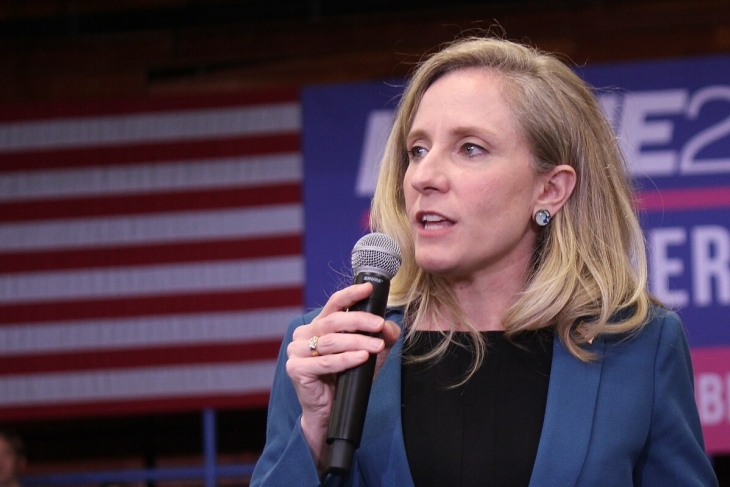
In Mikie Sherrill and Abigail Spanberger, Democrats have found two rising stars to carry the banner in this year’s marquee gubernatorial races. Both are suburban moms, military veterans, and consensus-builders—center-left moderates charting a post-2024 course correction away from culture war theatrics and back toward kitchen-table pragmatism. Yet when it comes to education—a perennial concern for voters and a key driver of Republican gains in recent cycles—their platforms feel safe, familiar, and decidedly unambitious. If these candidates represent the future of Democratic leadership, voters should brace for an education agenda long on caution and short on conviction.
Mikie Sherrill: Close to the base, far from bold
Of the two, New Jersey’s Sherrill has taken the more assertive tack—criticizing Trump on the trail and aligning closely with the state teachers union (though she has also made friendly visits to charter schools). While she’s been talking about the abundance agenda, her education rhetoric doesn’t follow suit. She’s firmly opposed to school vouchers and, save for the occasional crumb tossed toward magnet schools, largely uninterested in expanding education choice of any kind. In a state where she herself has noted the uneven distribution of high-quality schools, one might expect a more ambitious effort to build new options—if not brick by brick, then at least family by family.
Sherrill has prioritized more money and staffing for schools but has offered little to suggest that she’s serious about closing ever-widening achievement gaps. Her silence on testing and accountability stands out, particularly given New Jersey’s decision to back off standardized assessments during Covid. At a time when many students are still struggling to recover academically, the absence of a clear position on how to track progress or identify learning gaps speaks volumes.
Her approach to the culture wars has been similarly cautious—more calibrated than conflicted. During a Democratic primary debate, Sherrill was asked whether she would support parents seeking to opt their children out of curriculum materials that include LGBTQ content. Her response: “Parents have a right to opt out of a lot of things, but this is not an area where they should be opting out.” Her remark takes on added significance with the Supreme Court poised to decide Mahmoud v. Taylor, a case challenging the removal of opt-out provisions for LGBTQ-inclusive lessons in Montgomery County, Maryland. The Court is widely expected to side with the parents, affirming broader rights to exempt children from curriculum content that conflicts with their beliefs.
Sherrill’s answer reflects a broader dilemma for Democrats: how to reconcile inclusivity with pluralism in an era of deep cultural polarization. While Republicans have made political hay casting Democrats as hostile to parents, few Democratic candidates have articulated a persuasive alternative that affirms both parental rights and the complexities of public education in a diverse democracy. That balancing act remains elusive for Sherrill.
Abigail Spanberger: Gentler rhetoric, similar shortcomings
Virginia’s Spanberger has taken a lower-key approach to education. She largely sticks to the Democratic playbook, but avoids the overheated rhetoric that often accompanies it. Her language is heavy on vague aspiration: a “world-class” education and “strengthening” public schools—terms that often serve as a euphemism for preserving the status quo rather than pursuing any serious version of reform.
Her emphasis, like Sherrill’s, is on inputs. She’s called for more resources and support for schools but hasn’t made a compelling case for accountability or academic rigor. Her campaign dismissed recent efforts to raise Virginia’s test cut-scores, claiming that “tinkering with the pass-fail mark” misses what students truly need—“high-quality instructional materials, qualified teachers, and a strong curriculum.” That framing creates a false dichotomy—treating accountability as a distraction rather than a necessary complement to investment.
Matthew Yglesias recently captured the flaw in this approach. While supports like high dosage tutoring and expanded mental health services are worthwhile, simply layering them onto an underperforming system misses the point. Inputs matter—but without clear standards, transparent data, and consequences for failure, schools and districts are let off the hook.
On school choice, Spanberger is aligned with the broader Democratic line: she opposes vouchers and has shown no interest in expanding options for families. That’s particularly notable in Virginia, where charter growth has been stunted by a hyper-partisan debate and a structural quirk: Unlike the many states with state-level authorizers or appeals processes, Virginia leaves charter approval solely in the hands of local districts. As a result, the Old Dominion has just seven charter schools.
Culturally, Spanberger’s tone is similarly restrained, reflecting the dynamics of a race where Republicans aren’t calling for change but continuity. With Governor Glenn Youngkin still in good standing but barred from seeking a second consecutive term, his GOP opponent is campaigning as the heir to his reform-minded education agenda. In that context, Spanberger’s milquetoast positions may avoid controversy—but they also lack the sharper vision needed to counter a well-defined Republican narrative on schools.
Progress on tone, not on policy
Both Sherrill and Spanberger are emblematic of an emerging Democratic impulse to be reasonable and pragmatic. But their input-heavy, accountability-light, choice-averse approach to schooling offers no real strategy for improving student achievement—and risks deepening the public’s distrust in a system that too often delivers too little.
To be fair, education has not been a top-tier issue for either candidate, who have understandably focused more on bread-and-butter economic concerns. Which is precisely the point: If the Democratic Party’s standard-bearers-in-waiting won’t offer a compelling plan for schools—not even as a second-tier priority—then what hope is there for a bold, forward-looking agenda? As the general election campaign kicks into gear, here’s hoping they choose to lean in, offering more than reassurance and rhetoric, and showing that education reform is a cause worth championing.