Mobile Navigation

  • National
    • Policy
      • High Expectations
      • Quality Choices
      • Personalized Pathways
    • Research
    • Commentary
      • Gadfly Newsletter
      • Flypaper Blog
    • Events
    • Scholars Program
  • Ohio
    • Policy
      • Priorities
      • Media & Testimony
    • Research
    • Commentary
      • Ohio Education Gadfly Biweekly
      • Ohio Gadfly Daily
  • Charter Authorizing
    • Application
    • Sponsored Schools
    • Resources
  • About
    • Mission
    • Board
    • Staff
    • Career
Home
Home
Advancing Educational Excellence

Main Navigation

  • National
  • Ohio
  • Charter Authorizing
  • About

National Menu

  • Topics
    • Accountability & Testing
    • Advanced Education
    • Career & Technical Education
    • Charter Schools
    • Curriculum & Instruction
    • ESSA
    • Evidence-Based Learning
    • Facilities
    • Governance
    • Personalized Learning
    • Private School Choice
    • School Finance
    • Standards
    • Teachers & School Leaders
    • Think Again
  • Research
  • Commentary
    • Gadfly Newsletter
    • Flypaper Blog
    • Gadfly Podcast
  • Events
  • Scholars Program

The Education Gadfly Weekly

Sign Up to Receive Fordham Updates

We'll send you quality research, commentary, analysis, and news on the education issues you care about.
Thank you for signing up!
Please check your email to confirm the subscription.

The Education Gadfly Weekly: An agenda for raising student achievement

Volume 25, Number 20
5.22.2025
5.22.2025

The Education Gadfly Weekly: An agenda for raising student achievement

Volume 25, Number 20
view
student at desk
High Expectations

An agenda for raising student achievement

Earlier this month, Dana Goldstein of the New York Times argued that both political parties have abandoned the ed-reform agenda. Michael Petrilli responds, offering a robust agenda that would actually bring marked improvements to public schools.

Michael J. Petrilli 5.22.2025
NationalFlypaper

An agenda for raising student achievement

Michael J. Petrilli
5.22.2025
Flypaper

The voices we don't hear: Teachers who gave up

Robert Pondiscio
5.22.2025
Flypaper

Charter school advocates keep winning—at least in red states

Brandon Brown
5.22.2025
Flypaper

Restructuring teacher preparation programs to support the science of reading: A case study from Arkansas

Jeff Murray
5.22.2025
Flypaper

#970: Big moves in the Lone Star state: ESAs come to Texas, with Genevieve Collins

5.21.2025
Podcast

Cheers and Jeers: May 22, 2025

The Education Gadfly
5.22.2025
Flypaper

What we’re reading this week: May 22, 2025

The Education Gadfly
5.22.2025
Flypaper
view
Frustrated teacher

The voices we don't hear: Teachers who gave up

Robert Pondiscio 5.22.2025
Flypaper
view
Indiana flag

Charter school advocates keep winning—at least in red states

Brandon Brown 5.22.2025
Flypaper
view
Children reading with teacher

Restructuring teacher preparation programs to support the science of reading: A case study from Arkansas

Jeff Murray 5.22.2025
Flypaper
view

#970: Big moves in the Lone Star state: ESAs come to Texas, with Genevieve Collins

Genevieve Collins, Michael J. Petrilli, Amber M. Northern, Ph.D. 5.21.2025
Podcast
view
Fordham Gadfly image

Cheers and Jeers: May 22, 2025

The Education Gadfly 5.22.2025
Flypaper
view
Fordham Gadfly image

What we’re reading this week: May 22, 2025

The Education Gadfly 5.22.2025
Flypaper
view
student at desk

An agenda for raising student achievement

Michael J. Petrilli
5.22.2025
Flypaper

Earlier this month, Dana Goldstein of the New York Times wrote one of the most important education articles in years. In it, she argues that both political parties have abandoned the ed-reform agenda.

For decades, both Republicans and Democrats strove to be seen as champions of student achievement. Politicians believed pushing for stronger reading and math skills wasn’t just a responsibility, it was potentially a winning electoral strategy.

At the moment, though, it seems as though neither party, nor even a single major political figure, is vying to claim that mantle.

One could quibble around the edges of her argument (as Dan Buck did in these pages). As I’ve written before, there’s a good case to be made that OG ed reform is still alive and well in many red states. And at least a couple of policy areas have momentum and support from across the political spectrum, most notably the “science of reading” for little kids and Career and Technical Education for older ones.

But Goldstein is right that such islands of activity don’t add up to a serious agenda. They aren’t nearly enough to boost student achievement or close achievement gaps, especially given America’s long educational decline, which started more than a decade ago, before going off a pandemic-induced cliff.

So allow me to offer a robust education-reform agenda, one that would actually bring marked improvements to our public schools. Consider this a complement to ongoing efforts to expand high-quality parental choice via charter schools, private school scholarships, and other means. No doubt, “my agenda” will remain hypothetical unless and until politicians and other leaders embrace and run with it.

I will group the reforms by three prongs, organized around problems they are trying to address:

  1. Changes to educational practice that are eminently doable if we can overcome the tyranny of bad ideas;
  2. Reforms, especially related to spending and personnel, that must grapple with power politics, especially the politics of jobs, school boards, and teachers unions; and
  3. The hard but essential work of executing effectively.

Prong 1: Improving educational practice

The first prong of reforms should arguably be the easiest, because all that’s standing in our way is a bunch of bad ideas. We could call these changes “doing what works,” or “following the evidence,” or even just “following common sense.”

The most prominent example today is the science of reading. This one has struck a chord because the dumb way of trying (and failing) to teach kids to read was so obviously idiotic to anybody who had not spent their life inside an ed-school bubble. As in: Of course we must teach kids how to sound out the letters that make up words in the code we call the English language. Of course children are not going to learn how to read by osmosis, like we learn to speak.

And yet that basic notion—that we need to teach kids how to read via direct and explicit instruction in decoding letters and words—was denied in many U.S. classrooms for decades.

Now policy makers and education leaders are trying to replace bad ideas with reading pedagogies that align with evidence and common sense. Hooray!

The good news is that there’s much more where that came from. We could look next at math, where some still resist the obvious notion that little kids need to learn their math facts to the level of automaticity, meaning knowing how to add, subtract, multiply, and divide quickly and effortlessly. Conceptual understanding is important, too, but it’s not sufficient, and not much of it will happen without the basics.

Or we could embrace the importance of teaching elementary-age kids about the world they are inheriting, via exciting and engaging instruction in history, science, literature, and the arts. Which is not only their birthright and essential to informed citizenship, but also is the only proven way to build vocabulary and reading comprehension.

Or we could seize upon the commonsensical notion of grouping students by where they’re at in the learning progression, rather than with kids who merely share the same birth years. Because not all six- or seven- or eight-year-olds are at exactly the same level in reading or math, we should group kids with others at the same readiness level, at least for part of the school day. (That is surely the case for small-group tutoring.)

Indeed, as Emily Hanford’s Sold a Story explained recently, Success for All schools have been  grouping their pupils like this for decades, even with some kids spending part of their day in different grade levels, and it’s worked. Yet there are some out there who think that any kind of grouping amounts to “tracking” and is therefore racist, classist, and inequitable. Balderdash!

Fruitful terrain can also be plowed in grading and discipline practices. “Reforms” that have swept through our schools in recent years have led to lowered expectations for students “because equity.” We banned the use of zeros for kids who failed to turn in assignments or bombed their tests, even if they put in zero effort. We replaced traditional disciplinary practices, such as handing out detention during lunch or after school or on Saturday morning, and instead put kids in Kafkaesque “restorative circles”—or just looked the other way. We let phones and other devices invade the classroom.

Recalibrating our grading and disciplinary standards—while helping students meet them—would be a huge shot in the arm to our teachers, our schools, and our efforts to improve achievement.

Want more? Look at the hash we’ve made of middle schools and high schools because we reject the notion that not all teenagers need to tread the same pathway to college or career. We say we’re moving past the “college for all” era, yet we haven’t scrubbed the many course requirements still on the books, which leave little room for students to do real career training (like internships or apprenticeships). We pretend that making kids take three years of math and four years of English amounts to a call for rigor, and we keep adding new course requirements (coding! Financial literacy!) while never taking any away.

Let’s sum it up and reframe this as a positive agenda.

  • For our elementary schools, let’s make sure that districts adopt high-quality instructional materials, including English language arts programs that do an excellent job following the science of reading, and that also provide a content-rich curriculum in history, geography, science, literature, and the arts. And in math, let’s make sure that instructional materials are as focused on computational skills, especially in the early grades, as on conceptual understanding.  
  • From grades K through 12, let’s embrace the use of targeted, flexible groups, whether for early reading instruction or for math groups or, once kids get to middle and high school, for advanced versus on-grade-level instruction. By all means, let’s make sure that we are constantly looking for kids who might be late bloomers, and are now ready for more challenging assignments. And let’s make sure that the way we make decisions around those groups and course assignments is based on evidence and not bias. That means, for example, automatically enrolling students in advanced math courses if they demonstrate their readiness on the state test.  
  • And let’s return to the tried-and-true methods of grading and discipline that, like Chesterton’s fence, were adopted for good reason. Mainly because they make it clear to students that we have high expectations for them, and that they will be held accountable for their behavior and effort.

Prong 2: Reforming spending and personnel practices

Overcoming the tyranny of bad ideas is hard, especially in a system that is as fragmented as ours, with its 14,000 school districts and over 100,000 schools. That’s a lot of people to persuade! But it’s infinitely easier than trying to enact reforms that will impact the livelihoods of the adults who work in those schools.

And here is where we come to our second prong and the fundamental challenge of public education—and most public services: how to bring sound decision-making and accountability into a world where the politicians have every incentive to follow the will of the people who work for them rather than the people they are supposed to serve.

In other words, how do we deal with the all-powerful teachers unions, their capture of elected school boards, and the plain fact that the public education system is, among many other things, a gigantic jobs program?

If we want excellent public schools, we need to find a way to attract talented people and keep them, while quickly determining when we’ve made a mistake and be able to let those people go.

And we need to stop our practice of prioritizing teacher and staff quantity over quality.

A serious education reform agenda—one targeted at improving achievement and closing gaps—would focus on significantly raising teacher salaries, especially for new teachers, and especially for those willing to serve in our neediest schools. That’s because of basic labor economics. If we want great people, we need to pay for them. And if we want people to be willing to work in challenging circumstances, we need to pay them more. A lot more.

And how wonderful it would be if the only barrier to this agenda was money. Let’s just spend more money on our schools, and they will pay teachers more! Make that funding more progressive so that high-poverty schools get extra, and they will pay their teachers extra!

Except that it hasn’t worked. As Chad Alderman wrote recently, after adjusting for inflation, spending has gone up, up, up while teacher salaries have been flat, flat, flat.
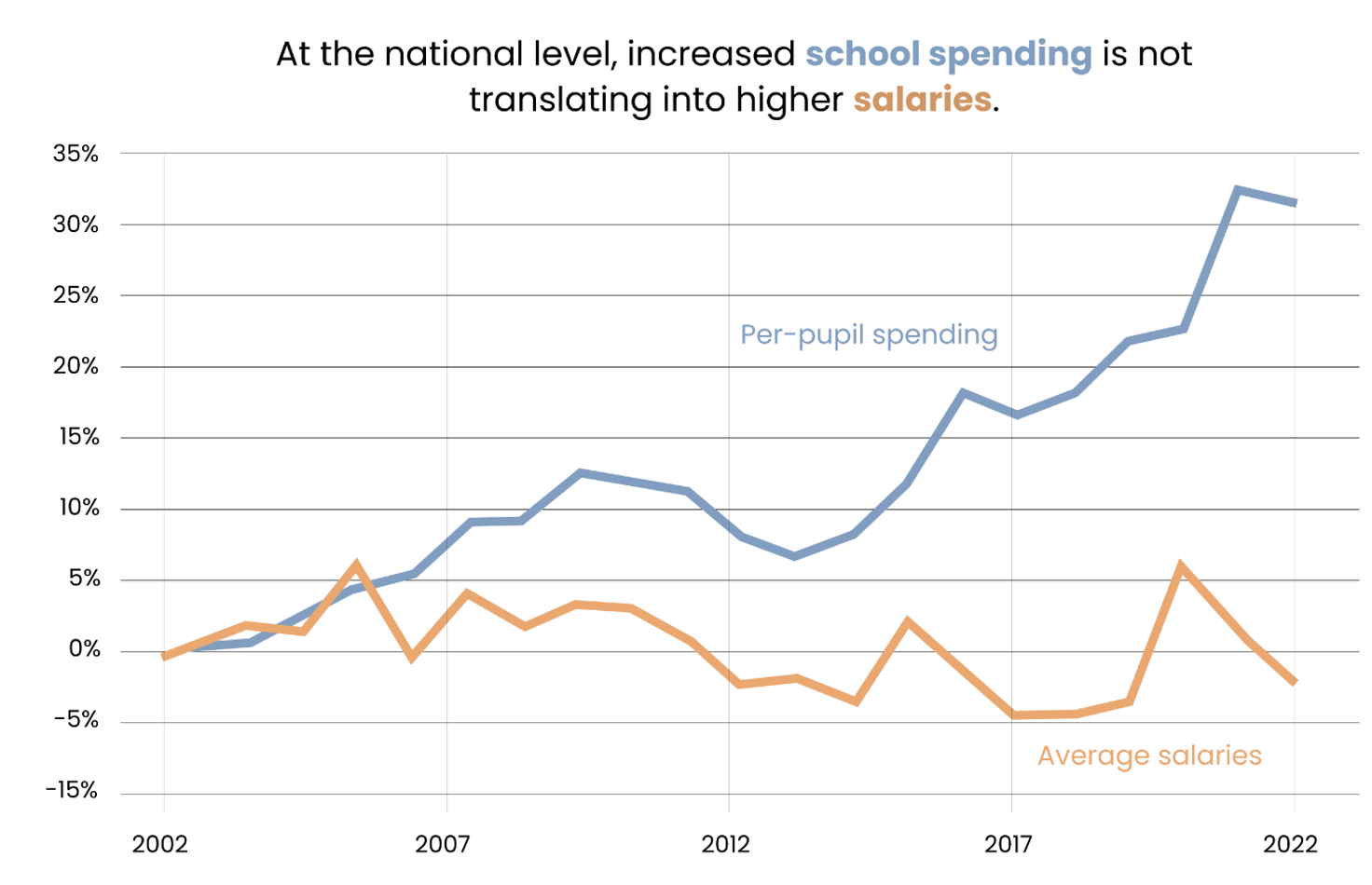
School spending and teacher salaries

And that is because, at every turn, and in practically every school district, when the time comes to choose between raising teacher salaries or hiring more teachers and other staff, we hire more teachers and other staff.

For a long time, this was in the cause of shrinking class sizes, which are now truly tiny in many places.

More recently, we have invented new categories of staff that we think we need in our schools. Reading coaches, math coaches, and now a whole slew of mental health counselors. Not to mention an ever-growing number of administrators and central-office personnel—on top of the classroom aides, school secretaries, bus drivers, lunch ladies, and the rest of the army of education staff we’ve had forever.

It’s not hard to understand why we have prioritized expanding the payroll—at least, if you’re willing to be cynical. Consider the teachers unions. As a friend reminded me recently, their fees are based on a per-head basis, so when schools add staff, they get more money. But when the unions successfully bargain for additional pay, that doesn’t put any more dollars in their coffers.

School boards members, meanwhile, like to hire people. The more the merrier. State and local politicians like that also. Because creating jobs is popular!

And so we’ve stumbled into a model whereby we offer mediocre pay to teachers and then try to help them be more effective by surrounding them with lots of other bodies.

If we wanted to do what’s best for kids and for raising student achievement, we would flip this model on its head. We would invest our resources in higher pay, and dramatically higher pay for teachers in high poverty schools. We would slim down the other staff, both in schools and central offices. We would let class sizes rise modestly. And we would use the tenure approval process seriously, weeding out the bad hires before they get lifelong protection.

“Raising teacher salaries” sounds like it should be a popular plank. But it’s the necessary trade-offs that make this so hard politically.

And other items in this prong might be even tougher—like expediently closing underenrolled and underperforming schools, which is political suicide but absolutely necessary given our country’s demographics.

Like I said: Hard. But necessary.

Prong 3: Execution

I debated whether to mention this, given that I honestly don’t have any great ideas on how to tackle it. But for any reform that is likely to help kids and boost student achievement, the key is not just passing a law or a school board resolution, but implementation and execution. That means getting the details right day in and day out at the classroom level.

Schools aren’t that different from other service-sector industries in this respect. I imagine that running assisted living centers or hospitals or even restaurant chains is challenging, too—making sure that customers have a positive experience, that great employees are hired and have the support and tools that they need, that mediocrity and bad management are addressed quickly.

In our world, many reforms struggle with the “last mile.” Many of us worry about that right now with the science of reading, and whether we are providing the best materials and training for teachers. We should also worry about it when it comes to math, or grouping, or grading, or discipline.

Mike Goldstein has thought about these problems longer and harder than anyone else I know, including wondering about some sort of management training system that we could put in place so that school districts have a cadre of professionals who are great at implementation, regardless of the initiative. That sounds about right to me.

Conclusion

Things might not be as dire as Dana Goldstein’s article implied. But it’s certainly true that most states and districts are lacking a reform agenda strong enough to overcome the inertia and forces that are dragging down student achievement. Policymakers and practitioners: take the agenda above and make it yours!


view
Frustrated teacher

The voices we don't hear: Teachers who gave up

Robert Pondiscio
5.22.2025
Flypaper

Earlier this month, I was flattered to be invited to a conference at Marquette University Law School, sparked by an article I’d written making the case that education reform has misfired by prioritizing testing, measurement, accountability, and other structural reforms instead of trying to improve classroom practice. It’s an argument I’ve made elsewhere and the theme of my Substack. The event, captured on YouTube, brought together educators and reformers for a thoughtful exchange, and I’m deeply grateful to Marquette for hosting it.

A highlight of the convening was the final panel of the day, featuring four teachers and administrators who acknowledged that many the challenges I cited—poor preparation, chronic problems with student behavior and classroom management, and the overwhelming demands placed on teachers—were real and concerning. But they pushed back politely on my assertion that we have made teaching “too hard for mere mortals.” I was particularly struck by remarks from Taylor Thompson, an earnest and winningly dedicated first-year fourth-grade teacher from Oshkosh, Wisconsin:

“[Teaching is] not an impossible task. It's demanding. It's hard. Each day is not rainbows and singing and dancing,” she said, but it's not impossible “if you are a collaborative person, work with your peers, and you have a community of coworkers and principals who don't allow you to silo into your own rooms and do your own thing. It can be a very, very empowering job.”

Thompson brought with her materials from the Core Knowledge Language Arts curriculum; having worked on CKLA’s launch during my time at the Core Knowledge Foundation, I was heartened that it contributed to her success. That said, I couldn’t help but wonder if her first-year experience would be different—if she’d even have had the time and energy to come to Marquette at all—had she not been given CKLA but an empty plan book, and expected to spend ten, twenty, or more hours a week scouring Google, Share My Lesson, or Teachers Pay Teachers for lesson plans and materials?

When it was my turn to respond, I told the audience that what they’d just heard didn’t contradict my argument; it amplified it. I suggested to my hosts that what we really needed was one more panel: earnest, well-intended people who wanted to teach but grew overwhelmed and walked away from their classrooms. Their absence from the conversation—not a flaw of Marquette’s thoughtful event but a field-wide oversight—limits our ability to address the issues driving nearly half of teachers to quit within five years. Those stories are legion.

After leaving the classroom, I worked briefly at an outfit called Prep for Prep under Ed Boland, who later left the organization to teach in a New York City public high school armed with little more than idealism. His 2016 memoir, The Battle for Room 314, described the relentless student misbehavior, homophobic slurs, and physical fights he endured. He wasn’t a minimally prepared Teach For America corps member or, like me, the product of an “alt cert” teacher prep program. He had two years of graduate school and six months of student teaching that he described as “a mix of folk wisdom, psycho-jargon, wishful thinking, and out-and-out bullshit.” After one freakishly difficult year, Boland returned to his old job. “I had taken courses in lesson planning, evaluation, psychology, and research. Next to nothing was said about what a first-year teacher most needs to know: how to control a classroom,” he wrote.

NPR’s All Things Considered not long ago ran a story about Liz Stepansky, the daughter of two schoolteachers who wanted to follow in their footsteps, thinking teaching would be a path to a stable, meaningful life. But when she took a job teaching at a South Carolina middle school, she found that she “had no idea” what she was in for. Her middle school students “dialed 911, threw balloons filled with bleach and ink in hallways and constantly pulled the fire alarm.”

“I'd go home and sometimes I'd spend an hour grading papers. And then I'd go back the next day and do it all over again,” she told NPR. “I remember my paycheck being $800 and something every two weeks." She transferred to another school, faced similar frustrations and threw in the towel. She’s now a speech pathologist.

It's not hard to find stories of earnest, well-intended people who wanted to teach but found the job untenable. But I can’t recall hearing from a single one at any of the education and policy conferences I’ve attended over the last twenty years.

Inattention to abandoned careers and disappointed hopes allow false and misleading narratives to gain traction. Last summer I was invited to give testimony before the U.S. Senate Committee on Health, Education, Labor, and Pensions. Senator Bernie Sanders was proposing a $60,000 minimum teacher salary to address teacher shortages. “By all means, pay teachers more,” I testified. “But don’t harbor any illusions that doing so will solve the problem.” Higher pay doesn’t fix shoddy preparation, unruly classrooms, or the ever-escalating burdens we pile on teachers’ plates as we treat schools as not just academic spaces but something akin to the social service agencies of last resort. “We are asking teachers to do too many things to do any of them well at any salary,” I said.

Teaching’s aspirational nature attracts optimists, but crushing demands betray them. A RAND study I cited in my Senate testimony found 99 percent of elementary teachers create their own materials, stealing time from honing their craft and working more closely with children and their parents. A 2024 Pew survey showed only 36 percent of teachers feel adequately resourced; a 2022 NEA poll revealed nearly half plan to quit due to poor school climate. These are systemic failures, not personal ones.

Teaching is among our most optimistic and aspirational professions, drawing idealists who believe education can transform lives. But celebrating only the successes—teachers who beat the odds, schools that defy demographics—distorts our vision. As I quipped at Marquette, it’s like watching Aaron Judge hit sixty-two home runs and concluding, “See? It can be done!”

And it can—if you’re Aaron Judge.

Other fields learn from failure—medicine from misdiagnoses, aviation from crashes. I urged Marquette’s audience to imagine a panel of teachers who quit—not to shame them, but to learn. What broke their optimism? What tools were missing? Thompson’s success shows what’s possible with support. But for every Thompson, countless idealists leave because they were overmatched, felt unprepared or betrayed by poor training or simply couldn’t manage chaos.

A few days later, Alan Borsuk, who organized and moderated the event at Marquette, told me about a conversation he’d had with a school administrator who was in attendance who disagreed with me that teachers who leave are failures. “She said one of the best teachers they have whose students have done well for year after year is leaving after this year,” Alan said. That teacher, she insisted, was not a failure.

Exactly! That teacher didn’t fail. We failed that teacher.

Education reform must weigh frustration alongside triumph. We need convenings where former teachers speak without judgment: their failures and frustration studied, not stigmatized. There’s no magic wand that will make the job easy or friction-free, but when you connect with students and go home feeling successful, there’s no job that compares to being a classroom teacher. You feel on top of the world. It’s immensely satisfying work.

The question ed reformers and policymakers need to ask now is what can we do to make more teachers feel successful and their jobs more doable?

Editor’s note: This was first published on the author’s Substack, The Next 30 Years.

view
Indiana flag

Charter school advocates keep winning—at least in red states

Brandon Brown
5.22.2025
Flypaper

The last decade’s political shifts have banished many previously popular education reforms to the proverbial wilderness. Charter schools, perhaps the most successful and lasting education reform in recent history, are not immune to these changes. It’s well-documented that the national charter movement faces a pivotal and potentially perilous moment.

The bipartisan school reform consensus that enabled the meteoric rise of charter schools has eroded. Instead, Republicans are passing sweeping voucher and education savings account (ESA) legislation in red states at record speed. With a few exceptions, Democrats have largely walked away from public school choice and have proposed no vision for K–12 public education other than dumping more money into the failed status quo. And now the Supreme Court looks poised to deliver an opinion that could forever change the nature of charter schooling as we know it.

There is a real threat that charters will be a casualty of these shifting dynamics. That would be a terrible outcome for the more than 3.8 million students who attend charter schools across the country.

Yet we also continue to see signs that state-level charter movements are strong—and growing stronger, at least in red states. Two years ago, legislation in Ohio dramatically narrowed the funding gap for charters during a year when eligibility for private school vouchers became universal. Last year, Iowa started sending more money to charter schools and allocating state resources to support their growth while also investing more resources in an expansion of its ESA program.

In Florida, many pro-charter bills worked their way through the state legislature this year, even as the state is hailed as a national leader in private school choice. Tennessee recently passed important structural charter school reforms alongside a universal voucher program.

My home state of Indiana is no different. Last month, charter schools concluded their most successful legislative session since the original law’s passage in 2001. This happened alongside legislators making Indiana’s voucher program universal beginning in 2026.

  • Charters will receive a pro-rata share of local operations property tax levies and future operating referenda, erasing the majority of a $7,900 per-pupil funding disparity.
  • Communities now have a mechanism to create independent facilities and transportation authorities to serve all students in a given geography.
  • A new law prevents the weaponization of the zoning process by allowing charter schools to be an approved use within any zoning category and preventing the denial of a zoning request based on the type of school.
  • Legislators maintained a supplemental state charter school grant even as budget writers made major cuts in other areas to address a projected budget shortfall. 

So, what lessons can charter advocates take from these recent victories? Here are four places to start.

  1. Establish a clear vision for how charters fit into a broad choice ecosystem. Charter leaders have a decision to make when it comes to advocacy. They can exclusively lock arms with traditional public schools and risk positioning charters as part of the entrenched status quo. The other option for red state advocates is to accept that choice, in all its forms, is here to stay and then explain how public school choice is essential to a comprehensive choice strategy. That includes being clear about what differentiates it from other forms of choice (i.e., charters are free, public, and open to all). This both/and approach provides a clear rationale for how legislators can support vouchers and ESAs while also expanding choice within the public school system. If it’s an either/or strategy, charters will lose every time.  
  2. Build a big-tent choice advocacy coalition. For any advocacy effort to be successful, advocates must develop a clear-eyed view of who holds power and where they hold it. Charter sector leaders tend to be a politically progressive group, so, understandably, advocates are often hesitant to work primarily with a political party they don’t identify with. For charter advocates to be successful in red states, though, they must work in coalition with other choice advocates to build the political power necessary to successfully persuade policymakers to view charters as an essential part of the broader choice agenda. This requires an intense, singular focus on achieving education policy wins even when advocates might disagree with the majority party on other hot-button issues.  
  3. Relentlessly expand the Overton window. It took several attempts, beginning in 1994, for state Senator Teresa Lubbers and others to finally get the original Indiana charter law across the finish line in 2001. More recently, Indiana charter advocates spent five legislative sessions working up to the historic reforms that passed into law this year. Sharing local property taxes, for example, seemed like an impossible political task just a few years ago. But advocates continued to work with legislators to introduce and advocate for our preferred comprehensive legislation—there was no negotiating against ourselves. Those policy ideas made a little more headway each year until seemingly marginal progress turned into an avalanche of legislative wins.  
  4. Outcomes still matter. In an era where the bipartisan consensus on school accountability has vanished, it can seem like there is no political constituency that values quantifiable academic outcomes. Our experience in Indiana, however, runs counter to that. Luckily, Indianapolis charter schools are the most widely studied education intervention in the history of Indiana. And the findings from those studies are consistently strong. These data were our most powerful advocacy tool, so much so that legislators accurately recited research findings in committee hearings and on the floor of the House and Senate. Without that strong research base, it would have been unlikely for legislators to use political capital to support charter school students while dozens of other high-profile policy challenges filled their plate.

The reports of the death of charter schools have been greatly exaggerated—at least in Republican-led states. Charter advocates across the country are showing that big policy change is still possible even amid rapidly expanding private school choice programs and fraying national political coalitions. A growing number of states are proving that expanding private school choice doesn’t have to come at the expense of the public version. Based on their popularity and outcomes for students, charter schools are worth the fight.

The only thing slowing us down—other than perhaps a Supreme Court ruling—is our own lack of audacity and foresight to think big and build winning coalitions. We have a roadmap for a new era of charter school success, especially in red states. The question becomes: Will we follow it, or will we find ourselves lost in the wilderness with no way out?

view
Children reading with teacher

Restructuring teacher preparation programs to support the science of reading: A case study from Arkansas

Jeff Murray
5.22.2025
Flypaper

Pandemic school disruptions, frustrations with ineffective reading methods, and sinking test scores lit a fire under the nascent science of reading movement which has borne fruit across the nation and raised hope that student reading achievement will begin to climb again. The science of reading is a comprehensive effort to change both policy and practice for the benefit of students, but one area that is sometimes overlooked is teacher preparation: ensuring not only that new teachers are trained in the five pillars of early literacy (and all that goes with them) but also that they are not being taught outdated, ineffective, or downright harmful curricula and instructional methods.

Teacher Preparation Inspection-US (TPI-US) has been conducting inspections of teacher preparation programs at colleges and universities across the country since 2013, partnering with the institutions themselves, as well as with state agencies and philanthropy. Literacy instruction was always an area of concern, but it became a central focus for TPI-US inspection teams starting in 2021 due to the raft of bad news coming on the heels of pandemic education disruptions. In partnership with the Barksdale Reading Institute, TPI-US began by reviewing every teacher prep program in Alabama, supplying data-based judgments about how well programs taught the science of reading to their pre-service teachers. These findings formed the basis of their current practice, detailed here. Their latest working paper is an informative snapshot of the changes that have taken place at one university over the last few years, describing two inspections of Southern Arkansas University’s Teacher Education Department (SAU) conducted in 2022 and 2024. It shows what the authors describe as a “shining example” of the positive changes they are working to make.

Among the initial findings in 2022: SAU’s literacy coursework covered the science of reading (including each component of structured literacy) but didn’t include adequate course-embedded connections to real-world practices so that teacher candidates could understand how to apply what they learned. Nor did pre-service teachers have sufficient opportunities to work with elementary students in real classrooms.

In consultation with TPI-US inspectors, SAU officials planned to restructure their literacy courses to integrate practice-based learning throughout the program, including placement in K–1 classrooms for the most junior teacher candidates and placement in grade 3–6 classrooms as they gained teaching experience. Their classroom work was also to include administering assessments, analyzing test results, and assisting in instructional planning using those data. Additionally, SAU staff and students would partner with veteran teachers and elementary school administrators to help review and select high-quality instructional materials to be used in those classrooms.

Returning in 2024, TPI-US found that all of these action items had been completed, and more besides. SAU had also created a structured mentoring program pairing veteran teachers with teacher candidates and now gave students frequent opportunities to observe and analyze recorded lessons using high-quality curricula and teaching methods. This is all good news, but unfortunately the details in the TPI-US working paper grow sparse from here on. We are told that “feedback from district partners” and “individual student growth” are both positive as a result of the revamp, but only the former is expounded on and that only to a vague degree. “District partners have consistently remarked on how much better prepared teaching candidates are to teach literacy and implement high-quality instructional materials in their classrooms effectively” we learn, and “this preparedness has led to districts actively seeking out SAU candidates for hiring, recognizing the value they bring in terms of literacy instruction proficiency and readiness.”

It is not that these findings don’t represent positive movement. Restructuring teacher preparation is a non-negotiable element of successful implementation of the science of reading and we do at least discover that—however it happened—SAU was readily accepting of big changes to their program. That’s not nothing. But measurable improvement of elementary students’ literacy achievement is the true arbiter of a job well done, and those data are conspicuously and unhelpfully absent from the paper. Maybe it’s too early to tell. If so, hopefully reporting that information is on the radar of TPI-US’s researchers sooner rather than later. But it is only in moving the student achievement needle that any policy or programmatic restructuring can be judged as successful. And the clock is ticking loudly for our youngest readers.

SOURCE: “Portrait of Practice: Southern Arkansas University,” TPI-US (April 2025).

view

#970: Big moves in the Lone Star state: ESAs come to Texas, with Genevieve Collins

5.21.2025
Podcast
 

On this week’s Education Gadfly Show podcast, Genevieve Collins, Texas State Director for Americans for Prosperity, joins us to discuss Texas’s newly passed Education Savings Account bill—an ambitious policy that could position the Lone Star State as a national leader in school choice. Then, on the Research Minute, Amber highlights a Michigan study showing that simply being flagged for third-grade retention can boost students’ reading scores—even if they aren’t actually held back.

Recommended content: 

  • “A Texas-Sized Win for Families in the Trump Education Era” —Genevieve Collins, RealClear Policy
  • “Jeb Bush: Texas’ Education Savings Account Victory Can Set Nationwide Standard” —Jeb Bush, The74
  • “How Genevieve Collins, Americans for Prosperity, Are Shaping Texas’s Future” —Daily Caller
  • “The Impacts of Grade Retention Policy With Minimal Retention” —Jordan S. Berne, Brian A. Jacob, Christina Weiland, Katharine O. Strunk, EdWorking Papers (May 2025)

Feedback Welcome: Have ideas for improving our podcast? Send them to Stephanie Distler at [email protected].  

view
Fordham Gadfly image

Cheers and Jeers: May 22, 2025

The Education Gadfly
5.22.2025
Flypaper

Cheers

  • The Department of Education will allocate an extra $60 million in grants for charter schools. —Education Week
  • Nat Malkus and Sam Hollon point out that many schools continue to operate under lowered expectations for attendance and graduation even though the pandemic is over. —The Washington Post

Jeers

  • Kindergarten absenteeism has reached crisis levels, especially in high-poverty areas. —The 74 Million
  • Houston ISD saw an increase in high school graduates earning invalid industry credentials, raising concern that schools were gaming the system to graduate students and boost ratings. —The Houston Chronicle
  • Amid continued post-COVID academic fallout, Illinois officials may lower proficiency benchmarks on standardized testing across the state. —Chalkbeat
view
Fordham Gadfly image

What we’re reading this week: May 22, 2025

The Education Gadfly
5.22.2025
Flypaper
  • President Trump’s AI mandate for education raises concerns about data privacy, human connection, and critical thinking. —Jessica Grose, New York Times
  • A rural Wyoming community decided to establish a charter school for students otherwise facing hour-long commutes. Controversy over the chosen school model and its ideological ties split the town. —News from the States
  • So, is Head Start worth saving? One conservative author reassesses his stance, influenced by James Heckman’s research on the program’s potential when implemented effectively. —Kevin D. Williamson, The Dispatch
  • Congress looks to shift billions in SNAP funding responsibilities to the states, a move that would almost certainly lead to budget cuts in other areas. —Maryland Matters
Fordham Logo

© 2026 The Thomas B. Fordham Institute
Privacy Policy
Usage Agreement

National

P.O. Box 110
Burke, VA 22009

202.223.5452

[email protected]

Ohio

P.O. Box 82291
Columbus, OH 43202

614.223.1580

[email protected]

Sponsorship

130 West Second Street, Suite 410
Dayton, Ohio 45402

937.227.3368

[email protected]