Mobile Navigation

  • National
    • Policy
      • High Expectations
      • Quality Choices
      • Personalized Pathways
    • Research
    • Commentary
      • Gadfly Newsletter
      • Flypaper Blog
    • Events
    • Scholars Program
  • Ohio
    • Policy
      • Priorities
      • Media & Testimony
    • Research
    • Commentary
      • Ohio Education Gadfly Biweekly
      • Ohio Gadfly Daily
  • Charter Authorizing
    • Application
    • Sponsored Schools
    • Resources
  • About
    • Mission
    • Board
    • Staff
    • Career
Home
Home
Advancing Educational Excellence

Main Navigation

  • National
  • Ohio
  • Charter Authorizing
  • About

National Menu

  • Topics
    • Accountability & Testing
    • Advanced Education
    • Career & Technical Education
    • Charter Schools
    • Curriculum & Instruction
    • ESSA
    • Evidence-Based Learning
    • Facilities
    • Governance
    • Personalized Learning
    • Private School Choice
    • School Finance
    • Standards
    • Teachers & School Leaders
    • Think Again
  • Research
  • Commentary
    • Gadfly Newsletter
    • Flypaper Blog
    • Gadfly Podcast
  • Events
  • Scholars Program

The Education Gadfly Weekly

Sign Up to Receive Fordham Updates

We'll send you quality research, commentary, analysis, and news on the education issues you care about.
Thank you for signing up!
Please check your email to confirm the subscription.

The Education Gadfly Weekly: 3 rules for doing educational equity right

Volume 24, Number 1
1.4.2024
1.4.2024

The Education Gadfly Weekly: 3 rules for doing educational equity right

Volume 24, Number 1
view
Group of students in a classroom
High Expectations

3 rules for doing educational equity right

“Suitcase words” have different meanings for different people. They’re everywhere in our political conversations and in K–12 education, and they include “social justice,” “parental rights,” and “accountability.” But the granddaddy of them all is surely “educational equity.” In coming weeks, this series will aim to unpack this phrase, and discuss what it would mean to do educational equity right.

Michael J. Petrilli 1.4.2024
NationalFlypaper

3 rules for doing educational equity right

Michael J. Petrilli
1.4.2024
Flypaper

When school becomes optional

Chester E. Finn, Jr.
1.4.2024
Flypaper

Ohio’s sluggish pandemic recovery in 2023 as seen through six charts

Aaron Churchill
12.31.2023
Ohio Gadfly Daily

How centralized enrollment systems enhance school choice

Jeff Murray
1.4.2024
Flypaper

How pandemic-era emergency teaching licenses diversified the teaching profession

Kate Kerin
1.4.2024
Flypaper

Cheers and Jeers: January 4, 2024

The Education Gadfly
1.4.2024
Flypaper

What we're reading this week: January 4, 2024

The Education Gadfly
1.4.2024
Flypaper
view

When school becomes optional

Chester E. Finn, Jr. 1.4.2024
Flypaper
view
Lookback 2023 in charts blog image

Ohio’s sluggish pandemic recovery in 2023 as seen through six charts

Aaron Churchill 12.31.2023
Ohio Gadfly Daily
view

How centralized enrollment systems enhance school choice

Jeff Murray 1.4.2024
Flypaper
view

How pandemic-era emergency teaching licenses diversified the teaching profession

Kate Kerin 1.4.2024
Flypaper

view

Cheers and Jeers: January 4, 2024

The Education Gadfly 1.4.2024
Flypaper
view

What we're reading this week: January 4, 2024

The Education Gadfly 1.4.2024
Flypaper
view
Group of students in a classroom

3 rules for doing educational equity right

Michael J. Petrilli
1.4.2024
Flypaper

This is the first post in a series on doing educational equity right. See additional ones on school finance, student discipline, advanced education, school closures, homework, grading, effective teachers, and a concluding post on doing educational equity wrong.

As regular readers know, I spent much of the past two years co-leading the Building Bridges Initiative, which sought to bring education reformers from left, right, and center together (again). One of the most useful moments in our deliberations came when one participant introduced the notion of a “suitcase word.” Like a suitcase, such words may look the same to everyone, but we each have different ideas of what may lie inside. In order to avoid misunderstandings or unnecessary conflict, it’s helpful to “unpack” these words and be crystal clear about the concepts we’re discussing.

Suitcase words are everywhere in our political conversations and in K–12 education, including “social justice,” “parental rights,” and “accountability.” But the granddaddy of them all is surely “educational equity.” In coming weeks, I aim to unpack this phrase and discuss what it would mean to do educational equity right (double meaning intended).

My experience is that “educational equity” lands very differently with my friends on the left versus the right. Their suitcases hold strikingly different contents. On the left, the phrase conjures up praiseworthy efforts to help low-income kids and kids of color succeed—to make up for past and present injustices by ensuring that students from marginalized groups have access to schools, teachers, and instruction that are just as good, if not better, than those enjoyed by their more advantaged peers. Who could be against that? Thus, my friends on the left don’t understand why their friends on the right are triggered by the phrase.

But that’s because, in conservative circles, there’s much alarm over what we see as the move away from “equality of opportunity” as the goal in American society and its replacement by “equality of outcomes.” This alarm stems from claims, like Ibram X. Kendi’s, that “the only remedy to past discrimination is present discrimination. The only remedy to present discrimination is future discrimination.” Which goes on to include the assertion that any racial disparity (in educational attainment or achievement, or involvement in the criminal justice system, or wages, or anything else) is by definition racist. Conservatives view this as a vast oversimplification and at odds with notions of personal responsibility and agency, not to mention meritocracy. It also paves the way for policies that we tend not to like, such as affirmative action and income redistribution.

So when liberals see the educational equity suitcase, they picture good things for poor kids and kids of color. When conservatives see that same suitcase, they picture Kendi-style discrimination and redistribution with a soupcon of accusation and implied guilt.

If we could unpack the suitcase, however, we might find a measure of agreement. For example, few people on the left or right would defend our (past) funding system that regularly sent more money to schools serving rich kids than poor kids. Nor would many disagree that it’s more expensive to effectively educate poor students than rich ones, and thus that progressive funding policies are appropriate. (This is the classic “equity” versus “equality” example. It’s not enough to provide equal funding for all kids; we must provide more money to high-poverty schools in order to ameliorate disadvantage.) Thus, we can find common ground around school funding reforms that provide adequate and equitable funding to high-poverty schools, as many red, blue, and purple states have embraced in recent years.

I’m not saying that identifying alternative words to use in place of “educational equity” will resolve all of our left-right debates; these have been around forever and will be here long after we’re gone. What we can do, however, and something surely worth trying to do, is to identify specific education policies and practices that embrace a version of “equity” that can garner broad support across the ideological spectrum and benefit the greatest number of students. Let me suggest three rules for doing so.

1. When aiming for equity, we should level-up instead of leveling-down. In graphic form, we should avoid modeling our actions on this meme, inspired by Kurt Vonnegut’s “Harrison Bergeron”:
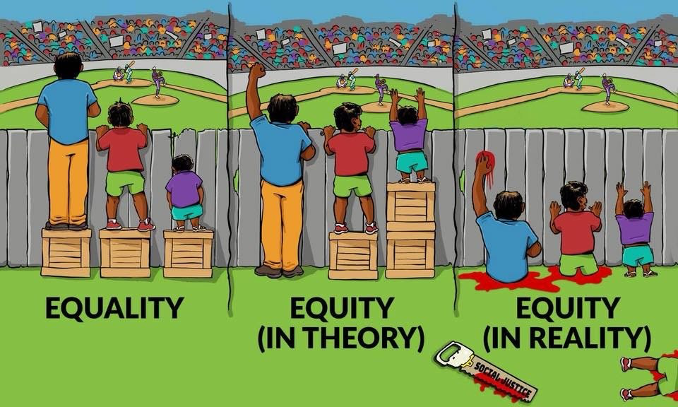
mp1

As one of my favorite Substackers, Noah Smith, writes about San Francisco’s attempt to ban high-achieving students from taking algebra until the ninth grade:

When you think about the idea of creating equity by restricting access to advanced math classes, it’s pretty much impossible to avoid the conclusion that the idea is to make all kids equal by making them equally unable to learn.

This is obviously terrible for the high-achieving students who don’t get to live up to their full potential, as well as for low-achievers subjected to the “soft bigotry of low expectations.” It’s a version of “equity” that we should all reject out of hand.

Indeed, as I argued recently, we should avoid pitting equity versus excellence. Whether the goal is to narrow achievement gaps, diversify gifted and talented programs, or reduce bias in grading, the strategy should always involve raising the bar, not lowering it.

2. Focus on closing gaps between affluent students and their disadvantaged peers, not between high-achieving students and their lower-achieving peers. While most economically disadvantaged students are relatively low-performing academically, due to the challenges of growing up in poverty, thankfully not all are. And if we create policies that encourage schools to prioritize the needs of low-achievers over high-achievers (like this one), we create a double-disadvantage for high achieving, low-income (HALO) students. There’s no moral justification for doing so, nor is there a good argument from a societal level either, given that these HALO kids are the ones with the best opportunity to use great schools (and selective colleges) to pole-vault into the middle class and above and into our leading professions.

For sure, it’s critical to raise the achievement and other outcomes of our lowest-performing students. But not at the expense of their higher-achieving peers.

3. Focus equity initiatives primarily on class, not race. Let me be clear: Anti-discrimination efforts must continue to be race-conscious, in line with longstanding civil rights laws. But when we switch our focus from ensuring fair treatment to giving disadvantaged students a boost, we should be cautious about defining disadvantage on racial grounds. On school funding, for example, it’s easy to justify sending extra dollars to high-poverty schools, but much harder to justify additional funding to upper-middle class Black schools. And given that the vast majority of the racial disparities in education are correlated with (if not caused by) socio-economic disparities, we can largely work towards racial equity via class-conscious but race-neutral approaches.

I understand that such an approach won’t satisfy all advocates on the left, but it will garner greater support from the center and the right.

In future posts, I’ll address how to apply these rules to debates around school funding, accountability systems, advanced education, school discipline, career and technical education, and grading reform.

We’ll explore: What would it mean to level up, not level down? For all economically-disadvantaged students, including high-achievers? With a primary focus on class, not race? In other words: How can we do equity right?

Stay tuned!

view

When school becomes optional

Chester E. Finn, Jr.
1.4.2024
Flypaper

“Truancy” may no longer be the right word for it, maybe not even “absenteeism,” for both imply being missing from a place where one is supposed to be. “Truancy,” with its overtone of misbehavior and illegality, suggests willfulness, i.e., that one is intentionally missing, while “absenteeism” is a more neutral term with no suggestion of motive. But “chronic absenteeism,” a phrase much used nowadays in the K–12 world, always with alarm or disapproval, carries a hint that one may be missing out of habit or inertia, like being “chronically ill” or “habitually lazy.”

Yet all of these terms suggest that one isn’t where one belongs, specifically that children who belong in school, should be in school, and are expected to be in school, in practice are not in school. Put differently: The normal state for school-age children is assumed to be attending school, being physically present under a school roof, yet they’re not there, many of them. They’re “absent.” They may be “chronically absent.” Perhaps they’re also “truant.”

No surprises, so far. But maybe it’s time to surprise ourselves with an alternative framing of the undeniable fact that, across much of the land, school attendance is down and a large number of youngsters are somewhere else. Maybe we must acknowledge that they—and the adults responsible for them—no longer take for granted that they “belong” in school. Maybe school—at least the physical structure called a “school building”—has come to be viewed by many as optional, volitional, akin to a public library or recreation center, a place in which one might choose to spend time but is under no obligation to. Perhaps the pandemic and the associated school closures, combined with the proliferation of arrangements by which one can learn things pretty much anywhere and anytime, have indeed brought about a cultural shift in America (and elsewhere?) regarding “a place called school” and our relationship to it.

That’s not an original insight. I’m borrowing it from Fordham colleagues who talk and write about today’s “disaffiliation” of Americans from traditional obligations such as “attending school” (and paying attention to the teacher rather than one’s phone), and from Paul Kihn, the District of Columbia’s sagacious deputy mayor for education. In a recent interview with The Washington Post, Kihn observed that “the pandemic did something to change students and families’ relationships with schools to some degree that we don’t yet fully understand.... We have also come to understand that there are a not insignificant number of families that actually don’t think it’s crucial to have their kids in school every day.”

I’m pretty sure he’s right. It’s part of a larger (and to me unwelcome) cultural shift in our society, such that traditional relationships and obligations have weakened. Thus fewer marriages, fewer marriages that last, fewer two-parent families, more misbehavior from airplanes to classrooms to public parks. One might say we have, in Pat Moynihan’s phrase, “defined deviancy down” across many domains. That means we no longer even view as deviant behaviors those that were once taboo.

When it comes to school attendance, the pandemic also made a difference that’s turning out to be durable. For many, many months, kids in many, many places weren’t expected to attend school. Indeed, tens of millions had no physical school to attend. Supposedly they were learning at home, but we have ample evidence (NAEP, PISA, more) that giant platoons didn’t learn much. Just as one’s physical muscles weaken and atrophy when they get no exercise over many months, our education muscles weakened. Our commitment to school atrophied. We got out of shape with respect to formal education, and many still are. That’s why—to the consternation of Kihn and education officials throughout the land—absenteeism today is far higher than before the pandemic. In D.C. last year, the Post reported, “43 percent of children missed at least 18 days of school” and “37 percent of children were deemed chronically truant.”

Numbers like those are no little blip. They’re a very big deal and likely a sign of something fundamental and probably durable. (Even as I deplore it, I can’t help relishing the fact that the teacher unions that pushed so hard for schools to stay closed for so long may have reaped the whirlwind of diminished attendance that in time will surely reduce the need for so many teachers and thus jeopardize a number of their jobs.)

What is to be done? I see three options.

First is to assume (or at least act as if) it’s a passing phase. Sooner or later kids will get bored at home and parents will tire of looking after them or making alternative arrangements for them. Maybe. But I suspect not. Technology means that one never need be bored. School as we know it isn’t all that much fun. And the changing nature of adult work means many parents are themselves at home far more than they used to be.

Second is to take heroic measures to woo kids back into school (or make miserable the lives of parents who don’t make them attend). Enforce the truancy laws. Maybe fine or jail parents of chronic non-attenders (or sentence them to volunteer in middle schools). Hold pizza parties in the principal’s office. Shorten the weeks and lengthen weekends, whether to make school attendance less off-putting or simply to define absenteeism down. Or just ease the learning burden by reducing homework, simplifying curricula, making it easier to get A’s on report cards—and less likely that one will fail anything, much less be held back for lack of achievement.

Some of all that is happening. Whether it will serve to boost attendance is anybody’s guess. I suspect it won’t do much—and insofar as it makes school “easier,” it’s sure to contribute to lower standards and diminished achievement among most of those who do attend.

Third—and by far the most challenging—is to rethink and revamp the education delivery system itself. Redefine “compulsory attendance.” Make it more about mastery than attendance. Welcome—and amplify—the many ways that mastery can be attained. Deploy technology and choice and tutors, mini-schools and micro-schools, part-time schools, schools that meet at odd times and places, smorgasbord schools that one attends (or zooms into) just for the things one still needs to learn. Make it all year-round and as much of it as possible 24/7. Help those who need it to access the technology, the counseling, the bandwidth, the transportation to avail themselves of this differentiated system. Make “access to education” more like today’s access to entertainment.

I’m not saying do away with traditional brick-and-mortar schools, especially for younger pupils—though what goes on in them should become more flexible, better attuned to mastery, more engaging, with more options and choices that are better matched to students’ needs, capabilities, and prior achievement. Many, perhaps most, families will favor that version for the foreseeable future, particularly for elementary-age kids. But stop assuming that it’s the only way.

Do, however, take mastery seriously across the K–12 board. That’s where standards and assessments come in, assessments of many kinds, not just standardized tests, whether students attend traditional schools or pursue learning through other means. And “enforce” it by making mastery of the academic core—the three R’s, science, civics, history, maybe the arts, plus potentially a bunch of other things like community service—the prerequisite for subsequent opportunities, whether college or career-related.

Hugely disruptive, I know, which is why option three will be resisted and avoided. But in the end, it might be the only one that recognizes our new reality. Just tabulating and lamenting the rising rate of “chronic absenteeism” won’t accomplish anything.

view
Lookback 2023 in charts blog image

Ohio’s sluggish pandemic recovery in 2023 as seen through six charts

Aaron Churchill
12.31.2023
Ohio Gadfly Daily

With the past year now in the books, it’s time to look back. During 2023, we at Fordham wrote extensively about the biggest and most important policy issues of the past year, most of which were debated as part of the state budget process. Those include Ohio’s bold moves towards scientifically based reading instruction, landmark reforms in the way the state education agency is overseen and led, universal eligibility (with a twist) for private-school scholarship programs, and advances in funding equity for public charter schools. For more about these initiatives, check out this recap of the final budget bill, along with the pieces linked above. 

Rather than rehash these policy wins, this lookback offers five data points, and six charts, that provide a picture of the year that was in Ohio education, with a particular focus on the Buckeye State’s sluggish pandemic recovery. It’s a sobering depiction of where students are at, but one that should remind us of the important work ahead to improve education in the new year.  

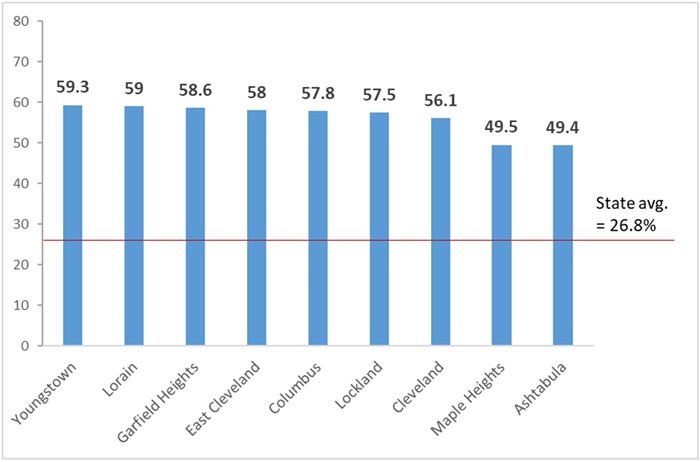
5. Ohio remains in the midst of a school attendance crisis. Following national patterns, absenteeism soared during the pandemic in Ohio. Various reasons help explain the rise, but regardless of cause, the most recent data from 2022–23 reveal that too many students are still missing large portions of the school year. Statewide, just over a quarter of students were chronically absent—i.e., missing the equivalent of eighteen or more days of school. As figure 1 indicates, more than half of students in districts such as Youngstown, Lorain, Columbus, and Cleveland were chronically absent last year. These rates remain much higher than pre-pandemic, and inconsistent attendance is surely making academic recovery harder. Fortunately, advocates have recognized the importance of regular attendance and offered a set of ideas to combat the crisis. State and local leaders should follow their lead and take action in the coming year to ensure students are in the classroom.

Figure 1: Ohio school districts with the highest chronic absenteeism rates, 2022–23

Lookback 2023 in charts blog figure 1
Source: Ohio Department of Education and Workforce. Note: Students are deemed chronically absent when they miss 10 percent or more of the school year for any reason (excused or unexcused).

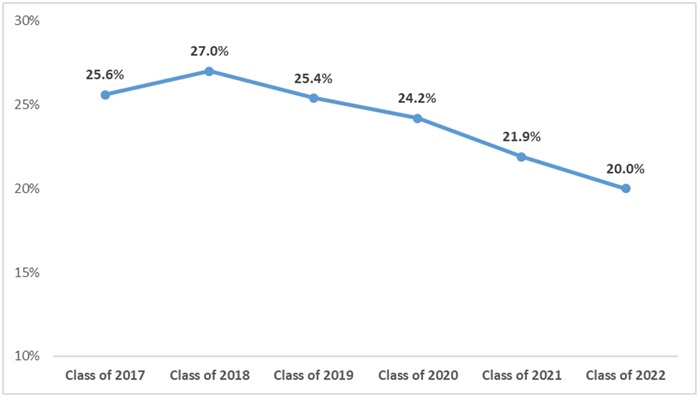
4. College readiness continues to slide. Last fall, the Ohio Department of Education and Workforce released its most recent college-and-career readiness data for the high school graduating class of 2022. Among the data points include the percentage of students achieving college-remediation-free scores on ACT or SAT exams. Achieving these benchmarks indicate that students are prepared for entry-level college coursework and remain important predictors of success in higher education. However, as figure 2 indicates, the state’s remediation-free rate has been on steady decline. Though Ohio has never had a very high remediation-free rate—the highest among recent cohorts is just 27 percent—the percentage sunk to just 20 percent for the class of 2022. The slide began just prior to the pandemic, but has accelerated since then—likely a result of pandemic learning loss. State leaders—and colleges, too—should be concerned that fewer students are exiting high school with the academic skills needed for college coursework.

Figure 2: Students meeting state remediation-free standards on the ACT or SAT, class of 2017 to 2022

Lookback 2023 in charts blog figure 2
Source: Ohio Department of Education and Workforce

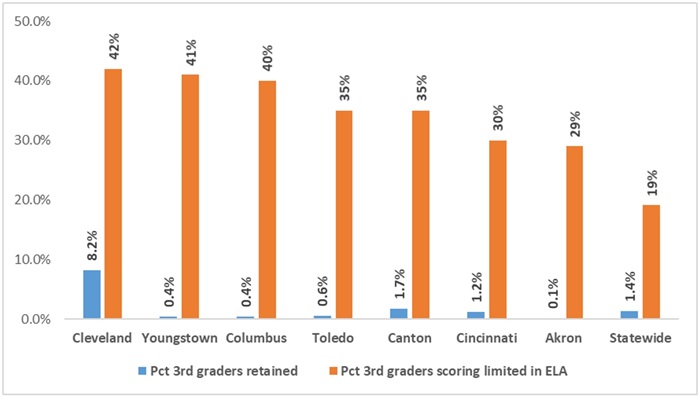
3. Social promotion runs rampant with the Third Grade Reading Guarantee in tatters. Under former state policy, schools would have been required to retain third graders who fell short of state reading benchmarks on their 2023 assessments. But via the state budget bill passed in July, lawmakers let schools off the hook for retaining struggling readers. Figure 3 shows the result of this requirement-free year. Statewide, just 1.4 percent of third graders were retained, despite almost one in five scoring “limited”—the lowest achievement level on state exams—on their English language arts (ELA) assessment. The discrepancies are even larger in urban districts. Akron, Columbus, Toledo, and Youngstown waved through virtually every third grader to fourth grade despite large numbers demonstrating severe reading deficiencies. Unfortunately, widespread social promotion is likely to persist. Beginning this school year (2023–24), the legislature (again via budget bill) carved out a Texas-sized loophole that allows schools to promote struggling third graders provided they receive parental sign-off. With little to stop the grade-promotion train, low-achieving students will once again be at-risk of falling through the cracks. As a growing number of studies indicate, they are apt to fare significantly worse as they progress through middle and high school than if they had been held back.

Figure 3: Third grade retention rates versus percentages of third graders scoring “limited,” 2022–23

Lookback 2023 in charts blog figure 3
Source: Ohio Department of Education and Workforce. Note: This chart displays seven of the Ohio Eight urban districts; Dayton is omitted because the retention rate that appears on its report card is a reporting error.

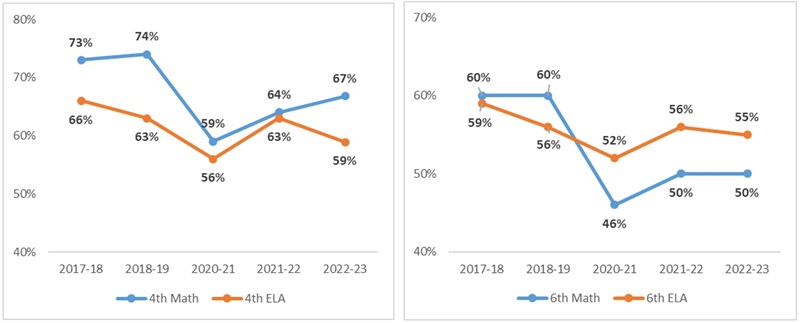
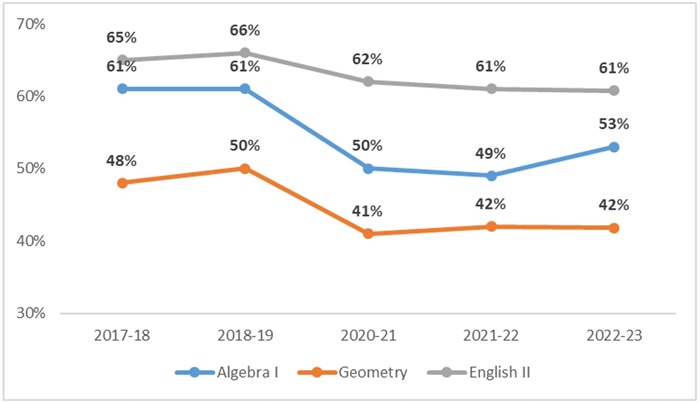
2. Achievement continues to recover from pandemic lows, but progress remains uneven across grade and subject. One of the most closely watched issues continues to be Ohio’s post-pandemic academic recovery. As has been widely documented, achievement plummeted as a result of the school closings and disruptions during the end of the 2019–20 school year and much of 2020–21. But with in-person instruction returning and billions in federal emergency aid being funneled to Ohio schools, achievement has climbed from pandemic lows. As figure 4 indicates, fourth grade math proficiency has risen from 59 to 67 percent between 2020–21 and 2022–23; sixth grade math proficiency has increased from 46 to 50 percent. But despite those upticks, math proficiency still lags noticeably behind pre-pandemic levels; the same holds true in some (though not all) grades for ELA. Meanwhile, as seen in figure 5, recovery has been less impressive in high school. With the exception of last year’s uptick in algebra I, very little improvement is discernable on recent high school exams.

Figure 4: Proficiency rates on fourth and sixth grade exams

Lookback 2023 in charts blog figure 4

Figure 5: High school proficiency rates on state end-of-course exams

Lookback 2023 in charts blog figure 5
Source: Ohio Department of Education and Workforce

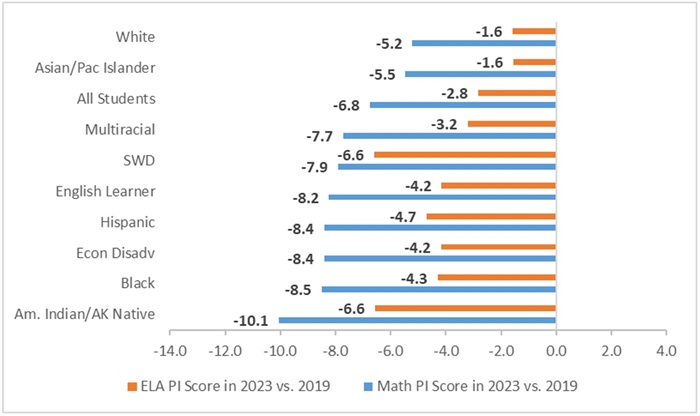
1. The state still has a long way to go to achieve full academic recovery. As a final look at the achievement numbers, figure 6 shows 2022–23 state assessment results by student group in comparison to each group’s pre-pandemic scores from 2018–19. The chart indicates that every student group—and students statewide—still lag their pre-pandemic counterparts. Historically disadvantaged groups (economically disadvantaged or Black or Hispanic students) have the most ground to make up, and students across the board are behind more in math than ELA. Remember, of course, that simply getting back to a pre-pandemic “square one” isn’t exactly cause for celebration, as achievement gaps were unacceptably wide before disaster struck.

Figure 6: Declines in math and ELA performance index scores by student group, 2022–23 versus 2018–19

Lookback 2023 in charts blog figure 6
Source: Ohio Department of Education and Workforce. Note: This chart displays the difference in performance index scores for a particular student group in 2022–23 versus that group’s performance index score in 2018–19. For instance, it shows that White students’ math PI scores in 2022–23 were 5.2 points below White students’ math PI scores in 2018–19. The performance index is a composite measure of student achievement on all state exams.

* * *

During the past year, Ohio leaders advanced a number of policies that can improve schools and boost student achievement. But as these data indicate, the work is far from finished. As we move into the new year, let’s recommit once again to putting student learning and educational excellence at the center of our policy discussions.

view

How centralized enrollment systems enhance school choice

Jeff Murray
1.4.2024
Flypaper

A new report from the National Center for Research on Education Access and Choice adds to the robust literature on school choice in New Orleans, shedding light on the ways in which the centralized enrollment system in the Crescent City has grown and evolved, as well as focusing on any potential disparate impacts to both enrollment and student achievement based on race.

When the education system was restarted following Katrina, city leaders were required by the state to institute an almost entirely charter school environment. While the Orleans Parish School Board (OPSB) still existed in name, the few schools under its control were run by charter management organizations (CMOs). The great majority of schools, also operated by various CMOs, were part of what was known as the Recovery School District (or RSD). Individual schools in both networks controlled their own application and enrollment processes, and parents applied directly to them. School staff were responsible for upholding laws regarding non-discrimination, and for holding lotteries when applications exceeded available seats. Non-network schools (charter and private) operated full or partial magnet programs with various selective criteria. However, enrollment gaming by schools was rife, and a lawsuit followed.

In an effort to make application easier and more transparent for families, in 2008, the RSD launched a centralized enrollment system for its schools, allowing parents to rank their choices among RSD options. Four years later, the RSD moved to an online system called OneApp, adding an algorithm that placed each applicant in a single seat based on families’ rankings, seat availability, and a set of school-determined student priorities. The OPSB joined OneApp the following year. Independent schools were invited but not required to join. Various policy changes were enacted over time to bring all public schools into the OneApp system, voluntarily or otherwise, and participation was universal by 2022.

Researchers Jane Arnold Lincove and Jon Valant exploit the incremental addition of New Orleans schools to OneApp—as well as the fact that selective-admission schools were allowed to keep their criteria in place after joining OneApp—to assess whether entry into centralized enrollment can be empirically associated with demographic shifts in the city’s public schools. They use restricted, student-level administrative data provided by the Louisiana Department of Education (LDOE) to aggregate data to the school-by-grade-by-year level. This includes all publicly-funded schools in New Orleans from 2007–08 through 2019–20.

The researchers measure the racial composition of each school or grade as the share of nonwhite students in LDOE’s fall enrollment counts. The percentage of Asian and Hispanic students in the data is very small—more than 95 percent of nonwhite students in the data identify as Black or multiracial (which the authors say likely includes one Black parent in most cases)—so while they are included in overall nonwhite data, they are excluded from subgroup analysis. The comparison, then, is a group of schools that had more than 15 percent White student enrollment prior to the 2012–13 school year—called “focus schools”—with the remaining schools whose student bodies were between 86 and 100 percent nonwhite prior to 2012–13.

We learn that the entry of schools into the centralized enrollment system was associated with a small but significant increase in Black and total nonwhite enrollment. Specifically, entering OneApp led to an increase of 0.7 percentage points in nonwhite enrollment per year in focus schools from their pre-OneApp mean of 60.4 percent—actually reversing pre-Katrina trends.

Effects were more pronounced at entry grades such as kindergarten and ninth (moving from middle to high school), with the former showing the strongest effects. Interestingly, analysts found no evidence of corresponding declines in White enrollment in these schools from either student exits or reduced demand among new families. Instead, focus schools increased their total enrollment after entering OneApp, allowing them to enroll more nonwhite students while largely retaining their already-enrolled White and nonwhite students. It seems likely from the specific grade level effects and the slow incremental boost in nonwhite enrollment that schools maximized seat availability for new students at entry grades.

Finally, various analyses of focus schools’ accountability scores, value-added test performance, student and teacher mobility, and student discipline rates showed insignificant or null effects of entering OneApp. That is, student outcomes across a range of measures did not change, even after several years of changing demographics in their schools. Robustness checks were made by running the analyses again after increasing the nonwhite percentage of focus schools to 25 percent and by running the analyses on individual focus schools with the largest student populations (which could have skewed the overall effects seen in earlier analyses). The results indicated minimal variation in outcomes.

The researchers are quick to note important limitations of their work, including a lack of generalizability to other contexts and that increasing racial integration in schools—even when desirable to expand opportunities—should not be deemed synonymous with achieving increased academic quality. What they do conclude, however, is that a centralized, near-universal school choice system like that in New Orleans likely increases transparency and reduces the enrollment barriers that families must navigate to find their best fit, including those based on racial composition of school buildings.

The OneApp system successfully opened more opportunities for Crescent City students of color in schools where they had been underrepresented before—likely due to residential assignment patterns—and these opportunities were acted upon without triggering an outmigration of White students or changing the academic outcomes in destination schools. These victories by school choice over archaic, address-based school assignment schemes are small but important. They should not be ignored.

SOURCE: Jane Arnold Lincove and Jon Valant, “How Has Centralized Enrollment Affected New Orleans Schools?” National Center for Research on Education Access and Choice (December 2023).

view

How pandemic-era emergency teaching licenses diversified the teaching profession

Kate Kerin
1.4.2024
Flypaper

The Covid-19 pandemic created innumerable disruptions to the education system. Among them were challenges faced by teacher candidates trying to complete licensure requirements. In response, those requirements got waived in many places. In a recent study, researchers from Boston University analyzed Massachusetts’s temporary easing of traditional certification requirements. Intended to prevent a teacher shortage during the pandemic, this policy seems to have succeeded in expanding the supply of interested and diverse individuals.

Almost every state requires teachers to pass at least one exam to obtain an initial or provisional teaching license. Prior to the pandemic, Massachusetts required prospective teachers to have both a bachelor’s degree and a passing score on the Massachusetts Tests for Educator Licensure (MTELs). However, in June 2020, the state made it possible for individuals who had not passed MTELS to receive emergency teaching licenses. Candidates who obtained such licenses could use them until June 2023, and could extend them an additional year if they were actively pursuing a standard license.

Using a combination of Massachusetts Department of Elementary and Secondary Education administrative data, survey responses, interviews, and focus groups, the researchers analyzed the characteristics of the individuals who acquired the emergency license, how many candidates were hired, and whether they intended to remain in the teaching profession and obtain a permanent license.

Overall, 12,407 individuals received new licenses, a 13 percent increase in the number of individuals receiving licenses for the 2020–21 school year. 5,800 of those individuals obtained an emergency license. Teachers hired with an emergency license were more likely to be Black (13 percent) and Hispanic (12 percent) than those with non-emergency (initial or provisional) licenses. Finally, the overwhelming majority of individuals with an emergency license (86 percent) planned to stay in the teaching profession and obtain a non-emergency license (80 percent).

During the pandemic, individuals had an opportunity to enter the profession because of emergency teaching licenses. There are a variety of reasons why teachers are not passing the tests typically required. Forty percent of study respondents with an emergency license stated they could not pass one or more tests required to obtain an initial or provisional license. Nineteen percent of respondents indicated that the cost of the tests were too much of a financial burden. While the intended goal of the emergency licensing program was to find and maintain and find an immediate steady supply of teachers, further research ought to examine the differences in effectiveness between emergency license holders and traditionally licensed teachers is critical, especially after teacher shortages during and after the pandemic.

SOURCE: Andrew Bacher-Hicks et al., “Who becomes a teacher when entry requirements are reduced? An analysis of emergency licenses in Massachusetts,” Annenberg Institute (October 2023).

view

Cheers and Jeers: January 4, 2024

The Education Gadfly
1.4.2024
Flypaper

Cheers

  • Hispanics are following the historical trend of the Irish, moving from stigmatized immigrants to integrated, successful, middle-class Americans. —Noahpinion
  • A new consortium of colleges and universities are more intentionally recruiting students from rural areas. —Hechinger Report
  • To maintain accountability, transparency, and academic improvement, New York must continue administering the Regent’s Exam universally. —James Peyser, Education Next
  • “The accountability challenge.” —Chester E. Finn, Jr., National Affairs

Jeers

  • Schools are facing pressure for prosecuting parents over student truancy. —Washington Post
view

What we're reading this week: January 4, 2024

The Education Gadfly
1.4.2024
Flypaper
  • After a year spent campaigning for the issue, deal cutting, and threats of primary challenges, Greg Abbott failed to pass school choice legislation. —Texas Tribune
  • Democratic governor of Arizona Katie Hobbs released an eight-point plan to regulate and curtail the state’s expansive school choice system. —Arizona Capitol Times
Fordham Logo

© 2026 The Thomas B. Fordham Institute
Privacy Policy
Usage Agreement

National

P.O. Box 110
Burke, VA 22009

202.223.5452

[email protected]

Ohio

P.O. Box 82291
Columbus, OH 43202

614.223.1580

[email protected]

Sponsorship

130 West Second Street, Suite 410
Dayton, Ohio 45402

937.227.3368

[email protected]