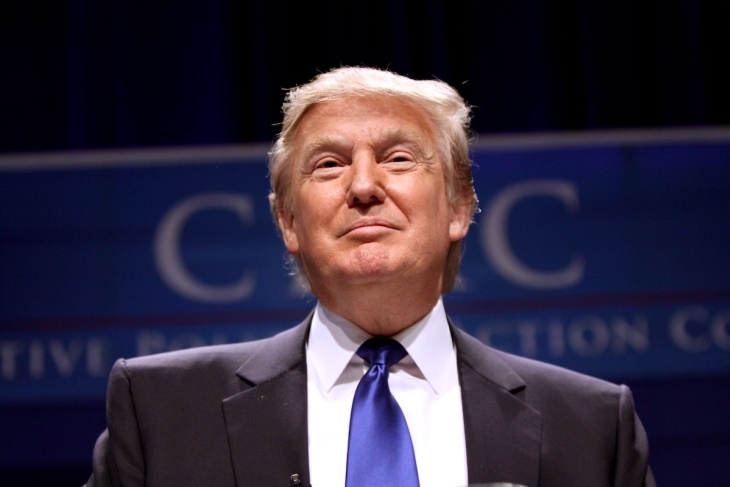
Last month, Education Secretary Linda McMahon expressed hope that Donald Trump will be remembered as an “education president,” arguing that “sending education back to the states” warrants that distinction. So far, Trump’s second-term record on K–12 includes a first-of-its-kind national school choice program and a significantly smaller U.S. Department of Education. At the same time, the administration has used federal levers more aggressively than ever to wage battles over culture and ideology in schools. If education ends up being one of Trump’s legacies, it raises a fundamental question: What defines an “education president,” and will he qualify?
The original education president, of course, was George H.W. Bush, who seized the issue for his 1988 campaign when he told a group of New Hampshire high school students, “I want to be the education president.” His tenure kicked off an era of federal-state cooperation and bipartisanship on education that lasted nearly 30 years through Clinton’s “Goals 2000” and Bush 43’s No Child Left Behind, along with much that followed under Obama. Together, these presidencies set a high bar for what it means to lead on schooling, combining ambition, policy action, and federal leadership.
Trump’s approach to education has been, to put it mildly, markedly different. He has largely used the issue as a cultural wedge—a strategy that has bolstered his political fortunes and energized his base, but left federal leadership fragmented and uncertainty high for states and districts. In short, Trump’s imprint on education is unmistakable, though it has been defined more by political theater than by the kind of serious policy leadership that previously earned the title of education president.
McMahon’s hope for her boss may simply reflect the loyalty of a friendship that dates back to the early 1980s. But whether any president earns the moniker has always been tied, in large part, to his choice of education secretary. Some appointees, like Lamar Alexander, Dick Riley, Margaret Spellings, and Arne Duncan, were widely respected for their policy expertise, leaving a lasting imprint on the sector. Others have left a far less favorable mark. Miguel Cardona, McMahon’s immediate predecessor, was almost universally panned as ineffectual and a failure. Few remember Lauro Cavazos.
By this measure, it’s still too early to assess McMahon’s impact or how Trump will ultimately be remembered in education. What matters more than anecdotes or activist praise is how effectively the president and his secretary work in partnership to influence student outcomes and federal leadership. Trump’s first education secretary, Betsy DeVos, provides a cautionary tale: Her singular focus on school choice—rooted in the belief that every education challenge could be solved through “competition from choice”—came at the expense of a broader federal agenda and limited her long-term impact on learning. To be an education president, a president must offer a comprehensive approach to education reform.
Looking ahead, much of Trump’s potential education legacy will hinge on how McMahon steers the department and executes upon his second-term policies. She is facing a real-time test with Oklahoma’s request to bypass federally-mandated end-of-year exams—a move that, if approved, could invite other states to follow suit and undermine the comparability that has been a hallmark of accountability for more than two decades. While McMahon hasn’t outright denied the state’s request, her official response is encouraging:
[The Trump] administration’s priorities are improving academics, empowering parents and expanding high quality school choice options. Assessment and accountability is critical to all three of those things… And we made it clear in [responding to Oklahoma’s proposal] that we’re going to closely scrutinize any waiver requests that pertain to assessment and accountability.
Holding the line on Oklahoma’s quixotic proposal matters, but waivers are a stopgap at best. Truly cementing a presidential education legacy demands far more.
At the heart of McMahon’s assignment lies a stark reality: The administration’s most ambitious education initiative—abolishing the Education Department—remains out of reach without Congress, leaving the ongoing effort to shrink it vulnerable to reversal by a future administration. Waivers, meanwhile, are a separate challenge. Used judiciously, they can help shape policy and telegraph priorities to states, but they carry many risks of eroding consistency and accountability. How she navigates these trade-offs—between advancing the administration’s aims and protecting core federal safeguards—could determine whether Trump’s education agenda is consequential.
When all is said and done, whether Trump will be remembered as an education president may come down less to slogans or grand gestures than to student achievement. NCLB, despite public misperception, actually produced modest but real gains, particularly in math. If McMahon can pair today’s unabated zeal for school choice with a genuine commitment to clear and consistent reporting of academic outcomes, she would leave a lasting mark that justifies a place for her boss among the pantheon of education presidents. If not, Trump’s education legacy will be more performative than substantive.