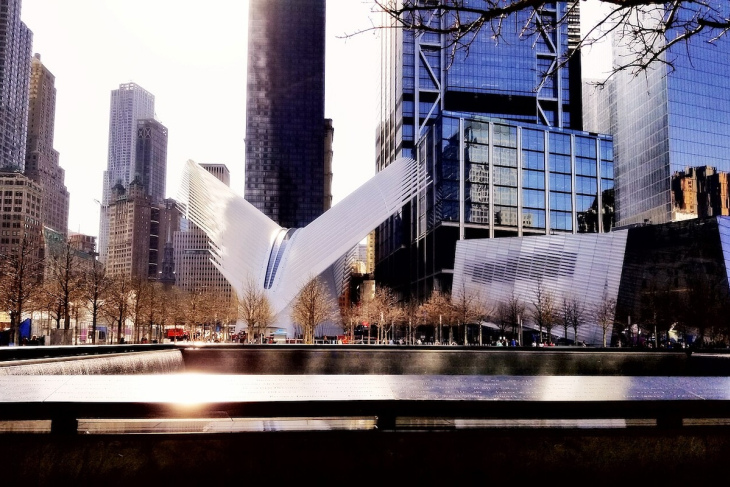
I was teaching third grade in California when I heard the news on the way to school that a plane had collided with one of the World Trade Center towers. Twenty-five years later, many Americans, including my daughter, have no firsthand memory of that fateful day—the tragedy it wrought or the unity it inspired. For those who lived through it, the passage of time may have also changed how the attacks and their legacy are understood. These were the early days of the internet, before smartphones and social media transformed how Americans experience the news. When I wrote about the anniversary in these pages five years ago, it was a very different moment in time, one in which the full fallout of pandemic-related school closures had not yet hit. Nor did we know that 9/11 would help shape American education in ways that, a quarter-century later, would make the contrast with our response to Covid impossible to ignore.
It’s easy to forget that, on the morning of September 11, 2001, President George W. Bush was literally at an elementary school in Florida promoting No Child Left Behind. Education was Bush’s top domestic priority, and the issue had featured prominently in the 2000 presidential campaign. But negotiations between the White House and congressional Democrats had stalled. The attacks, remarkably, created an extraordinary political moment that helped push NCLB across the finish line. As Senator Ted Kennedy himself put it at the time:
This is a defining issue about the future of our nation and about the future of democracy, the future of liberty, and the future of the United States in leading the free world. No piece of legislation will have a greater impact or influence on that.
It was a remarkable expression of bipartisan faith in both the power of education and the ability of government to improve it.
To be sure, NCLB had its flaws. The law’s utopian 100 percent proficiency target in reading and math flattened a worthy goal into a bureaucratic compliance exercise. However, these shortcomings should be separated from the law’s animating principle: Schools and districts shouldn’t be permitted to hide the performance of disadvantaged children behind averages. Annual statewide testing, disaggregated results, and accountability make it harder to ignore students who aren’t being served well. And the achievement gains during the NCLB era were real (more on that below). That’s a legacy worth preserving.
The twist, as Sandy Kress, one of NCLB’s key architects, has observed, is that 9/11 also disrupted the bipartisan reform movement that had produced the law. The attacks redirected the country’s attention toward national security and foreign policy, and although they initially forged a rare sense of national unity, partisan politics gradually returned. As Kress put it:
This is really what 9/11 meant: People moved on to other things. Afghanistan and Al Qaeda, plus the return of normal politics, that was huge. The president certainly moved on, and so did the rest of the world… That whole sweet thing that was put together in the ‘80s and came together in various states and then saw this incredible peak in Washington in 2001—all of that largely fell apart because of 9/11, and the failure of everyone on all sides to hold it together in the wake of 9/11.
By the time Congress replaced NCLB with the Every Student Succeeds Act in 2015, much of the bipartisan consensus that had given rise to it had come apart. It was also around this period that the nation’s progress on student achievement began to stall and, eventually, reverse.
Then came the coronavirus pandemic, another crisis of historic magnitude. But instead of bringing Americans together, it exacerbated existing divisions. Education was a particularly vivid example: Debates over masks, social distancing, testing, vaccines, remote instruction, and extended school closures quickly became partisan and institutional battles. Student achievement took a nosedive. If we screwed the pooch with ESSA, we lost much of our urgency around student outcomes after Covid. The contrast with 2001 couldn’t be more stark.
Closing schools in March 2020 was understandable at the time, given all of the uncertainty. But the case for prolonged closures became difficult to sustain as evidence accumulated about the minimal risks that Covid posed to young people and the enormous educational and developmental toll of lost in-person instruction. As former Senator Mitt Romney asked in March 2021, “The cost to children in learning of not having schools open is so overwhelming… how is it that even to this day that there are schools not open yet?” Whatever one’s views about the broader pandemic response, schools should have been among the first institutions we fought to restore because our children had so much to lose.
The results from the post-9/11 and NCLB years are worth remembering. Student achievement made substantial gains from the mid-1990s through the early 2010s, particularly among low-income and minority students. Hispanic and Black fourth graders gained 20 and 21 points, respectively, on NAEP reading, while eighth graders in both groups gained roughly 10 points. Those gains had begun to stall by the mid-2010s, with the effects especially pronounced among the nation’s lowest-performing students. Then came the pandemic, which turned a troubling trend into a much steeper decline. In just a few years, the country lost much of the hard-won progress students had made.
The strange education legacy of 9/11 was, in many ways, an accident of history. The attacks helped propel an ambitious national education agenda into law, even as the political coalition behind it eventually unraveled. Twenty-five years later, the pandemic revealed just how far the country had moved from the consensus that once united reformers. Uncle Sam set out to eliminate achievement gaps with No Child Left Behind. The prolonged school closures of Covid gave new meaning to the phrase. Millions of children were, in fact, left even further behind.