
If you’ve paid even general attention to Texas education news over the past few years, you’ve likely heard some version of the phrase “local school districts being taken over by the state.” Maybe it registered as a Houston story, since that made statewide headlines. If you missed that, you hopefully didn’t miss that the same thing happened 35 miles west of Dallas on Interstate 30.
Fort Worth ISD lost its elected school board this spring. A state-appointed superintendent and a nine-member board named by Texas Education Commissioner Mike Morath now run the district, because one campus, Leadership Academy at Forest Oak, failed the state’s academic standards for five straight years. Most North Texans never heard the countdown happening. Worth noting: as state action became imminent, Fort Worth’s own elected leadership responded by adopting a bold campus transformation strategy. It was the right move, but it came too late to stop what was already in motion.
That countdown to a state intervention in a school district is rooted in a 2015 Texas law requiring the education commissioner to act whenever a single public school campus receives a failing grade from the state for five consecutive years. The commissioner has two choices, and only two: close that campus, or replace the district’s entire elected school board with local residents the state appoints. There is no third option once the fifth year hits. The only thing a district controls is what it does with the four years before that.
Most people call this a “takeover,” but that word describes only one of the two things the law can temporarily do, and it flattens a distinction that matters. The more accurate term, and the one I’ll use, is intervention. A takeover implies a grab for power. An intervention implies a response to need, the same word we use when a family finally confronts a loved one who can no longer help themselves. That is closer to what this law actually is: a last-resort response to schools that have been failing children for five straight years, with no end in sight.
Right now, Austin ISD is living the moment Fort Worth already lived. Two of its middle schools, Burnet and Webb, just posted their fifth consecutive preliminary failing grade, though those ratings are not yet final. About a dozen other Texas districts are watching Austin closely, because they are on the same clock, closer to home than most of us realize. The state publishes annual A–F ratings for every campus in Texas at TXschools.gov. But keep in mind: it only takes one failing campus to trigger intervention for an entire district. In a large district, the campus putting a school board at risk may not be your own child’s school. Look at all of them.
I have watched this happen from the inside, serving seven years on the Dallas ISD board when our district faced this same law and the possibility of state intervention. What I learned is that this law is neither what its strongest defenders nor its strongest critics sometimes make it out to be.
The national research on state intervention does not support the simple proposition that replacing elected governance, by itself, improves student achievement. Texas Education Commissioner Mike Morath argues that intervention has improved learning in Texas, and Houston’s recent results provide evidence for that case. But the broader research is far more mixed. The more important lesson may be something different: A credible deadline can change behavior if local leaders act while there is still time on the clock.
The law’s author understood this. State Rep. Harold Dutton, the Houston Democrat who wrote the underlying provision, has described it as a hammer: Don’t let a campus fail five consecutive years, and the state never has to use it. The law grew out of his frustration over chronically struggling schools in Houston, including schools serving generations of Black students, that remained low-performing year after year despite repeated promises of improvement.
Dallas once faced a similar reckoning. In 2012, 34 Dallas ISD campuses were on the state’s failing list, some for multiple years. We hired Superintendent Mike Miles, now Houston’s superintendent, who moved aggressively to change how the district recruited, evaluated, and compensated educators and how it staffed its lowest-performing schools. The politics were brutal. There were public board fights, efforts to remove the superintendent, and even a separate campaign to replace the school district with a home-rule charter. None of that is a footnote. It is the actual texture of change, and all of it happened before the state ever sent us a warning.
Then, in October 2016, the state’s warning became explicit. Commissioner Morath told Dallas and ten other districts, including Houston and Fort Worth, to demonstrate meaningful improvement or risk state sanctions. Dallas ISD chose to accelerate. We expanded reforms that rewarded teacher effectiveness and placed highly rated educators in our lowest-performing schools. Within a year, six of our seven original turnaround campuses came off the failing list. Within two years, the district was down to three failing campuses. We never crossed the five-year line, not because the threat was meaningless, but because we acted with bold urgency before time ran out.
That work did not stop when Miles left. Superintendent Michael Hinojosa’s tenure built durable systems on those early reforms, and current Superintendent Stephanie Elizalde has boldly led that commitment forward. The results Dallas shows today belong to all three eras, not any one of them.
Dallas residents backed that choice with their own money. Less than two years after the state’s warning, nearly 60 percent of voters approved a tax increase dedicated to sustaining those reforms. Voters subsequently supported major bond investments in 2020 and 2026. Not every reform worked perfectly. Some proved too expensive and had to be redesigned. That is the nature of difficult institutional change. But Dallas retained control of its schools because its leaders and community chose to act while they still could.
That is why the debate over intervention too often misses the most important question. Yes, temporarily removing authority from an elected school board should make anyone who values local democracy uncomfortable. But persistent academic failure should make us even more uncomfortable, when we know the children forever impacted by an inadequate education have no vote and will never get those years back.
Houston is further down this road than Fort Worth or Austin, and the most damning account of why comes not from critics, but from inside Houston’s own boardroom. Sue Deigaard, a Houston ISD trustee whose seat was stripped when the intervention began, did not blame the Legislature for what happened to her district. She blamed her own board’s inaction, five years of it, in her own words: “We stole five years from kids.” Her board sat on nine figures in reserves while resisting both real structural cuts and full use of the money it was holding, right up until the state acted.
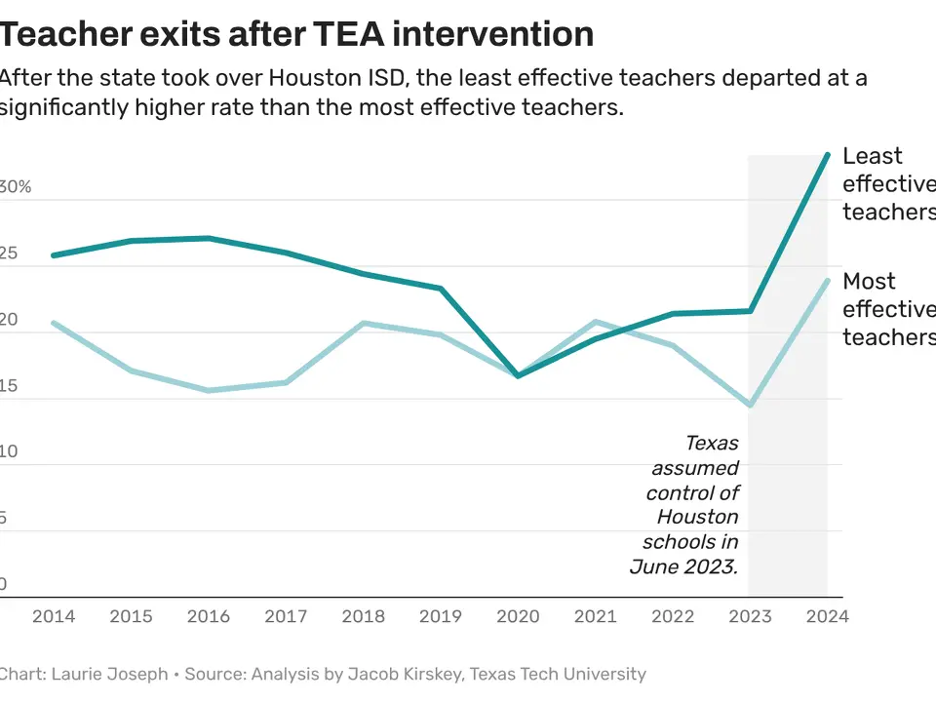
Texas’s intervention model has real defenders, and the numbers give them ground to stand on: Since intervention, Houston has closed the gap to the state average in reading, math, and end-of-course exams, and nearly eight out of ten of its schools now earn an A or B rating, up from three out of ten when intervention began. None of that is easy to square with another number: Houston lost roughly a third of its teachers in a single year, a rate nearly double the state average. But Texas Tech researcher Jacob Kirksey, who tracked every Houston teacher over a decade, offers a clarifying reframe: The question was never how many teachers left. It was which ones. In 2024, Houston’s least effective teachers left at a rate nearly ten points higher than its most effective, and the district’s best teachers ended up concentrated at the campuses that needed them most. Kirksey’s separate research finds that districts using the Teacher Incentive Allotment, a state program that mirrors Dallas’s pay-for-performance work, reduce turnover among their highest-performing teachers by roughly 20 percent.
That’s the outcome of good legislation already on the books. House Bill 3, passed in 2019, and its most recent iteration, House Bill 2, represent the most significant investment in teacher workforce strategy Texas has made in a generation. Baked within them are tools any district can reach for right now: the Teacher Incentive Allotment; resource campus designations that direct dollars to the highest-need schools; expanded pre-kindergarten funding; and outcomes bonus funding tied to college, career, and military readiness. The dollars are in Austin. The question is whether district leaders are willing to do what it takes to unlock them.
None of this erases real, uneven costs. Houston has posted genuine gains at the district level even as the campus that triggered the state intervention, Wheatley High School, shows that its students who are still learning English are losing ground in core subjects. It is also true that this law addresses real neglect of Black and Latino students, and that research shows majority-Black and majority-Latino districts experience intervention at disproportionate rates nationally. I do not think those two facts cancel each other out. I think we owe our children the discomfort of recognizing that doing nothing to address persistent underperformance has the worst effect on those who the system has historically left behind. That is precisely why no district should wait for a warning letter to act.
The debate over intervention has become Manichean: You are either for it or against it, state power versus local democracy, disruption versus the status quo. But that binary misses the most important question entirely. The real question is not whether intervention is inherently good or bad. The better one is why it should ever become necessary. The tools to avoid it already exist, and any district in Texas can reach for them today.
Five years is a long time in the life of a school system. It is an eternity in the life of a child. Austin’s leaders will likely face state intervention because of ongoing struggles at Burnet and Webb. Fort Worth and Houston are already there, with Houston experiencing some important improvements. Other Texas districts still have time. They should use it to act before action is taken.
The greatest threat is not ultimately that the state might intervene. It is that a child can spend year after year in a school everyone knows is failing them while the adults debate what to do. The clock belongs to the adults. But the five years? They belong to the child sitting in that classroom, hoping someone will finally decide she is worth the fight. And once those years are gone, no court ruling, no board vote, no state appointment will ever give them back to her.
Editor’s note: This was first published by the Dallas Morning News.