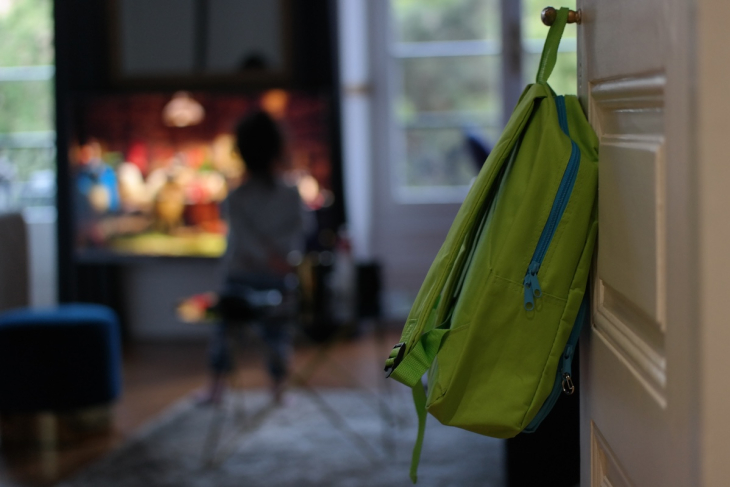
In Fordham’s new survey of American high school students and recent graduates, less than half believe their school has realistic AI policies that keep up with the times. Most students believe their peers use AI on schoolwork without permission (62 percent) and the majority (58 percent) indicate that homework is meaningless due to AI use on assignments. Are they right?
In an attempt to determine what’s lost when students outsource assignments to AI, researchers from Stockholm University and the University of Hong Kong analyzed administrative data from nearly 27,000 Chinese secondary school students over a 30-month period coinciding with the growth of publicly accessible sophisticated AI models. The data include homework scores and completion times, test scores, and self-reported student AI use from September 2022 through June 2025. The findings, described in a working paper, show a clear disruption to learning.
Between September 2022 and June 2025, self-reported student AI use rose from nearly zero to about 80 percent. Among users, 81 percent showed signs of outsourcing homework. Homework scores rose 18 percent in the first six months of students’ AI use, even as they spent much less time completing the assignments. Meanwhile, scores on their monthly exams fell 20 percent below the baseline results. The learning loss compounded, with AI-user scores on China’s high-stakes college and high school entrance exams falling by 18 and 24 percent, respectively, after two years. Learning loss was greatest for younger secondary school students, boys, and high achievers.
It’s a trend that extends beyond China. Newly released PISA results show the lowest reading and math scores on record among students in OECD nations. American students’ reading scores fell 14 points since the 2022 assessment, a period that overlaps with the expansion of widely available AI tools. Andreas Schleicher, Director for Education and Skills at the OECD, notes that students using AI “are more likely to report lower levels of intrinsic motivation for learning,” adding that those who believe hard work matters more than talent tend to perform better on PISA. There’s nothing hard about copying and pasting your problem set or essay prompt into ChatGPT.
AI-outsourced homework doesn’t just remove a tool that reinforces in-class lessons and lets students learn how to work through difficult tasks independently. The outsourcing also breaks a feedback loop that helps teachers, parents, and students work in partnership to ensure struggling students receive the support they need.
It was only possible to see how much students lost by outsourcing their work to AI in the Chinese secondary school study because the students were regularly assessed: closed-book exam results let researchers trace learning trends, including cross-subject trends that may be missed by individual teachers. A return to old-school testing like blue books and oral exams might help within individual classrooms—the Fordham report shows that over a quarter of U.S. students even use AI for help during quizzes and tests. However, the scale of potential learning loss makes this concern larger than any one classroom or school. States must maintain rigorous accountability systems that can reveal compounding knowledge and skill gaps before it’s too late for students to catch up.
For decades, homework assignments provided checkpoints between unit tests while building students’ capacity for sustained effort. Today, homework assignments are just as likely to mask deficiencies in skills and broader understanding. It’s irresponsible to ignore the reality of new technology and its effects on learning, particularly on independent assignments. Growing evidence about student AI use supports sounding an alarm about learning loss, though it’s not a death knell for school as we know it. Yet for traditional homework? Perhaps it should be.