
Earlier this month, I was having a conversation with a state leader I respect about why adoption of high-quality curriculum materials has been slow in their state. “Why not use the muscle of the state agency to speed things up?” I asked.
“Because my state isn’t like Louisiana,” they said. “We’re a local-control state. I can’t just tell districts what to do.”
I’ve heard versions of that sentence many times over the years, and it comes from a very real place. Our education system is structured around local control. School boards run their districts; they decide how they spend their money, and they make decisions about curriculum and staffing.
But somewhere along the way, “local control” has become shorthand for “there’s not much the state can do.” And when that happens, it can unintentionally limit a state’s ability to drive change at the classroom level.
So today, let’s debunk the myth of local control.
States need to set a clear vision for kids
Many state agencies do not believe it is their role to have an instructional opinion. They see themselves as administrators of programs, distributors of funds, and writers of memos.
State leaders are policymakers, not just administrators of programs. The truth is that state leaders can respect local control and believe it’s their job to change the classroom experience.
Setting a clear vision at the state level means getting specific about the classroom experience you want for students. It means being able to answer questions like:
- When you walk into a third grade English language arts classroom, what should be happening? Are students engaging with grade-level texts and writing about them in ways that build knowledge over time?
- Are districts using strong, coherent instructional materials? Do teachers have the training and support to teach those materials well?
It’s not the state’s role to dictate which novel gets read on a Tuesday morning; that’s where local control comes in. But the state absolutely has a responsibility to define what strong instruction looks like, ensure materials meet that bar, and build the support systems that help teachers deliver it well.
Once you can articulate your vision, you repeat it. Over and over again. A colleague of mine used to say that you have to say something 17 times before it really sticks. Clarity, simplicity, and repetition are powerful and deeply underestimated in system leadership. If you want districts to align, they have to hear the same message in every speech, every grant application, every guidance document, every accountability conversation.
When you know where you are going, you can begin aligning your levers around that vision.
Levers, not mandates
Every state is a local control state. And still, every state has levers they can pull to improve outcomes for kids.
Those who fall victim to the myth of local control assume that the only way for states to influence districts is to tell them what to do, which local control bans. But mandates aren’t the only way to lead.
States have access to a powerful arsenal of tools they can use to assert a point of view—from funding and accountability systems to guidance, professional learning, and communications—that shape what districts prioritize and what students ultimately experience. If you want to go deeper on what we mean by “levers,” we at Watershed Advisors have broken them down in a previous issue of our Delta newsletter.
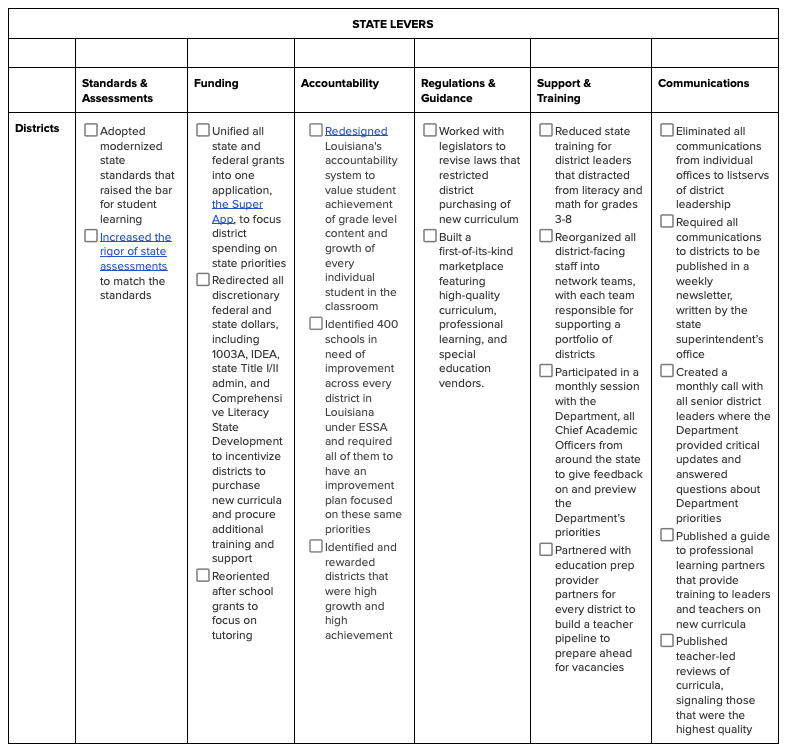
The vast majority of people I’ve met who work in public education are doing it because they want to help kids learn. States don’t need to force districts to make the right choice; they need to make the right choice, the easy choice.
Louisiana wasn’t special. We had no magical power over districts—we had to convince everyone to get on board with our vision, just like everyone else does.
Our accountability system was one of the levers we used to do that. Federal law requires states to identify the bottom 5 percent of schools for intervention. But we knew that far more schools were underperforming than just the lowest-ranking ones. So instead, we identified the bottom 40 percent and built a clear, statewide plan around what strong instruction should look like.
We called that plan Louisiana Believes, and we repeated it—over and over and over again (at least 17 times!). If you worked in Louisiana education, you knew what we believed.
Then we aligned our systems around that vision. We created teacher leader roles in every school, launched a School Support Institute that met three times a year for schools needing the most support, and hosted a summer Teacher Leader Summit that eventually grew to 7,000 educators, building a shared language around high-quality materials. We aligned professional learning, support, and—maybe most importantly—funding through Super App.
None of those efforts overrode local control. Districts still made decisions, principals still led their buildings, and teachers still taught their classrooms. We did not have authority other state leaders don’t have. We had a clear vision, and we leaned on all the levers of the state.
Editor’s note: This was first published in the Watershed Advisors’ “Delta” newsletter.