
With updated reading policies on the books in over 40 states, ed policy advocates and legislators are now turning to math. Fourth grade NAEP math results are just as bad (if not worse), so why not take it on, as well? Bellwether has a nice round up of the current state of affairs.
But who has the winning playbook for math? We naturally look to the NAEP, the “gold standard” for measuring state-level student achievement. In reading, Mississippi’s NAEP “miracle”—going from 45th to 1st for economically disadvantaged fourth graders—became the model for dozens of states. More recently Louisiana has joined them, going from 46th to 6th.
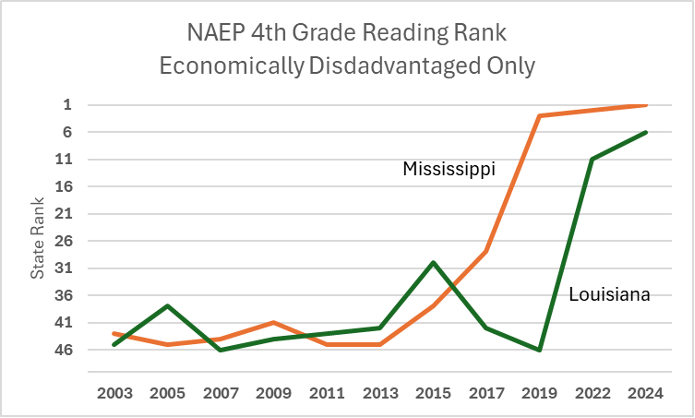
So which states are the leaders in fourth grade NAEP math improvement for economically disadvantaged students? Here’s a surprise: It’s also Mississippi and Louisiana. A few have noted and commented on this, such as here and here, but the success in early literacy has crowded out attention to their progress in math.
Both saw their math rankings rise almost in lockstep with reading. Both also rank at or near the top of the Urban Institute’s demographically adjusted NAEP rankings (Mississippi is number one in both fourth and eighth grade; Louisiana is number four and number three).
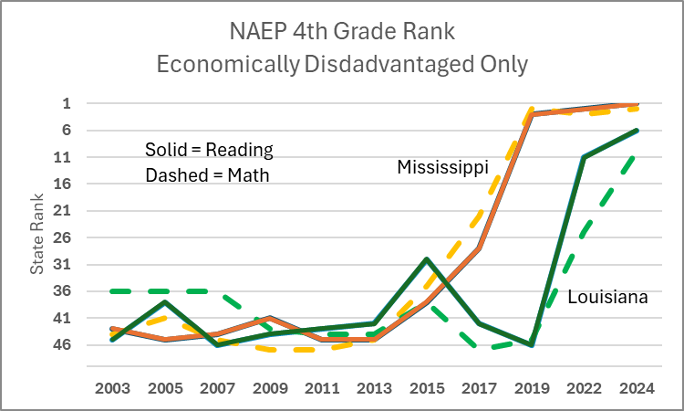
So there wasn’t just one Mississippi (and Louisiana) “miracle”—there were two: reading and math. What was behind it?
One thing we know wasn’t the cause: major math initiatives. Neither state had large scale math-specific initiatives underway at the same time as their reading initiatives. Louisiana rolled out evidence-based math curriculum (Eureka) across many districts in the mid-2010s, along with teacher training, but scores didn’t improve until 2022 (at the same time as reading scores). Mississippi had no state-wide math efforts during the 2010s, aside from adoption of Common Core and related professional development early in the decade, similar to many other states.
So if they weren’t focused on math, why did math scores go up—especially at a time when most states saw significant drops in NAEP scores?
Some research points to reading “spillover,” a phenomenon where improved reading skills lead to improvement in other subjects. This makes sense—better readers “read to learn” better, as well as likely having more positive feelings toward school in general. But the spillover effect is usually modest; it seems unlikely to explain what we see in Mississippi and Louisiana.
What seems more powerful is how both Mississippi and Louisiana went about implementing their initiatives. As many have reported (e.g., here and here), both states had strong and comprehensive implementation approaches, focused on evidence-based pedagogy, data-driven instruction, and strong teacher coaching and supports.
Both had aggressive and highly visible state education leaders—Cary Wright in Mississippi and John White and Cary Brumley in Louisiana—who used every available tool to drive improvement in their schools. Mississippi pioneered the use of state-trained reading coaches, deployed across the state to Title 1 schools. Louisiana designated over 40 percent of their schools “in need of improvement” and focused this group of schools on better curriculum, teacher training on the curriculum, and data-driven student supports (California, for comparison, designates less than 13 percent.)
And both went all-in on student achievement, with an explicit focus on improving test score results. Mississippi went so far as to put in place its “third grade reading gate” requiring state-test performance for promotion. (For those still suspicious of Mississippi “gaming” the system, Louisiana had no student retention policy.)
So what does this mean for new state math initiatives?
For most states, they should proceed with caution. The lesson from Mississippi and Louisiana isn’t that they launched major math initiatives. It is that they did an exceptional job of implementing the initiatives they already had.
That strong “implementation chain,” as Watershed’s Kunjan Narechania and Jessica Baghian call it, is very hard to build, and requires years of strong leadership and close attention to detail. In particular it requires sustained focus—cutting out the admirable but secondary initiatives that compete for time, attention, and resources.
Many states have recently passed reading legislation that is just in the early stages of implementation. Many, maybe most, of those implementation efforts are not strong—they don’t have the vocal top-level support of state leaders, the dedicated teams needed to support schools and teachers, or the clear lines of accountability for delivering all the steps in the chain.
The takeaway from Mississippi and Louisiana is clear: Success in math didn’t require a new “playbook,” but rather a relentless commitment on solid implementation fundamentals—even if it was in reading! For states struggling with reading implementation, don’t add a new initiative—focus on delivering the one you already have.