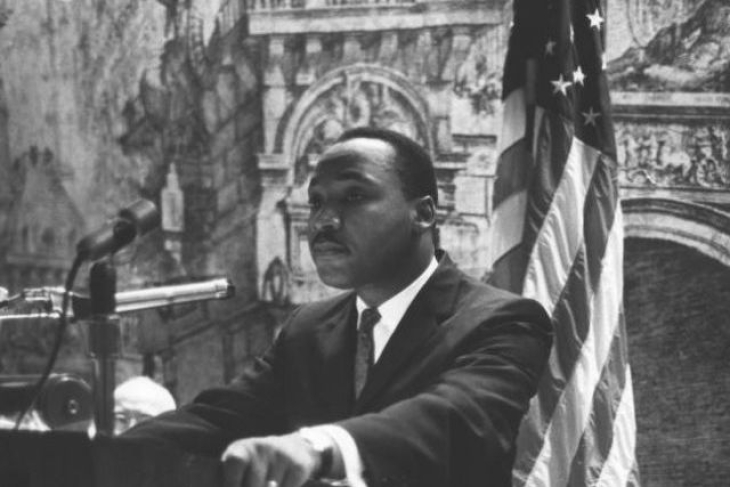
On September 12, 1962, Dr. Martin Luther King Jr. spoke at the request of the New York Civil War Commission at the Centennial Celebration of the Emancipation Proclamation. In his remarks in New York City, King emphasized that the document that started the long process of ridding America of slavery was actually inspired by the core principle of equality embedded in the country’s founding document: “The Declaration of Independence proclaimed to a world, organized politically and spiritually around the concept of the inequality of man, that the dignity of human personality was inherent in man as a living being,” King said. “The Emancipation Proclamation was the offspring of the Declaration of Independence. It was a constructive use of the force of law to uproot a social order which sought to separate liberty from a segment of humanity.”
What King so eloquently revealed was that slavery, far from being a particular American atrocity, was an accepted, grotesque feature at the center of a world ordered around the normalcy of human bondage. Yet it was America’s Enlightenment principles that allowed it to “uproot a social order” and liberate millions of enslaved people in recognition of their inherent and individual human dignity.
As educators debate how best to teach K–12 students about slavery today, it is important to see its barbaric adoption in the United States as a dispiriting but common “oppressor versus oppressed” element of the human condition worldwide and to emphasize as uncommon America’s post-abolition march toward becoming a multiethnic society with an unprecedented combination of size, peacefulness, and prosperity. It is now accepted that America’s founders laid out inspiring ideals around life, liberty, and the pursuit of happiness, but also committed the original sin of not allowing all human beings the right to fully live up to those same ideals.
Yet despite that inherent contradiction, America has made steady progress dismantling laws that imposed a racial hierarchy. Educators today are trying to figure out how to portray slavery in America as an example of state-sanctioned oppression and one that is central to our history. Their challenge is to do that effectively while also celebrating how our nation’s enduring principles have provided the world an indispensable model of how formerly enslaved people came to regularly produce some of the country’s most influential leaders in virtually every facet of American life.
In 2020, I was proud to help found 1776 Unites, a project of the Woodson Center. Led by primarily Black activists, educators, and scholars, 1776 Unites acknowledges that “racial discrimination exists—and works towards diminishing it. But we dissent from contemporary groupthink and rhetoric about race, class, and American history that defames our national heritage, divides our people, and instills helplessness among those who already hold within themselves the grit and resilience to better their lot in life.”
1776 Unites has developed free K–12 lesson plans based on the ten “Woodson Principles” of competence, integrity, transparency, resilience, witness, innovation, inspiration, agency, access, and grace. The curriculum offers lessons on Black excellence in the face of unimaginable adversity. Among such examples were the nearly 5,000 Rosenwald Schools built during the Jim Crow era that educated more than 700,000 Black children throughout fourteen southern states. These 1776 Unites lessons are now used by educators in all fifty states in private, charter, district, and parochial schools, after-school programs, home schools, and prison ministries.
A hopeful and upwardly mobile future for Americans of all races must be built on a shared understanding of our past that is accurate and expansive, not falsely embellished and narrowly selective (a serious flaw of the New York Times’s 1619 Project). Educators must be encouraged to impart a more complete telling of the Black American experience, one that offers an empowering alternative to curricula that emphasize racial subjugation almost to the exclusion of Black resilience.
As King said on the 100th anniversary of the Emancipation Proclamation: “If our nation had done nothing more in its whole history than to create just two documents, its contribution to civilization would be imperishable. The first of these documents is the Declaration of Independence and the other is that which we are here to honor tonight, the Emancipation Proclamation. All tyrants, past, present, and future, are powerless to bury the truths in these declarations, no matter how extensive their legions, how vast their power, and how malignant their evil.”
Those who seek to teach a sanitized version of history to achieve some false sense of patriotic education do our country and students a disservice, and, ironically, so do those who cherry-pick the most egregiously cruel acts to weave together a narrative of a permanent American malignancy of racism. It is through exposing “all the truths in these declarations” that we can best teach about U.S. slavery in K–12 schools, and, as a dividend, perhaps we will also inspire a reverence for liberty and the American experiment.
Editor's note: This was first published by Education Next.