Editor’s note: This was first published as part of a newsletter for Mike’s Substack, SCHOOLED.
Matt Barnum wrote a great post last week illustrating that most “non-college career pathways” don’t lead to high-paying jobs:
The most common non-college jobs make far below the median. For instance, there are over 4 million people who work as home health and personal care aides in America, the largest single occupation. That’s more than the number of plumbers, electricians, carpenters, HVAC specialists, welders, car mechanics, roofers, and power-line installers combined. The Bureau of Labor Statistics predicts more growth in jobs for home health aides than any other occupation. The median salary is about $35,000 a year.
Other large non-college vocations—each encompassing millions of people—include retail sales workers, cashiers, order stockers, waiters and waitresses, fast-food workers, and janitors. All of these pay substantially below the median. One exception is truck driving, a position that pays relatively well and employs millions of people. But many fear the job is at particularly high risk of automation.
All this maps onto other data showing that college-educated workers have a large wage advantage, on average, compared to those without a degree.
This is all true, but I wish that Matt had written that of course the college wage premium only flows to those who complete college. And it’s hard to do that if you’re not among the 30 or 40 percent of American 18-year-olds who graduate high school academically-prepared for college. See this chart I published back in 2023, showing that about the same number of students now graduate from college as were academically ready for college, even though many more give college a try:
Chart 1 displays the percentage of twelfth-graders in a given high school graduating class who reached the National Assessment’s “college-prepared“ level in reading over the past three decades, which, according to the National Assessment Governing Board, equates to “proficient.”
[It] also shows the percentage of students in that same high school graduating class who matriculated directly to college, as well as the percentage of that class that eventually graduated with bachelor’s degrees within eight years. The most recent college completion data come from 2022, for the high school class of 2014.
Chart 1: College preparedness, college matriculation, and college completion
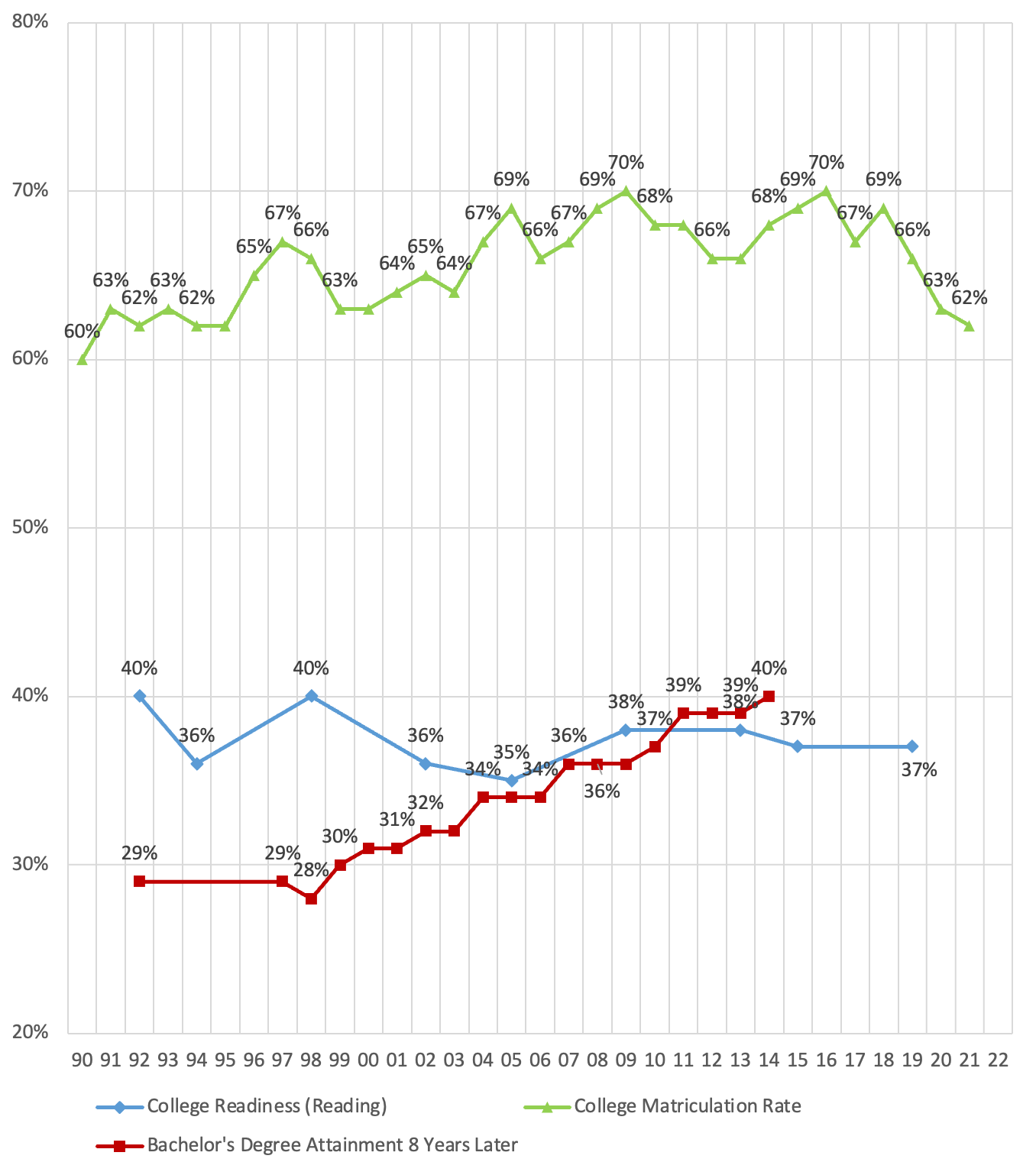
To argue that most of the people becoming home health aides, fast-food workers, and the like could have gone to college and ended up with much higher wages requires ignoring the fact that many of those folks were nowhere near college ready at the end of high school. It’s hard to complete college if you’re reading and doing math at a sixth-grade level. Which is a strong argument for education reform and our work to dramatically improve the K-12 system and boost achievement as early as possible! Teenagers with low academic skills face bleak prospects—and taking on student loans they can’t afford to repay only makes them bleaker.
I don’t mean to pick on Matt. But we see this line of thinking everywhere. For example, consider Emmanuel Lalande’s recent article in the Hechinger Report about the college completion crisis, which blamed said crisis on everything but academic readiness or the lack thereof.
On the flip side, though, it also strikes me as crazy to think that students who are high-achieving academically should consider skipping college. My friend Scott Laband, for example, writes that “the college-first mindset is an outdated relic that’s failing us all.”
A quality education at a top-level university is right for some, yes, but for many others, the path to success looks like an excellent apprenticeship program, a modern community college pathway, employer-led training, or short-term credentials that are tied to real labor market demand.
All true, as were Scott’s strong arguments for shifting more of our tax dollars away from traditional higher education and into training for the trades. But I wish Scott had said that a “top level university is right” for students with strong grades and high test scores, who are best positioned to complete college and reap the college wage premium.
The tough calls are for students in the middle of the performance spectrum—in NAEP parlance, those who are above basic but below proficient, meaning they have solid basic skills but would likely struggle in college. Matt pointed me to a study by Jack Mountjoy indicating that even kids around 32nd percentile in achievement benefited from attending community college; that’s an argument for thinking that our definition of “college ready” might be too high and too exclusive (or perhaps should only apply to four-year schools).
On the other hand, as Preston Cooper just pointed out, a new Justice Department interpretation of disparate-impact law could make it easier for companies to test applicants again, making a college degree less useful as a proxy for academic readiness and reducing the “sheepskin effect.”
Under disparate-impact doctrine, employers generally cannot rely on hiring tests or screening criteria that produce substantially different outcomes across demographic groups unless those criteria are “job related for the position in question and consistent with business necessity.”
…[R]egulators have interpreted this law to block employers’ use of employment aptitude tests, written exams, and English proficiency tests, among other things. Curiously—and for reasons that are unclear even to legal experts—regulators have not applied the same logic to college degrees…
In a new opinion to the Equal Employment Opportunity Commission, the Justice Department…moves toward placing other hiring practices, such as knowledge or aptitude tests, on a level playing field with college degrees. This gives employers legal cover to shift away from degree requirements towards other measures of job fitness.
So this is my request, fellow writers and analysts: When discussing whether students should go to college, let’s be clear about whether we’re talking about young people with strong academic skills, weak academic skills, or something in between. And we need lots more studies to help the vast majority of 18-year-olds, who find themselves in the middle of the performance distribution, to determine which kind of post-secondary education or training is right for them.