College is on my mind because of two recent tidbits. First, Alabama submitted its official Ed-Flex waiver request to the feds, including a plan to use the WorkKeys assessment as part of its high school accountability system, in part to balance the scales for students who are not planning to go to college—and the schools that serve them.
And second, Chalkbeat’s Matt Barnum published a thoughtful rebuttal to my claim that we should discourage students with low grades and/or test scores from giving college a try because of the low probability that they will complete a degree or credential, and therefore will be worse off than if they had gone straight into the workforce.
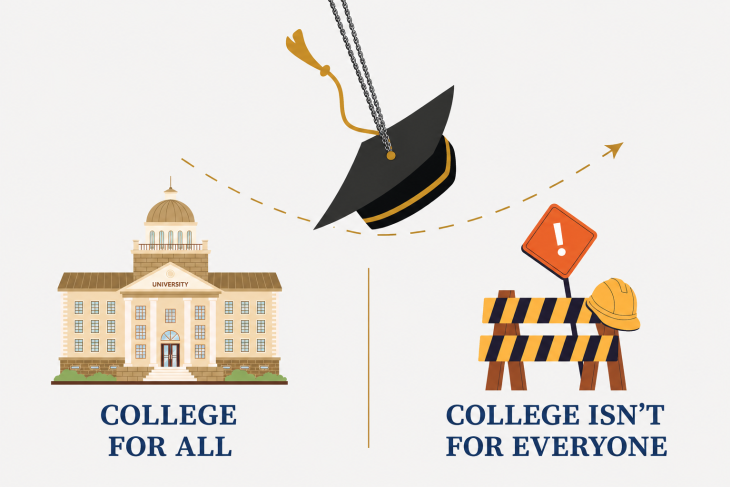
What all this brings to mind is the ongoing debate about whether we education reformers overreached back during the Bush-Obama years by focusing too much on sending everyone to college, and now whether we have perhaps overcorrected by going too far in the other direction.
I know what some of you are thinking: Nobody ever actually said that everyone should go to college. Perhaps. But if you go back and look at the rhetoric from those years, it sure sounded like the message we were sending to kids was: College is the path to opportunity and you should take it. That’s when we started naming classrooms after teachers’ alma maters, especially in high-performing charter schools; when school reform organizations set their targets on dramatically increasing the number of students who made it to and through four-year universities; and when we determined that state academic standards, in the form of the Common Core, should aim for college readiness (and allowed career readiness to be an afterthought). In my sons’ district (Montgomery County, Maryland) we even had a (well-respected) superintendent who promoted the “7 keys to college.”
And at the same time, we let the old Vo-Tech system atrophy. That was for good reason, as it had racist and classist elements and often led to dead-end jobs—if it led to jobs at all.
But where we erred was in (mostly) seeking to end rather than mend vocational education. I had my conversion experience about this around 2014, when I was working on a book about education for upward mobility and kept running into social scientists, often outside the field of education, who would point to career academies as one of the most impactful interventions in all of American domestic policy. It turned out that these career academies were super effective at boosting students’ earnings—especially boys’—and even decreased their rates of incarceration and increased their rates of marriage. This was also one of the key arguments of an influential report by William Symonds, Robert Schwartz, and Ronald Ferguson, Pathways to Prosperity.
My enthusiasm-of-a-convert is clear when I go back and read my cringeworthy Slate article from back then. But I still stand by the basic thesis: College is a great path to upward mobility for students who are academically and otherwise prepared to complete a degree, but it’s a waste of time and money for those who are not. And thankfully, there are other pathways to upward mobility for students for whom academic learning is not their thing.
Now, I understand that this line of reasoning creates significant risk. Fellow reformers often worry that this will lead to a lowering of expectations, especially if we decide too early who is and who is not “college material.” And especially if we make those decisions based on race, ZIP code, or other group characteristics.
I agree 100 percent. As I wrote a few weeks ago, we have to be worried about students who could have succeeded in college but were discouraged from attending just as much as we’re worried about those students who are nudged to give college a try when their chances of success are extraordinarily low.
So it’s a balancing act. I am comfortable with where Maryland landed with its Blueprint, calling for all students to master a high level of knowledge and skills through the end of the 10th grade—as determined by end-of-course exams—before giving them choices among traditional college prep courses of study and high-quality career pathways, including significant work-based learning.
That’s way better than making everybody sleepwalk through the same traditional curriculum all the way to the end of 12th grade. Which is mostly what we are doing today.
But recent developments add some complications. The Alabama plan, for example, is for all 11th graders to take the WorkKeys assessment in the fall and the ACT in the spring, and for the state to deem some students “proficient” even if they don’t hit the cut score on the ACT as long as they do well enough on WorkKeys. The problem is that, even though the state raised its original cut score for the WorkKeys exam, that standard is still set at a very low level, much lower than the college-ready standard for the ACT. Are we OK with that?
And as Matt Barnum showed, some high-quality studies indicate that students with surprisingly low test scores and grades can still benefit from attending selective four-year universities. That’s almost surely because some of them do end up completing a degree, even though the odds were stacked against them. It’s also possible that leaving with just a few course credits is helpful in boosting earnings.
The implication is that some students whom I might steer into workforce training rather than traditional college because of their modest academic readiness might have been able to make it to and through a four-year degree—and gained all the benefits that the college wage premium has to offer.
Still, the bulk of the evidence indicates that students with low test scores and grades really do have the odds stacked against them because their chances of completing a degree are so low. (That’s especially the case if they matriculate to community colleges, which tend to have fewer resources and dismal completion rates.) We shouldn’t ignore those odds when designing policies or advising students.
But I’m sure some of you see it differently and believe that the risks of lost potential from not sending kids to college are so high that we should continue to be willing to have a whole bunch of young people go to college and drop or stop out—40 percent of the total today—if need be.
But that’s the question. Are we moving to an appropriate balance, supporting multiple high-quality pathways to success, not just the college-for-all approach? Or have we overcorrected and, as a result, discouraged too many students from going to college who might actually find success there? I know where I stand. What about you?
Editor’s note: A version of this was first published on Mike’s Substack, SCHOOLED.