Defense Secretary Pete Hegseth has called the CLT the nation’s new “gold standard.” USA Today’s blockbuster investigation, published today, suggests a more accurate label would be “boondoggle.” In Florida, the state that has done more than any other to mainstream the CLT, the exam isn’t primarily functioning as a college admissions test at all. It’s a graduation escape hatch for students who couldn’t clear the state’s own algebra and reading bars, or post qualifying ACT/SAT scores. That distinction matters enormously, and it’s one policymakers in a growing number of states are ignoring at their students’ peril.
Here’s the mechanism, as USA Today lays it out: since 2023, Florida high schoolers who fail the state’s reading and algebra graduation exams can substitute a CLT score instead. At least nine districts now credit the CLT with lifting graduation rates. Duval County’s rate climbed from 87 percent to just over 94 percent between 2022–23 and 2024–25, and Superintendent Christopher Bernier (pictured above) attributes that gain directly to the CLT. In Hillsborough County, roughly 2,500 members of the 2025 graduating class, about one in six, used the CLT to satisfy their math requirement.
The reason this works as a graduation strategy is buried in the math content itself. Five math education experts reviewed the CLT, ACT, and SAT math sections for the USA Today investigation and found the CLT skews heavily toward pre-algebra and middle-school-level content: about 25 percent of the CLT’s questions are in this realm compared with 13 percent on the ACT and just 4 percent on the SAT. The SAT leans hardest into algebra; the ACT covers trigonometry, statistics, and precalculus. The CLT is heavy on geometry, ratios, division, and pattern recognition, skills generally covered in elementary and middle school. The College Board’s own executive vice president over the SAT, Priscilla Rodriguez, put it bluntly: the CLT math section is “not even possible to compare” with the SAT because it’s so different. “The layman’s term would be ‘easier,’” she said.
That lowering of the bar is what seems to be driving CLT adoption. Leesa Crescenzi, former head of Hillsborough’s math department, described a “beat the test” strategy circulating among students: answer the easy items honestly, then bubble the same letter for the rest. “Nine times out of 10,” she said, that strategy produced a passing score. “We’re saying, ‘Oh yay, they got it,’ but we know they didn’t.” That is not a measurement problem. That’s a massive validity failure at the core of what the instrument claims to assess.
This should alarm anyone who cares about high school graduation standards, not just testing wonks. The entire premise of using a standardized assessment as a graduation gate is that it verifies a floor of competency the diploma is supposed to represent. When a state quietly swaps in an instrument with a lower ceiling of difficulty and calls the resulting graduation-rate bump a success story, it isn’t closing an achievement gap, it’s lowering the bar for success.
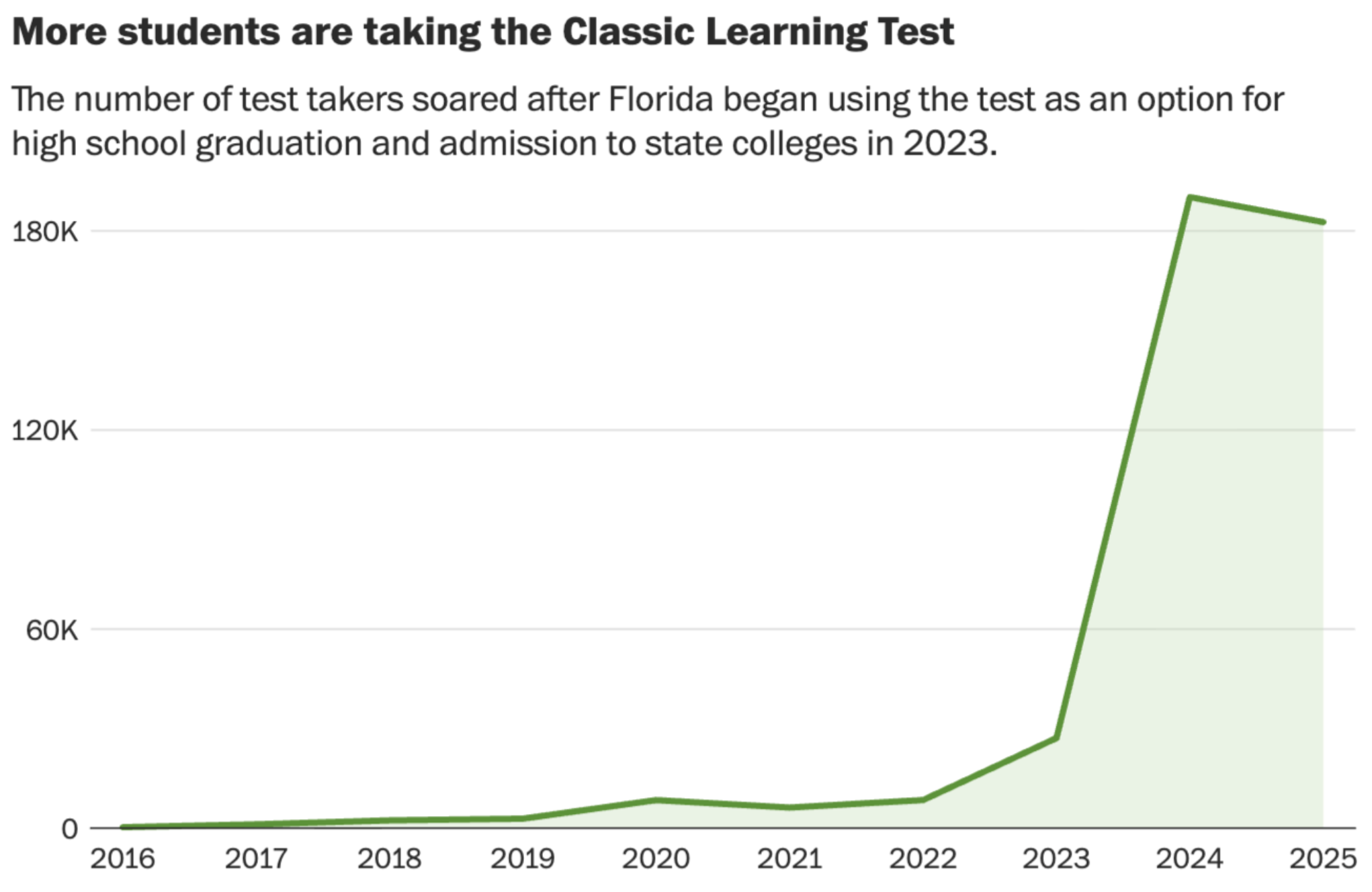
Source: Classic Learning Initiative via The Washington Post.
The predictive validity question i.e., whether and how CLT performance is correlated with postsecondary outcomes, is even more damning, because it’s the one piece of evidence that should exist before a test is scaled to hundreds of thousands of students and paid for by tens of millions of taxpayer dollars. Florida districts have signed at least $2.8 million in CLT contracts since 2023, and Arkansas has committed $12 million over four years. Yet no Florida university could produce outcome data comparing CLT-admitted students with ACT/SAT-admitted students three years in.
The CLT’s own vendor told USA Today it tracks where scores are sent, not whether students are admitted, enrolled, or persist in postsecondary education. Iowa’s Board of Regents reviewed the available research and concluded there is “no evidence to support the predictive efficacy of the CLT” and recommended against using it for automatic admission. The College Board’s analysis echoes this conclusion, noting the CLT’s concordance study “does not meet industry standards” for comparing scores across exams. Arizona State’s Audrey Amrein-Beardsley called rigor claims built on unrepresentative samples an “overstatement” inconsistent with professional testing standards.
None of this is happening in a vacuum. The CLT’s expansion into Indiana, Georgia, North Carolina, Arkansas, Texas, and the U.S. service academies is explicitly bundled with a broader conservative education agenda, from DEI bans to Western-canon civics centers. That’s a separate political discussion. And it’s an entirely different debate from whether the CLT is psychometrically sound enough to gatekeep diplomas, scholarships, and admissions. Right now, the evidence says it isn’t.
Hillsborough board member Nadia Combs captured the real stakes: students who think they’re ready, who aren’t, discover the gap “when they get a job or they go to college.” An accountability system that manufactures that discovery after graduation instead of before it isn’t rigorous. It’s a prescription for failure that we’re handing to the kids, families, higher education institutions, and employers who are being told to trust it.
Editor’s note: This was first published on the author’s Substack,