Standards & Accountability
Here’s how Ohio’s implementation of the science of reading is going
In 2023, Ohio lawmakers enacted a sweeping early literacy initiative aligned with the science of reading, an evidence-based
In 2023, Ohio lawmakers enacted a sweeping early literacy initiative aligned with the science of reading, an evidence-based
In 2023, Ohio lawmakers enacted a sweeping early literacy initiative aligned with the science of reading, an evidence-based instructional approach that emphasizes phonics and knowledge-building. The ultimate goal is to boost Ohio’s troublingly low reading scores. Based on the latest round of state report cards (2024–25), districts and schools have their work cut out for them. But a recently published report from the Ohio Department of Education and Workforce (DEW) suggests that implementation is on the right track. Let’s take a closer look at three key areas covered in the report.
1. High-quality curriculum and instructional materials
The cornerstone of Ohio’s early literacy efforts is a requirement for public schools—traditional districts, charters, and STEM schools—to use state-approved, high-quality instructional materials (HQIM) that are aligned with the science of reading. Three-cueing, an instructional approach that encourages students to guess at words based on pictures or context rather than using phonics-based word recognition skills, is prohibited, though districts are permitted to apply for a waiver on an individual student basis.[1]
Since publishing its initial list of approved materials in early 2024, DEW has “refined” how it evaluates curricula. Although EdReports was the “initial gateway” for evaluation, DEW partnered with the National Center on Improving Literacy in 2024–25 to develop more comprehensive review rubrics. During the 2025–26 review cycle, the department used these updated rubrics to evaluate revised editions of previously approved materials. As of April 2026, DEW had approved 30 high-quality core comprehensive materials: 18 for grades K–5, six for grades K–2, and six for grades 3–5. (The most up-to-date list can be found here.) Curricula that embed social studies and science topics into instruction have been identified as “content rich” and marked with a seal.[2] The majority of core comprehensive/core no foundational skills materials—28 of 33—have earned the seal.
Under state law, public schools are required to annually report the core curriculum and instructional materials they use in English language arts for grades pre-K–5. By the end of the 2024–25 reporting window, 81 percent said they were using a state-approved option. Public districts had the highest rate at 95 percent, followed by charters (68 percent), STEM schools (43 percent), Educational Service Centers (32 percent), and Joint Vocational School Districts (15 percent). In an effort to provide a more complete picture, DEW reached out to the 144 schools and districts that hadn’t yet reported their information or said they were using materials that were not aligned or partially aligned. As a result of this follow-up, 132 of them reported using approved materials by the end of December, bringing the statewide total to 99 percent. Data for the 2025–26 school year will be available this fall on the High-Quality Instructional Materials Dashboard.
2. Professional development for teachers
Ohio’s early literacy initiative requires teachers, administrators, speech-language pathologists, and school psychologists to complete professional development in the science of reading. More specifically, educators must complete DEW’s Introduction to the Science of Reading course and its Science of Reading Refresher course. Timelines and requirements depend on when educators were hired and which grade level they teach.
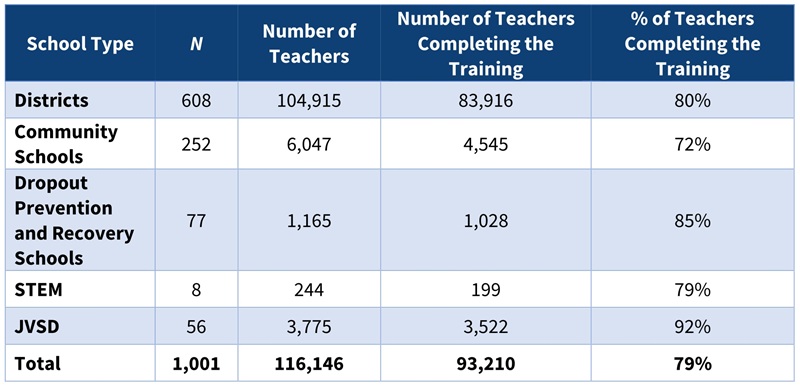
According to the DEW report, participation has been “robust.” Between February 2024 and June 2025, more than 79 percent of Ohio educators completed state-developed science of reading training. Table 1 breaks down completion numbers by school type. It’s important to remember that state-developed options aren’t the only way to meet this requirement. Previously completed training that’s considered comparable to the state-developed courses also counts, which explains why the numbers below don’t equal 100 percent. Unfortunately, DEW doesn’t have completion data for the other options.
Table 1. Number and percentage of teachers who completed state-developed science of reading training
Given that the initial completion deadline was June 2025, it’s too early to know whether professional development has helped boost student achievement. DEW’s report indicates that preliminary analyses show a “positive association between educator training completion and improvements on the K–3 reading diagnostic.” But the department is careful to note that these results should not be used to draw a causal relationship. Moreover, the fact that professional development was a universal requirement makes measuring impacts complicated.
3. Reading coaches
Another way DEW supports educators is through state-funded reading coaches who implement the coaching model outlined in the state’s plan to raise literacy achievement. This model includes four levels that vary in intensity from universal building support (level one) to one-on-one coaching (level four). All four focus on incorporating evidence-based strategies and how to use and analyze student data.
Coaching began in the fall of 2023 with 33 coaches in 53 schools. It expanded in the fall of 2024 to include 84 coaches in 124 schools, and then again in 2025 to include 97 coaches in 151 schools. At the direction of Governor DeWine, DEW will increase its coaching ranks by 50 additional coaches for the 2026–27 school year. DeWine also instructed the department to offer free coaching credentialing to district-employed literacy coaches, which will begin this August.
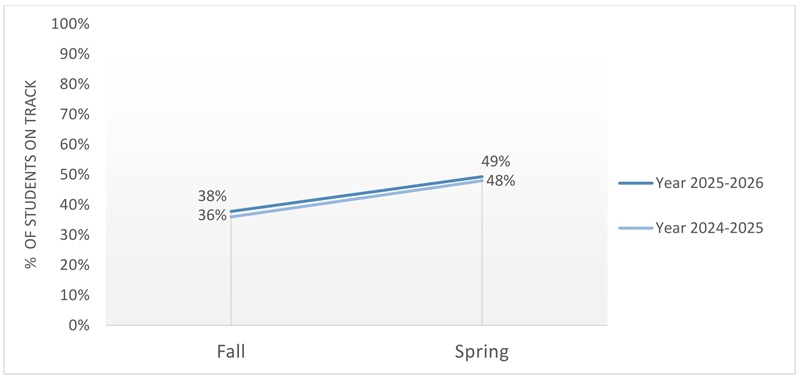
Results from year three (2025–26) won’t be available until later this summer. But according to the DEW report, preliminary analyses suggest similar results to year two. One-on-one sessions, followed by small groups, were the most frequently implemented coaching levels. The most frequently addressed coaching topic was evidence-based strategies/high-quality materials. And when coaches reported the percentage of students who scored “on track” on universal screeners, both years two and three showed similar gains on student outcomes (see Figure 1). Going forward, additional context from DEW—like including as a point of comparison the fall-to-spring percentage change in a typical school without coaches—would be helpful.
Figure 1. Change in percentage of students scoring on track in reading from fall to spring
***
DEW’s latest science of reading report offers plenty of positive signs that Ohio is on the right track to improve reading achievement. Districts and schools have adopted high-quality instructional materials at a nearly universal rate. The vast majority of educators have completed professional development aligned to the science of reading. And ongoing efforts designed to improve instructional practice, like reading coaches and the forthcoming instructional implementation teams, will help ensure rigorous implementation. There’s still a long way to go before Ohio can declare victory. But the foundation that’s been laid is solid.
In April, the Ohio Department of Education and Workforce released an amended ESSA plan for public comment that proposes stronger state interventions in chronically low-performing schools. More assertive turnaround efforts couldn’t come soon enough for students attending such schools. But as news reports have covered, some education advocates have sharply criticized the amendment. If their complaints prevail and the department walks back its proposal (not yet finalized), low-performing schools will be allowed to continue poorly educating students without serious accountability or consequence.
As policy background, federal education law—the Every Student Succeeds Act (ESSA), the 2015 rewrite of No Child Left Behind—requires states to identify low-performing schools and undertake improvement efforts. Schools in the bottom 5 percent statewide or with graduation rates below 67 percent are placed in “comprehensive support and improvement” (CSI) status. Identified schools must create a state-approved improvement plan and are eligible for federal improvement grants. If CSI schools fail to improve within a certain timeframe (three years in Ohio), states must then implement “more rigorous interventions.”
While ESSA obligates states to help low-performing schools improve, the law does not prescribe how precisely to execute that assistance. In Ohio’s initial—and still current—ESSA plan, state officials mention things such as light-touch “supports” from regional educational service centers and vague “improvement reviews” for CSI schools—even for those subject to ESSA’s more rigorous interventions. Nothing, however, is mentioned about bolder efforts to more fundamentally restructure low-performing schools or permanently close them.
Not surprisingly, Ohio’s laid-back approach to ESSA-era school turnaround has proven ineffectual. In a 2025 study, American Institutes for Research/Rand Corporation researchers uncovered no discernible improvements in state exam scores and diminished attendance and graduation rates in Ohio CSI schools. In a necessary course correction, the ESSA amendment sharpens what intervention would look like in the state’s lowest performing schools. The department lists sixteen possible actions that it may require of CSI schools subject to more rigorous interventions. They include:
DEW’s tougher stance opens the door to actions that lead to better outcomes, yet the proposal received nothing but scorn from the public-school establishment. Canton City Schools superintendent Jeff Talbert asserted that DEW was pushing “unproven models that risk undermining public education and community control.” Teachers’ union boss Melissa Cropper bemoaned a lack of “stakeholder input” in objecting to the amended plan. The Cleveland Plain Dealer editorial board threw a fit, accusing DEW of “trying to sneak through” stronger interventions “through a waiver [sic] request” that is “almost certainly illegal.”[2]
The complaints are off the mark for several reasons.
First, DEW is not circumventing the political process. On the contrary, with its proposed amendment, the agency is more faithfully fulfilling its responsibilities under federal education law. Recall that ESSA demands that state education agencies escalate interventions when a CSI school continues to fail year after year. Here’s the text (emphasis mine):
The State educational agency shall establish statewide exit criteria for schools identified by the State for comprehensive support and improvement, which if not satisfied…shall result in more rigorous State-determined action, such as the implementation of interventions.
When local control does not produce acceptable results, federal law obligates state officials to intervene on behalf of students through “state-determined action” in low-performing schools. What DEW proposes upholds the law—not undermines it.
Second, the low-performing schools facing these tougher, “more rigorous” interventions have struggled to make sufficient improvements for multiple years. In the traditional district sector, 34 CSI schools have been in such status since 2018 (going on a decade), and another 9 CSI schools have been so identified since 2022. In the charter realm, 20 general-education charter schools have been identified for CSI since at least 2018.[3] Simply identifying these schools as low-performers and requiring some paperwork has not made a difference. DEW is right to ratchet up the pressure when they persistently underperform. And in the charter sector, sponsors should also play their part by closing poor performers. If they refuse, the state’s recently beefed-up automatic closure law may finally kick in.
Third, some have decried charter school mergers or takeovers as a possible intervention. But their concerns are more political theatrics than an evenhanded assessment of the merits. As research from Ohio and elsewhere reveals, high-performing charter networks deliver the equivalent of weeks and months’ worth of additional learning. Handing over the keys to a high-performing charter operator may in fact be the best recourse for the school, and the students who attend it.
***
Every student deserves to attend an excellent school that prepares them for life after high school. Unfortunately, thousands of Ohio students attend subpar schools that rob them of opportunities for success. DEW’s ESSA amendment is a critical step toward fixing what ails these public institutions. Ohio policymakers should disregard the critics, dig in their heels, and start the hard work of turning around the state’s most troubled schools.
[1] Other possible interventions include mandatory instructional coaches, overhauling curriculum and teacher PD, comprehensive academic reviews by an external entity, and several other actions. CSI schools subject to “more rigorous interventions” would be required by DEW to implement one or more of the sixteen measures.
[2] The Plain Dealer misrepresented DEW’s proposal for state intervention in low-performing schools, which is an amendment to its ESSA implementation plan—not a “waiver” from federal law.
[3] This excludes 64 dropout-recovery charter high schools that almost by definition have low four-year graduation rates and result in CSI identification.

With a growing number of Ohio school districts projecting budget deficits and even insolvency in coming years, the search for someone to blame has begun. For district leaders facing hard choices, the state budget has become a convenient scapegoat—including the recent expansion of the Ohio EdChoice private school voucher program.
Public school advocates have long tried to blame vouchers for every imaginable ill afflicting their districts, and the coming budget challenges are no exception. In their account, the expansion of EdChoice is part of a broader strategy of “disinvestment” designed to intentionally starve public schools of resources.
As I explain in more detail below, however, the districts’ own numbers tell a different story. Crucially, state funding for Ohio public schools has in fact far exceeded what the school districts were expecting before the recent EdChoice expansion. Ohio’s school districts were on track to collect $1 billion more in state aid during the 2026 fiscal year than they were anticipating just a few years ago, with total revenues overshooting projections by nearly 20 percent.
A deeper dive into these projections is critical to understanding why the state underfunding narrative being pushed by some local officials is wrong.
Declining enrollment driving fiscal stress
At the root of the public schools’ coming budget woes is the steady decline in student enrollment. In 2025, the number of students attending Ohio traditional public schools was 230,000 lower than it had been in 2010, representing a decline of nearly 15 percent. The purpose of state funds is to support students, not empty buildings, so declining enrollment has begun to limit the resources available to local districts. Temporary federal pandemic aid helped districts put off making politically unpopular decisions—and some even used these one-time dollars to make long-term spending commitments. But with that money spent down, they can no longer continue to kick the can down the road.
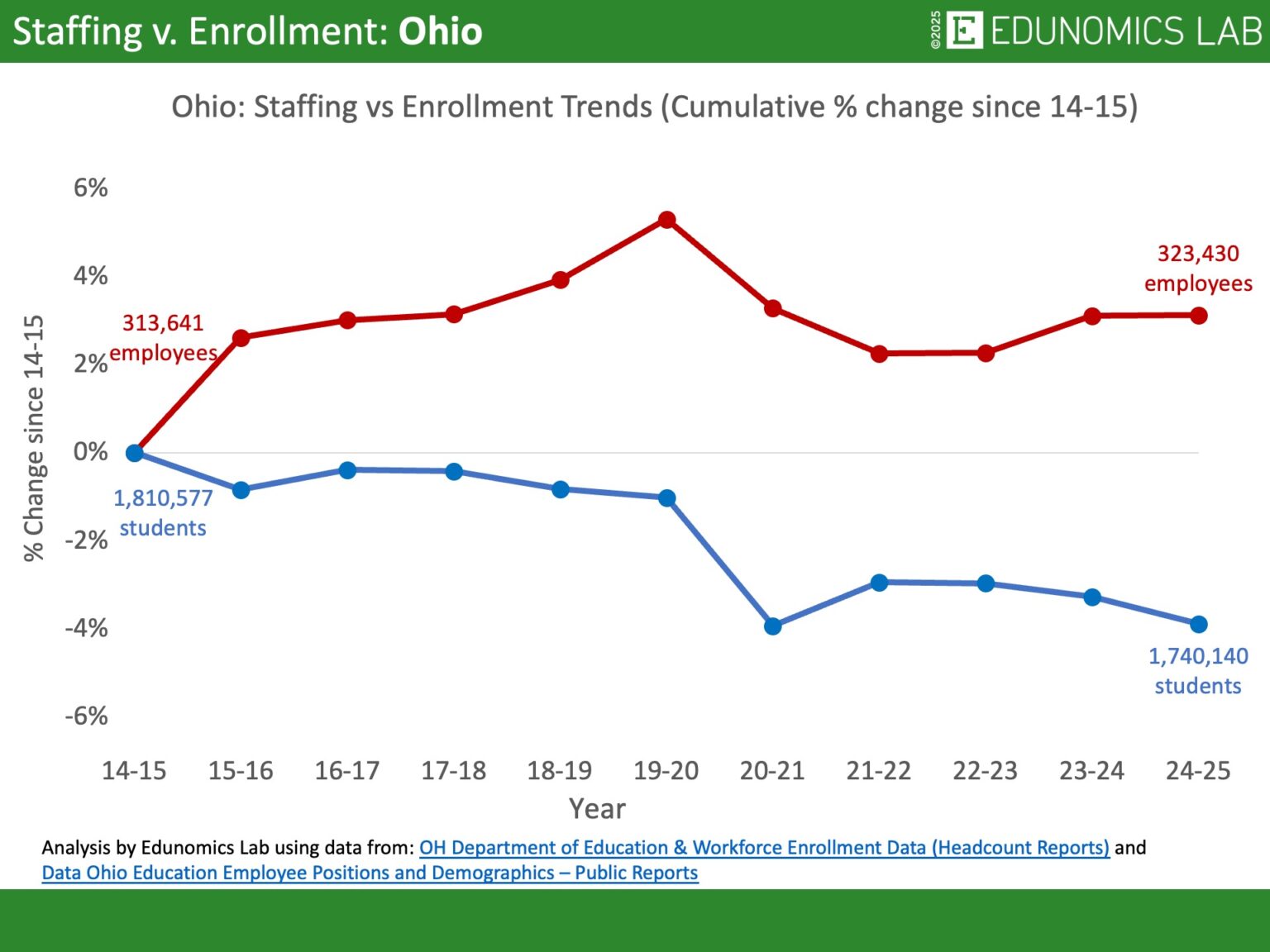
Lower enrollment by itself would not normally create problems. Although some costs are fixed, the overwhelming majority of school district budgets are spent on people, so an obvious response to fewer students is fewer school staff. Yet staffing and student trends have diverged over time.
Over the same 15-year period, the number of teachers employed in Ohio’s public schools has declined by only 5 percent, and the number of administrators has actually increased. Since 2015, the total number of staff employed in Ohio schools has increased by 3 percent, even as student enrollment has continued to decline.
To distract from this basic arithmetic, some advocates have attempted to connect declining public school enrollment with increased access to vouchers. A widely read Washington Post article from last year, for example, implied that public school enrollment losses in Arizona were caused by the state’s embrace of universal vouchers. More recently, the nation’s two largest teachers unions put out a joint statement trying to pressure Democratic governors into opting out of the new federal education choice tax credit, warning that “vouchers will shrink public school enrollment, reducing per pupil state revenue while fixed costs remain.”
At least in Ohio, this argument holds little water. The number of Ohio students receiving EdChoice vouchers has doubled over the past three years—the result of an eligibility expansion adopted in 2023. But, as shown in the figure below, there is no relationship between the increase in the number of students using vouchers and public school enrollment change over the same period. In fact, if anything, districts that have seen the largest increase in voucher use among their residents have actually suffered some of the smallest enrollment declines. This is not definitive proof that vouchers have no effect on enrollment, but it is the opposite of what we would see if expanded voucher access were driving students out of public schools.
Vouchers have not caused state funding for districts to decline
Since the expansion of EdChoice has little to do with falling public school enrollment, some Ohio advocates have focused on a different argument: “Each public tax dollar that goes to private schools is a dollar less for public schools.”
As my colleague Stéphane Lavertu has already noted, this argument rests on a hypothetical—a prediction that, had the EdChoice program not existed, the state legislature would have chosen to spend the money it allocates toward it on public schools instead.[1]
The challenge is that this hypothetical is ultimately untestable. The mere possibility that voucher funding would’ve been redirected to public schools, no matter how unlikely, appeared to have been sufficient to convince Franklin County Judge Jaiza Page when she moved to block the EdChoice program last summer.
“It is not unreasonable to believe that if the EdChoice voucher program were struck down, some of its funding would be shifted to distressed public schools like the Plaintiff districts,” she wrote in her opinion.
Of course, “reasonableness” is in the eye of the beholder. Just as EdChoice critics cannot prove that voucher funding has come at the expense of public schools, defenders of the program have not been able to prove that it has not done so. But the single best piece of evidence on this score has long been overlooked.
Under Ohio law, each school district is required to adopt annual budget forecasts for the coming years, doing its best to anticipate both future revenues and expenditures in light of the information they have available at the time. Ohio school districts adopted one such five-year forecast in spring 2022—almost a full year before the legislature adopted the most recent expansion of EdChoice eligibility. Importantly, these projections were completed after the state had enacted its Fair School Funding Plan.
Comparing how much districts expected to receive from the state in light of the new funding formula—before EdChoice expansion—to what they actually received after the expansion speaks directly, in districts’ own numbers, to whether the expansion of vouchers resulted in less public school funding.
It did not. State funding for Ohio public schools for 2026 came in nearly $1 billion above what districts themselves had projected before EdChoice eligibility was made near-universal. Overall, 86 percent of all public school districts received more in 2026 than they had expected. If money spent on vouchers came out of funds the state (and school districts) had expected to go to public schools, state aid should have fallen short of the districts’ own pre-expansion forecasts. Instead, it far exceeded them.
To be sure, it is possible that districts would have received even more had the EdChoice expansion not occurred. But they cannot claim that it has resulted in a reduction in state support or produced unexpected budget shortfalls.
Nor was state aid the only revenue source to beat expectations. Districts also collected almost $2 billion more in local property taxes than they had anticipated, bringing total revenues roughly $4 billion—about 19 percent—above initial projections.[2]
What about expenditures?
Of course, revenues only tell half of the story. On the other side of the ledger are expenditures, and a major complaint from school districts is that the state has not updated the “inputs” used in the Fair School Funding Plan to reflect rising costs during a period of unusually high inflation.
As it happens, however, the districts did a far better job predicting their future expenditures than their revenues. Overall spending last year exceeded initial expectations by only 5 percent. In the single largest spending category, employee salaries and wages, actual spending was only 2.8 percent higher than projected, and health insurance and retirement costs actually came in below projections.
Put another way, the unexpected windfall in state revenues far exceeded unanticipated cost increases.
Bottom line
In late June 2021, the Ohio School Boards Association sent out a celebratory press release praising the recently adopted state budget and the Fair School Funding Plan it enacted.
“This is a bold and historic decision that will reverberate for decades,” it quoted the group’s then-CEO as saying. “Enacting this funding model represents a generational investment that will thrust Ohio forward into an era of stable and predictable education budgets to help schools meet the needs of all students.”
The formula turned out to be less predictable than hoped—but in a good way. School districts ultimately received a billion more in state funding last year than they had anticipated shortly after the new funding plan was put into place, and long before the state expanded its EdChoice program to make private school vouchers available to nearly all families.
To be sure, school districts across the state are facing some tough fiscal times, but lack of state funding is not at the root of the problem. It’s time for district leaders to stop blaming the state and help prepare their constituents to make some tough decisions.
Vladimir Kogan is a senior research fellow at the Thomas B. Fordham Institute and a professor of political science at the Ohio State University. He is the author of the 2025 book No Adult Left Behind: How Politics Hijacks Education Policy and Hurts Kids (Cambridge University Press).
[1] Note that the same argument could be made about every dollar in the state budget that doesn’t go to public schools. For example, Ohio decided to participate in the Affordable Care Act Medicaid expansion in 2013, which is estimated to cost the state somewhere between $250 million and $800 million each year. Under the same logic, a tax dollar spent on Medicaid expansion is also a dollar that could’ve been spent on public schools instead. Many Ohioans probably agree that this tradeoff was worth making, but the same consideration should be given to the EdChoice program.
[2] The remaining revenue sources include state payments to cover local property tax rollbacks and homestead exemptions, reimbursements for the tangible personal property tax elimination, income taxes, and other miscellaneous revenue sources. While the first two categories are also funded by the state, they are not part of the state school funding formula, so I don’t include them in my calculation of state aid. Including them means that state revenue surpassed expectations by even bigger margins than the $1 billion I cite above.
Known as the “Nation’s Report Card,” the National Assessment of Educational Progress (NAEP) has long provided the clearest yardstick by which states can compare their students’ math and reading performance to other states. Results from these exams—given biennially in fourth and eighth grade—drive important national and statewide conversations about improving achievement in these two key subjects.
Yet those aren’t the only subjects worthy of such conversations. A solid civics education is essential if our nation is to remain a vibrant, self-governing republic. Regrettably, students’ knowledge of civics often goes unchecked and underdiscussed. Without a federal testing requirement, assessment in social studies is spotty at best. Ohio gives only two such exams, both during high school. At the national level, the NAEP civics assessment has only been given to eighth graders in recent years and results have not been available for states.
What we do know from NAEP is that too few American youngsters understand how their government functions and the principles of citizenship. On the last round of civics testing (2022), not even a quarter of eighth graders met the “proficient” standard, while almost a third scored “below basic.”
But how did Ohio students fare on this assessment?
Answer: We have no idea. Unlike the math and reading results, NAEP civics data have never been reported state by state. Thus, we’ve had no way of comparing Ohio students’ civics knowledge to the national average or to students from Massachusetts, Michigan, or Mississippi.
Fortunately, Ohio now has an opportunity to start seeing how its students stack up nationally. NAEP’s governing board recently announced that states can, at no cost, opt into state-level reporting for the civics assessments.[1] Ohio should absolutely sign up (through the state department of education), not merely for the sake of getting additional data, but also as a catalyst for stronger civics education across this state.
That will happen in several ways. State-level reporting will definitely call more attention to civics. When was the last time anyone saw a news story about Ohio students’ civics or social studies knowledge? A quick online search found no recent local stories about the national NAEP civics results—not surprising given the absence of state-specific data—nor any serious coverage of the state’s own social studies assessments. With nary a peep from the media, it’s easy to pretend that civics doesn’t matter. On the other hand, Ohio-specific NAEP civics data would draw much-needed attention to this subject.
Participation would also challenge Ohio to strengthen civics education. One of the greatest benefits of state-level NAEP reporting in math and reading has been the kick-start it’s given to reform efforts. Leaders of Southern states used their once-lagging NAEP math and reading scores to press for bold school reforms, which have since delivered big for students. And other states have followed their example (Ohio’s literacy initiatives, for instance, are based on Mississippi’s impressive work). Over the past two decades, a number of states have drawn lessons from high-scoring Massachusetts, particularly around its strong standards and accountability systems.
When it comes to civics, it could turn out that Ohio leads the pack. If so, let’s be ready to share lessons with the rest of the nation. More likely, however, Ohio is somewhere in the middle, with much work ahead to reach the summit. Efforts to strengthen civics education are more likely to occur when policy leaders can pinpoint Ohio’s current position and have a clear and measurable goal of becoming the nation’s best state for civics education.
***
For Ohio to remain a great place to live and raise a family, future generations must learn what it takes to be responsible, engaged citizens. Unfortunately, education’s civic mission is often ignored or taken for granted. As a result, way too many kids receive a subpar civics education. Signing up for state-level NAEP reporting could be just the accelerant that Ohio needs to get moving in the right direction.
[1] States can also participate in state-level reporting of twelfth-grade NAEP math and reading, as well as eighth-grade science, all of which Ohio should also opt into.
Public school districts are microcosms of American civic life—operated by and for members of the community, with their agendas susceptible to the cultural and political winds that blow through those communities. Even in states where school choice is common, the school district and its elected board still remain part of the infrastructure of cities, towns, and counties. It’s no surprise, then, that disputes which bubble (or erupt) through the larger culture regularly land on board agendas and often land rancorously. The Brookings Institution has been digging deeply into the function of America’s elected school boards, and its first published report looks at how recent cultural conflicts were handled by board members, through the lens of that other quintessential pillar of our civic life: the media.
The research team built a dataset of media reports by web-scraping Google search results via its “News” tab for school district conflicts over a specific set of issues. The analysts chose issues which “had been prominent in education politics from 2018 through 2024 (based on [an] initial screening of articles and Google Trends data)” and which used “distinctive language” easily searchable in news reports. The final list comprises Covid-19 mask mandates, critical race theory (CRT), book restrictions, and transgender students’ rights. Not a perfect overlap with so-called “culture war” issues, but close enough.
Districts were chosen for inclusion based on a stratified sampling strategy using the National Center for Education Statistics’ 12 locale type categories (City-Large, Rural-Remote, etc.). The team randomly selected a maximum of 200 school districts of each locale type from across the country—some locale types did not have 200 exemplars—resulting in a final sample of 2,337 districts out of about 13,500 nationwide. They also applied weights so that the sample would be nationally representative and ran a second analysis including student enrollment data to give a picture of how many students attended districts with school board conflicts, not just the number of districts. Team members manually reviewed each article to confirm whether a genuine conflict within the school board had arisen, rather than a simple and non-confrontational discussion of an issue.
The first and perhaps most striking finding is that media reports on these cultural issues were not widespread. Overall, just 10 percent of districts had at least one media report of a conflict between 2018 and 2024 that was related to any of the four issues under study. However, these were often large districts, so about 30 percent of public school students attended school in places with reported conflicts. During individual years, no more than 5 percent of districts (representing 18 percent of students) had any reported school board conflict. Of the districts that did have a reported conflict, most had reports related to just one of the four issues. The most common source of conflict was book content and possible restriction, while the least common was mask mandates.
Between January 2018 and January 2020 (pre-pandemic), media reports of all four issues were scarce—conflicts were reported for less than 1 percent of districts (representing less than 1.5 percent of students)—which makes sense for Covid masking, but comes as something of a surprise for the other three issues. By 2021, reports of school board conflicts over all four issues began to rise. Media coverage of conflicts over Covid-19 masking policies and CRT peaked in 2021 and then steadily declined to near pre-pandemic levels—that is, near zero—by 2024. Media coverage of conflicts over book restrictions and issues involving transgender students peaked in 2023, and, although declining in 2024, still remained well above pre-pandemic levels.
Media reporting on these cultural issues was most common in large districts (as noted above) and urban areas, with nearly half of large districts (more than 15,000 students) having at least one reported conflict. About a third of city districts had at least one reported conflict, compared with 17.9 percent of suburban districts, 8.4 percent of town districts, and just 3.9 percent of rural districts. Reported conflicts were higher in politically liberal (“blue”) and moderate (“purple”) communities, as determined by the 2020 presidential election share won by either Joe Biden or Donald Trump in that district.
The Brookings team is quick to note that while its findings provide a useful snapshot of what was happening around boardroom tables during the period, the picture is incomplete. Local media has been in decline for years, accelerating during the 2018–2024 period. Does the low incidence of conflicts reflect actual frequency of discord, a more vigilant press overall in this period, or just the situation in those districts under watch by journalists and other public meeting documenters? Either way, the analysts say, their findings offer local district leaders a useful corrective for national narratives—especially those leaders not in large, urban, and politically competitive districts.
SOURCE: Jon Valant et al., “Media reporting on school board conflicts,” Brookings (June 2026).
In December, the board of the Cleveland Metropolitan School District (CMSD) unanimously approved a building consolidation plan. The move is part of the district’s Building Brighter Futures initiative, which aims to take “bold action to right-size, stabilize, and secure a brighter future for CMSD scholars.” Starting this fall, the district will operate 29 fewer schools.
Closing and consolidating schools is complicated, difficult work. But that’s especially true in Cleveland, where constant change has become the norm. Since 2020, district families and staff have weathered the pandemic and remote schooling; experienced a “refresh” of the Cleveland Plan (a comprehensive improvement plan that was signed into state law in 2012); gone through the hiring process for a new CEO after longtime leader Eric Gordon stepped down; and received word that the Cleveland Transformation Alliance, a nonprofit responsible for supporting implementation of the Cleveland Plan, would dissolve.
For some families and staff, the district’s consolidation effort likely feels like yet another upheaval. Their concerns and frustrations are understandable. But the district has been on this trajectory for years. Maintaining the status quo isn’t financially sustainable or in the best interest of students.
To their credit, Cleveland leaders, including Mayor Justin Bibb, are tackling the problem head-on. They’re learning from other districts. And they’re creating a blueprint for how to handle the complexities of consolidation.
First, they’ve been clear and concise about why consolidation is necessary. More than two decades of steadily declining enrollment—just 34,000 students are enrolled today, compared to 70,000 in 2004—have left many school buildings half-full and many students without access to programs and services. The district has openly acknowledged that there are students who lack “high-quality college, career, and enrichment programs in their school.” Costs to maintain and operate buildings, many of which need upgrades and repairs, have gone up. And a budget shortfall of roughly $150 million is on the horizon.
Second, they’ve outlined how consolidation will address these issues. Once implemented, CMSD’s plan will save the district an estimated $30 million each year. Among affected students, 96 percent will move to schools with equal or higher star ratings on state report cards, 100 percent will have equal or expanded academic and extracurricular opportunities, and 95 percent will attend a school located in a building that’s in equal or better physical condition.
Third, they’ve focused on engagement and gathering feedback. Outreach efforts during phase one, which began in spring 2025 and continued through the fall, included community meetings, staff meetings at all schools, discussions with both the Student Advisory and District Parent Advisory Committees, board meetings, media briefings, online resources, virtual meeting options, and presentations to civic, service, and faith-based groups. Phase two, which began in the fall, focused on impacted schools and included in-person meetings for staff and families, as well as administrators and school-based staffing groups.
Fourth, they’ve prioritized transparency. Results from a community survey conducted in April 2025 were published online. All of the district’s presentations, including the region-specific ones, are also online. Consolidation recommendations were grounded in data (student enrollment trends, building condition, and building size and use), as well as school and neighborhood factors (student outcomes, special programming, student demographics and retention, and the number of school options nearby). Data sheets containing information for every school are—you guessed it—available online.
Last but not least, they’re working to ensure that transitions are as smooth as possible. A schedule of transition activities and culture building/welcoming activities for families, students, and staff is available online. It includes family carnivals, game nights, block parties, community art shows, and farewell celebrations for buildings closing their doors. The district hosted two School Choice Expos that allowed families to connect with school leaders and get more information about neighborhood schools, magnet programs, college-credit pathways, and specialty programs. And that’s all in addition to resources the district already annually publishes, like choice books and an interactive school finder, to help families decide which district-run school is right for their child.
There’s still a long way to go before CMSD’s consolidation effort can be labeled a success. But Cleveland leaders deserve credit for working to create a better long-term future for kids instead of kicking the can down the road. Over the next few years, demographic changes will force districts across the nation to face similar decisions. Local context and needs should be paramount. But following Cleveland’s blueprint would be a great place to start.
Editor’s note: This was first published by RealClearEducation.