In 2023, Ohio lawmakers enacted a sweeping early literacy initiative aligned with the science of reading, an evidence-based instructional approach that emphasizes phonics and knowledge-building. The ultimate goal is to boost Ohio’s troublingly low reading scores. Based on the latest round of state report cards (2024–25), districts and schools have their work cut out for them. But a recently published report from the Ohio Department of Education and Workforce (DEW) suggests that implementation is on the right track. Let’s take a closer look at three key areas covered in the report.
1. High-quality curriculum and instructional materials
The cornerstone of Ohio’s early literacy efforts is a requirement for public schools—traditional districts, charters, and STEM schools—to use state-approved, high-quality instructional materials (HQIM) that are aligned with the science of reading. Three-cueing, an instructional approach that encourages students to guess at words based on pictures or context rather than using phonics-based word recognition skills, is prohibited, though districts are permitted to apply for a waiver on an individual student basis.[1]
Since publishing its initial list of approved materials in early 2024, DEW has “refined” how it evaluates curricula. Although EdReports was the “initial gateway” for evaluation, DEW partnered with the National Center on Improving Literacy in 2024–25 to develop more comprehensive review rubrics. During the 2025–26 review cycle, the department used these updated rubrics to evaluate revised editions of previously approved materials. As of April 2026, DEW had approved 30 high-quality core comprehensive materials: 18 for grades K–5, six for grades K–2, and six for grades 3–5. (The most up-to-date list can be found here.) Curricula that embed social studies and science topics into instruction have been identified as “content rich” and marked with a seal.[2] The majority of core comprehensive/core no foundational skills materials—28 of 33—have earned the seal.
Under state law, public schools are required to annually report the core curriculum and instructional materials they use in English language arts for grades pre-K–5. By the end of the 2024–25 reporting window, 81 percent said they were using a state-approved option. Public districts had the highest rate at 95 percent, followed by charters (68 percent), STEM schools (43 percent), Educational Service Centers (32 percent), and Joint Vocational School Districts (15 percent). In an effort to provide a more complete picture, DEW reached out to the 144 schools and districts that hadn’t yet reported their information or said they were using materials that were not aligned or partially aligned. As a result of this follow-up, 132 of them reported using approved materials by the end of December, bringing the statewide total to 99 percent. Data for the 2025–26 school year will be available this fall on the High-Quality Instructional Materials Dashboard.
2. Professional development for teachers
Ohio’s early literacy initiative requires teachers, administrators, speech-language pathologists, and school psychologists to complete professional development in the science of reading. More specifically, educators must complete DEW’s Introduction to the Science of Reading course and its Science of Reading Refresher course. Timelines and requirements depend on when educators were hired and which grade level they teach.
According to the DEW report, participation has been “robust.” Between February 2024 and June 2025, more than 79 percent of Ohio educators completed state-developed science of reading training. Table 1 breaks down completion numbers by school type. It’s important to remember that state-developed options aren’t the only way to meet this requirement. Previously completed training that’s considered comparable to the state-developed courses also counts, which explains why the numbers below don’t equal 100 percent. Unfortunately, DEW doesn’t have completion data for the other options.
Table 1. Number and percentage of teachers who completed state-developed science of reading training
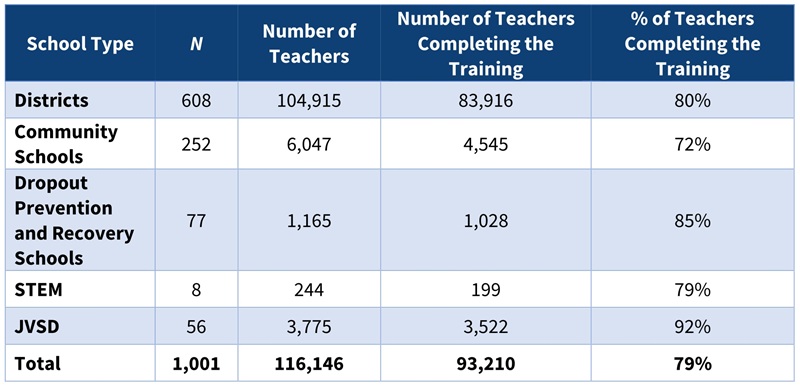
Given that the initial completion deadline was June 2025, it’s too early to know whether professional development has helped boost student achievement. DEW’s report indicates that preliminary analyses show a “positive association between educator training completion and improvements on the K–3 reading diagnostic.” But the department is careful to note that these results should not be used to draw a causal relationship. Moreover, the fact that professional development was a universal requirement makes measuring impacts complicated.
3. Reading coaches
Another way DEW supports educators is through state-funded reading coaches who implement the coaching model outlined in the state’s plan to raise literacy achievement. This model includes four levels that vary in intensity from universal building support (level one) to one-on-one coaching (level four). All four focus on incorporating evidence-based strategies and how to use and analyze student data.
Coaching began in the fall of 2023 with 33 coaches in 53 schools. It expanded in the fall of 2024 to include 84 coaches in 124 schools, and then again in 2025 to include 97 coaches in 151 schools. At the direction of Governor DeWine, DEW will increase its coaching ranks by 50 additional coaches for the 2026–27 school year. DeWine also instructed the department to offer free coaching credentialing to district-employed literacy coaches, which will begin this August.
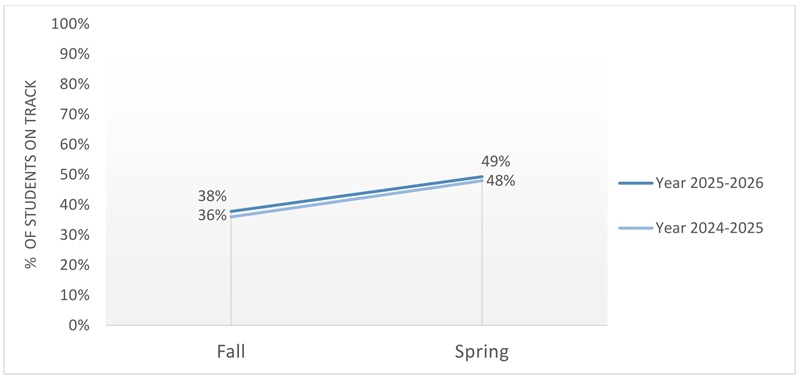
Results from year three (2025–26) won’t be available until later this summer. But according to the DEW report, preliminary analyses suggest similar results to year two. One-on-one sessions, followed by small groups, were the most frequently implemented coaching levels. The most frequently addressed coaching topic was evidence-based strategies/high-quality materials. And when coaches reported the percentage of students who scored “on track” on universal screeners, both years two and three showed similar gains on student outcomes (see Figure 1). Going forward, additional context from DEW—like including as a point of comparison the fall-to-spring percentage change in a typical school without coaches—would be helpful.
Figure 1. Change in percentage of students scoring on track in reading from fall to spring
***
DEW’s latest science of reading report offers plenty of positive signs that Ohio is on the right track to improve reading achievement. Districts and schools have adopted high-quality instructional materials at a nearly universal rate. The vast majority of educators have completed professional development aligned to the science of reading. And ongoing efforts designed to improve instructional practice, like reading coaches and the forthcoming instructional implementation teams, will help ensure rigorous implementation. There’s still a long way to go before Ohio can declare victory. But the foundation that’s been laid is solid.