Schools have a responsibility to educate students about what it means to be an American. Students should exit high school with an appreciation for our nation’s values, among which include freedom, liberty, and justice for all—and the knowledge of how we’ve failed at times to live up to them. They should come away understanding how free-market principles have raised living standards to unseen heights. And how our ancestors fought tyranny overseas and won. Schools should teach students how democratic institutions protect our unalienable rights and give voice to all Americans today.
Yet various data indicate that schools are failing in this important task. Consider recent surveys revealing troubling attitudes among young people about our nation and its ideals.
- This summer, Gallup reported that just 41 percent of Gen Z—13- to 28-year-olds—say they are “proud to be an American.” This is a far lower rate than older age groups, and it’s lower than the large majorities of Gen X who were “proud to be an American” as young adults during the early 2000s.
- A Cato Institute/YouGov survey recently found that more young people hold favorable views of socialism than capitalism (62 to 50 percent). Alarmingly, one-third express a favorable view toward communism, an ideology that has left millions dead.
- Pew Research Center surveys find that just 39 percent of young adults believe the American Dream is “still possible,” and a mere 16 percent affirm that the U.S. “stands above all other countries in the world.”
Besides these glum views, the Nation’s Report Card (NAEP) reveals major deficiencies in students’ knowledge about America. In 2022, just 13 and 20 percent of eighth graders scored proficient on national U.S. history and civics exams, respectively. Other survey data uncover similar knowledge deficits among young people, whether in high school or college.
Ohio lawmakers should be doing more to make sure that students are well-educated in American history and government. Yet a recent proposal from House lawmakers would hit the brakes. What do they propose, and how would it undermine civics education? And what could lawmakers do instead that would give students a stronger understanding and appreciation for our nation?
First, the bad idea. Tucked in a larger bill aimed at public school deregulation, Representatives Gayle Manning and Adam Bird seek to eliminate Ohio’s U.S. history and government end-of-course exams. Though these high school tests are not required under federal law—likely why they’re being targeted—the proposal would erode accountability for civics education. Results from these exams are reported publicly and count towards schools’ state ratings, as they are included in performance index and value-added scores. These checks help ensure that high schools, at least,[1] prioritize civics education, alongside math and reading.
Dumping the U.S. history and government tests would actually turn back the clock by more than two decades, as the state has long administered high school social studies exams.[2] Without a history assessment, Ohio would no longer check whether students know something about the New Deal, World War II, and the Cold War—all topics outlined in the state’s high school history standards and which may appear on the state exam. Lacking a government exam, students’ understanding of the Declaration of Independence, Northwest Ordinance, and U.S. Constitution could go untested.
Lawmakers should resist the urge to cut U.S. history and government exams, but also consider constructive steps that can improve civics instruction from elementary to high school. This is a bigger discussion than what space affords here, but let’s consider three starter ideas:
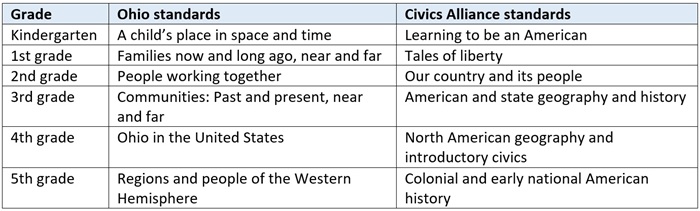
1. Beef-up instruction about American history and civics in elementary schools. As a 2021 national Fordham analysis pointed out, U.S. history and government content is lacking in Ohio’s elementary social studies standards. Having read these standards (and Ohio’s model curriculum) myself, I cannot help but concur. It is indeed thin gruel in the earliest grades. In grades K–3, the only clear expectation that schools teach children about their country comes in kindergarten. There, schools are prompted to teach that “symbols and practices of the United States include the flag, Pledge of Allegiance, and the National Anthem.” Nowhere else do we find expectations in those grades that schools introduce children to crucial events (e.g., American Revolution), influential figures (e.g., Abraham Lincoln), important places (e.g., Ohio River), or founding documents (e.g., Constitution). Instead, we discover mostly vague, uninspiring statements such as a first grade history standard urging schools to teach that “the ways basic human needs are met have changed over time.”
To put a finer point on it, consider the stark contrast between Ohio’s social studies standards and those developed by the conservative Civics Alliance. In its K–3 standards, the emphasis rests on teaching children about their nation. Meanwhile, Ohio’s early elementary standards are organized around family and community, topics worthy of inclusion, but don’t introduce American history and government in a serious way until fourth grade. To be clear, I am not suggesting that Ohio rush out and adopt the Civics Alliance framework, as policymakers would need to address concerns or be ready to stand firm against progressives’ pushback.[3] Still, it’s worth reading the two sets of standards side by side (and other quality standards) and judging for yourself whether Ohio does enough to promote knowledge about America during elementary school.[4]
Table 1: The main theme of Ohio and Civics Alliance social studies standards, grades K–5
2. Ensure the U.S. history exam covers all the nation’s history, from 1492 to present (not just 1877 through today). Surprisingly, Ohio’s U.S. history exam doesn’t cover the full sweep of the nation’s history. Why? Ohio’s social studies standards split American history into two courses: an eighth-grade course that covers history until 1876, and then a high school course that covers 1877 to the present. This means that the high school U.S. history exam only covers “part II” of American history.[5] And since there is no eighth-grade social studies assessment, students’ knowledge about colonial America, the Revolutionary War, westward expansion, and slavery and the Civil War goes untested. Lawmakers should make sure that students have a firm understanding of all American history, which—assuming the state maintains its current social studies framework—means adding an eighth grade U.S. history exam to its high school test.
3. Require students to pass the U.S. history and government exams (or the citizenship test, as an alternative) as a condition of graduation. Students passing U.S. history and government exams earn one of the two “seals” needed for graduation. That’s an OK start. But since students have a dozen seal options—and course grades may substitute for test passage—they can easily graduate without demonstrating proficiency on U.S. history and government exams. State lawmakers should insist that students pass these exams or the citizenship test, as GOP gubernatorial candidate Vivek Ramaswamy has proposed. This would push American history and government to the forefront in schools’ priorities, motivate students to learn valuable content, and help ensure that all Ohio students leave high school with the knowledge necessary for responsible citizenship.
* * *
Ohio schools should be places where students learn what it means to be an American. Standards and accountability measures help ensure schools carry out this important responsibility. These policy levers aren’t the only ones that matter, of course, but they are essential if we are to graduate young people knowledgeable about our nation and the values that have held it together for almost two hundred and fifty years.
[1] State lawmakers in 2021 ditched the fourth and sixth grade social studies exams, so there is no assessment-based civics accountability before high school.
[2] In previous iterations of the state testing program, this consisted of a ninth-grade citizenship test and, later, a tenth-grade social studies Ohio Graduation Test.
[3] House Bill 103 of the 135th General Assembly proposed a task force charged with revising social studies standards with an eye toward using the Civics Alliance framework as a baseline. The bill did not move out of committee (for proponents and opponents, see here).
[4] Some elementary schools may introduce American history and government through strong, knowledge-rich ELA curricula such as Core Knowledge Language Arts and Wit and Wisdom.
[5] The only exception is that high school U.S. history covers founding documents (e.g., Constitution and Declaration of Independence), as does eighth grade history.