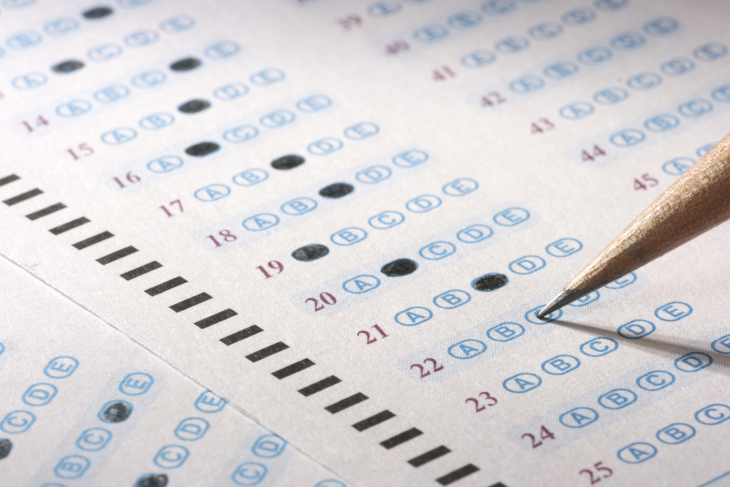
Known as the “Nation’s Report Card,” the National Assessment of Educational Progress (NAEP) has long provided the clearest yardstick by which states can compare their students’ math and reading performance to other states. Results from these exams—given biennially in fourth and eighth grade—drive important national and statewide conversations about improving achievement in these two key subjects.
Yet those aren’t the only subjects worthy of such conversations. A solid civics education is essential if our nation is to remain a vibrant, self-governing republic. Regrettably, students’ knowledge of civics often goes unchecked and underdiscussed. Without a federal testing requirement, assessment in social studies is spotty at best. Ohio gives only two such exams, both during high school. At the national level, the NAEP civics assessment has only been given to eighth graders in recent years and results have not been available for states.
What we do know from NAEP is that too few American youngsters understand how their government functions and the principles of citizenship. On the last round of civics testing (2022), not even a quarter of eighth graders met the “proficient” standard, while almost a third scored “below basic.”
But how did Ohio students fare on this assessment?
Answer: We have no idea. Unlike the math and reading results, NAEP civics data have never been reported state by state. Thus, we’ve had no way of comparing Ohio students’ civics knowledge to the national average or to students from Massachusetts, Michigan, or Mississippi.
Fortunately, Ohio now has an opportunity to start seeing how its students stack up nationally. NAEP’s governing board recently announced that states can, at no cost, opt into state-level reporting for the civics assessments.[1] Ohio should absolutely sign up (through the state department of education), not merely for the sake of getting additional data, but also as a catalyst for stronger civics education across this state.
That will happen in several ways. State-level reporting will definitely call more attention to civics. When was the last time anyone saw a news story about Ohio students’ civics or social studies knowledge? A quick online search found no recent local stories about the national NAEP civics results—not surprising given the absence of state-specific data—nor any serious coverage of the state’s own social studies assessments. With nary a peep from the media, it’s easy to pretend that civics doesn’t matter. On the other hand, Ohio-specific NAEP civics data would draw much-needed attention to this subject.
Participation would also challenge Ohio to strengthen civics education. One of the greatest benefits of state-level NAEP reporting in math and reading has been the kick-start it’s given to reform efforts. Leaders of Southern states used their once-lagging NAEP math and reading scores to press for bold school reforms, which have since delivered big for students. And other states have followed their example (Ohio’s literacy initiatives, for instance, are based on Mississippi’s impressive work). Over the past two decades, a number of states have drawn lessons from high-scoring Massachusetts, particularly around its strong standards and accountability systems.
When it comes to civics, it could turn out that Ohio leads the pack. If so, let’s be ready to share lessons with the rest of the nation. More likely, however, Ohio is somewhere in the middle, with much work ahead to reach the summit. Efforts to strengthen civics education are more likely to occur when policy leaders can pinpoint Ohio’s current position and have a clear and measurable goal of becoming the nation’s best state for civics education.
***
For Ohio to remain a great place to live and raise a family, future generations must learn what it takes to be responsible, engaged citizens. Unfortunately, education’s civic mission is often ignored or taken for granted. As a result, way too many kids receive a subpar civics education. Signing up for state-level NAEP reporting could be just the accelerant that Ohio needs to get moving in the right direction.
[1] States can also participate in state-level reporting of twelfth-grade NAEP math and reading, as well as eighth-grade science, all of which Ohio should also opt into.