With a growing number of Ohio school districts projecting budget deficits and even insolvency in coming years, the search for someone to blame has begun. For district leaders facing hard choices, the state budget has become a convenient scapegoat—including the recent expansion of the Ohio EdChoice private school voucher program.
Public school advocates have long tried to blame vouchers for every imaginable ill afflicting their districts, and the coming budget challenges are no exception. In their account, the expansion of EdChoice is part of a broader strategy of “disinvestment” designed to intentionally starve public schools of resources.
As I explain in more detail below, however, the districts’ own numbers tell a different story. Crucially, state funding for Ohio public schools has in fact far exceeded what the school districts were expecting before the recent EdChoice expansion. Ohio’s school districts were on track to collect $1 billion more in state aid during the 2026 fiscal year than they were anticipating just a few years ago, with total revenues overshooting projections by nearly 20 percent.
A deeper dive into these projections is critical to understanding why the state underfunding narrative being pushed by some local officials is wrong.
Declining enrollment driving fiscal stress
At the root of the public schools’ coming budget woes is the steady decline in student enrollment. In 2025, the number of students attending Ohio traditional public schools was 230,000 lower than it had been in 2010, representing a decline of nearly 15 percent. The purpose of state funds is to support students, not empty buildings, so declining enrollment has begun to limit the resources available to local districts. Temporary federal pandemic aid helped districts put off making politically unpopular decisions—and some even used these one-time dollars to make long-term spending commitments. But with that money spent down, they can no longer continue to kick the can down the road.
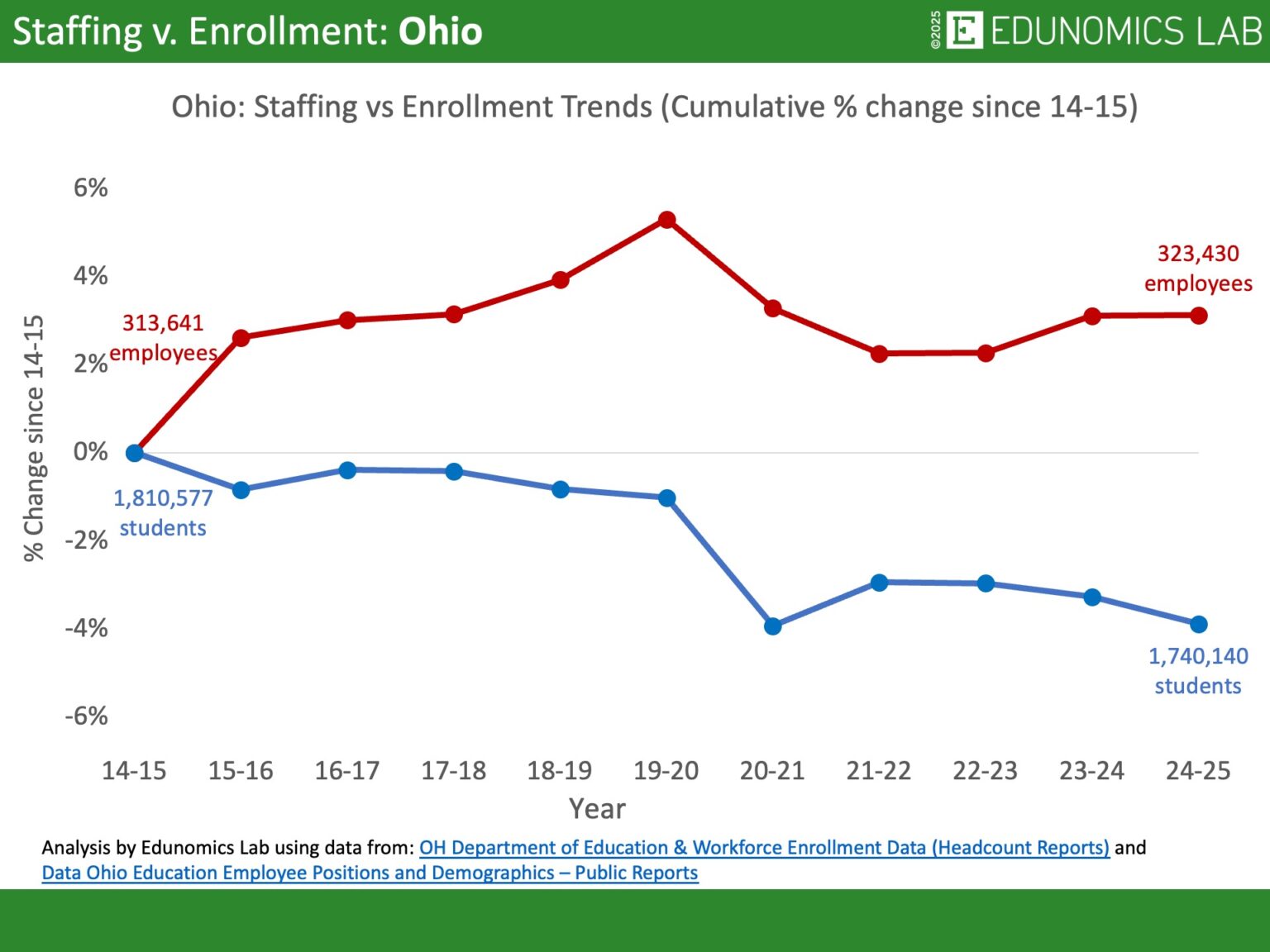
Lower enrollment by itself would not normally create problems. Although some costs are fixed, the overwhelming majority of school district budgets are spent on people, so an obvious response to fewer students is fewer school staff. Yet staffing and student trends have diverged over time.
Over the same 15-year period, the number of teachers employed in Ohio’s public schools has declined by only 5 percent, and the number of administrators has actually increased. Since 2015, the total number of staff employed in Ohio schools has increased by 3 percent, even as student enrollment has continued to decline.
To distract from this basic arithmetic, some advocates have attempted to connect declining public school enrollment with increased access to vouchers. A widely read Washington Post article from last year, for example, implied that public school enrollment losses in Arizona were caused by the state’s embrace of universal vouchers. More recently, the nation’s two largest teachers unions put out a joint statement trying to pressure Democratic governors into opting out of the new federal education choice tax credit, warning that “vouchers will shrink public school enrollment, reducing per pupil state revenue while fixed costs remain.”
At least in Ohio, this argument holds little water. The number of Ohio students receiving EdChoice vouchers has doubled over the past three years—the result of an eligibility expansion adopted in 2023. But, as shown in the figure below, there is no relationship between the increase in the number of students using vouchers and public school enrollment change over the same period. In fact, if anything, districts that have seen the largest increase in voucher use among their residents have actually suffered some of the smallest enrollment declines. This is not definitive proof that vouchers have no effect on enrollment, but it is the opposite of what we would see if expanded voucher access were driving students out of public schools.
Vouchers have not caused state funding for districts to decline
Since the expansion of EdChoice has little to do with falling public school enrollment, some Ohio advocates have focused on a different argument: “Each public tax dollar that goes to private schools is a dollar less for public schools.”
As my colleague Stéphane Lavertu has already noted, this argument rests on a hypothetical—a prediction that, had the EdChoice program not existed, the state legislature would have chosen to spend the money it allocates toward it on public schools instead.[1]
The challenge is that this hypothetical is ultimately untestable. The mere possibility that voucher funding would’ve been redirected to public schools, no matter how unlikely, appeared to have been sufficient to convince Franklin County Judge Jaiza Page when she moved to block the EdChoice program last summer.
“It is not unreasonable to believe that if the EdChoice voucher program were struck down, some of its funding would be shifted to distressed public schools like the Plaintiff districts,” she wrote in her opinion.
Of course, “reasonableness” is in the eye of the beholder. Just as EdChoice critics cannot prove that voucher funding has come at the expense of public schools, defenders of the program have not been able to prove that it has not done so. But the single best piece of evidence on this score has long been overlooked.
Under Ohio law, each school district is required to adopt annual budget forecasts for the coming years, doing its best to anticipate both future revenues and expenditures in light of the information they have available at the time. Ohio school districts adopted one such five-year forecast in spring 2022—almost a full year before the legislature adopted the most recent expansion of EdChoice eligibility. Importantly, these projections were completed after the state had enacted its Fair School Funding Plan.
Comparing how much districts expected to receive from the state in light of the new funding formula—before EdChoice expansion—to what they actually received after the expansion speaks directly, in districts’ own numbers, to whether the expansion of vouchers resulted in less public school funding.
It did not. State funding for Ohio public schools for 2026 came in nearly $1 billion above what districts themselves had projected before EdChoice eligibility was made near-universal. Overall, 86 percent of all public school districts received more in 2026 than they had expected. If money spent on vouchers came out of funds the state (and school districts) had expected to go to public schools, state aid should have fallen short of the districts’ own pre-expansion forecasts. Instead, it far exceeded them.
To be sure, it is possible that districts would have received even more had the EdChoice expansion not occurred. But they cannot claim that it has resulted in a reduction in state support or produced unexpected budget shortfalls.
Nor was state aid the only revenue source to beat expectations. Districts also collected almost $2 billion more in local property taxes than they had anticipated, bringing total revenues roughly $4 billion—about 19 percent—above initial projections.[2]
What about expenditures?
Of course, revenues only tell half of the story. On the other side of the ledger are expenditures, and a major complaint from school districts is that the state has not updated the “inputs” used in the Fair School Funding Plan to reflect rising costs during a period of unusually high inflation.
As it happens, however, the districts did a far better job predicting their future expenditures than their revenues. Overall spending last year exceeded initial expectations by only 5 percent. In the single largest spending category, employee salaries and wages, actual spending was only 2.8 percent higher than projected, and health insurance and retirement costs actually came in below projections.
Put another way, the unexpected windfall in state revenues far exceeded unanticipated cost increases.
Bottom line
In late June 2021, the Ohio School Boards Association sent out a celebratory press release praising the recently adopted state budget and the Fair School Funding Plan it enacted.
“This is a bold and historic decision that will reverberate for decades,” it quoted the group’s then-CEO as saying. “Enacting this funding model represents a generational investment that will thrust Ohio forward into an era of stable and predictable education budgets to help schools meet the needs of all students.”
The formula turned out to be less predictable than hoped—but in a good way. School districts ultimately received a billion more in state funding last year than they had anticipated shortly after the new funding plan was put into place, and long before the state expanded its EdChoice program to make private school vouchers available to nearly all families.
To be sure, school districts across the state are facing some tough fiscal times, but lack of state funding is not at the root of the problem. It’s time for district leaders to stop blaming the state and help prepare their constituents to make some tough decisions.
Vladimir Kogan is a senior research fellow at the Thomas B. Fordham Institute and a professor of political science at the Ohio State University. He is the author of the 2025 book No Adult Left Behind: How Politics Hijacks Education Policy and Hurts Kids (Cambridge University Press).
[1] Note that the same argument could be made about every dollar in the state budget that doesn’t go to public schools. For example, Ohio decided to participate in the Affordable Care Act Medicaid expansion in 2013, which is estimated to cost the state somewhere between $250 million and $800 million each year. Under the same logic, a tax dollar spent on Medicaid expansion is also a dollar that could’ve been spent on public schools instead. Many Ohioans probably agree that this tradeoff was worth making, but the same consideration should be given to the EdChoice program.
[2] The remaining revenue sources include state payments to cover local property tax rollbacks and homestead exemptions, reimbursements for the tangible personal property tax elimination, income taxes, and other miscellaneous revenue sources. While the first two categories are also funded by the state, they are not part of the state school funding formula, so I don’t include them in my calculation of state aid. Including them means that state revenue surpassed expectations by even bigger margins than the $1 billion I cite above.