State report cards have long provided transparency and accountability for student learning. The current framework has commendable features, yet policymakers should make sure that the system functions well and meets intended goals. This is the third in a series that examines report card elements that could use refinement (previous pieces covered chronic absenteeism and early literacy).
Recognizing that too many students graduate ill-prepared for their next steps, Ohio policymakers have made increased college and career readiness a priority. Within this larger effort, the state introduced a readiness measure on its school report card nearly a decade ago to encourage schools to provide rigorous preparation beyond what is required for high school graduation.
As initially implemented, the measure (then known as “Prepared for Success”) was overly focused on college-ready metrics, such as ACT, SAT, AP, and IB exam scores. In 2021, lawmakers rebooted the component with new indicators added to the mix, including career-tech assessments, work-based learning, and military enlistment. Today, students who meet one of 11 (!) possible indicators are deemed “ready,” and count toward their schools’ “College, Career, Workforce, and Military Readiness” rating.
Revamping the measure was a smart move, but how is the next iteration functioning?
As a starting point, Ohio does a better job differentiating schools than the former model, which flunked nearly everyone. In 2024–25, the first year a star rating was assigned for the measure, 33 percent of districts received 1 or 2 stars and 29 percent 4 or 5 stars, leaving 38 percent at 3 stars.[1]
But a deeper-dive analysis reveals concerns about how accurately Ohio identifies “college and career ready” students, especially along the career-oriented dimension. This in turn raises the question of whether the ratings provide a reliable and honest portrayal of student readiness.
Figure 1 shows the percentage of students deemed “ready” by meeting an indicator listed in Figure 2. The statewide readiness rate jumped from 39 to 56 percent between 2022 and 2023, and increased again to 61 percent for the class of 2024. The current number sits below the state’s 88 percent graduation rate, indicating that the readiness bar is—as it should be—higher than the basic graduation standard. Yet to put the rate into additional context, it’s roughly double Ohio’s longstanding college-completion rate (associate degree or higher) of roughly 30 percent.
Figure 1: Percentage of Ohio students deemed college and career ready, classes of 2022–24
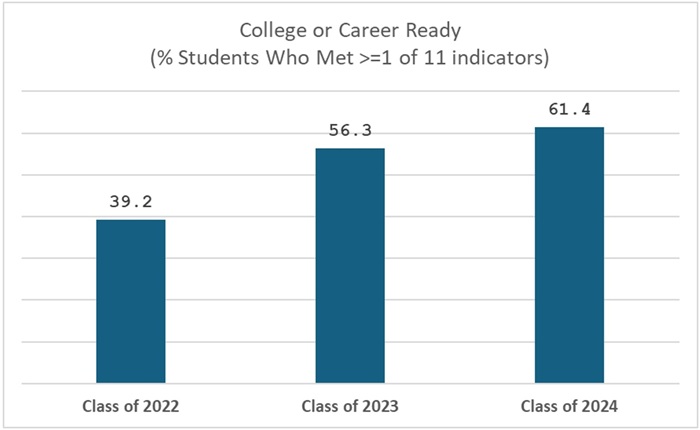
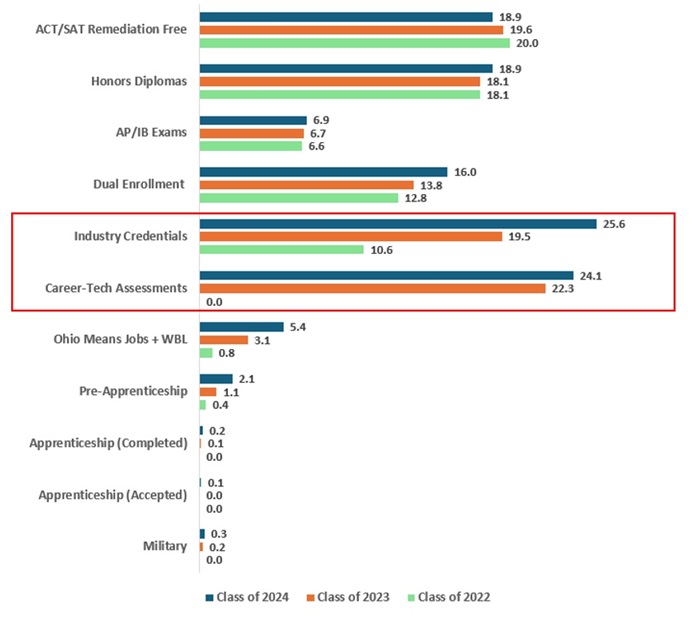
Figure 2 breaks down the overall number by the various indicators, showing that the recent jump is largely attributable to the “career-ready” measures. Among the class of 2024, 26 percent met the industry credentials indicator—more than double the rate from a couple years ago—while 24 percent passed three or more career-technical assessments, whereas no students in the class of 2022 were reported as passing three or more.[2] These two rates have risen not only in response to the report card, but also to the state’s new graduation requirements, which allow low-performing students to receive diplomas through an alternative route that includes credentials and career-tech assessments as options.
Figure 2: Percentage of students meeting various college and career ready indicators
The rise in the career-based numbers could be a positive, except that we know many students have been accumulating credentials of questionable value. The most-earned credentials among the class of 2024 were basic first aid and job safety certificates, as well as a customer service and introductory retail certificate, each of which can be attained relatively easily. Students in urban school districts have been especially apt to collect credentials such as these, likely in an effort to meet alternative graduation requirements. Meanwhile, there are more than 200 career-technical exams, and nothing is known publicly about which exams students are passing or their rigor.
Incorporating the career-ready indicators on an equal basis as ACT or SAT scores has yielded some head-scratching results. The charts below provide illustrations. In Summit County, both Akron and suburban Hudson school district received 4-star college and career readiness ratings. But Hudson earned that rating through the tougher college-ready metrics, while Akron did so through the softer career indicators. In Central Ohio, Columbus and suburban Upper Arlington received 3-star ratings, but Upper Arlington did so through the college-ready metrics and Columbus mostly through credentials.
Figure 3: Percentage of students who meet various indicators, Akron versus Hudson
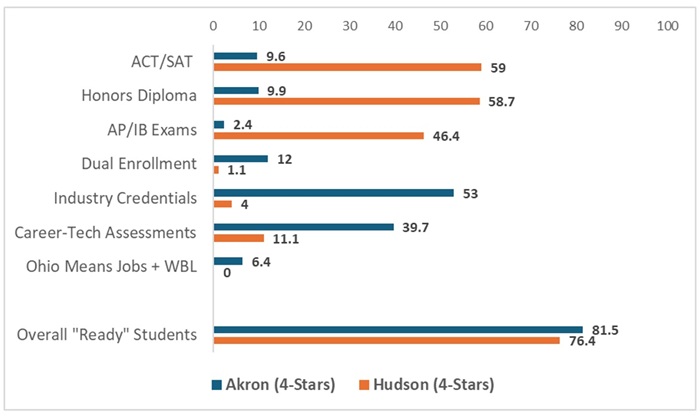
Figure 4: Percentage of students who meet various indicators, Columbus versus Upper Arlington
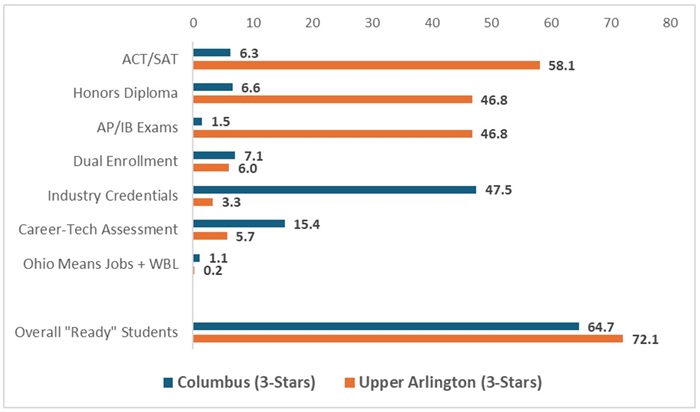
It’s hard to believe that Columbus—where student proficiency is abysmal—is equally good at preparing students as Upper Arlington, or that Akron does as well as Hudson. But that’s the impression from the report card. The problem, which we’ve warned about before, lies in the uneven rigor between the “career-ready” and “college-ready” measures. Passing three career-tech exams is not nearly as challenging as passing three AP exams. Attaining a retail or job-safety credential is nowhere near as demanding as earning a college-ready score on the ACT or SAT. But under the current structure, they are all are treated equally.
Career-focused measures should continue to be included in the report card, but state lawmakers should take two steps to ensure workforce readiness is accurately measured:
1. Count students as “ready” only if they achieve proficiency on the state Algebra I and English II assessment. Basic academic proficiency is the building block of both college and career readiness. Yet under current policy, students who are not proficient can still be deemed “ready” through the career-based metrics. Rather than ignoring academic deficiencies, Ohio should only count students as “college and career ready” when they achieve proficiency on the two key state high school exams (and meet one of the readiness indicators, as under current policy).[3]
2. Consolidate the credentials and technical-exam indicators, so that students have to meet both (in the same career cluster) to be counted as meeting the indicator. “Career readiness” takes more than just earning a credential. It also requires coursework and demonstrations of technical expertise on an objective exam. Rather than allowing an “either-or” approach, Ohio should require students on career-technical pathways to meet both the credentials and technical exam metrics (or complete one of the other existing career indicators, such as an apprenticeship).
Ohio’s college and career ready measure should challenge schools to equip students with the knowledge and skills needed to succeed after high school. The “college-ready” side of the state’s current measure is sound, but the “career-ready” side still needs work. With strengthening, the state would provide a better gauge of college and career readiness in Ohio schools.
[1] Data for the component were reported for the prior two years, but no ratings were assigned.
[2] It’s possible that some students in the class of 2022 passed assessments, but the data were just not reported by schools (these exams were not used in the state’s former Prepared for Success measure).
[3] Adding this condition is unlikely to impact measures such as ACT/SAT, honors diplomas, and AP/IB exams, as the vast majority of students meeting them are likely to have achieved proficiency on state exams.