Commentary
Charter Schools
“Voucherizing Title I” is worth a shot
Why not try strapping Title I dollars to the backs of needy kids and letting them take it to the schools of their choice?
Why not try strapping Title I dollars to the backs of needy kids and letting them take it to the schools of their choice?
Mike analyzes Governor Romney's education proposal on WSJ.com.
Join us for this important, nonpartisan event about digital learning and where it will take education in Ohio -- and the nation -- in the years to come. National and state-based education experts and policymakers will debate and discuss digital learning in the context of the Common Core academic standards initiatives, teacher evaluations and school accountability, governance challenges and opportunities, and school funding and spending.
The Common Core State Standards (CCSS) for English language arts and mathematics represent a sea change in standards-based reform and their implementation is the movement’s next—and greatest—challenge. Yet, while most states have now set forth implementation plans, these tomes seldom address the crucial matter of cost. This report estimates the implementation cost for each of the forty-five states (and the District of Columbia) that have adopted the Common Core State Standards and shows that costs naturally depend on how states approach implementation.

Portable funding is a worthy idea; just make it voluntary
A look back at wit and wisdom from the Fordham Institute’s blogs from the week of May 14, 2012.
A look back at commentary from the Fordham Institute's blogs for the week of May 7, 2012
The problem with the idea that tomorrow’s ALEC vote is part of a “growing movement” against federal intrusion vis-à-vis the Common Core standards? ALEC is already on record against federal intrusion into education vis-à-vis the Common Core standards.
Terry Ryan's writes today that Fordham would be willing to lead the way in going through a vetting process led by the Transformation Alliance in Cleveland.
Naomi Schaefer Riley's termination is a sad sign that the Chronicle of Higher Education has replaced vibrancy with political correctness and intimidation.
Three cheers for California’s governor, state superintendent, and state board chair, for applying for a waiver from the Elementary and Secondary Education Act (aka No Child Left Behind) that doesn’t kowtow to Washington.
A look at commentary from the Fordham Institute's blogs for the week of April 30, 2012.
A look around at wit and wisdom from the Fordham Institute's blogs for the week April 23, 2012.
Guest blogger Eleanor Laurans, co-author of “The Costs of Online Learning,” asks, Can online learning be less expensive and better for students?
Mike tries to explain why we’re seeing such strong progress (in math at least, especially among our lowest-performing students) at the elementary and middle school levels, but not in high school.
Education Sector's John E. Chubb wonders how to encourage public schools to adopt technology at a pace governed more by what works for students and less by what is comfortable politically.
Fordham's latest publication, Education Reform for the Digital Era, explains how the U.S. education system must change in order to realize the potential of digital learning.
Watch the full video from yesterday's panel discussion on the future of digital learning.
Can we be smarter about taking high-quality online and blended schools to scale—and to educational success? Yes, says this volume, as it addresses such thorny policy issues as quality control, staffing, funding, and governance for the digital sector. Read on to learn more.
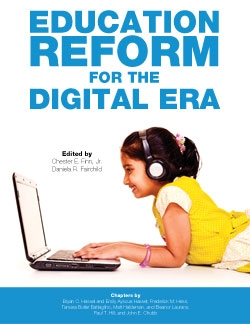
Is digital learning education's latest fad or its future? What fundamental changes to the ways we fund, staff, and govern American schools are necessary to fulfill the technology's potential? Will policy tweaks suffice or do we need a total system overhaul—and a big change in the reform priorities that can bring this about? Who will resist—and do their objections have merit? Fordham is bringing together experts on all aspects of education policy—from governance to finance to human capital—to examine how policymakers can make digital learning a transformative tool to improve American education...and weigh the dangers that lie ahead. The panel featured the governance expertise of the Hoover Institution's John Chubb, insights into teaching's future from Bryan Hassel of Public Impact, analysis of the costs of online learning from the Parthenon Group's Eleanor Laurans, and the cautionary perspective of Emory University's Mark Bauerlein.
Fordham president Michael J. Petrilli explains three solutions to schools’ money woes.