
Guest blogger Eleanor Laurans, a senior principal at The Parthenon Group, co-authored "The Costs of Online Learning," a chapter in Fordham's new volume, Education Reform for the Digital Era.
“Online learning is a cheaper way to educate my kids? That’s great—where do we sign up?!”
I don’t know many parents who would utter such a remark—do you?
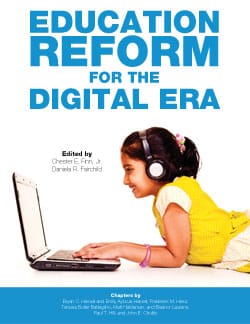 |
Our team’s research for our recent chapter of the Fordham book, Education Reform for the Digital Era, did in fact demonstrate that online learning can be less expensive—sometimes significantly less expensive—than traditional bricks-and-mortar schools. This is an important and exciting finding, as many schools today are striving to figure out ways to navigate budget crises. But it would be a mistake to focus solely on cost as the field of digital learning evolves. Of course there are cheaper ways to educate our kids. The critical question is, Can online learning be less expensive and better for students?
We don't know if online learning works. We hope it does. Technology has certainly been integrated into almost every other sector of our economy, so why not education? Our colleagues in higher education have certainly made progress integrating online learning, with a third of current postsecondary students taking at least one online course. There is every reason to hope that technology can help us fundamentally rethink the K-12 classroom and current teaching and learning approaches, which have been infamously stagnant for decades and fail too many American children.
As the nascent field of digital learning evolves, there will be successes and failures. That is the nature of innovation, as entrepreneurs and schools experiment with what works. What’s needed is a transparent system to identify the successes and failures, which doesn't look solely at costs or outcomes, but assesses the two together to understand value. In the “new normal” of school financing, we’re going to have to adapt to looking for better results with the money we’ve got, rather than layering on new reforms with new money. Doing so requires a shift in how people across our system think.
In fact, online learning doesn’t just necessitate a different way of looking at results; it requires that we rethink almost everything about how the system interacts with individual schools, students, and parents in order to foster the kind of digital experimentation that holds promise. In the book released yesterday, Fordham brought together experts from across the field to reflect on such policy issues as quality control, staffing, funding, and governance. Hopefully this collection of thought-provoking pieces can help advance the dialogue, and the action, necessary for innovation to flourish.