
Commentary
Making Schools Work: A Revolutionary Plan to Get Your Children the Education They Need
William G. Ouchi, Simon and SchusterSeptember 2003
William G. Ouchi, Simon and SchusterSeptember 2003
In June, Gadfly voiced some skepticism when the Department of Education announced with great fanfare that it had approved the NCLB accountability plans of all fifty states, as well as the District of Columbia, and Puerto Rico. We noted that the "victory" was at best pyrrhic, since many states cut corners to comply and at least one (Iowa) was approved despite lacking state standards.
The American Federation of Teachers is out with the 2002 edition of its Survey and Analysis of Teacher Salary Trends, and this year's report is even cheekier than usual. Acknowledging that, according to the union's own data, "average teacher salaries improved faster than inflation for the fourth time in five years," the authors demand yet more money for teacher pay.
A teacher takes Post education columnist Jay Mathews to task for his rankings of America's best public schools, which he bases on the number of students within a school who take Advanced Placement (AP) or International Baccalaureate (IB) classes.
David A. Goslin, The Scarecrow Press, Inc.2003
Though the phrase "don't know much about history" is now a clich?, we can't argue with the sentiments of this article in National Journal, which argues that the well-intentioned No Child Left Behind act is perversely marginalizing subjects like history.
Patrick Murphy, Michael DeArmond, and Kacey Guin, Education Policy Analysis ArchivesJuly 2003
When hizzoner Michael Bloomberg gained control of Gotham's crippled school system, many had high hopes. Perhaps at last New York City would muster the strength to free itself from the establishment monopoly over education reform, curriculum, and pedagogy--and the innumerable underperforming schools it has created.
On January 8, Indiana became one of five states singled out by the U.S. Department of Education for early approval of its No Child Left Behind accountability plan. These states were depicted as leaders that had set aside excuses and committed themselves to educating all students.
Carol Ascher et al., Institute for Education and Social Policy2003
Andrew J. Wayne and Peter Youngs, Review of Educational Research Spring 2003, Vol. 73, No. 1, pp. 89-122
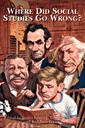
This new report from the Thomas B. Fordham Foundation consists of penetrating critiques by renegade social studies educators who fault the regnant teaching methods and curricular ideas of their field and suggest how it can be reformed. While nearly everyone recognizes that American students don't know much about history and civics, these analysts probe the causes of this ignorance-and lay primary responsibility at the feet of the social studies 'establishment' to which they belong.
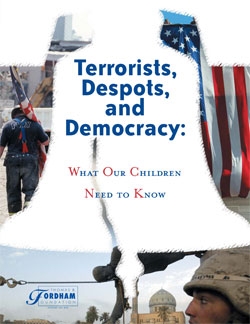
This new report from the Thomas B. Fordham Foundation includes the voices of 29 political leaders, education practitioners, and cultural analysts who discuss what schools should teach about U.S. history, American ideals, and American civic life in the wake of 9/11, the war on terror, and the liberation of Iraq.
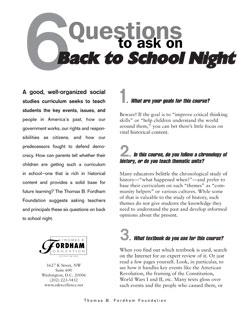
A good, well-organized social studies curriculum seeks to teach students the key events, issues, and people in America's past, how our government works, our rights and responsibilities as citizens, and how our predecessors fought to defend democracy. How can parents tell whether their children are getting such a curriculum in school?one that is rich in historical content and provides a solid base for future learning? The Thomas B. Fordham Foundation suggests asking teachers and principals these six questions on back to school night.
Gadfly readers know that teacher certification is no guarantee of teacher effectiveness. So our interest was piqued by a recent Wall Street Journal op-ed that spotlights a summer school program run largely by students with no formal education training.
With states aflutter over how to meet NCLB's mandate that they must guarantee a "highly qualified teacher in every classroom," two recent reports are illuminating.Last month, Education Secretary Rod Paige issued his second annual report on teacher quality ("Meeting the Highly Qualified Teachers Challenge" or
Marvin Kosters and Brent Mast, American Enterprise Institute Press2003
Nelson Smith, Progressive Policy InstituteJuly 9, 2003
Jane K. Doty, Gregory N. Cameron, and Mary Lee Barton, Mid-Continent Research for Education and Learning (McREL)2003
If you're planning some summer reading, allow us to suggest "An Impossible Job?
First, there was the Bush administration's proposal to reform Head Start. [See http://www.edexcellence.net/gadfly/issue.cfm?issue=10#350.] That proved too strong for the House, which watered the measure down.
Gadfly is pleased to note that Phoebe Cottingham has been named commissioner of the National Center for Education Evaluation and Regional Assistance at the Department of Education (within the new Institute for Education Sciences that replaced the old Office of Educational Research and Improvement).
United States General Accounting OfficeJuly 2003
Former Los Angeles school board president Caprice Young, who warmed the hearts of education reformers during her four years in office and accomplished more than anyone expected with that sprawling, balky school system, has agreed to head a newly formed organization that will support the 400+ charter schools in California and help others get started.
We don't always agree with every single thing the Bill and Melinda Gates Foundation has to say about education but they're growing wiser with age, particularly when it comes to charter (and private) schools.
Across the country, art and music programs in schools are being squeezed by contracting budgets and the demands of No Child Left Behind, which places the curricular focus on reading and math. Devotees of these programs are fighting back with letter-writing campaigns and a website, http://www.supportmusic.com/index-home.html.
James Tooley has spent years documenting how private education can work wonders for low-income students in international settings.
Erika Frankenberg and Chungmei Lee, The Civil Rights Project, Harvard UniversityJuly 2003
Gail Jones, Brett Jones, and Tracy Hargrove, Rowman and Littlefield2003