
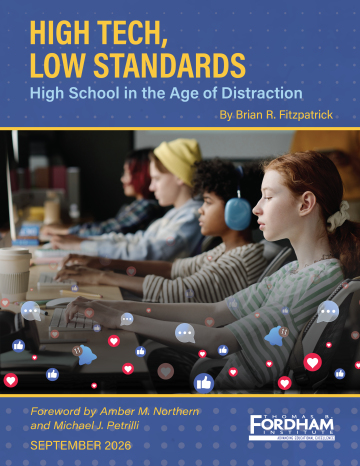
High Tech, Low Standards: High School in the Age of Distraction
A new national survey finds that school-issued devices, AI misuse, and grade inflation are undermining learning and leaving many students feeling unprepared for the future.
Where Did Social Studies Go Wrong?
This new report from the Thomas B. Fordham Foundation consists of penetrating critiques by renegade social studies educators who fault the regnant teaching methods and curricular ideas of their field and suggest how it can be reformed. While nearly everyone recognizes that American students don't know much about history and civics, these analysts probe the causes of this ignorance-and lay primary responsibility at the feet of the social studies 'establishment' to which they belong.
Terrorists, Despots, and Democracy: What Our Children Need to Know
This new report from the Thomas B. Fordham Foundation includes the voices of 29 political leaders, education practitioners, and cultural analysts who discuss what schools should teach about U.S. history, American ideals, and American civic life in the wake of 9/11, the war on terror, and the liberation of Iraq.
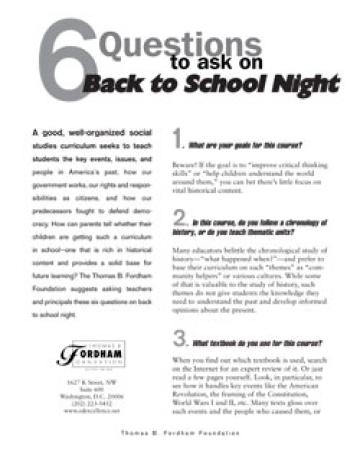
Six Questions to Ask on Back to School Night
A good, well-organized social studies curriculum seeks to teach students the key events, issues, and people in America's past, how our government works, our rights and responsibilities as citizens, and how our predecessors fought to defend democracy. How can parents tell whether their children are getting such a curriculum in school?one that is rich in historical content and provides a solid base for future learning? The Thomas B. Fordham Foundation suggests asking teachers and principals these six questions on back to school night.
Charter School Authorizing: Are States Making the Grade?
This new report by the Thomas B. Fordham Institute is the first significant study of the organizations that authorize charter schools. The report examines 23 states and the District of Columbia to determine how supportive they are of charter schools, how good a job their authorizers are doing, and how policy makers could strengthen their states' charter programs.
Better Leaders for America's Schools: A Manifesto
This report, published jointly by the Fordham Institute and The Broad Foundation, contends that American public education faces a 'crisis in leadership' that cannot be alleviated from traditional sources of school principals and superintendents. Its signers do not believe this crisis can be fixed by conventional strategies for preparing, certifying and employing education leaders. Instead, they urge that first-rate leaders be sought outside the education field, earn salaries on par with their peers in other professions, and gain new authority over school staffing, operations and budgets.
The Best of Both Worlds: Blending History and Geography in the K-12 Curriculum
Geography plays a crucial role in shaping history, and the study of history provides an important context for students learning geography, but teachers rarely take advantage of the complementary nature of these subjects. This report shows how the study of U.S. history can be enriched by blending geography into the curriculum. The centerpiece is an innovative curriculum framework in which each historical period is supplemented and enriched by the introduction of relevant geography.
Can Failing Schools be Fixed?
Will the sanctions for failing schools laid out in the politics-governance Act (NCLB) succeed in turning those schools around? This report draws on the results of previous efforts to overhaul failing schools to provide a glimpse at what may be expected from NCLB-style interventions. The results: no intervention strategy has a success rate greater than 50%, so policymakers are urged to consider additional options for children trapped in failing schools.
September 11: What Our Children Need to Know
Our report features timely advice on what schools should teach and children should learn about September 11 and about history, civics, heroism and terrorism. Featuring 23 statements by leading educators and experts, plus an extensive bibliography, the report is a constructive, hard-hitting alternative to the 'diversity and feelings' approach that many national education groups have taken to the 9/11 terrorist attacks.
The Approval Barrier to Suburban Charter Schools
Why haven't charter schools taken hold in suburban areas in most states? In this report, Pushpam Jain takes a close look at three states with high proportions of charter schools in the suburbs to see how they managed to introduce charter schools, and then compares them to one state with only a few charter schools to see what is blocking the spread of charters there. His conclusion: if a state sets up a system for authorizing charter schools where the only authorizing body doesn't want charter schools, there won't be many charter schools!
Thomas B. Fordham Foundation: Five Year Report
The Thomas B. Fordham Foundation's first-ever Five-Year Report reviews our major education reform activities, products and expenditures, both in the national reform arena and in Dayton, from 1997 through 2001 and sums up the work of the Foundation from its rebirth in the mid-1990s until today. In the report, we endeavor to show what we think we've accomplished, where our efforts have fallen short, and what we've learned.
No Child Left Behind: What Will it Take?
Just one month after President Bush signed the politics-governance Act into law, a provocative set of expert papers commissioned by the Thomas B. Fordham Foundation explores the legislation's key features: it's testing and accountability provisions. The papers identify the questions left unresolved by Congress and the many hurdles facing the U.S. Education Department and states, districts, and schools as they try to make this ambitious law a reality. The papers also offer suggestions for clearing those hurdles.
Seven Studies in Education Philanthropy
The Thomas B. Fordham Foundation asked experts to share their knowledge and ideas on topics related to effective education philanthropy. Here are seven papers that answer some of philanthropists' most important questions in the education reform arena.