Mobile Navigation

  • National
    • Policy
      • High Expectations
      • Quality Choices
      • Personalized Pathways
    • Research
    • Commentary
      • Gadfly Newsletter
      • Flypaper Blog
    • Events
    • Scholars Program
  • Ohio
    • Policy
      • Priorities
      • Media & Testimony
    • Research
    • Commentary
      • Ohio Education Gadfly Biweekly
      • Ohio Gadfly Daily
  • Charter Authorizing
    • Application
    • Sponsored Schools
    • Resources
  • About
    • Mission
    • Board
    • Staff
    • Career
Home
Home
Advancing Educational Excellence

Main Navigation

  • National
  • Ohio
  • Charter Authorizing
  • About

National Menu

  • Topics
    • Accountability & Testing
    • Advanced Education
    • Career & Technical Education
    • Charter Schools
    • Curriculum & Instruction
    • ESSA
    • Evidence-Based Learning
    • Facilities
    • Governance
    • Personalized Learning
    • Private School Choice
    • School Finance
    • Standards
    • Teachers & School Leaders
    • Think Again
  • Research
  • Commentary
    • Gadfly Newsletter
    • Flypaper Blog
    • Gadfly Podcast
  • Events
  • Scholars Program

The Education Gadfly Weekly

Sign Up to Receive Fordham Updates

We'll send you quality research, commentary, analysis, and news on the education issues you care about.
Thank you for signing up!
Please check your email to confirm the subscription.

The Education Gadfly Weekly: The true enemy of equity

Volume 23, Number 3
1.19.2023
1.19.2023

The Education Gadfly Weekly: The true enemy of equity

Volume 23, Number 3
view
High Expectations

The true enemy of equity

Advocates have turned “equity” into a trigger word by pitting the concept against “excellence.” But that line of argument is not only politically unpopular, it’s wrong. In fact, excellence is not the enemy of equity, but the antidote to inequity.

Michael J. Petrilli 1.19.2023
NationalFlypaper

The true enemy of equity

Michael J. Petrilli
1.19.2023
Flypaper

“Curriculum transparency” is harder to achieve than lawmakers assume

Robert Pondiscio
1.19.2023
Flypaper

Are education leaders mismeasuring schools’ vital signs?

David Osborne
1.19.2023
Flypaper

National Working Group on Advanced Education: Summary of third meeting

The Education Gadfly
1.19.2023
Flypaper

Casting a wide net to help define teacher expertise

Jeff Murray
1.17.2023
Ohio Gadfly Daily

The slowly-narrowing achievement gap

Josh Einis
1.19.2023
Flypaper

Education Gadfly Show #853: The Supreme Court and religious charters schools, with Nicole Garnett

1.17.2023
Podcast

Cheers and Jeers: January 19, 2023

The Education Gadfly
1.19.2023
Flypaper

What we're reading this week: January 19, 2023

The Education Gadfly
1.19.2023
Flypaper
view

“Curriculum transparency” is harder to achieve than lawmakers assume

Robert Pondiscio 1.19.2023
Flypaper
view

Are education leaders mismeasuring schools’ vital signs?

David Osborne 1.19.2023
Flypaper
view

National Working Group on Advanced Education: Summary of third meeting

The Education Gadfly 1.19.2023
Flypaper
view
Teacher expertise SR image

Casting a wide net to help define teacher expertise

Jeff Murray 1.17.2023
Ohio Gadfly Daily
view

The slowly-narrowing achievement gap

Josh Einis 1.19.2023
Flypaper
view
iStock/Getty Images/Plusmonkeybusinessimages

Education Gadfly Show #853: The Supreme Court and religious charters schools, with Nicole Garnett

Michael J. Petrilli, Amber M. Northern, Ph.D., David Griffith, Ph.D., Nicole Garnett 1.17.2023
Podcast
view

Cheers and Jeers: January 19, 2023

The Education Gadfly 1.19.2023
Flypaper
view

What we're reading this week: January 19, 2023

The Education Gadfly 1.19.2023
Flypaper
view

The true enemy of equity

Michael J. Petrilli
1.19.2023
Flypaper

Last fall, Stephen Sawchuk published an Education Week article exploring why “educational equity” had become a “trigger word”—even though the notion has been baked into federal policy for decades. “Equity may be the law,” he wrote, “but we don’t agree on what it means.”

I can understand Sawchuk’s confusion because, properly construed, the call for greater equity can and should command widespread support from Americans across the ideological spectrum. A potentially unifying argument might go something like this:

In a great country like ours, we should aspire for every child to grow up to achieve his or her full potential. Anything less is a waste of talent and a blemish on human dignity and flourishing.

Schools have a particular role to play in helping children achieve their full academic potential, and supporting roles in helping children develop socially, emotionally, artistically, and athletically, as well.

Yet we know that our country is failing to live up to this aspiration because millions of boys and girls are failing to live up to their full potential. And we know that most of the reasons have to do with what happens between conception and kindergarten—that the strains of poverty, family instability, parental substance abuse, and other social ills mean that many children enter schools far behind what their cognitive trajectory otherwise could have been.

We know this in part because of the evidence of achievement gaps that can be measured at school entry, if not before. If we reject the notion that genetic differences drive racial achievement gaps as morally and empirically dubious—which we absolutely should—then the explanation for their existence as early as age five must be differing life circumstances, including the gaping chasms in socioeconomic status and its associated opportunities.

A major focus of “equity work,” then, is to close these gaps in the zero-to-five years—both because it’s the right thing to do, and so that all children have the opportunity to achieve their full potential—cognitively, academically, and otherwise.

This project has tended to be the domain of the political left, with its calls for better pre- and post-natal healthcare; the eradication of environmental pollutants like lead paint; direct financial supports for families with young children, like 2021’s expanded and fully refundable child tax credits; and expanded public support for high quality childcare. Yet the political right has contributions to make, as well, with its calls for greater personal responsibility; greater family stability, especially via married, two-parent families; and for welfare programs that encourage—rather than discourage—marriage and work, which have been shown to lead to better outcomes for kids.

Schools also have a critical role to play, especially at the elementary level, where students are still young enough for a great education to make a significant difference in their academic trajectories. Schools may not be able to overcome all of the damage of poverty, family instability, and their associated ills, but they can do a lot, as we know from the markedly different achievement trajectories of children in the highest-performing high-poverty schools—many of them public charter schools—compared to kids in more typical school settings.

Educational equity, then, means providing children, and especially poor children, with excellence—excellent instruction, excellent curricula, excellent teachers, excellent tutoring, excellent enrichment. Some of that costs more money in high-poverty settings, so yes, educational equity demands that we spend more public dollars on the students who need it most.

The greatest enemy of equity, then, is mediocrity. It’s the everyday bureaucratic dysfunction that remains all too common in American education. It’s the decisions that public officials take that block excellent schools, including excellent public charter schools, from growing or replicating. It’s the inertia that keeps traditional public schools from retaining many of their best young teachers. It’s the refusal to intervene when a principal is not up to the task of creating a culture of excellence.

Note what is not an enemy of equity: excellence. Indeed, far from it—excellence is the antidote to inequity.

—

And yet—back to the puzzle that Sawchuk presented in his article—some “equity advocates” have turned the notion into a “trigger word” by arguing that excellence is indeed the enemy. By their line of thinking, anything that helps a subgroup of children achieve at high levels, or even just celebrates that achievement—such as gifted-and-talented programs, exam schools, or National Merit Scholarships—is at war with equity. These advocates see equity as a zero-sum game. Rather than focus on helping every child achieve his or her potential, potential that inevitably varies from individual to individual, they seek a world in which the outcomes children achieve are closer to equal—even if that equality comes by leveling-down the high achievers.

Needless to say, this conception of equity is highly unpopular, and not just on the political right. As well it should be because it’s also morally bankrupt. It is simply wrong to embrace policies and practices and seek to put a ceiling on any child’s achievement—just as it is wrong to block efforts to get all students to a floor of basic literacy and numeracy.

John Gardner once asked if we can “be equal and excellent too.” The answer is an unequivocal “yes!” And in the domain of racial equity, the way to do that is to ensure that all children, from every racial and ethnic group, get what they need to live up to their full potential. And for high-potential children from underrepresented groups in particular, it means identifying their talent early, cultivating it through gifted-and-talented programs and the like, and keeping them on a trajectory of high achievement all the way through high school and beyond.

It bears repeating: Excellence is not the enemy of equity, it is the antidote to inequity. Equity advocates would do well to keep that in mind.

view

“Curriculum transparency” is harder to achieve than lawmakers assume

Robert Pondiscio
1.19.2023
Flypaper

House Republicans this week introduced a curriculum transparency bill aimed at ensuring parents know what their kids are learning in school, particularly when that includes “divisive concepts” like critical race theory, which has been banned from classrooms or restricted in at least eighteen US states. But even if enacted, the measure won’t have its intended effect. It could even make the problem worse.

The puckishly titled Curriculum Review of Teachings Transparency Act or “CRT Transparency Act” (get it?) would require that schools receiving federal funding post the curriculum in use in elementary and secondary schools on a publicly accessible school or district website. This is an unremarkable demand. As a rule, taxpayers deserve to know how their dollars are being spent, and schools are no exception.

“Parents have the right to know what their children are being taught in the classroom,” insists Congressman Scott Fitzgerald (R-WI) who introduced the bill. “It’s clear bureaucrats and teachers’ unions have no reservations about putting divisive material such as critical race theory in front of our children that seeks to put people in groups based on skin color or gender. The CRT Transparency Act will solve this problem by helping parents get a straight answer about what their children are hearing in school.”

It probably won’t. As a rule, you can learn more about a restaurant you’ve never patronized by reading its menu online than about what’s happening in your child’s classroom through the lens of her school’s “adopted” curriculum. The simple fact is most teachers don’t consistently use their district or school’s officially adopted curriculum when one even exists. Less than 30 percent of the teachers surveyed by the RAND Corporation’s American Educator Panel report using a single published curriculum as written. “The other 70 percent either mostly relied on instructional materials they created themselves, modified more than half of the curriculum materials they used, or cobbled together multiple curricula,” notes RAND’s Julia Kaufman.

Previous studies have shown that nearly every U.S. teacher draws upon “materials I developed and/or selected myself” in teaching English language arts. Only one in four secondary-school social-studies teachers cited resources “provided by my school or district” as comprising the majority of what they use in class on a given day. In one Connecticut school district, a recent external audit discovered that only 20 percent of high schools have a written curriculum at all. The figure for middle schools was even lower.

Moreover, all this curriculum creation and cobbling is not regarded as a flaw, but a feature of classroom practice. Teachers are trained to “differentiate instruction,” adapting or supplementing the textbooks and other materials to make lessons more engaging, accessible, or challenging based on the needs of individual students.

Teachers turning their classrooms into havens for social justice activism and using their professional discretion to indulge their political priors in front of captive audiences of children is not even the worst problem of public education’s impressionistic relationship with curriculum and classroom materials. Multiple studies have shown that when they deviate from adopted curriculum, the materials produced or chosen by teachers are consistently of low quality and rigor. David Steiner, who heads the Johns Hopkins Institute for Education Policy, states the matter succinctly: “We have built a system that not only fails to support the sustained use of demanding curriculum—but actively produces powerful disincentives to its use.”

Outsiders assume far more top-down control over classroom content than actually exists. If conservative lawmakers’ primary concern is classroom social justice activism and teachers promoting their politics, the “CRT Transparency Act” might even make worse the problem it seeks to fix, lulling watchdogs into a false sense of security, assuming that knowing the “curriculum” is a sufficient safeguard against controversial content in schools. It’s simply not so.

Editor’s note: This was first published by the American Enterprise Institute.

view

Are education leaders mismeasuring schools’ vital signs?

David Osborne
1.19.2023
Flypaper

Two years ago, students at a charter school in East Los Angeles were learning at 1.5 to two times the pace of their grade level peers around the state, based on three years of standardized test scores. But the California Department of Education labeled the school a “low performer,” which put it at risk of closure. Why? Because California’s method of measuring academic growth was deeply flawed.

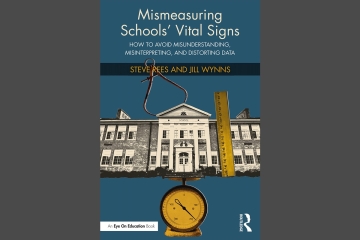
I have written before in these pages about the importance of accurate and balanced methods of measuring school quality. In the same spirit, I recommend a new book by Steve Rees and Jill Wynns, Mismeasuring Schools’ Vital Signs: How to Avoid Misunderstanding, Misinterpreting, and Distorting Data.

Wynns spent twenty-four years on the San Francisco school board, while Rees spent just as long running a company that helped school districts measure and report on the quality of their schools. Both have seen their share of mistakes, many of which lead to real pain: teachers reassigned and principals removed based on faulty data; English learners held back from entering the mainstream academic program even after they have become fluent; charter schools closed due to inadequate measurement of growth; even students denied graduation based on flawed interpretation of test results.

Rees and Wynns have now authored a highly readable guide that superintendents, principals, school board members, education reporters, teachers, and advocates can use to avoid these kinds of errors. They underline four flaws that are most common:

Growth versus proficiency

The first is using children’s current test scores—rather than a measure of their academic growth—to judge the quality of schools and teachers. In high poverty schools, students often arrive several years behind grade level. Few of them are “proficient” in math or reading. But too often states and districts give greatest weight to students’ current test scores, not their rate of improvement.

Consider a middle school whose sixth grade students arrived three years behind grade level. If they are only one year behind grade level at the end of sixth grade, that would be spectacular progress. But in California, to use but one example, the school’s academic score would be in one of the two lowest categories.

Apples versus oranges

The second major flaw Rees and Wynns point out is related: When trying to measure academic growth, some states and districts fail to measure the same students over time. Instead, they measure a school or grade level’s average over time. But in a middle school, a third of the students each year are new arrivals, and another third from last year have departed. In four-year high schools, a quarter leave each year, another quarter arrive. So annual school or grade level averages are measuring different kids.

The solution is obvious: Measure the same cohort of students over time, following them from one grade level to the next. Even better, remove from your measure students who have departed or recently arrived at the school.

Ignoring the imprecision of test results

The third common flaw is failure to acknowledge the imprecision of test scores. “When we test kids, we’re trying to gather evidence of something that exists out of sight, somewhere between their ears,” Rees and Wynns write. “Whatever their test scores reveal, it can only be an estimate of what they know.”

Standardized tests are often used to rate children—typically into four categories, which might be summarized as advanced, proficient, needing improvement, and far behind grade level. But imprecision means some of these classifications are dubious. “The major test publishers include what they call classification error rates in their technical manuals,” the authors explain. “It is common to find a 25–30 percent classification error rate in the middle bands of a range of test scores—and that’s for a standardized assessment with forty-five to sixty-five questions.”

“In Texas, Illinois, Maryland, California, Ohio, Indiana, Florida, and many other states,” they add, “the parent reports make no mention of imprecision.” Yet these reports tell parents whether a child is on grade level. Some states use a standardized test called the Smarter Balance Assessment. Its “technical manual reveals that the classification accuracy rate in these middle two bands (Levels 2 and 3) is about 70 percent. In other words, just seven out of every ten kids whose scores land in the middle two bands will be classified correctly as having either met the standard or scored below the standard.” 

Lack of context

The fourth major flaw Rees and Wynns discuss is “’disregarding context when analyzing gaps in achievement.” Often, a school is compared to the statewide average, when its students are anything but average. They might be affluent, or poor, or recent immigrants. If so, do we learn anything about the quality of their school by comparing them to a state average?

Rees and Wynns urge school and district leaders to compare their students to schools or districts with demographically similar children. “If you can identify other schools with kids very much like your own who are enjoying success where your students are lagging, you can call the site or district leaders and see how their approach to teaching reading differs from your own,” they suggest. “That last step, compare-and-contrast with colleagues who are teaching students very similar to your own, is where your analytic investment will pay off.”

The authors point a finger of blame at schools of education, which rarely teach future teachers or administrators about data, assessment, or statistics. “Schools of education simply must stop sending data- and assessment-illiterate educators into the field,” they declare.

They also urge state departments of education to disclose the imprecision of test scores whenever they report results, to do more to communicate the meaning of those results, and to create help desks that district and school leaders can turn to with data and assessment questions.

Perhaps their most novel recommendation is that we begin measuring “opportunities to learn,” to draw attention to yawning gaps. Some districts assign students to the school closest to their home, for instance, while others offer significant choices—hence greater opportunity. Most districts give teachers with seniority more ability to choose their schools, leaving the schools in low-income neighborhoods to settle for rookie teachers or those no one else wants—creating a huge opportunity gap for low-income students. Some schools offer the opportunity to take more advanced courses or more career-oriented courses.

A few districts work hard to match their supply of courses and schools to what students and their families want, but most don’t. The result: yet another opportunity gap. “If 90 percent of your sections are dedicated to college-level course work, and 50 percent of your graduating seniors have chosen a path to the workforce or the military, then your master schedule constrains the opportunities to learn that your students care most about,” the book explains. “Work force prep courses and multiple pathways toward work-related professions would be a needed addition for that school. The question for those leading or governing districts is how actively you listen to students when they tell you what future they’re aiming for, and the extent to which you direct your budget and staff to meet their desires.”

A brief article cannot begin to suggest the depth and detail the authors plumb in this volume. In addition, every chapter of Mismeasuring Schools’ Vital Signs includes questions people can ask to uncover data and measurement problems—and methods to solve them—in their own districts and schools. There is even a website that extends the book, which includes interactive data visualizations and resources, such as a glossary of statistical terms and a “visual glossary” showing the types of charts and graphs you can use to communicate meaningful data. There’s an old saying in the management world: What gets measured gets done. As Rees and Wynns demonstrate, in public education we too often measure the wrong things in the wrong ways. If we’re going to improve the lives of children, we have to learn how to measure what matters, accurately, and then understand what it means. Mismeasuring Schools’ Vital Signs is a good place to start.

Editor’s note: This was first published in The 74.

view

National Working Group on Advanced Education: Summary of third meeting

The Education Gadfly
1.19.2023
Flypaper

Editor’s note: On November 17, 2022, seventeen members of the National Working Group on Advanced Education met for its third meeting in Indianapolis. (The first was on March 7, 2022, in Washington, D.C., and the second was on June 29, 2022, and held virtually.) The following is a summary of the discussion, with particular focus on integrating and reconciling excellence and equity, aligning advanced programs from kindergarten through twelfth grade, removing problematic state policy barriers, improving teacher training and selection, and the proper roles of high schools and higher education.

Integrating equity and excellence:

How do we integrate concepts of equity with excellence so that the narrative also encompasses the principle of quality education for all? What is the best way, for example, to conceptualize programs for advanced learners that signals more equity and inclusivity and is more politically palatable? What is the best language to use? In particular, what are alternatives to the terms “gifted education,” “ability grouping,” and “tracking”?

  • We should not set up excellence and equity as a dichotomy. Great practice has to be and can be both.
  • What equity and excellence in gifted education is and what it is not1 :
    • It is not about “status” or sacrificing the needs of one group of students for another or providing the same services to all. It is meeting the needs of all students.
    • It is not seeing students as at-risk. It is seeing students as at-potential.
    • It is not having multiple hoops to show a student’s perfection at everything. It is about multiple opportunities for students to demonstrate their potential.
    • It is not based on a national comparison for local programs. It is based on local context and data.
    • It is not only recognizing students who come with easily recognizable gifted and talents. It is about being a talent scout and intentionally creating environments to recognize and develop talents not yet tapped.
  • Be proactive to promote culturally responsive attitudes, access, assessments, and accommodations that create the environment for excellence, regardless of background.
  • As much as possible, we should provide a “continuum of services,” individualized to each student, rather than thinking of children as either gifted or not.
  • Change the terminology around “gifted education” to something like “advanced education,” “education for high achievers,” or “advanced learning opportunities.”
  • “Grouping” or “equitable grouping” is a more accurate term than “tracking,” since the former imply flexibility, which is key to ensuring that these programs do not reinforce social inequities as tracking once did.
  • Ideally, we’ll get to a point where we can individualize and personalize instruction, and in doing so, challenge all kids. But this isn’t going to happen anytime soon, and until then, we need to acknowledge that advanced learning opportunities are the best way to meet the needs of advanced students. Grouping is also of minimal effectiveness without altering the complexity and pace of the curriculum, as well as methods of teaching. We must minimize making incorrect selections for these groupings, and make them flexible with on-ramps and, where appropriate, off-ramps.
  • Building- and district-level leadership is very significant. If principals and district leaders believe that it’s possible to achieve both excellence and equity, then it’s possible.

Aligning advanced education from K through 12:

How can districts make sure advanced education services are well aligned across K–12 (or even pre-K–12), to ensure a robust, diverse pipeline into advanced courses in high school? What should on-ramps and off-ramps look like? As children progress through the grade levels, how do issues around identification and gatekeeping change? How important is it, for example, at different grade levels for districts to use measures beyond achievement tests when identifying students for these services or advanced courses, particularly in schools with high populations of low-income students and those from underrepresented racial groups? How can systems make sure students don’t encounter duplicative content or, conversely, significant gaps?

  • There is a disconnect between the advanced learning services offered in elementary school, middle school, and high school. For better or worse, elementary gifted programs focus more on “critical thinking” and enrichment, while middle and high school advanced courses are usually subject-specific. The result is the lack of a continuous pipeline of learning for advanced students, and a lot of confusion for parents.
  • To fix this, we need clear goals that reach and coordinate services across the levels. Among those should be expanding the pipeline of kids prepared for advanced courses in middle school and high school. That’s going to mean different programming in elementary school especially—gifted programs to boost critical thinking related to major subject areas and equitable opportunities for academic, subject-specific acceleration. A good solution is for school districts to hire K–12 coordinators of advanced learning opportunities to manage articulation between the levels.
  • The “rules for getting in” are also inconsistent, so children may “qualify” for advanced programming at one level but not at the next, or qualify at a level for which they are not well prepared because they didn’t qualify for (or it didn’t exist or have room for them) at the previous level.
  • High schools especially tend to put up barriers, such as not allowing middle school students to take high school level classes early or receive credit for such courses, during the transition from middle to high school, stemming in part from them having no control over the content and instruction at the middle schools that feed them. This can lead to both blocking kids from services and opportunities for which their qualified. On the other hand, the trend toward open enrollment for AP classes can result in encouraging kids to take AP and other advanced classes who are ill prepared to succeed in them.
  • Some high schools may need to rely on outside resources for advanced classes, such as arrangements with local community colleges and/or online courses, but these can present logistical and other challenges for an individual high school to manage in the absence of state dual enrollment policies. But it can and does work in places, and can be a good option for some districts. It would also help many administrators if they had models of schools that have successfully integrated outside resources.
  • Districts should automatically enroll gifted kids from elementary school into advanced courses in middle school and high school, as long as the courses represent their strengths and interests, and if students are demonstrating sufficient levels of performance. One caveat is the transition from enrichment classes to accelerative options, which might require some kind of re-evaluation of student preparedness.
  • If a student is already identified for gifted or advanced education services, then the hoops to be accelerated should not be many. And for those not officially identified, schools should embrace a philosophy of rigor and challenge and allow promising motivated students to be accelerated. Once students, particularly under-represented groups, are accelerated and experience success, the bar is raised and they realize they are more capable than they realized.
  • Schools need to do a better job of showcasing their successes of students in advanced courses, particularly under-represented groups and in Title I schools. School leaders should institute a student ambassador program as part of the advanced education services pipeline, where high school students are sharing about their experiences and pathways with middle schoolers, and middle schoolers with elementary school students. Many kids from under-represented groups and their parents do not know about the diverse options available, and educators have not effectively invited them into the spaces and conversations where they can learn or be influenced and supported to stretch. This is where peer-to-peer ambassador efforts can help. Youth listen to youth.

State policy barriers:

Which state policies impede this agenda? Regarding accountability and incentives, for example, if a superintendent or principal knows they will receive no “credit” for increasing advanced achievement, it may be rational for them to eschew advanced education. What else might be getting in the way?

Barriers that need to be removed:

  • State policies are often used as an excuse to limit options for gifted students. People hide behind state policies as a reason to not accept certain proposals. One example is not giving “graduation credit” for high school level courses taken before entering high school. The kid may get “placement credit” but not “Carnegie unit” credit nor count coursework towards satisfying the state requirement for “four years of high school math.”
  • Age-based placement is a problem. Districts and states shouldn’t impede early entrance to schooling, nor early entrance to middle schools or high schools. If a student is ready for instruction at a higher grade level—in all subjects or individual subjects—that student should not be prohibited from receiving it because of age.

Proactive steps states should take:

  • State accountability policies must balance academic growth and moving students beyond proficiency. This advances both equity and excellence, as it ensures schools “credit” is given when low achievers make good progress, as well as when schools enable students who are already “proficient” to forge ahead further.
  • States should create systems to support partnerships between advanced education programs and the entire school community to provide services and interventions for students who need advanced learning beyond the regular curriculum.
  • States should mandate:
    • Local, school-based norms for identifying students for advanced programs, as opposed to district-based norms that can under-identify students from marginalized backgrounds.
    • Access to acceleration—both grade acceleration and subject-specific acceleration—where appropriate.
    • The articulation or procedures of acceleration—including how students are identified, how they’re enrolled, how the programs work, and the alignment between elementary, middle, and high school (including credits, school report cards, and funding).
    • Data collection, reporting, and accountability (number of identified kids, by demographic subgroup).
  • States should enable schools to take advantage of online options for offering AP and other advanced coursework.
  • We don’t know a lot about “effective” funding systems for gifted education; they vary dramatically. Competitive grants probably don’t do much good if they are the sole source, but are OK when used as a supplement to set the base funding amount. This should be monitored, though, to make sure the money is spent on advanced learning opportunities.

Teacher training and selection:

What content should be covered in training programs for teachers of advanced students? How does that vary by elementary/middle/high school? What are specific examples of effective training programs and/or textbooks for teachers of advanced students? Should schools/districts select teachers who themselves were advanced learners to teach advanced students?

  • Providing in-service professional learning opportunities is incredibly important. High-quality versions, that teach educators how to make their instruction culturally responsive, should be required for teachers working with gifted kids, but everyone should be invited.
  • There is a difference between the training needs and knowledge and skill requirements of teachers within advanced education programs and that of coordinators of advanced education programs, and their training should reflect their different needs. Teachers who are going to specialize in advanced opportunities, and especially in administrating such services, should also have coursework or a certificate.
  • Many gifted-education coordinators who take on the role of gifted education in their school have never been exposed to gifted education courses or training. That’s a problem.
  • Most states offer licensure or certificates in gifted education, but they usually aren’t required. And very few states have pre-service requirements for general education teachers.
  • We can learn a lot about professional learning and support from the AP and IB programs.
  • There is a federal requirement in ESSA that states provide gifted training to teachers and other school leaders. This ought to be enforced, but it isn’t.
  • Funding for better training seems to work, as states with more and better funding are more likely to have licensure programs.
  • Schools of education must stop promoting the ideas that ability grouping doesn’t work, acceleration doesn’t work, and meeting the needs of advanced learners is racist. None of this is true. Instead, the focus should be on providing equitable access to acceleration and other advanced learning opportunities.
  • Teacher preparation programs should promote clear learning experiences for pre-service teachers focused on gifted education, as well as the importance of evidence-based concepts versus myths.

The roles of high schools and higher education:

What role should selective and specialized high schools play in districts’ playbook of programs, as well as their recruitment and retention of low-income students and those from racially underrepresented groups? To what degree can and should districts link their high school programming to higher education goals and outcomes? What role should institutions of higher education play in this agenda? Should they partner with districts in ways that provide dual enrollment or credentialing opportunities? And do the answers to these questions change for low-income students and those from racially underrepresented groups?

  • Call high schools designed for advanced students “selective enrollment” or “specialized” high schools,” not “exam schools.”
  • Specialized or selective enrollment high schools can act as one arrow among many in the quiver of programming and services for advanced students.
  • To be justified, these schools should offer more than just a chance to join a select group of peers—they must offer programming that is not available at students’ base high schools.
  • Admission should be based on more than an exam.
  • These schools should be conceptualized as capstones of a continuum of services in K–12.
  • Existing problems with selective high schools include a lack of transparency in admissions procedures, as well as rationing, with there not being enough spots. Too many kids who are eligible or could benefit don’t get into them. So districts should work to build a large, diverse pipeline into these schools. Districts that don’t have any should create them, and those that have had to resort to rationing should create additional schools, as well as “schools within schools” and honors-track alternatives.
  • Selective high schools should marry the way the instruction is structured with the background and prior preparation of students who are admitted. In other words, they should be ready to scaffold supports for kids who might be underprepared and embed culturally-responsive policies and practices.
  • Dual enrollment is often a good thing, but there must be much greater collaboration between the state and individual districts. And the state ought to lead to ensure that program benefits are being equitably distributed and that offerings in each district are high quality. For example, the credits awarded by a community college via dual credit or early college need to be transferrable to four-year colleges.
  • Right now, lots of high school kids are ready for higher education, but there are still too many barriers. Access to dual-enrollment courses is sometimes restricted to eleventh and twelfth graders‚ for example. Scrap senseless polices such as these and broaden access in ways that maintain program quality.
  • There is a quality control concern with dual enrollment, but one way to mitigate this is to select classes for which colleges grant credit. Steer kids toward classes that will transfer to four-year colleges. That’s built-in quality control. It’s also best if students can take classes directly from college professors and—if possible—in person on the college campus itself. Advising and counseling are also important.

Areas ripe for additional research:

  • Out of school activities, parent-pay tutoring, and their impacts on achievement.
  • Why are so many more kids above grade level in English language arts versus math? And what intentional efforts are being made to recruit and retain underrepresented groups to enroll in advanced English language arts and math?
  • Do the attributes of effective teachers for advanced students from underrepresented groups differ from those for effective teachers of advanced students writ-large? For example, are teachers who themselves were academically high achieving in high school or college more effective with advanced students?
  • 1Sourcing primarily from the North Carolina Department of Public Instruction’s “Critical actions to realize equity and excellence in gifted education: Changing mindsets, policies, and practices.”
view
Teacher expertise SR image

Casting a wide net to help define teacher expertise

Jeff Murray
1.17.2023
Ohio Gadfly Daily

We need many more effective, “expert” teachers in our schools. Thus, a new report aiming to synthesize numerous past studies in order to identify attributes that make a top performing teacher should be of interest to practitioners and policymakers alike.

In undertaking this first-of-its-kind effort—and accepting at the outset that there is likely no simple definition of “expert”—researchers Jason Anderson and Gülden Taner want to include every possible resource available. They employ a “metasummary method,” which is meant to allow both qualitative and quantitative studies of teacher expertise to be included together in the metadata. This not only allows the largest number of studies to be considered at the outset, but also keeps more studies in the final mix. As long as the original findings can be abstracted to a common level, they will be included in the metasummary data.

Using four databases (ERIC, Proquest, Web of Science, and Google Scholar), Anderson and Taner cast a wide net around terms related to teacher expertise/expert teaching. The first pass yielded 5,323 works, including published and unpublished papers, reports, books, chapters and articles, as well as Ph.D. and master’s degree theses. Nearly 90 percent of these were rejected because they were non-empirical (opinion pieces, practical teaching guides, and the like) or were studies that did not involve teachers characterized as experts despite including a related term in the body. In their second pass, the researchers looked to include any work that featured a) empirical findings on aspects of one or more “expert” teachers’ cognition or practice in primary or secondary school settings, and b) some effort to define expertise beyond years on the job and whatever each school, state, or country being investigated marked as basic qualified teacher status—things like student outcome data, advanced certification, or status as a teacher educator.

Their final metasummary includes 106 studies. All were published between 1983 and 2021 and together included 1,124 expert teachers. Most came from the United States, but China, the United Kingdom, Australia, Germany, Estonia, Hong Kong, and India contributed some, as well. Sixty-six focused on teachers at the secondary level, thrity-one at the primary/elementary level, and the rest mixed grade levels. Eighty-three were qualitative in nature, thirteen quantitative, and the rest mixed methods. More than a quarter of the reports looked at general education teachers at the primary level and teachers of various subjects at both primary and secondary levels. The remainder covered teachers of specific subjects, with math teachers comprising the majority of these.

In the end, findings in seventy-three works made the cut. Pedagogic practice, professional practice, and knowledge base were the three most commonly cited domains of expertise. That is, an expert teacher knows what her students need, understands various means by which to deliver instruction to each of them, and continually refines her knowledge and practice. More specifically, Anderson and Taner explain that expert teachers are driven by “moral duty” toward their learners and exhibit unconditional care for them; have a passion for teaching, a positive self-image, and a desire to succeed in their profession; have a habit of reflection and a desire for lifelong learning; and work in collaboration with their peers. Expert teachers motivate their students to work hard, reflect critically, and cope with challenges on their way to success. They assess student progress, spot misunderstandings, and offer ongoing feedback and individualized support to erase any barriers to progress. Sounds like a high-quality practitioner for sure.

Anderson cautions that the attributes as summarized here should not be seen as a “prescriptive checklist” that school leaders should be looking for when hiring, but rather as a set of vital skills to be supported, nurtured, and developed in teachers as they progress from novices to veterans. It would be interesting to determine if any external measures (master’s degree, additional college coursework, etc.) correlated with expertise, but that is beyond the scope of this metasummary. At the least, schools of education should take heed of these attributes. “This study is more holistic than previous research in the field,” he says, and paints “a more complete picture of teacher expertise than individual studies have been able to do to date. It links aspects of the knowledge, cognition, practice, and personalities of expert teachers in ways that are likely to benefit stakeholders across primary and secondary education.”

SOURCE: Jason Anderson and Gülden Taner, “Building the expert teacher prototype: A metasummary of teacher expertise studies in primary and secondary education,” Educational Research Review (January 2023).

view

The slowly-narrowing achievement gap

Josh Einis
1.19.2023
Flypaper

A recent study by Eric Hanushek, Jacob Light, Paul Peterson, Laura Talpey, and Ludger Woessmann finds that, contrary to conventional wisdom in the education field, socioeconomic gaps in education outcomes have steadily decreased over the past forty years. Their study compares the academic achievement of more than half a million U.S. students from the top and bottom socioeconomic status (SES) quartiles, in cohorts born between 1961 and 2001. Using a novel definition of SES and more comprehensive data set than previous studies, the researchers concluded that the SES education gap has narrowed by 0.05 standard deviations (S.D.) per decade, indicating steady but modest progress.

They examined data from four sources that are linked over time: Long-Term Trend of the National Assessment of Educational Progress (LTT-NAEP), the Main-NAEP, the Trends in International Mathematics and Science Study (TIMSS), and the Program for International Student Assessment (PISA). These tests assess nationally-representative groups of students in math, reading, and science, and ask a variety of questions about student family background.

The analysts constructed an index of socioeconomic status based on information about parental education and home possessions: the more education and possessions, the higher the status. This approach contrasts with previous approaches to this type of research, which rely on student-reported parent income as a proxy for SES. A famous example of the standard version is a 2011 study by Sean Reardon, which used student-reported family income as a proxy for SES, and found a widening SES education gap. However, Hanushek et al. argue that students don’t always have an accurate picture of their parents’ finances, so in the present study, they use parental education and home possessions, judging these to be more accurate proxies for SES.

In the earliest cohort, born in 1961, the achievement gap between the top and bottom SES quartiles is 0.9 S.D., equivalent to about three years of learning. After four decades, the gap has narrowed to 0.7 S.D., a gap of around 2.5 years of learning.

This finding conflicts with the conventional wisdom that SES-achievement gaps are increasing. But it also suggests that, if this trend continues apace, it will take until mid-22nd century for such gaps to disappear.

The authors suggest a few social changes that coincide chronologically with the narrowing SES-achievement gap and could have contributed to it. Over the past forty years, there has been a decline in teen pregnancies, an increase in parental education, and a reduction in the number of children per household. Education policy changes that could have played a role include Title I funding, special education programs, early childhood programs, and charter school expansion. Other possibilities include improvements in health and economic wellbeing of the poorest children.

Some of the differences between these results and Reardon’s may center in disagreement about whether family income or parental education is more important in determining SES. Indeed, Anna Chmielewski, a researcher who worked on the Reardon study, noted that the Reardon test data indicated little change in SES achievement gaps when parents’ education was used as a stand-in for SES. What is clear is that modest progress has been made towards narrowing the SES-achievement gap, based on parents’ education. But much more is needed.

SOURCE: Eric A. Hanushek, Jacob D. Light, Paul E. Peterson, Laura M. Talpey, and Ludger Woessmann, “Long-run Trends in the U.S. SES-Achievement Gap,” Education Finance and Policy, Volume 17, Issue 4, Fall 2022.

view
iStock/Getty Images/Plusmonkeybusinessimages

Education Gadfly Show #853: The Supreme Court and religious charters schools, with Nicole Garnett

1.17.2023
Podcast
 

On this week’s Education Gadfly Show podcast, Mike Petrilli and David Griffith talk with Nicole Garnett, a professor at the University of Notre Dame Law School, about the Supreme Court decisions that could legalize religious charter schools. Then, on the Research Minute, Amber reports on a literature review about inclusion for special education students.

Recommended content:

  • “Supreme Court Opens a Path to Religious Charter Schools” —Nicole Garnett
  • “The Education Exchange: Will Supreme Court Pave Way For Religious Charter Schools?” —Education Next
  • “Oklahoma’s Endorsement of Religious Charter Schools Could Alter Legal Landscape for Choice” —The 74
  • The study that Amber reviewed on the Research Minute: Nina T. Dalgaard et al., “The effects of inclusion on academic achievement, socioemotional development and wellbeing of children with special educational needs,” Campbell Systematic Reviews (December 2022)

Feedback Welcome:

Have ideas for improving our podcast? Send them to our producer Nathaniel Grossman at [email protected].

view

Cheers and Jeers: January 19, 2023

The Education Gadfly
1.19.2023
Flypaper

Cheers

  • For the first time in a decade, all the current school board commissioners of Indianapolis Public Schools are backed by pro-charter groups. —Chalkbeat Indiana
  • Arkansas Governor Sarah Huckabee Sanders signed an executive order calling for more charter schools in her state. —KNWA Fox 24
  • America has more talent than ever before, a good sign for productivity, innovation, and living standards. —David Brooks

Jeers

  • New Jersey Governor Phil Murphy continues to restrict the growth of charter schools in his state despite clear evidence that they are outperforming traditional public schools there. —Wall Street Journal
  • Oakland Unified School district delays the inevitable by reversing a decision to close six under-enrolled schools (and ignores Tim Daly’s advice in the process). —NBC Bay Area
  • Lawmakers in Illinois have passed a bill authorizing collective bargaining for Chicago principals and assistant principals. —Wall Street Journal
  • High schools in Virginia’s Fairfax County failed to tell hundreds of students—many of them Asian American—they had won National Merit Commendation awards in order to protect the feelings of students who hadn’t won. —George Will
view

What we're reading this week: January 19, 2023

The Education Gadfly
1.19.2023
Flypaper
  • “In Kyiv, Ukraine’s capital, Russian strikes and power outages are part of the school day. Teachers and students press on with resolve.” —New York Times
  • A school in South Carolina is introducing STEM-focused career path education to elementary students. —USA Today
  • “As student misbehavior rises, [President Biden] urges a return to Obama-era policies that encourage lax discipline.” —Wall Street Journal
  • After proposing onerous new rules last year, a top official in the Biden administration could be signaling more openness toward charter schools. —The 74
Fordham Logo

© 2026 The Thomas B. Fordham Institute
Privacy Policy
Usage Agreement

National

P.O. Box 110
Burke, VA 22009

202.223.5452

[email protected]

Ohio

P.O. Box 82291
Columbus, OH 43202

614.223.1580

[email protected]

Sponsorship

130 West Second Street, Suite 410
Dayton, Ohio 45402

937.227.3368

[email protected]