Mobile Navigation

  • National
    • Policy
      • High Expectations
      • Quality Choices
      • Personalized Pathways
    • Research
    • Commentary
      • Gadfly Newsletter
      • Flypaper Blog
    • Events
    • Scholars Program
  • Ohio
    • Policy
      • Priorities
      • Media & Testimony
    • Research
    • Commentary
      • Ohio Education Gadfly Biweekly
      • Ohio Gadfly Daily
  • Charter Authorizing
    • Application
    • Sponsored Schools
    • Resources
  • About
    • Mission
    • Board
    • Staff
    • Career
Home
Home
Advancing Educational Excellence

Main Navigation

  • National
  • Ohio
  • Charter Authorizing
  • About

National Menu

  • Topics
    • Accountability & Testing
    • Advanced Education
    • Career & Technical Education
    • Charter Schools
    • Curriculum & Instruction
    • ESSA
    • Evidence-Based Learning
    • Facilities
    • Governance
    • Personalized Learning
    • Private School Choice
    • School Finance
    • Standards
    • Teachers & School Leaders
    • Think Again
  • Research
  • Commentary
    • Gadfly Newsletter
    • Flypaper Blog
    • Gadfly Podcast
  • Events
  • Scholars Program

The Education Gadfly Weekly

Sign Up to Receive Fordham Updates

We'll send you quality research, commentary, analysis, and news on the education issues you care about.
Thank you for signing up!
Please check your email to confirm the subscription.

The Education Gadfly Weekly: Teachers don’t like “equitable” grading practices

Volume 25, Number 33
8.21.2025
8.21.2025

The Education Gadfly Weekly: Teachers don’t like “equitable” grading practices

Volume 25, Number 33
view
Teacher grading a school assignment
High Expectations

Teachers don’t like “equitable” grading practices

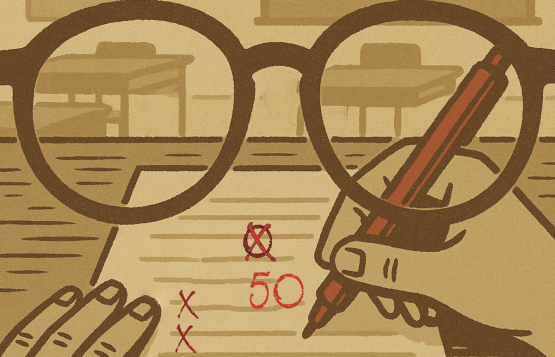
Teachers hate it when the powers that be take a sledgehammer to their few sources of leverage over student motivation and effort. Nor do they like giving students grades they don’t deserve. How did we get here?

Michael J. Petrilli 8.21.2025
NationalFlypaper

Teachers don’t like “equitable” grading practices

Michael J. Petrilli
8.21.2025
Flypaper

How administrators can support classroom discipline

Daniel Buck
8.21.2025
Flypaper

The limit on classical education’s growth

Robert Pondiscio | Annika Hernandez
8.21.2025
Flypaper

Tennessee charter schools help their students recover from pandemic learning loss

Jeff Murray
8.19.2025
Ohio Gadfly Daily

Tracing the CTE teacher pipeline from industry to classroom

Jill Hoppe
8.21.2025
Flypaper

Should all state-funded schools take state standardized tests? | Episode 982 of The Education Gadfly Show

8.20.2025
Podcast
view
Teacher in an unruly classroom

How administrators can support classroom discipline

Daniel Buck 8.21.2025
Flypaper
view
Slow road sign

The limit on classical education’s growth

Robert Pondiscio, Annika Hernandez 8.21.2025
Flypaper
view
Covid recovery in TN charter schools SR image

Tennessee charter schools help their students recover from pandemic learning loss

Jeff Murray 8.19.2025
Ohio Gadfly Daily
view
Electrician apprenticeship

Tracing the CTE teacher pipeline from industry to classroom

Jill Hoppe 8.21.2025
Flypaper
view
Michael J. Petrilli

Should all state-funded schools take state standardized tests? | Episode 982 of The Education Gadfly Show

Michael J. Petrilli, David Griffith, Ph.D., Adam Tyner, Ph.D. 8.20.2025
Podcast
view
Teacher grading a school assignment

Teachers don’t like “equitable” grading practices

Michael J. Petrilli
8.21.2025
Flypaper

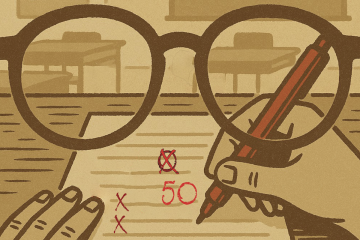
In recent years, the traditional grading practices of U.S. schools have been criticized for failing to correct longstanding social inequities. Proposed “reforms”—which supposedly promote “equity”—include awarding half-credit for assignments that are never completed, allowing students to retake tests and quizzes without penalty, and giving no credit for homework or classroom participation.

Anecdotal evidence suggests that many teachers have adopted some of these practices, as have a non-trivial minority of departments, schools, and districts where so-called “no zeros” policies are effectively mandatory. Yet, to our knowledge, there has been almost no research on the prevalence or efficacy of “grading for equity.” So we asked Fordham analysts David Griffith and Adam Tyner to craft a few questions about this topic for RAND’s nationally representative teacher panel, which lead to our latest study, “Equitable” Grading Through the Eyes of Teachers.

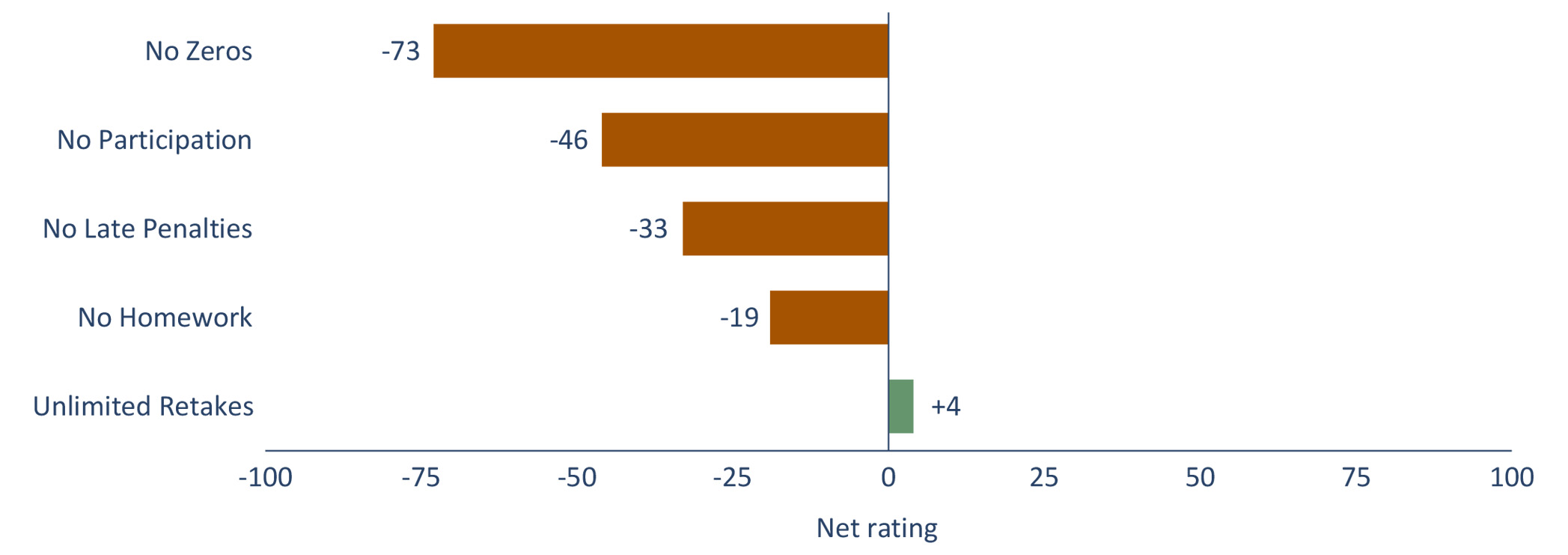
As shown in Figure 1, the results suggest that teachers are skeptical of the five “equitable” practices that are the new report’s focus, at least one of which (those same results suggest) has now been adopted by no less than half of America’s public schools and nearly three-quarters of the country’s “majority minority” middle schools.

Figure 1. Teachers are skeptical of most “equitable” grading practices.

1

Turns out, teachers don’t like it when the powers that be take a sledgehammer to their few sources of leverage over student motivation and effort. Nor do they like giving students grades they don’t deserve.

So how did we get here?

Although debates over grading aren’t new, there are two sides to the most recent chapter of this story—one well-meaning, the other indefensible.

The sorta-kinda-understandable take, advanced by consultant Joe Feldman among others, is that traditional grading practices don’t focus enough on student learning, and that “standards-based grading” would more accurately reflect whether students have mastered the knowledge and skills articulated in state standards (and encourage them to keep at it until they do). Therefore, we shouldn’t include homework or class participation in students’ grades (as these reflect effort and diligence, not achievement), and we should allow re-takes and re-dos of tests and assignments until students demonstrate mastery.

That’s all well and good except that—as Tyner and colleague Meredith Coffey argued last year in their policy brief, Think Again: Does “equitable” grading benefit students?—in practice, these policies “tend to reduce expectations and accountability for students, hamstring teachers’ ability to manage their classrooms and motivate students, and confuse parents and other stakeholders who do not understand what grades have come to signify.”

The wholly indefensible arguments that lurk beneath the recent push for “equitable” grading, meanwhile, represent little more than a return to the “soft bigotry of low expectations.” Stemming from the writings of scholars such as Ibram X. Kendi and Tema Okun, this pseudo-intellectual approach seeks to close whatever racial gaps it encounters by shooting the messenger. For example, by Kendi’s reasoning, any racial disparity—such as the fact that the average Black student’s GPA is nearly half a point lower than the average White student’s—is a sign of racism. Therefore, something must be wrong with the grades.

Or consider Okun’s offensive assertion that “punctuality” is a feature of “white supremacy”—a claim that still shows up in teacher professional development nationwide—and that regards as racist any grading of students on factors such as attendance or participation. It’s hard to know what to say to this claim except that, if we truly believe in all our students’ potential, it is obviously wrong, as are policies that give Black students tacit permission to skip class.

Given the influence that such ideas achieved during the “Great Awokening,” it’s not surprising that evidence-free arguments for “equitable” grading have gained some purchase. But despite the fact that Peak Woke seems to be behind us, the data suggest that many places are still dealing with “reformed” grading practices that teachers simply don’t support.

So, rather than continue to pay unwitting homage to ideas that most Americans reject, we should listen to teachers and go back to tried and true methods that reflect high expectations for all students.

After all, it’s not unrealistic or racist to expect students to come to class and do the work. Nor is it unreasonable or cruel to assign grades that accurately reflect their lack of effort or mastery when the alternative is allowing them to exert minimal effort and consequently fall further behind.

Otherwise, how often should we expect the one in four U.S. students who are chronically absent to come to class if there is no reward for participation or penalty for late work? How hard should we expect the typical middle schooler to try if they can get a C by completing less than half of their assignments? Does anyone really believe that inflated GPAs will help high school students who haven’t really learned anything to land high-paying jobs after they graduate?

In short, if our goal is to prepare them to succeed in the real world, don’t we owe the millions of American students whose futures depend on a solid K–12 experience at least a few zeros?

view
Teacher in an unruly classroom

How administrators can support classroom discipline

Daniel Buck
8.21.2025
Flypaper

When still a teacher, I considered my building principal a consequence vending machine. When all else failed, press H5 for an in-school suspension. Having been on both sides now, I realize that the role of the administrator in maintaining school order is far more consequential. They can create the conditions where even a first-year teacher can run a functional class room or where even the veterans have quit trying.

Unfortunately, principal preparation in America is wanting, and the research into effective leadership finds that their effects are consequential but diffuse. Trying to define effective school leadership is akin to describing what makes Grandma’s house so welcoming. Where do you even begin?

I’ve developed more sympathy for building principals and assistant principals who want to maintain order but are unsure how. Benjamin Franklin said that “experience keeps a dear school, yet fools will learn from no other.” School leaders—wise or foolish—have few opportunities for development aside from experience.

With that in mind, I cannot profess that the following recommendations ground themselves in the latest randomized controlled trial. Rather, they’re a collection of simple insights that I gathered from wise mentors, my own failures, and the feedback of teachers.

Never send a student back without a consequence

Put yourself in a teacher’s shoes. Little Johnny has been a thorn in his teacher's side since September. She has moved his seat, administered her own recess or lunch detentions, stayed late to call his parents, held heart-to-hearts with the boy, and put in countless more hours that you don’t see. Finally, one day, he just refuses to sit in his chair. It is something small, something simple, but for that teacher to have any command in her classroom, students need to comply with her requests. If she cannot expect compliance in the small things, why should a student follow directions for the big things?

She sends little Johnny to the office. What does it communicate if that student returns within minutes after only a conversation and a pat on the back? That kid know they can get away with anything. There will be zero expectation that he respects his teacher.

Always, always provide a consequence, no matter how small. It does not have to be a ten-day suspension. It can be a phone call home that you make to signal the severity to the parents (and support for the teacher.) It could be half a recess in your office. It could be a single demerit on your schoolwide incentive system. But it has to be something.

You may well have some ineffective teachers in your building. Their slipshod classroom management fosters higher levels of misbehavior. Even in these cases, you must never undercut the teacher’s authority. Have a difficult conversation with that teacher or set them on an improvement plan. But in those moments, never undermine them. If you do, you will make that environment worse in the immediate and so overwhelm them that they cannot improve going forward.

Communicate with teachers

While a teacher, I rarely received communication about what transpired after I wrote an office referral. Was there a classroom dynamic that caused this misbehavior? Did the kid get a consequence? Did they meet with the assistant or head principal?

Where possible, leadership should walk the student back to the classroom personally. At once, this simple act establishes your authority in the building, backs up the teacher’s authority, and communicates the seriousness to other students. It also provides you a brief moment to discourse with the classroom teacher. Explain to them what you did and why you did it. They may provide valuable insight or this moment may allow the catharsis they need to return to teaching with full focus.

If that is not possible, send a quick email. It does not have to be long: what did you learn, what did you do, and why.

Empower teachers to be the authorities

This recommendation may prove the most controversial in practice, but each classroom’s culture is a teacher’s responsibility. You can set the conditions to make that easier or harder, but much of it is up to them.

In every school where I have worked, I’ve witnessed a school leader chastise an entire classroom for their failure to respect a teacher, usually but not always one new to the profession. Like scratching an itchy rash, this well-meaning impulse to intervene can undermine a teacher.

When the admin steps in, what does that communicate implicitly? It signals that this teacher cannot control their classroom, so doesn’t deserve as much respect. I have never seen it work.

Instead, you, as the administrator, have to help establish the teacher as the authority in the classroom. One of the most effective ways to accomplish this (and here’s the controversy) is to compel teachers to administer a consequence. I can sense the hackles of my teacher-readers rising, so let me explain.

Very often, students served their consequences with me: a lunch, recess, or after- school detention in my room; a phone call that I made home; a parent conference that I requested; an apology letter or reflection written under my watch. But when the administrator always owns the consequences, student conclude that they really only have to obey when administration gets involved.

Instead, it is better to have students serve detention with the teacher. You can provide the reflection activity, or leave it up to the teacher if they prefer it. In the background, there must also be the threat that, if this student continues to give the teacher trouble, then there will be more severe consequences with administration.

In the moment, this asks more of the teacher, but it better allows the teacher to command the classroom, meaning fewer misbehaviors in the long run. Moreover, as teachers deliver consequences, the whole building can stay on top of more student behaviors. A single principal can administer a handful of consequences in a day. A building’s entire personnel? Hundreds. This shared responsibility enables the school to truly sweat the small stuff and maintain the highest of behavioral expectations.

Establish clear routines and procedures

An instructive meta-analysis notes that classroom structure is one of the most consequential classroom factors for academic achievement. Such structure includes “communicating and maintaining clear expectations, framing students’ activity with explicit directions, guidance, routines, or schedules, creating an organized space and materials, providing clear, organized activities, monitoring progress,” as well as “proactively communicating desirable behavior” with “relevant ongoing guidance.”

Administration can provide professional development that ties directly to the “clear, organized” activities in their curriculum. They can set, communicate, and maintain “clear expectations” regarding student behavior. They can establish efficient routines to diminish downtime, confusion, and thereby conflict. These range from morning drop-off to cafeteria line flows.

If every routine, procedure, and expectation is left up to every single teacher, this creates an unhealthy environment in your school. One teacher is the respected authoritative voice. Another is a cruel, petty authoritarian. Yet another is permissive, spreading the message, explicitly or not, that everyone else is just too serious.

There is absolutely room for teacher individuality, but every teacher cannot have their own style. If structure, clear behavioral expectations, and incentive systems create the environments for learning, teachers should be expected to follow them.

Don’t cave to pressure

This one is hard: do not cave to parental pressure. Parents are not in charge of your institution. Ultimately, the school board is. If you have a rule that there are no late assignments, make no exceptions (save for illness, death, and other such situations). If you have a behavior code that compels suspensions for a specific behavior, follow through.

If a parent is badgering a teacher, step in. Send a polite but firm email that says “Mr. Smith is an excellent staff member in whom I place my trust and is faithfully following the duties expected of him set forth by the staff manual and parent handbook. If you have any further concerns, please direct them to me.”

Obviously, staff members can be in the wrong. Do not paper over impropriety on the part of your staff. But apologize and make exceptions to parents from a place of conviction, not compulsion.

Be present

If nothing else, just be present. I know schools where students do not know the principal’s name. Teachers have told me that their building leader just “hides in the office.” Make a note to walk the halls every morning and afternoon. If you can combine this with other errands, all the better.

You will notice problems that need solving before they’re major, correct behavior and maintain norms (not just deputize teachers into it), catch discipline issue while they’re still minor, and establish your presence in the building. Such presence may not manifest in anything immediately tangible, but it will establish, over time, the knowledge that you are in command, that your teachers will be supported, and that everyone in the building expects student excellence.

Walking the halls, strolling through the cafeteria, taking the occasional recess duty, greeting students at the door in the morning—these alone are impactful. If possible, regular classroom pop-ins are a valuable addition to that list. Unfortunately, many unions prohibit regular, unannounced classroom walk-throughs.

But if you can, get into every teacher’s room every other week, if only for a few minutes at a time. Each visit needn’t include a condescending feedback sandwich—compliment, critique, compliment. If the teacher is doing an excellent job, simply tell them so, noting a few discrete things that stood out. That encouragement will do wonders. If you notice something that they could be doing better, point that out, too.

Again, more than anything else, regular classroom visits establish your presence in the building. If an issue arises with a parent, you can assure them that you were in their child’s classroom just yesterday. You will notice problems. You will notice uniform infractions. You will get ideas for professional development that speaks to your staff’s actual needs. Students will learn that you can be expected anywhere, so they should always be on their best behavior.

—

Most of these recommendations are pretty simple—walk around, give consequences, stand your ground—but they are difficult to carry out. No one enjoys reprimanding a staff member or sending home a parent dissatisfied. But being a school leader means creating the conditions where teachers can succeed, which often means carrying out difficult duties. This is what is expected of us. We should expect nothing less of ourselves.

view
Slow road sign

The limit on classical education’s growth

Robert Pondiscio | Annika Hernandez
8.21.2025
Flypaper

Classical education has become one of the brightest spots in the K–12 landscape. Once a niche movement, it now encompasses more than 1,500 public, private, and charter schools serving nearly 700,000 students. By 2035, projections suggest that number could reach 2,600, enrolling well over a million children. Families are flocking to these schools because of their rigorous liberal arts curriculum, their commitment to moral and intellectual formation, and their rejection of faddish pedagogies in favor of enduring works and ideas.

But there is a catch. Classical schools may be growing as fast as demand will allow—but only as fast as they can find teachers. In a new report that we co-authored for the American Enterprise Institute along with Riley Fletcher, The Achilles Heel of Classical Education, we reported our findings from a dozen or so interviews with classical school leaders across the country. In these conversations with leaders from Great Hearts Academies, Veritas School, Liberty Common School, Cincinnati Classical, and others, one theme emerged with striking consistency: There is no reliable pipeline of teachers prepared to staff classical schools. This teacher shortage, leaders across the sector acknowledge, is the primary constraint on the movement’s growth.

After all, unlike district schools, classical institutions cannot depend on colleges of education. Many leaders prefer to hire teachers with strong subject-matter expertise rather than traditionally trained teachers whose preparation might conflict with classical pedagogy or with a school’s culture. This preference makes sense. Classical schools want faculty steeped in literature, history, philosophy, and science, not constructivists or those lured by the siren song of faddish ideas like “21st century skills.” But the choice comes at a cost: the absence of a steady, credentialed stream of new teachers can force classical schools to cobble together a workforce from less conventional sources. Three sources of talent have emerged:

  • Liberal arts graduates. For decades, classical schools have recruited from “great books” programs like St. John’s and Thomas Aquinas College. As demand grows, leaders are casting a wider net, seeking mission-aligned graduates through sympathetic professors and institutes at universities nationwide. Graduate students and early-career professors are another promising source. Before teaching at Scottsdale Prep, a Great Hearts charter school, James Hall taught philosophy at Arizona State University and Chandler Gilbert Community College. When he arrived at Great Hearts, he said he was “blown away” by the intelligence of his high schoolers and found that they were better equipped to discuss philosophical texts in depth than his college students.

  • “Refugee” teachers. Another growing source is disillusioned public school veterans, whom Cincinnati Classical’s Michael Rose calls “refugee teachers.” Burned out on standardized test prep, bureaucratic mandates, and ideological fashions, they are drawn to schools that value coherent culture, enduring works, and character formation. “A common refrain is, ‘This is what I’ve been looking for. I didn’t know a school like this existed,’” Rose told us. As Liberty Common’s Casey Churchill notes, refugee teachers often have deep community roots, making them more likely to stay long-term. The challenge, however, is that they often arrive with ingrained pedagogical habits—like project-based learning and constructivist assumptions—that must be unlearned.

  • Career switchers. Mid-career professionals, often entering through alternative certification programs, bring both maturity and subject knowledge. Their experience and intellectual seriousness align well with classical schools’ mission, and for a movement skeptical of ed schools, these pathways provide a welcome stream of new talent.

Faced with a limited talent pool, thoughtful leaders are also building their own informal pipelines. Valor Education’s recruiters identify college professors who “lead the souls of their students toward the truth [and] toward beauty,” the network’s president and CEO David Williams told us. They scour institutes like the de Nicola Center for Ethics and Culture at Notre Dame. “We just hired a great young lady from that institute this past year,” Williams said. “She’s doing a great job teaching, and then we’ll look to hire her friends.”

Other schools are exploring residency-style apprenticeships. The Brilla Schools Network’s Seton Teaching Fellowship, akin to Teach For America in the classical space, trains about 60 teachers each year in New York, Cincinnati, and Texas. Classical Charter Schools in the Bronx offers a fellowship called ClassiCorps, a three-year program in which fellows teach during the day and earn a master of arts (MA) in teaching at night. Approximately 90 percent of their teachers come from this fellowship program.

Schools are also realizing that they must take formation seriously—not only for students but also for teachers. Refugee educators in particular need support to shed old habits and embrace a teacher-led, content-rich model. New liberal arts graduates often require guidance in classroom management and the practicalities of daily teaching. Before the first day of school, new hires at Great Hearts spend several weeks in new faculty orientation, where they receive training in the network’s curriculum and pedagogy and participate in seminars on classic texts. Several other schools described similar approaches.

Finally, classical schools are starting to collaborate with external organizations on teacher preparation efforts. Several colleges and universities, including University of Dallas, Hillsdale, and the Templeton Honors College, have launched master’s programs in classical teaching. A classical school can send one or two outstanding teachers to these programs each year to prepare them for leadership when they return to their school community. Classical U offers an online library of video courses that schools can use for professional development, and there are plans to establish an undergraduate certificate in classical teaching at Florida State University in the next few years. These efforts are fragmented, but they represent the beginnings of a deliberate infrastructure to build and sustain the sector’s growth.

The classical education movement has momentum. Parents are eager, enrollments are rising, and new schools are opening each year. But without a robust teacher pipeline, growth will slow—or worse, schools will compromise on the very characteristics that drive families to them in the first place.

The challenge is clear: Classical education must do for teachers what it has already done for students—form them in knowledge, skill, and character. The movement’s future will depend not just on curriculum and culture, but also on whether it can cultivate enough adults prepared to lead the next generation into the great conversation of Western civilization.

view
Covid recovery in TN charter schools SR image

Tennessee charter schools help their students recover from pandemic learning loss

Jeff Murray
8.19.2025
Ohio Gadfly Daily

Helping students recover from pandemic learning loss is a vital, ongoing job with a ticking clock. Many students impacted by school closures, ineffective remote education practices, inconsistent reopening policies, and long-term chronic absenteeism have already graduated or dropped out. Those who remain deserve the best possible methods and efforts teachers and school leaders can employ to help them catch up. A new working paper looks at the difference in academic performance between charter school and traditional district school students—the second such statewide analysis after Fordham’s own work in Ohio—to determine who is doing the best job so far of getting their kids back on track.

Student-level data come from the Tennessee Department of Education and cover the 2017–18 to 2022–23 school years. 2020–21 is considered “during the pandemic,” the years following are considered “post-pandemic,” and the years before are used to set test score baselines for the purposes of the analysis. A unique student identifier includes the schools students attend, their grade levels, and their test scores from the state’s math and English language arts (ELA) assessments in grades 3–12. The trio of researchers, including Fordham/AEI EEPS scholar Adam Kho, include only schools that were open for all the academic years under study and exclude all students who made nonstructural school switches in that time (that is, changing schools for reasons other than moving from elementary to middle or middle to high school), as well as all students who switched school type after the start of the pandemic. Students in magnet, virtual, alternative, and optional enrollment schools are also excluded.

Kho and his colleagues compare the test score performance of charter school students to that of closely-matched peers attending traditional district schools, with several robustness checks to ensure that the two groups are as similar as possible. The results are reported statewide, by school type (elementary, middle, and high schools), and in the two metro areas—Nashville and Memphis—where the majority of charter schools are located. Those results show that charter and district students performed comparably during the pandemic in 2020–21, relative to baseline, with only one statistically-significant difference (Nashville-area charter students outperformed their district peers in ELA). Post-pandemic, however, charter school students consistently outperformed their district peers—statewide and in the Nashville area—in both math and ELA over both school years studied. The statewide effect estimates, all statistically significant, ranged from 0.05 to 0.14 standard deviations (SD), while estimates from the broader Nashville region ranged from 0.06 to 0.17 SD. In the Memphis area, charter students outperformed district students in math (0.08 SD) and performed similarly to their peers in ELA. These positive impacts were concentrated in elementary and middle schools, while charter and district high school students performed similarly.

The researchers note that charter schools in Tennessee largely mirrored the pandemic-era closing and opening protocols utilized by the districts in which they were located, including allowing parents to choose virtual or in-person options and periods of closure where in-person students switched to virtual instruction based on disease surge data. Thus, all indications are that Tennessee charter schools specifically upped their game considerably in the post-pandemic period in response to the fear of learning loss for their students, even before any data were available to illustrate such a loss. Kho and his colleagues suggest that the autonomy and flexibility inherent in the charter school model—as compared to larger, more rigid, more bureaucratic traditional school districts—were key to their relatively quick success in boosting student achievement.

The Education Scorecard concurs that Tennessee has made some strong strides in recovery overall, recently ranking third among all the states in math recovery and ninth in reading between 2019 and 2024. But Volunteer State students are still not out of the woods yet. Whatever these charter schools are doing needs to be defined, replicated, and expanded in all schools, stat.

SOURCE: Adam Kho, Shelby L. Smith, and Ron Zimmer, “From Disruption to Recovery: Charter School Performance During and After the COVID-19 Pandemic,” Annenberg Institute at Brown University (July 2025).

view
Electrician apprenticeship

Tracing the CTE teacher pipeline from industry to classroom

Jill Hoppe
8.21.2025
Flypaper

Student participation in career and technical education (CTE) has grown significantly in recent years, backed by bipartisan support and increased state investment. While the benefits of CTE programs for students, families, and the economy are well established, less is known about the professional backgrounds of CTE teachers and the financial losses or gains they incur when moving from industry to the classroom. A new working paper from CALDER builds on prior research to examine where CTE teachers come from, and how their earnings change after entering teaching.

The study relies on data from Washington state, where all high school students are required to complete at least one CTE credit to graduate. Industry professionals in the state can enter CTE teaching through one of two routes: (1) the Business and Industry (B & I) Pathway, which requires at least 6,000 hours of relevant work experience and participation in a CTE teacher training program, or (2) traditional CTE licensure, which requires a bachelor’s degree in teaching and a minimum of 45 quarter hours (approximately 30 credits) in a specific CTE subject area.

The research team linked statewide public-school records (2011–19) to unemployment insurance data (2010–23) to reveal teacher entry patterns, credentials, pre-service industries, and earnings. They grouped prior jobs into eight industry clusters and constructed three analytic samples: a one-year sample (n = 1,634), a three-year sample (n = 1,144), and a five-year sample (n = 759), depending on how many years of pre-service data were available. Teachers with no recorded pre-service employment (n = 314) were excluded from the samples.

The study yields several findings of note. First, the B & I pathway was twice as common as the university route, and two-thirds of teachers with no recorded pre-service employment entered through B & I, likely drawing on self-employment or unpaid experience. Three years before entering teaching, 54 percent had recorded earnings in Washington’s unemployment insurance system, with employment rates steadily rising as they approached entry. Because out-of-state, self-employed, and off-the-books work are not capture in the data, these rates likely understate actual pre-service employment.

Despite diverse industry backgrounds, alignment between pre-service employment and teaching assignment was low: only 28 percent of B & I teachers and 19 percent of university-route teachers taught in the same cluster they came from. Alignment was highest in agriculture (71 percent), digital technology (46 percent), and healthcare (43 percent), and lowest in financial services (9 percent) and education (11 percent). Notably, only 1 percent of teachers came from the agriculture, energy, and natural resources cluster, and just 7 percent from digital technology, management, and marketing—two sectors with high student demand—while 39 percent came from the education cluster (e.g., education roles outside of CTE teaching).

Next, nearly all CTE teachers experienced increased earnings upon entering teaching, except those coming from digital technology (who saw a $12,000 drop though the marginal effect is not statistically significant). On average, teachers earned $15,000 more per year, even after adjusting for hours worked, as the average hourly wage rose from $23.62 to $28.89. The size of the increase depended on the teacher’s prior industry: teachers coming from higher-paying fields saw smaller increases, with each additional $1 in their pre-service hourly wage linked to about 51 cents less in added pay after entering teaching.

Lastly, both traditionally certified and B & I teachers saw pay increases, but gains were much larger for those from the university pathway ($21,208 versus $10,409). The pay increases were consistent across most industries, with particularly large bumps for B & I teachers coming from lower-paying fields like hospitality. Despite more varied and often higher pre-service pay among B & I teachers, both those who entered through the university pathway and B & I ended up with similar first-year teaching salaries in terms of distribution and median values, reflecting the homogeneity of teacher compensation compared to industry employment.

The study helps to fill long-standing gaps in the literature and highlights a pressing mismatch between where CTE teachers are coming from and the industries where they are most needed. Notably, although agriculture is one of Washington’s largest industries, only 1 percent of CTE teachers come from that sector. Where shortages exist, districts and industry leaders should strengthen recruitment partnerships, streamline certification pathways, and promote teaching as a viable and rewarding career path. Given the consistent earnings boost experienced across nearly all industries, research like this can help inform and attract the next generation of CTE educators in high-need areas at a time when staffing shortages threaten the growth of these valuable programs.

SOURCE: Elise Dizon-Ross, Grace Falken, Dan Goldhaber, Patrick Lavallee Delgado, and Roddy Theobald, “The Front End of the CTE Teacher Pipeline: Characterizing the Prior Work Experiences of CTE Teachers,” CALDER (July 2025).

view
Michael J. Petrilli

Should all state-funded schools take state standardized tests? | Episode 982 of The Education Gadfly Show

8.20.2025
Podcast
 

On this week’s solo episode, Mike shares his thoughts on whether it’s ever okay to let schools opt out of state standardized tests and use nationally normed assessments instead.

Then, on a special Research Minute, Fordham’s own Adam Tyner and David Griffith share results from their brand new report about the pressure on teachers to give higher grades in the name of equity.

Recommended content:

On state standardized tests

Welcome to Lake Wobegon, Oklahoma —Michael J. Petrilli, Thomas B. Fordham Institute

When private schools take public dollars: What's the place of accountability in school voucher programs? — Michael J. Petrilli, Chester E. Finn, Jr., Christina Hentges, and Amber M. Northern for the Thomas B. Fordham Institute (2009)

Evaluating the content and quality of next generation assessments —Nancy Doorey and Morgan Polikoff for the Thomas B. Fordham Institute (2016)

The Research Minute

“Equitable” grading through the eyes of teachers —David Griffith and Adam Tyner for the Thomas B. Fordham Institute (2025)

Grade inflation: Why it matters and how to stop it —Adam Tyner, Thomas B. Fordham Institute

Webinar

Don’t forget to sign up for a special webinar on equitable grading practices hosted by Jessica Grose of the New York Times on Wednesday, September 10 from 12-1 pm ET:

Does "equitable" grading lower expectations for students?

Feedback Welcome: Have ideas for improving our show? Send them to Alicia Anderson at [email protected].

Fordham Logo

© 2026 The Thomas B. Fordham Institute
Privacy Policy
Usage Agreement

National

P.O. Box 110
Burke, VA 22009

202.223.5452

[email protected]

Ohio

P.O. Box 82291
Columbus, OH 43202

614.223.1580

[email protected]

Sponsorship

130 West Second Street, Suite 410
Dayton, Ohio 45402

937.227.3368

[email protected]