Mobile Navigation

  • National
    • Policy
      • High Expectations
      • Quality Choices
      • Personalized Pathways
    • Research
    • Commentary
      • Gadfly Newsletter
      • Flypaper Blog
    • Events
    • Scholars Program
  • Ohio
    • Policy
      • Priorities
      • Media & Testimony
    • Research
    • Commentary
      • Ohio Education Gadfly Biweekly
      • Ohio Gadfly Daily
  • Charter Authorizing
    • Application
    • Sponsored Schools
    • Resources
  • About
    • Mission
    • Board
    • Staff
    • Career
Home
Home
Advancing Educational Excellence

Main Navigation

  • National
  • Ohio
  • Charter Authorizing
  • About

National Menu

  • Topics
    • Accountability & Testing
    • Advanced Education
    • Career & Technical Education
    • Charter Schools
    • Curriculum & Instruction
    • ESSA
    • Evidence-Based Learning
    • Facilities
    • Governance
    • Personalized Learning
    • Private School Choice
    • School Finance
    • Standards
    • Teachers & School Leaders
    • Think Again
  • Research
  • Commentary
    • Gadfly Newsletter
    • Flypaper Blog
    • Gadfly Podcast
  • Events
  • Scholars Program

The Education Gadfly Weekly

Sign Up to Receive Fordham Updates

We'll send you quality research, commentary, analysis, and news on the education issues you care about.
Thank you for signing up!
Please check your email to confirm the subscription.

The Education Gadfly Weekly: School choice is growing, and families need to know what they’re choosing

Volume 25, Number 31
8.7.2025
8.7.2025

The Education Gadfly Weekly: School choice is growing, and families need to know what they’re choosing

Volume 25, Number 31
view
Mother and son reading
High Expectations

Picture books lay the groundwork for reading success and cultural literacy

If reading truly makes us smarter, then picture books are where smart begins. They give children access to sophisticated language, teach them how stories work, and lay the groundwork for background knowledge and cultural literacy.

Robert Pondiscio 8.7.2025
NationalFlypaper

Picture books lay the groundwork for reading success and cultural literacy

Robert Pondiscio
8.7.2025
Flypaper

A new way to measure school quality

David Griffith, Ph.D. | Meredith Coffey, Ph.D.
8.6.2025
Flypaper

A book that shows how much America underestimates its students

Alina Adams
8.6.2025
Flypaper

“No strings cash” for high school students: results from a randomized control trial

Jeff Murray
8.5.2025
Ohio Gadfly Daily

#980: Can education reform help Democrats win again? with Ben Austin

8.6.2025
Podcast
view
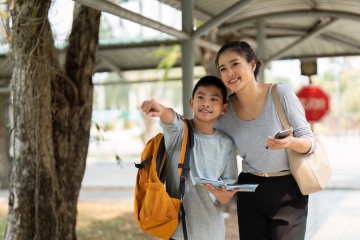
Mother and son touring city

A new way to measure school quality

David Griffith, Ph.D., Meredith Coffey, Ph.D. 8.6.2025
Flypaper
view
"Dear Diary Boy" book cover

A book that shows how much America underestimates its students

Alina Adams 8.6.2025
Flypaper
view
The $50 study SR image

“No strings cash” for high school students: results from a randomized control trial

Jeff Murray 8.5.2025
Ohio Gadfly Daily
view
Ben Austin on Democratic education reform – The Education Gadfly Show podcast episode 980

#980: Can education reform help Democrats win again? with Ben Austin

Ben Austin, Michael J. Petrilli, David Griffith, Ph.D., Adam Tyner, Ph.D. 8.6.2025
Podcast
view
Mother and son reading

Picture books lay the groundwork for reading success and cultural literacy

Robert Pondiscio
8.7.2025
Flypaper

A few weeks ago, a staff editor for The Atlantic reached out asking me to recommend five picture books for very young children, up to second grade. While list-making is fun and will spark spirited debates about which titles belong in the picture book canon and I’m happy to contribute, I want to use the occasion to make a broader point: The real aim ought to be exposing children to the widest possible range of stories, subjects, and language as possible. Picture books aren’t just charming artifacts of early childhood or a bulwark against a screen-based life. They are the foundation of literacy, cultural knowledge, and cognitive growth.

E.D. Hirsch, Jr., whose work on cultural literacy has shaped my thinking for decades, has long argued that reading comprehension is not a transferable “skill” like riding a bike or throwing a ball, but depends heavily on what the reader already knows. The stories, vocabulary, and archetypes embedded in picture books provide the background knowledge children need to make sense of more complex texts later on. In this way, picture books are not just an entry point to literacy—they’re a child’s first curriculum.

The cognitive benefits of reading aloud

In her email seeking a five-best list, the Atlantic editor defined picture books as those that “teach children the habit of turning pages, following a story, and becoming enchanted by literature.” All worthy goals, but there’s more to reading with children than encouraging them to fall in love with books. Research by Anne Cunningham and Keith Stanovich in their landmark 1998 article What Reading Does for the Mind demonstrated that children’s books contain more rare and sophisticated vocabulary than the spoken language of even college graduates, and 50 percent more rare words per thousand than prime-time adult television. In fact, the only category of speech more sophisticated than the language in children’s books, they found, is expert testimony given at trials.

Teachers call these sophisticated words “tier two vocabulary” and it’s the sweet spot for language development: high-utility words that appear across many subjects and contexts (e.g., contrast, fortunate, investigate). Unlike “tier one” words, which are basic terms children usually learn in daily conversation before school (dog, happy, car), tier two words are often encountered in print but less common in everyday speech. They also differ from “tier three” words, which are specialized terms tied to a particular subject area (isotope, photosynthesis) and rarely used outside that domain.

This is why print exposure is so important and powerful. The more children read and are read to, the more vocabulary and complex syntax they acquire. Early advantages and disadvantages in reading ability lead to increasingly larger gaps over time. Children who start out strong in vocabulary and reading tend to read more, gain more knowledge, and get even stronger, while struggling readers fall further behind. Stanovich dubbed this the “Matthew Effect” after the biblical verse Matthew 25:29: “For to everyone who has, more will be given... but from the one who has not, even what he has will be taken away.” Simply put, the rich get richer; the poor get poorer. Those who get an early start in vocabulary and background knowledge tend to advance faster, while those who do not fall further behind. Picture books can start children off on the right side of the Matthew Effect.

Cultural literacy

Hirsch’s central insight is that reading comprehension is impossible without background knowledge. Picture books fill this gap by introducing children to the “world of the world,” as well as the “world of words.” There are countless examples: Miss Rumphius transports a child across time and continents; The Story of Ferdinand opens a window onto Spain and the idea of individuality; The Snowy Day captures a child’s-eye view of a winter cityscape. These books do not simply tell stories. They build familiarity with cultural references, settings, and concepts that will reappear in literature, history, and science classes for years to come.

Reading comprehension strategies such as “making predictions” or “finding the main idea” are often overemphasized in classrooms as all-purpose reading comprehension “skills” to be explicitly taught, perhaps to compensate for a lack of background knowledge. But these skills emerge almost organically when children are immersed in classic stories with familiar archetypes and structures. When a child has heard dozens of trickster tales like Anansi the Spider, they begin to recognize story patterns and anticipate outcomes. The repetitive structure of The Little Red Hen or The Little Engine That Could teaches story grammar—characters, conflict, resolution—long before formal instruction. This familiarity helps children approach new texts. A child who knows how fairy tales unfold or who has met Sendak’s Wild Things will more easily make sense of new narratives, simply because they have a mental model for prediction and comprehension.

Children who grow up immersed in nursery rhymes, Aesop’s fables, and classic fairy tales develop what might be called archetypal fluency—a familiarity with timeless story structures, character types, and moral dilemmas that serve as the scaffolding for countless contemporary stories. It’s a childhood version of how adults recognize West Side Story as a modern retelling of Romeo and Juliet, or how a literate adult sees The Lion King not just as an animated classic, but as an accessible riff on Hamlet—a princely exile haunted by a dead father and betrayed by an ambitious uncle.

Children who know the story of The Tortoise and the Hare will grasp the moral arc of Lightning McQueen in Pixar’s Cars more intuitively. Those familiar with The Ugly Duckling are primed to appreciate the underdog triumph of Kung Fu Panda or Ratatouille. A child who has heard The Boy Who Cried Wolf multiple times knows, when watching Chicken Little, that a lesson about trust and truth-telling is coming. Familiarity with Little Red Riding Hood prepares a child to recognize narrative cues in films like Into the Woods or Hoodwinked!—the stranger with the big smile, the danger that lurks beneath. Just as adults find meaning in modern adaptations of classical works, children find coherence and delight in contemporary stories when they are fluent in the source material that undergirds them.

While the focus of this exercise is on picture books, a final and crucial point is that reading aloud should continue long after children can read independently. Studies show that a child’s reading comprehension ability usually doesn’t catch up to listening comprehension until middle school. This means children can understand complex language and ideas much more easily when they hear them read aloud than when they read it themselves. Stopping read-aloud sessions at home or at school when a child “graduates” from picture books leaves a gap during the very years when vocabulary and knowledge acquisition could accelerate the fastest.

A canon of many, not few

The Atlantic asked me to name five picture books for very young children. I’ll freely admit I’m cheating with my recommendations by choosing anthologies. I make no apologies. The world is too rich, varied, and enticing to confine ourselves to five individual stories—no matter how extraordinary they are. If the aim is not only to grow a reader but to cultivate curiosity, wonder, and excitement, then breadth matters. Think of these five collections as capacious “first libraries” in a single binding, giving children dozens of entry points into language, culture, and knowledge:

  1. Aesop’s Fables, illustrated by Charles Santore (2018). A beautifully rendered edition of timeless moral tales—The Tortoise and the Hare, The Boy Who Cried Wolf, and more. Compact plots and clear morals build ethical reasoning and archetypal story structures that echo across literature and media.
  2. The Real Mother Goose, illustrated by Blanche Fisher Wright (original 1916 edition; various reprints). The definitive collection many modern versions draw from. Wright’s iconic vintage art pairs with rhythmic rhymes—Jack and Jill, Humpty Dumpty, Little Miss Muffet—to cement memory, cadence, and shared cultural references.
  3. A Year Full of Stories: 52 Folk Tales and Legends from Around the World,by Angela McAllister, illustrated by Christopher Corr. One short, vibrant tale per week, tied to seasons and festivals. Folk‑art illustrations and global settings sustain attention while widening children’s cultural map.
  4. Over the Hills and Far Away: A Treasury of Nursery Rhymes from Around the World, edited by Elizabeth Hammill. A global anthology of nursery rhymes, each spread interpreted by a different acclaimed illustrator. Terrific for rhythm, memory, pronunciation, and cross‑cultural connections.
  5. An Anthology of Intriguing Animals, by Ben Hoare (DK). Choosing a single science picture book was the hardest part of this exercise and candidly, somewhat arbitrary. This one boasts large, sumptuous spreads with short “micro‑essays” perfect for three to five minute read-alouds. Rich vocabulary and factual sidebars invite questions and comparisons—the raw materials of scientific curiosity.

These five volumes are launchpads, not limits. Read them widely and repeatedly. Let children linger, question, and wander. The goal is a childhood saturated with stories, words, images, and knowledge—so that love of reading is fueled by the even more durable habit of wonder.

If reading truly “makes us smarter,” as Cunningham and Stanovich argued, then picture books are where it begins. They give children access to sophisticated language, teach them how stories work, and lay the groundwork for background knowledge and cultural literacy. For Hirsch, literacy was always more than decoding letters. It was the ability to understand references, context, and ideas that knit a society together. Picture books begin this work at the earliest stage, building the knowledge and vocabulary they will draw upon for a lifetime.

Happy reading.

view
Mother and son touring city

A new way to measure school quality

David Griffith, Ph.D. | Meredith Coffey, Ph.D.
8.6.2025
Flypaper

Education savings accounts in Texas. Open enrollment in Missouri. Each week seems to bring a new story and more education options for American students.

But to make the most of these new opportunities, families need the full picture.

So what information do they have currently? And what additional data would it make sense for them to have?

When it comes to public schools, whether neighborhood schools, magnets, or charters, the most common data points are academic achievement and year-to-year growth in math and reading, as measured on standardized tests.

Although this information is crucial—something is very wrong if the kids can’t pass the tests—critics from both sides of the aisle rightly note that it doesn’t capture everything that families should want to know about a school’s academics.

For example, what about subjects like history and science, which are tested less frequently than reading and math? What about foreign languages, the arts and other subjects that aren’t tested at all? And what about all the stuff that good schools impart that tests don’t capture, like critical thinking, teamwork, self-discipline, and respect for others?

For years, education reformers who believe that data are critical to improving America’s schools but recognize the limitations of standardized tests have struggled to answer these questions. That’s why a recent analysis that explores a new and potentially powerful measure of school quality called high school readiness is so exciting.

As the name suggests, the basic idea is to capture how well a middle school prepares its students for the next stage of their education by quantifying its effects on high school grades—or to be more precise, ninth-grade grade-point averages.

The report finds that middle schools have a significant impact on students’ future grades. For example, in North Carolina and Maryland, attending a middle school with a strong high school readiness score boosted a student’s ninth-grade GPA by approximately one-tenth of a grade point.

Figure 1. Effect of attending a middle school with a higher high school readiness score on ninth-grade GPA

Figure ES-1: Attending a middle school with high GPA-based value-added has a sizable effect on a student's 9th grade GPA.

Note: This figure shows the estimated effect of attending a middle school with a GPA value-added score that is 1 standard deviation above the average middle school’s score on the average student’s ninth-grade GPA in North Carolina and Maryland.

One-tenth of a grade point may not sound like much, but it’s enough to keep a marginal student out of the University of California or Texas A&M. And that increase is fairly impressive when you consider the number of factors that can affect GPA, from the quality of a student’s elementary school to his or her socioeconomic circumstances and home life.

Importantly, schools’ influences on GPAs aren’t necessarily the same as their effects on test scores. In fact, the two are only weakly correlated.

Figure 2. Middle schools that boost students’ test scores don’t necessarily boost their high school GPAs

Figure ES-4: GPA-based growth is weakly correlated with test-based growth.

Note: This figure shows the correlation between value-added to ninth-grade GPA and value-added to ninth-grade math achievement for Maryland middle schools. Data come from the Maryland Department of Education.

In other words, analyzing middle schools’ effects on grades reveals something new and different about how schools serve students—which the many families who don’t care exclusively about test scores might want to consider when choosing a school.

While it may seem strange to suggest evaluating middle schools based on their students’ high school readiness, many states already do something similar at the high school level, where indicators of college and career readiness have long been an accepted part of school report cards.

And while there are technical challenges associated with isolating middle schools’ effects on high school grades, most states already provide publicly available school report cards, and most already collect data on students’ high school GPAs. So, with a bit of number-crunching and some clear messaging, a new high school readiness indicator could give families the information they’re looking for—and begin to move America’s education system away from its obsession with standardized tests and toward a broader concept of student success.

As educational options expand, so should the information available to families. Test scores alone will never paint a complete picture of school quality or student success. But in the age of big data, there is no shortage of paint.

Editor’s note: This was first published by The 74.

view
"Dear Diary Boy" book cover

A book that shows how much America underestimates its students

Alina Adams
8.6.2025
Flypaper

In her memoir, Dear Diary Boy: An Exacting Mother, Her Free-Spirited Son, and Their Bittersweet Adventures in an Elite Japanese School, author Kumiko Makihara recounts her son Taro’s experience attending first through sixth grade in her home country of Japan.

“Japan has a well-respected public education system that emphasizes a high-level standardized curriculum and a belief that all children have the same potential to learn,” she writes. But “[d]eclining academic levels, demoralized teachers, and sub-standard facilities [led to] about 7 percent of Japanese children now [attending] private secondary schools because their parents believe that they offer higher quality teaching and help pave the way for entry into prestigious high schools and universities.”

Like other countries, Japan has periodically attempted to alter its traditional education system:

Regurgitating facts has long been a prized skill in Japanese schools because of the country’s rigorous university entrance exams. But from around the 1980s, there was growing criticism that such one-dimensional learning, dubbed “cramming,” was producing people who couldn’t think out of the box. In response, the country cut back school hours and pared curricula under the slogan “leeway.” But then, the cherished high scores of Japanese students in global comparative testing of math and science began to fall, while independent thinking didn’t show much improvement. “Leeway” was blamed for the slide, and the pendulum swung back to increased classrooms and hours.

As a result, Makihara decided to apply Taro to the same prestigious private school her father once attended.

There, the admissions criteria consisted of:

  • An hour-long written test including listening comprehension, where children hear a recording of a story followed by questions. Many recorded stories run for about five minutes, and the children don’t take notes. They are also asked to discern and predict patterns, reverse mirror images, fill in gaps in three-dimensional shapes, and speculate about what happens to water volume once you put objects in it (akin to some tasks on American “gifted” exams).
  • A group-behavior exam featuring table settings, party manners, and points for cooperation on an assigned task.
  • Arts like origami and calligraphy.
  • Athletic feats ranging from hopping on a specified foot to jumping rope, bouncing a ball, skipping, completing an obstacle course, and using a hula hoop.
  • Household tasks like folding ironed pajamas, separating garbage for recycling, wringing out a wet washcloth, hanging laundry with clothespins, and tying a bow behind your back on an apron.

Makihara explains that, in Japan, “There are no gifted tracks in public primary schools that go from grade one through six.” But who needs a “gifted” track when all children are expected to master the above skill set? Think of all the American teenagers who’ve never been asked to do half the chores above!

In all seriousness, one of the keys to Japanese success in education seems to be the expectation “that all children have the same potential to learn.” This was confirmed by a study over forty years ago, with research based on different types of Japanese schools, not merely one private, elite institution.

My oldest son just turned twenty-six. When he was four years old, like many New York City children, he took the required tests for admission to public and private schools. On one, he scored around the 65th percentile. On another, somewhere in the low 80s. So no inherent “giftedness” to be found.

Nonetheless, my husband and I enrolled him in the most rigorous, academic private school that would accept him. We were warned that he’d struggle. That the other children actually were “gifted” and he’d be unable to keep up. We said we’d take our chances.

Did our son struggle? Sometimes. Was he at the top of the class? Rarely. Did he learn to work hard in order to achieve a goal? Absolutely!

In eighth grade, our son took the public Specialized High School Admissions Test (SHSAT). He got into Stuyvesant High School, which required the highest cut-off score. Suddenly, our 65th percentile child was in the top 2 percent of NYC test takers.

At Stuyvesant, the work ethic he’d developed while struggling in elementary and middle school landed him at the top of the class. This was a kid who would meet whatever bar you’d set for him. By the time he took the SAT, he only missed one question. Now he was in the top 1 percent. He got into an Ivy League university. No one cared what he’d scored at four years old. The only thing that mattered was what he’d mastered since then. And what he’d mastered came about because he was in a school that expected him to do so.

Makihara also sent her son to a school where Taro struggled with a daily load of Japanese, social studies, math, science, integrated studies, music, art, physical education, and English. She worried that Taro was developing an inferiority complex. She felt “the other children progress much faster, and we are always desperately chasing after them, one step behind.”

Makihara admitted, however, that even though Taro was struggling, he “was mastering his academic subjects to at least an acceptable and, in some cases, an advanced level.” She said he was getting some A’s, some B’s, and once in a while, a C.

Which brings me to my eighteen-year-old daughter. She scored much higher than her eldest brother on those kindergarten tests of “giftedness,” in the 93rd percentile. We also sent her to an academically rigorous private school, where (as she has given me permission to describe) my daughter loved everything about school…except the school part. She sang in the choir, wrote for the newspaper, served on student council, and was invited to present at evenings for prospective parents. Teachers loved her. Fellow students loved her. The administration loved her.

She was also a mediocre student. My daughter did just the bare minimum so she wouldn’t be bothered. On dedicated private school assessments, she rarely scored above the 70th percentile, sometimes even in the 60th or 50th. Yet, on national public school norms, she was in the 99th. When she transferred to a public, screened high school, she was using her seventh grade chemistry notes to help the eleventh graders with their Regents exam prep. Even at the bottom of a rigorous academic private school, my disinterested daughter was still mastering advanced level skills compared to her public-school peers.

My husband and I were OK with our daughter not getting straight A’s, as long as she was actually learning. We know how many kids get all A’s and objectively learn nothing.

Makihara, meanwhile, concerned with Taro’s self-esteem, withdrew him from school in Japan and sent him to boarding school in the U.S. There, her son quickly learned such American rationalizations as “I don’t test well.”

Taro’s mom had concerns about the new educational approach:

Was Taro stocking up on enough fundamental knowledge needed for critical thinking further down the line? Taro’s American teachers patiently tailored his instruction to his level instead of leaving it up to him to try to catch up to the class average, as we were expected in Japan. In fact, the U.S. school’s motto was, “to meet boys where they are.” It sounds great, but I wondered, does that mean a boy might stay at that level? The U.S. teachers patiently tried to guide Taro into independent, analytical thinking. But should they also be pushing to memorize as many facts as possible to build up the foundation from where such thoughts would arise?

Ultimately, Makiharo decided that her son’s feelings about learning were more important than what he was actually learning. She had some reservations about his new American school such as indicated above but, in the end, determined that their academic move was for the best.

Her conclusion is on par with the American school system, which keeps lowering academic standards so no one has to struggle or feel bad about failing. (Also so the school system doesn’t have to take responsibility for not adequately educating students. But the first reason sounds a lot more noble, doesn’t it?)

My family took the opposite approach. We believed that our children’s grades were less important than what they were actually learning. A “C” in one school was more meaningful than an “A” in another. As for their self-esteem, research backs up my gut sense that children are more likely to feel good about themselves when they struggle and ultimately meet their goals.

My husband and I believed that being in the middle of the pack in a rigorous classroom was more valuable than being at the top of a weak one. Yes, even if it leads to a crying child. Senior year of high school, my daughter was sobbing practically every week over AP Calculus. But the score of 3 she ultimately earned on her AP test meant more to her than the 5 she received in AP English Literature and Composition, where she’d needed to put in less effort. And it taught her the lesson that, yes, she can get results if she applies herself—that she is hard-working and capable and resilient. That’s a skill beyond calculus. That’s a skill she can use for the rest of her life.

In the end, I am most enamored of a quote Makihara heard from her son’s cram school teacher: “Please remember that these children have only been in the world for a short five years. If they fail, please blame yourselves.”


view
The $50 study SR image

“No strings cash” for high school students: results from a randomized control trial

Jeff Murray
8.5.2025
Ohio Gadfly Daily

Providing some form of “no strings attached” money to low-income individuals and monitoring the results is a longstanding research protocol aimed at finding a tipping point at which people’s lives measurably improve. Compared to what? Often it’s a comparison with others who are given lesser amounts in randomized control trials. A new report from the Rooted School Foundation looks at outcomes of the latest iteration—conducted with high school students for the first time. Some of the academic outcomes are interesting. And though the results are underwhelming, that may not be the point.

Students in grades nine through 12 were recruited during their orientation at three charter schools—two in New Orleans and one in Indianapolis, all supported by the Rooted School Foundation—over two consecutive school years. Those chosen for the treatment groups received $50 per week over 40 weeks via a reloadable debit card funded by another non-profit, while those in the control groups received a $10 Amazon gift card monthly. The big picture goal is stated to be “rapidly reduc[ing] child poverty while increasing academic achievement, financial capability, and mental health” among young people, though this report concentrates on the academic and financial capability outcomes.

Phase I of the project (2022–23) comprised 74 treatment students and 77 control students at two schools; Phase II (2023–24) comprised 90 treatment students and 150 control students at three schools. Spending data, for treatment group students only, came from the bank issuing the cards, with permission from students over 18 and the parents of those under 18. (The average age of students in both treatment and control groups was 16.) Academic data were provided by the schools and all students completed a Financial Capability Survey created by the Consumer Financial Protection Bureau, as well as an in-depth questionnaire called Possible Selves, developed at the University of Kansas, to assess their self-perceptions.

The vast majority of students in both groups were Black and low-income, with more than 80 percent of families reporting $50,000 or less in annual income. Nearly 90 percent of treatment group students reported having jobs, as did 92 percent of control group students.

First let’s look at the comparison findings. Students who received the cash attended 1.23 more days of school in the semester following the intervention than students in the control group. While differences in average GPA were not statistically significant, control group students did consistently record higher average GPA than their treatment group peers. On the other hand, the latter showed greater understanding of financial products (such as savings accounts and IRAs) and long-term expenditure planning compared to the control group. Both groups reported increased feelings of control over their finances and confidence in making long-term decisions, with no significant differences between groups.

What did students who received $2,000 per school year spend their money on? The basics. Nearly half (45.8 percent) was spent on food, with retail sales and services (35.2 percent) and transportation expenses (12 percent) consuming most of the rest. Quotes from student interviews state that many in the treatment group became co-breadwinners for their families, contributing to food, transportation, rent, and other necessities for siblings and parents, as well as themselves. Additionally, some treatment group students amassed significant savings[1] by underspending their weekly $50 in pursuit of some large future expenditure.

The report does not analyze these findings at all, but Hechinger Reports coverage of it finds several voices within the Rooted School family willing to laud the handful of statistically-significant results as “incredibly impactful” or “laying the foundation for lifelong financial capability,” despite the fact that much of the data shows little or no difference between the higher-award and lower-award groups. Nor does $50 per week seem likely to achieve the goals of rapidly reducing childhood poverty, boosting academic achievement, and all the rest.

But even before numbers were crunched for this report, the “no strings cash for kiddos” experiment was already expanding to more schools in Louisiana (thanks to a $1 million investment by the City of New Orleans) and to a school in Washington, D.C. Each of the expansions is using the same methodology and data capture protocols with the promise of more reports in the years ahead. So perhaps making strides toward understanding the results is secondary to just running the experiment again and again in different permutations, perhaps hoping for more dramatic results.

Is that a pipedream? A recent New York Times piece discusses another novel iteration, this time focused on children in four metro areas whose low-income moms received $333 per month for four years after giving birth. Their children showed no significant differences in terms of language skills, behavioral problems, executive functioning, or cognitive development than four-year-olds in a comparison group that received just $20 per month. “We were all very surprised,” by this outcome, said one of the researchers. “The money did not make a difference.” Similar findings to the Rooted School experiment. But another member of the birth-mother research team stressed that there was still two more years to go on the experiment and conclusions must wait for the next report showing outcomes when the children turn six. In that case, as with the Rooted School experiment, the point seems to be to keep the research dance going with new and innovative permutations in the hope that minimal or null effects will somehow grow.

SOURCE: Stacia West, Zibei Chen, and Joana Halder, “The $50 Study: Outcomes from a dual-year randomized controlled trial,” Rooted School Foundation (June 2025).


[1] Something like three times the national average for savings, relative to income.

view
Ben Austin on Democratic education reform – The Education Gadfly Show podcast episode 980

#980: Can education reform help Democrats win again? with Ben Austin

8.6.2025
Podcast
 

On this week’s Education Gadfly Show, Ben Austin, Founding Director of Education Civil Rights Now, joins us to discuss why the Democratic Party lost its way on education policy—and what it must do to rebuild credibility and improve its chances in national elections.

Then, on the Research Minute, Adam shares a new study on state takeovers of school districts, examining who benefits and how these interventions impact district finances.

Recommended content: 

  • “Democrats have lost their way on education policy. Here’s how to get back on track.” —Ben Austin, The Hill
  • “Democrats need to break up with Randi Weingarten” —Ben Austin, The Hill
  • “Trump’s school choice initiative puts Democratic governors in a bind” —Michael J. Petrilli, Thomas B. Fordham Institute
  • “Help wanted: Ed-reform governors needed (again)” —Chester E. Finn, Jr., Thomas B. Fordham Institute
  • “How state takeovers of school districts affect education finance, 1990 to 2019”—Melissa Arnold Lyon,  Joshua Bleiberg, and Beth Schueler, Education Finance and Policy (2025)

Feedback Welcome: Have ideas for improving our podcast? Send them to Alicia Anderson at [email protected].  

Fordham Logo

© 2026 The Thomas B. Fordham Institute
Privacy Policy
Usage Agreement

National

P.O. Box 110
Burke, VA 22009

202.223.5452

[email protected]

Ohio

P.O. Box 82291
Columbus, OH 43202

614.223.1580

[email protected]

Sponsorship

130 West Second Street, Suite 410
Dayton, Ohio 45402

937.227.3368

[email protected]