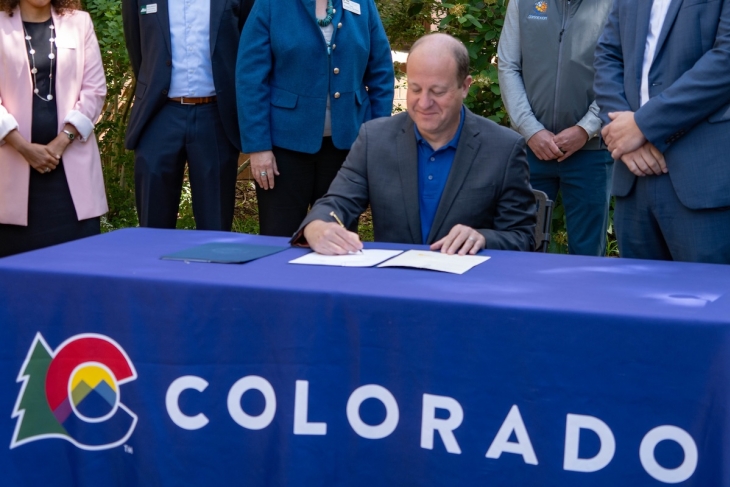
The wide-ranging new report that Colorado Governor Jared Polis extracted from the National Governors Association (NGA) during his recently ended term as chairman kindled a lot of memories.
Once upon a time, back in what Gen Z views as prehistory—I’m talking about the 1980’s and ‘90’s, when I was middle-aged—state governors were the most potent drivers of K–12 education reform in America and the NGA was a major force for change.
It started in the ‘80s with an enormous amount of education reform, almost entirely at the state level, typically catalyzed by governors though sometimes by legislators and occasionally by business leaders. States periodically collaborated, both under NGA auspices and in smaller compacts such as the Southern Regional Education Board (SREB) and Education Commission of the States (ECS).
Their agendas varied but typically included higher standards, improved reporting, better teachers, stronger graduation rates, wider access to college, and early stirrings of accountability for schools and sometimes for students in the form of minimum-competency graduation tests. Many of these governor-reformers were southern—North Carolina’s Jim Hunt, Florida’s Bob Graham, Mississippi’s Bill Winter, Tennessee’s Lamar Alexander, South Carolina’s Dick Riley, Arkansas’s Bill Clinton, etc.—but not all. Their northern counterparts included Minnesota’s Al Quie, Wisconsin’s Tommy Thompson, Colorado’s Roy Romer and New Jersey’s Tom Kean.
It was quite a line-up—and stayed that way well into the ‘90’s.
Their occasional joint efforts could be powerful, as in the SREB’s piloting of state-level NAEP reporting and the multiyear “Time for Results” project that Alexander launched when he chaired the NGA. But sometimes they competed. I recall Alexander and Graham—Republican and Democrat—amiably racing to see whose state could first enact a merit pay program for teachers.
The apogee of their collective influence on the country as a whole was surely the “Charlottesville Summit” of 1989, where forty-nine governors, together with President George H.W. Bush—“I want to be the education president”—agreed, for the first time in history, on an ambitious set of national education goals to be achieved by century’s end.
Bush reiterated those six lofty goals in his State of the Union Address in January 1990 and a month later, at its annual winter meeting, the NGA adopted them along with specific objectives that clarified and amplified them.
Four years later, prompted by President Bill Clinton, who had been a force for ed-reform both as governor and within the NGA (which he chaired in 1986–87, immediately following Alexander), Congress passed the “Goals 2000: Educate America Act” and the “Improving America’s Schools Act,” precursor and foundation-builder for No Child Left Behind (NCLB) in 2001. These set the course for federal education policy for two decades, until ESSA rolled it partway back in 2015.
The governors’ insistence on better achievement data also played a major role in the statutory retooling of NAEP in 1988, in the state-specific reports of student performance that followed, and in the establishment of NAEP’s “achievement levels” that today comprise the closest thing we have to national education standards.[1]
Gubernatorial ed-reform energy continued through the ‘90’s, as the National Education Goals Panel followed up on Charlottesville and associated federal laws, and as school choice made its debut, with the pioneering Milwaukee voucher program authorized in 1989 and the pathbreaking Minnesota charter-school law enacted two years later.
Many more “education governors” surfaced, too, such as Michigan’s John Engler, Ohio’s George Voinovich, Massachusetts’s Bill Weld, and Texas’s George W. Bush, who famously brought his experience and zeal from Austin to Washington when he moved into the Oval Office in January 2001.
Why do I recount all this prehistory? Partly because I was there, partly because it really made a difference, but also to contrast it—in two ways—with the present-day situation.
The first contrast, unsurprisingly, involves partisanship. Back in prehistoric times, lots of states were purple and most of the reforming within them entailed a degree of cooperation across party lines—which is also why many of those reforms proved fairly durable. So, too, the multistate collaborations, not just within the SREB and NGA—where the hand-off from Alexander to Clinton, for instance, was seamless and “Time for Results” forged onward—but also the ad hoc reform panels and commissions that kept up the momentum. That was true of the “Goals Panel,” of the National Council on Education Standards and Testing (co-chaired by Colorado’s Romer and South Carolina’s Carroll Campbell), and of the National Assessment Governing Board, which has always had one governor from each party among its members—and often supplying much of its oomph.
The second contrast has to do with that oomph. When ed-reform was hot, governors generated much of the heat—and the NGA was a force to be reckoned with, not only influencing federal policy but also as a forum for reform ideas, for staff support, for enlisting expertise, and for lively debates, comparisons, and competitions.[2]
Fast forward to 2025
Not so today. As choice-focused reforms burgeon in red states, there’s backsliding almost everywhere when it comes to standards, assessment, and accountability, and bipartisanship is rare indeed. With a small number of exceptions—Youngkin in Virginia, Polis in Colorado, and Huckabee in Arkansas come to mind—governors have turned to other issues, sometimes including the cultural conflicts that today dominate education discourse, and few seem to resist the omnipresent (union-driven) pushback against testing and accountability.
As for the NGA, from time to time it returns to education, most recently the worthy initiative spearheaded by Colorado’s Polis, who chaired the group from July 2024 until two weeks ago. He launched a multi-faceted project called “Let’s Get Ready: Educating All Americans for Success,” and within his one-year term, pressed NGA to create and issue a pretty good blueprint for education reform across a number of fronts. (More on this below.)
But his predecessor, Utah’s Spencer Cox had a different priority—a good one, to be sure, encouraging Americans to “disagree better,” get out of their silos, foster good citizenship, and transcend some of the bitter partisanship. And his successor, Oklahoma’s Kevin Stitt, wants to “reignite the American Dream.”
Yes, there’s still an education piece within Stitt’s plan. Yes, NGA has an ongoing gubernatorial “Task Force on Education, Workforce and Community Investment.” And yes, the NGA staff still contains an able “program director for K–12 education,” with a strong team, within its multi-purpose Center for Best Practices. Far be it from me to suggest that they ignore the topic. Yet only episodically is K–12 education reform high on their agenda and there’s scant continuity from year to year—a fatal flaw for a realm that only ever changes when the pressure for change is sustained over many years, election cycles, and party switches.
It has to be added that NGA’s latest K–12 offering—Polis’s legacy—is comprehensive but lacks edge. The Let’s Get Ready report contains good stuff, particularly the parts that focus on career preparation, and its “roadmap for governors” is sound, as far as it goes. But the report—and roadmap—range over such vast territory as to have no real focus. I find myself nodding in agreement with—for instance—its recommendations for statewide data systems and focusing on outcomes. Yet when you look closely, it wants so many different outcomes that no leader of any jurisdiction, much less a governor, has the bandwidth or clout to work on all of them. It’s common knowledge that an elected official with a four- or even eight-year term must select a few key targets—provided they want to get something done—and shoot all their arrows at those targets, not get diverted onto a hundred other worthy efforts even if all carry the “education” label.
Combine the vastness of the Polis legacy menu and the unlikelihood that Governor Stitt or his successors will push the NGA to double down on that menu—every new leader (in this case with a one-year term) is tempted to declare their own glittering priority—and I find it unrealistic to count on NGA to juice the ed-reform effort that so urgently needs a lot of juice.
Some individual governors will stick with—or rediscover—that an educated population is key to just about everything else they want their states to achieve. At a time when national leadership for this activity has been so lacking—not just Trump and team, also Biden and his, plus a vacuum among business leaders—I applaud the governors that work at it. But there aren’t nearly enough of them and nowadays they mostly work in isolation.
All things considered, prehistory has seldom looked better.
[1] That saga began immediately after the release of A Nation at Risk in 1983, when many education-minded governors sought better data than was then available on how their states were doing in producing educated children. The NAEP “study group” that Lamar Alexander chaired urged that this well-respected national testing program be revamped in a number of ways, including the release of state-level data, and the National Assessment Governing Board, which I chaired for two years at its outset, realized that Charlottesville’s third goal—that every child become “proficient” in core subjects—would be meaningless until some authoritative body determined what constitutes proficiency and how to gauge its attainment. I go into this history in some depth in Assessing the Nation’s Report Card.